Key details
Date of redevelopment: Grant awarded 2018; project officially closed March 2024
Cost: circa £3 million
Who funded it: Wigan Council and The National Lottery Heritage Fund
Case study themes
Service sustainability, community engagement, accessibility
Project summary
From 2018-2024, Wigan Council undertook a project to transform the Wigan Archives and Local Studies service through major capital works at their centre, Archives: Wigan and Leigh. This included new collections storage, new exhibition spaces, an improved public offer and a programme of community and volunteer activity. The project was part of a wider scheme for the refurbishment of the Grade II listed Leigh Town Hall, where the archive service is housed.
Wigan Council and a £1.3 million grant from The National Lottery Heritage Fund funded this project. Construction started in March 2019 and the service reopened in June 2021.
Challenges and opportunities
The refurbishment focused on improving the volunteering programme and creating more storage space. Although there was a good volunteer offer, the facilities available were cramped. The volunteer experience and capacity have now improved thanks to a new conservation room, a larger search room and a break room. The volunteering programme was restructured and new volunteer roles were introduced.
There wasn’t enough space in the existing strongrooms to store new collections, resulting in several donations being turned down prior to the project. The expansion of the strongroom was key to the success of the project.
The project enabled the staff to develop relationships with community groups. This included audiences they had not engaged with before, such as young people and townships in the borough. The new shop window exhibitions (which are visible from the street) have been popular and enabled community groups to curate their own stories. Co-curation projects with young people have resulted in new donations that represent their voices and those from LGBTQ+ communities.
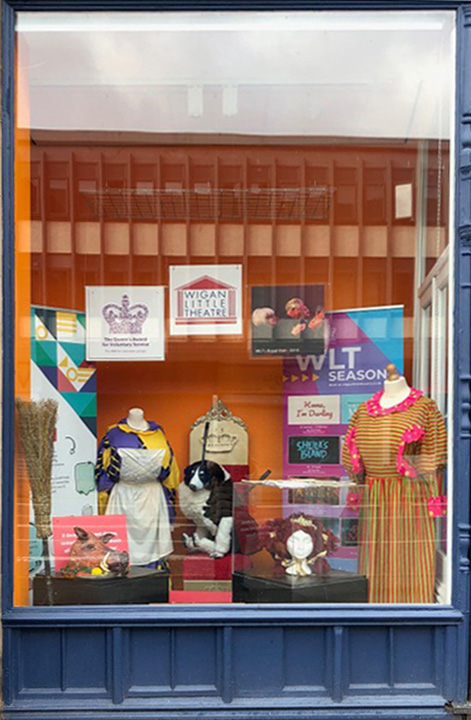
Wigan Little Theatre exhibition in one of the shop windows at Archives: Wigan and Leigh. © Wigan Council.
Despite the success of this engagement, the project evaluation highlighted the need for stronger marketing. The service has developed its social media presence and now has a digital marketing budget. However, there is still the challenge that many people do not know what an archive is or think the building is for other council services.
The foyer café was also a challenge. As part of the evaluation, staff reported they thought the foyer was too small for a café and that town hall staff could not access it easily, resulting in a lower than expected demand. The café is now closed but the public can still bring their own food and drink to the foyer. This has been promoted through the council’s ‘Warm Spaces’ scheme which aims to counter the effects of the cost of living crisis. This has proved popular.
Outcomes
Before the refurbishment in 2015/16, there were 4,300 visitors. Between June 2021 and December 2023, there were 19,089 visitors. In addition:
- 59% were visitors to the exhibition space of which 20% were children, a new audience for the archive.
- 60% were first-time visitors and 38% had never visited an archive before.
- The average satisfaction score was 9.4/10.
- Visitors felt that visiting the archive gave them a greater understanding of their community, its history and people (88%), made them happier (85%), made them feel part of a community (82%), helped improve their knowledge (80%), and made them feel connected to others (71%).
Alongside this, the service delivered 378 activities (attended by 8,744 people) between 2020-2023 including family events, school visits and projects with young people. The activities had a strong emphasis on learning, developing skills and creativity.
Volunteer numbers also increased. Between 2020-2023, 180 volunteers contributed 18,456 hours. This included 25 students from schools, colleges and universities and paid internships with Employ Autism. In addition:
- 81% of volunteers were extremely likely and 19% were somewhat likely to recommend volunteering at the service to a friend.
- They felt that volunteering gave them a greater understanding of their community, its history and people (100%), made them feel they are making a difference (95%), made them happier (100%), and helped improve their knowledge (100%).
Finally, the service raised its profile within the council – councillors, senior management and departments now regularly use the service.
What did you learn from the process?
The project had strong political support from council senior management and councillors. This was critical to the project’s success, especially when they faced challenges around timescales and costs during the Covid-19 pandemic. The Project Board had the right people to manage the project and help overcome any issues.
It was important to have the continuity of council staff working on the project. They were able to explain why decisions had been made in a certain way, particularly relating to the budget. At the same time, it was also vital to have good documentation on decision-making, especially when staff left.
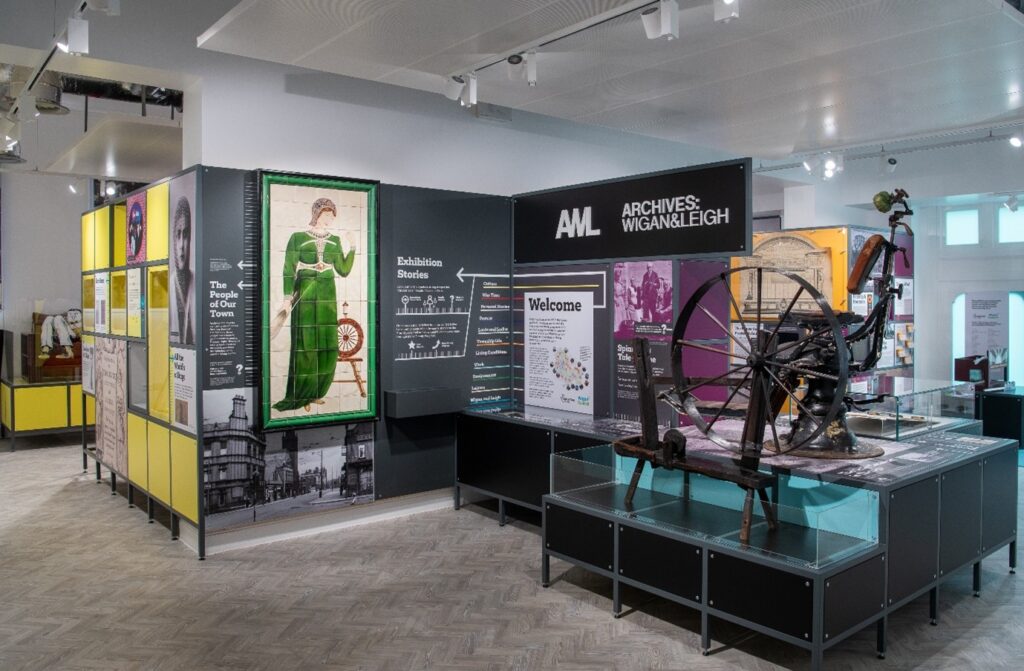
Exhibition area at Archives: Wigan and Leigh. © Wigan Council.
The quality of the strongrooms is good. One innovative idea was to remove a floor to create a strongroom with 5m-high shelving allowing good accrual space. The council’s Conservation Officer played a role in the project to ensure the building’s heritage was considered. That said, upon evaluation some staff felt that the design of the strongrooms could have been more efficient if the design consultancy had been more of a specialist in strongrooms and historical buildings.
What is one piece of advice you would give others in a similar position?
Ensure you have the right people with the correct skills involved across different parts of the project. In this instance for the capital elements, this included archive staff, senior management, finance staff and a Capital Project Officer. The National Lottery Heritage Fund grant enabled new staff to be brought in with experience in engagement and volunteering, expertise and most importantly capacity.
In addition, where possible, ensure you have enough staff resources. During the evaluation, some staff reported that the project could have benefitted from a dedicated project manager. Furthermore, council/archive staff time had to step up and take on some unfamiliar areas of work. This extra responsibility impacted on their time. However, staff developed new skills as a positive result of this.
How will this work be developed in the future?
The service is building on the success of The National Lottery Heritage Fund project by continuing to deliver its activities programme. The Learning and Engagement Officer post has been made permanent and work with community groups to curate and host exhibitions in the shop windows and main exhibition space continues. Other activities include school visits, family events (including an annual Christmas event that attracted 250 people in 2023) and talks. Further priorities include a stronger focus on digital – both digital access (e.g. online catalogue) and digital preservation as well as posting YouTube Shorts to the Archives: Wigan & Leigh YouTube channel.
In terms of sustainability, it is critical that advocacy and raising the service’s profile within the council continues to be a priority. The service are also considering external funding to help deliver some of their engagement work.
Find out more
Visit the Archives: Wigan and Leigh website