Key details
Date of redevelopment: 2020
Cost: £20 million
Who funded it: The National Lottery Heritage Fund, Suffolk County Council, University of Suffolk, Coastal Communities Fund, New Anglia Local Enterprise Partnership, Ipswich Borough Council, Garfield Weston Foundation, The Wolfson Foundation, The National Archives. The Lord Belstead Charitable Trust, the Leslie Mary Carter Charitable Trust and many other local heritage organisations. Full details are available on the website.
Case study themes
Environmental sustainability, service sustainability, community engagement, accessibility
Project summary
In 2017, Suffolk County Council (Suffolk Archives) partnered with the University of Suffolk to deliver The Hold, a new heritage facility on Ipswich’s waterfront. Construction began in summer 2018 and it opened to the public in September 2020.
The Hold includes exhibition spaces, a café, a retail space, research spaces, archive storage and shared learning spaces with the University of Suffolk. Alongside the construction, Suffolk Archives delivered Sharing Suffolk Stories projects, outreach activities across Suffolk, and a volunteering programme. The National Lottery Heritage Fund was the main funder of the project, providing a £10.3 million grant.
Challenges and opportunities
The project has successfully engaged with a wide range of people through its exhibitions, volunteering, events, and activities. This has meant that Suffolk Archives can include the stories of those previously underrepresented in the archive. This has resulted in new collections being deposited – including Black Lives Matter placards, three LGBTQ+ collections, photographs of Jewish World War II refugees in Newmarket and various oral histories.
This success has been partly due to strong partnerships with external organisations. For example, the service worked with several partners, including refugee charities, to recruit volunteers. They have also built strong relationships with various departments at the University of Suffolk.
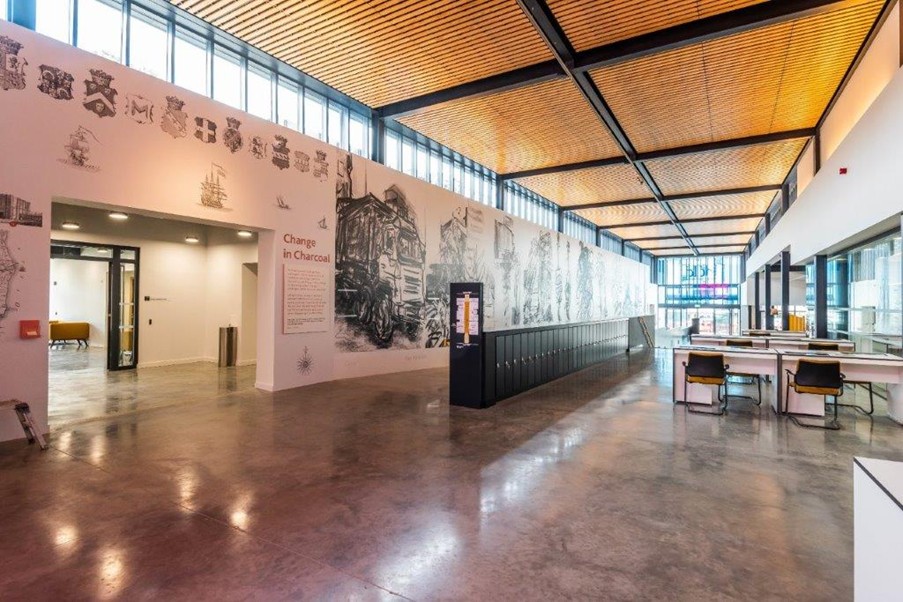
Looking down ‘The Street’ towards the waterfront, with Valerie Irwin’s Change in Charcoal drawings on the left-hand side. © The Hold.
The new spaces in the building have allowed the service to deliver new functions. This has been particularly important for collections management, volunteering, events, school visits, and exhibitions. However, from a commercial point of view, there have been some challenges. For example, the café lacks the space to carry out large-scale catering. At times it has also been difficult for the service to manage expectations around commercialisation and balance this with their core archives work. For example, when using education rooms what takes priority – commercial bookings or school visits?
Staffing resources have also been a challenge. It would have been helpful to have more project management resources to help with the handover and opening of the building. Although The National Lottery Heritage Fund grant funded new staff posts, the impact of the project on the current staff was underestimated. It also took a while to understand how the building operates and what staffing levels are needed.
Outcomes
In its second year of opening (October 2021 to September 2022) The Hold had 74,640 visitors. Visitor surveys suggest that The Hold is attracting a younger audience than previously – 59% of respondents were aged 45 and above (compared with 78% at their former building in 2016). Feedback from visitors has generally been positive – 89% of respondents to a first impressions survey thought The Hold was “Excellent” or “Very Good”.
The service delivered over 700 events and activities across the county between April 2018 and September 2022, reaching over 32,000 people. This included events relating to Sharing Suffolk Stories projects, activities for families, and activities with University of Suffolk students. The Archives on Tour travelling exhibition trailer delivered two exhibitions – ‘A Brief History of Ipswich Town Football Club’ and ‘Suffolk Rebels’. These exhibitions have toured the county and were particularly successful at engaging new audiences and a countywide audience.
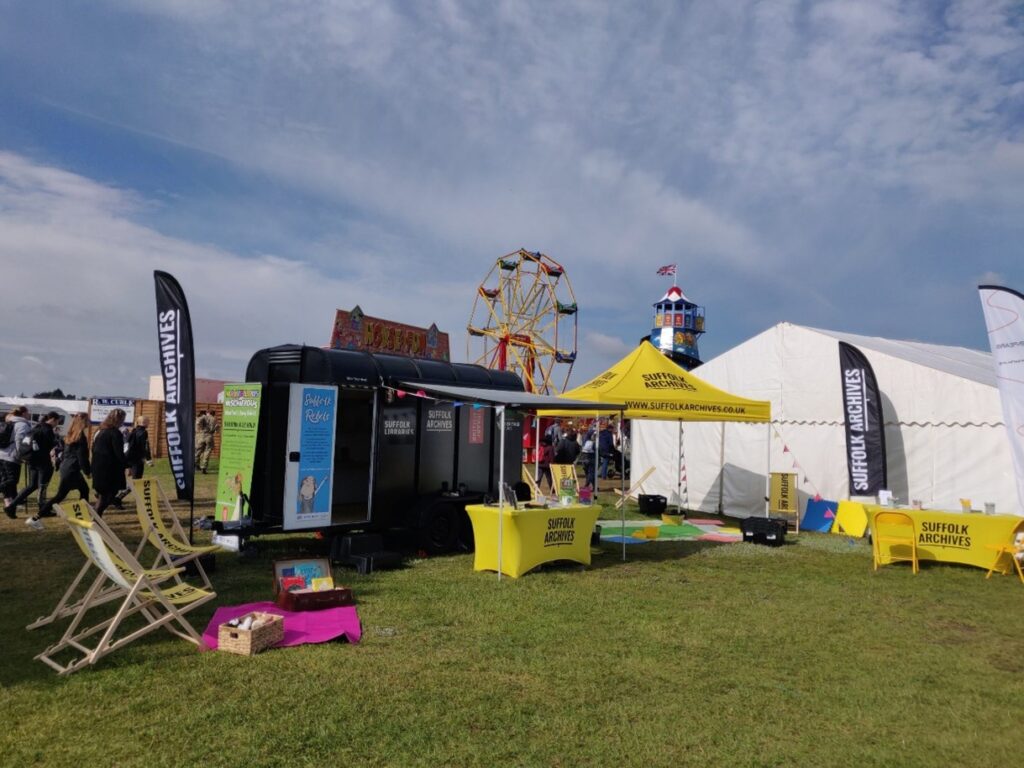
Archives on Tour – Suffolk Rebels. © The Hold.
The aim of Sharing Suffolk Stories was to encourage groups of people to learn more about where they live, create their own responses to it, and share their work as widely as possible. Participants could search Suffolk Archives’ collections to uncover unique stories about the people, places, and events of the county. 20 projects were delivered between 2018-2022. There is good evidence that the projects have had a strong impact on people, especially by helping participants and volunteers develop new skills and confidence.
What did you learn from the process?
A two-stage tender process was carried out for the construction. This helped create a good relationship between the client and the contractor. Two stage tendering is often used to allow the early appointment of a contractor, prior to the completion of all the tender information that they would require to be able to offer the client a fixed price – the design still being in development for example.
The local knowledge of the project managers and contractors was important. They had a good understanding of local supply chains and issues specific to the waterfront.
The IT fit-out was challenging. Having to work with both the council and university IT departments made this complex. Issues can still occur, but the service has worked hard to build relationships with both IT departments.
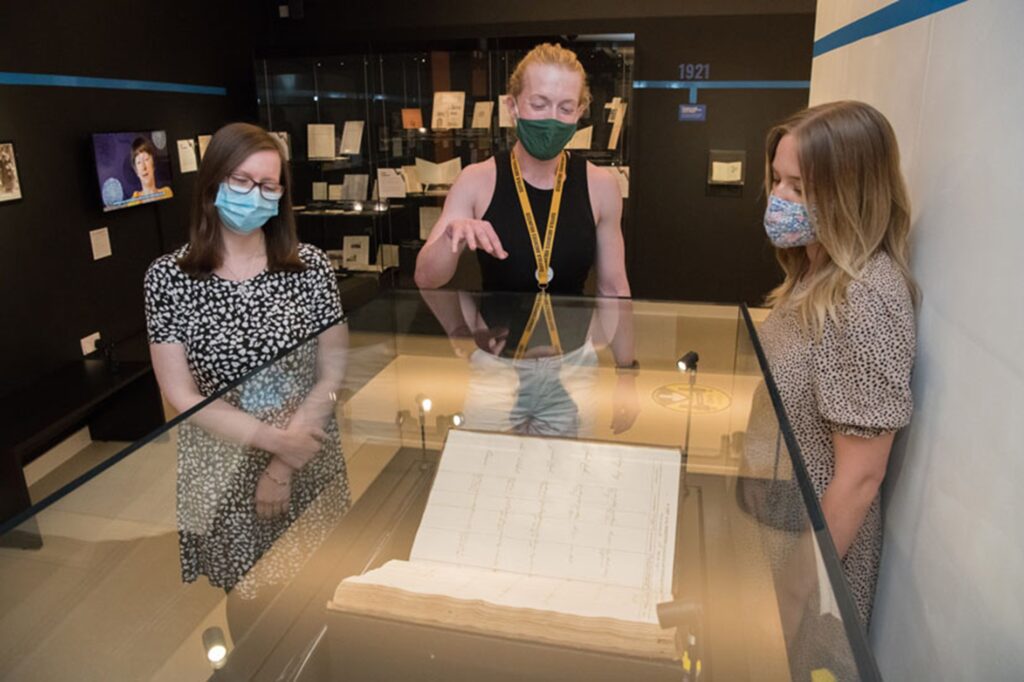
Volunteers and staff at the Pride in Suffolk’s Past exhibition. © The Hold.
The exhibition design and installation were also challenging at times. The service procured the installation as lots of separate packages and this led to work in terms of coordination. Looking back, it would have been easier splitting the installation into one or two packages.
The drying of the strongrooms took longer than expected and fans and de-humidifiers needed to be used. The strongrooms are not yet fully passive at present – they are still running with a low level of air-conditioning. A Conservator is currently being recruited and the service hope to review the conditions in the future.
The service realised they needed more non-archive storage than planned for things like activity equipment and exhibition cases. Some slight changes to the building have been made to create additional storage.
What is one piece of advice you would give others in a similar position?
Ensure that your communication is clear and that you have the necessary resources and expertise to support it. Although the service employed a part-time Marketing and Communications Officer, there were times during the project when this position was vacant and it would have been better to have had someone in the role earlier. This would have not only helped with the external communication with stakeholders and the public, but also internally with staff. This is especially important considering the length of the project. Targeted marketing is also crucial for exhibitions and events. This role is now full-time.
How will this work be developed in the future?
In 2024, the council confirmed the closure of the North-East and West Suffolk branches of the archive service. They closed at the end of August 2024 and their collections were transferred to The Hold. One of the council’s motivations for this was to provide better value for money.
To facilitate this work, the search room/library areas at The Hold were closed for three months. As part of their reopening in January 2025, they reintroduced drop-in appointments and extended their opening hours. The service has also reviewed their opening hours for the wider building based on use and they will be closing on Sundays and Thursday evenings. However, during these times they may have special openings for events etc.
The service also has a dedicated audience development team which includes staffing for exhibitions and events. One of their key priorities is to continue with the countywide events programme. The service also received funding from The National Lottery Fund to deliver the Arrivals: Celebrating migration to Suffolk project.
Find out more
Visit the Suffolk Archives website