Key details
Date of development: 2024
Cost: circa £1.2 million
Who funded it: Internally funded through donations plus a loan (subsequently turned into a donation) from another charity
Case study themes
Project summary
The Bus Archive is a volunteer-run collection held over three sites documenting the history of the bus industry. With a long-term aim to achieve Archive Service Accreditation, the service realised that their current storage conditions (with notably little fire protection) would hold them back. The National Conservation Service recommended the construction of a storage pod within an existing building to create expanded storage space and better conditions for collections work. Out of the three sites, Droitwich presented the best opportunity and the service secured private funding to complete the work. The new archive centre is very close to the previous site and consists of a warehouse with office space at the front and a two-storey storage pod (with roller racking) at the back. The service is open two days a week to researchers and more frequently to its volunteers for collection work.
Challenges and opportunities
Filling a skills gap: Despite there being some experience of capital build projects following long careers in the bus industry, none of the trustees or volunteers were qualified builders or architects. The project was managed by taking specialist advice from the National Conservation Service who suggested building a pod as a practical and affordable solution for warehouse premises.
The need to work differently: Trustees and volunteers have always had a good working relationship with a shared aim to preserve the heritage of the bus industry. However, the complexity of a capital build means everything has to be formalised and documented for accountability. For example, typically relaxed meetings in the early stages of the project did not record decisions made and this caused problems later on. A different way of working was needed for this project.
Taking advice and managing risk: Following a recommendation from the architect, the project team selected a building contractor who was fairly newly qualified to complete the work. This could have been seen as a risk however it turned out the opposite. The contractor gave his best to the project to make it succeed as he was keen to improve his portfolio with a significant project. The contractor managed all subcontractors (except the shelving contractor) and reported back to the trustees. To mitigate probably the most significant risk, the shelving contractor was then invited to attend when the flooring for the racking was laid so that any problems could be solved as early as possible.
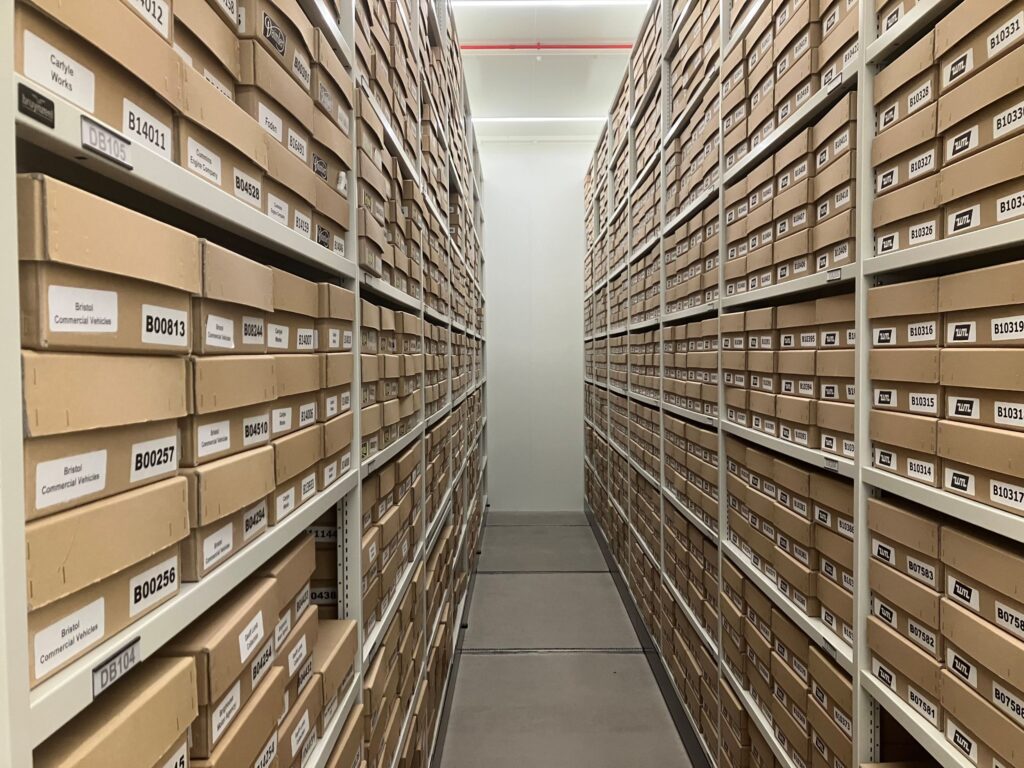
Boxes stored on mobile shelving in the storage pod
Outcomes
Even though budget constraints meant the project’s environmental sustainability impact was limited, there is no doubt the building is using less energy compared to the old site. There are no longer electric radiators and chilly working spaces for volunteers – they appreciate the better work spaces. The building project has also improved the profile of the Bus Archive. If this results in an increase in donations to the collection, the considerable expansion space in the storage pod means that the service can say yes to new depositors.
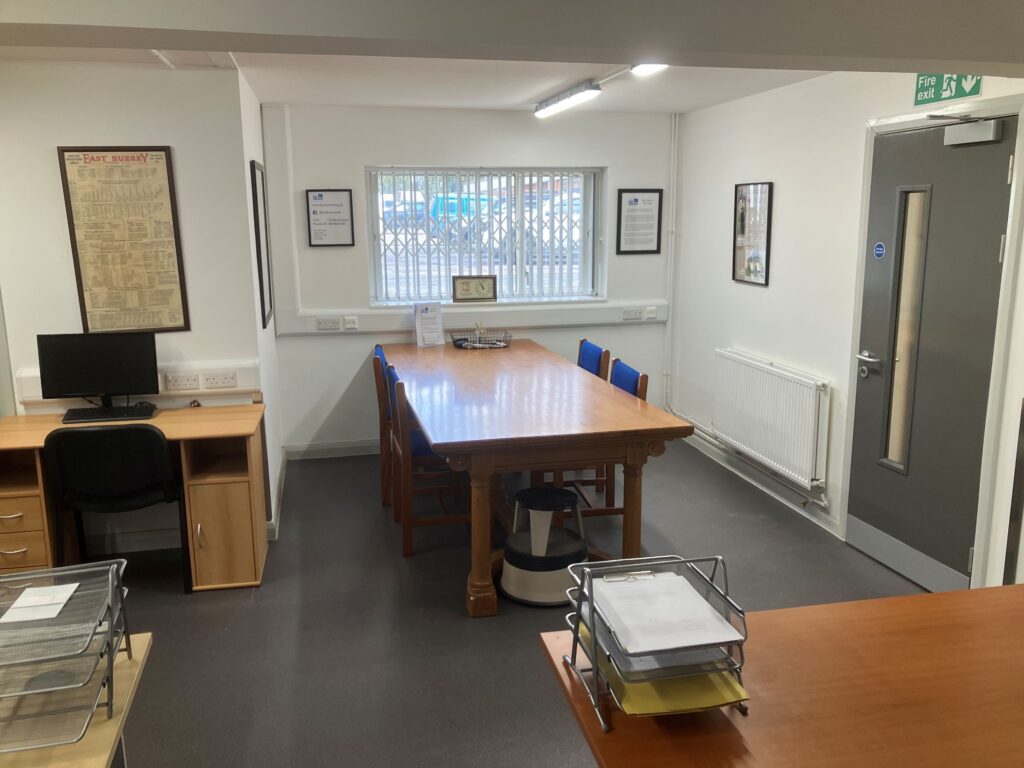
The research centre at Droitwich. External visitors can visit to consult material in this space.
As the building was a modification of an existing site rather than a new-build, the building regulations were slightly less onerous and therefore easier to achieve. Accessibility has been considered and it is now far easier for wheelchair users to enter the building and work on collections.
What did you learn from the process?
You can’t please everyone. In the early stages it became difficult to manage the large number of stakeholders alongside unstructured consultation about the scope of the project. There were raised expectations about what could be achieved, which then could not be met by the available budget. On reflection, it may have been better to carry out smaller amounts of specific consultation as the project developed.
Ownership and accountability: It was also necessary to be clearer about roles and responsibilities, especially around who has the final sign off on the project. From the start of the project, everyone involved should have a defined role with responsibilities. It is also essential to have multiple people checking everything to make sure that nothing is overlooked.
Checking things off the list: With experience in the bus industry, the project team were used to working with clear guidance. For example, the Health and Safety Executive (HSE) produces checklists in plain English that can be used. Whilst there is some guidance on Archive Service Accreditation standards with examples of good and bad, there is nothing that is ‘in-between’ or ‘good enough’. Non-specialists may also find the guidance difficult to understand.
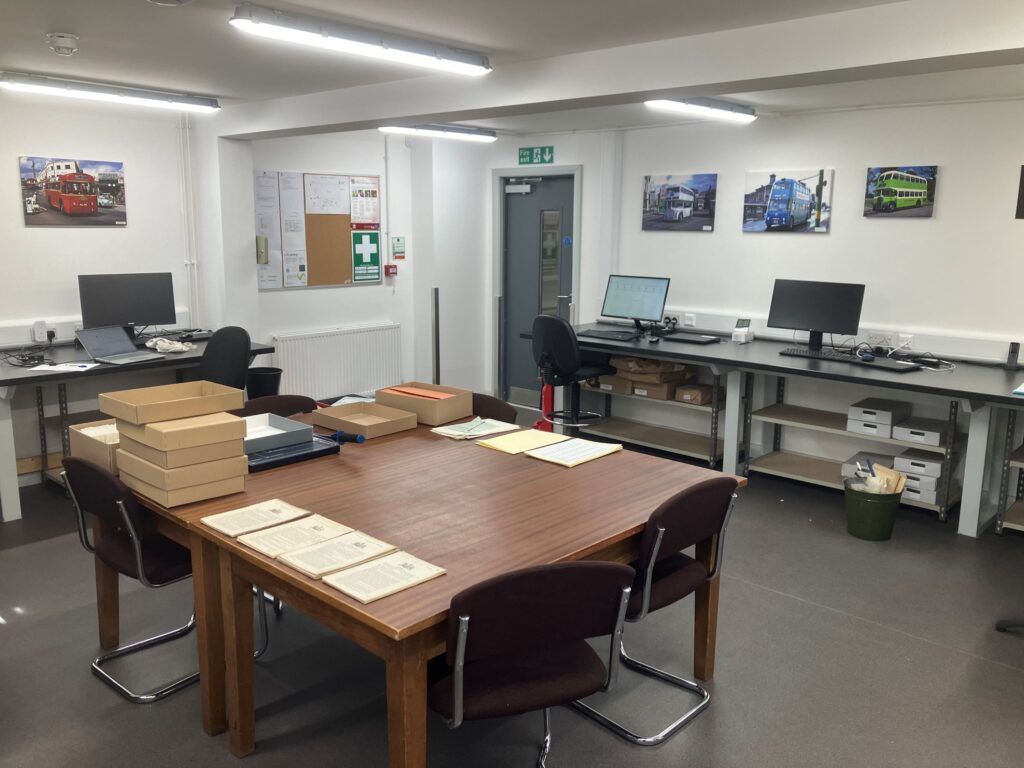
The work room at Droitwich. This space is used for collections work such as cataloguing by the service’s staff and volunteers.
What is one piece of advice you would give others in a similar position?
Set a realistic budget right at the start as everything depends on this. Trust the process and be clear about your aims. Don’t be afraid to stay completely focused to keep your budget on track.
How will this work be developed in the future?
The move has resulted in a better understanding of the material in the collection. This will potentially impact on new accessions and the deaccessioning of material. The project has given us some space to think about the contents of the other two archive centres and how some of this might be moved or the buildings improved. However, funds would need to be built up to carry out anything new. The project’s success has made us feel that an application to become an accredited archive service is now within reach.
Find out more
Visit The Bus Archive website