Important information
This article contains references to systemic transphobia, gender dysphoria, suicide, and the dehumanising treatment of trans people (including conversion practices).
Our records contain words readers might find offensive. Some of this original language is shown here to accurately represent historical records and people’s past experiences.
Early life
To share her story with care, we have drawn on April’s own testimony alongside archival records reflecting contemporary legal and state perspectives. We also intentionally do not include records showing April’s pre-transition appearance or name, out of respect to her and the trans community.

Liverpool in the 1930s, where April was born. Catalogue reference: INF 9/684
April was born in 1935 to a large, Catholic family in an impoverished area of Liverpool. April’s childhood was marked by ill health, family difficulties and an internal conflict about her gender identity. April had been assigned male at birth but as a child, she felt that ‘if I was to live it could only be as a woman’.
Following in the footsteps of her family members and to escape her life at home, April joined the Merchant Navy (Britain's commercial shipping industry). During this time, she was deeply depressed and uncomfortable with the changes puberty was creating in her body. April later reflected that she may have been born intersex, but this language was not widely known at the time. Feeling very alone and isolated, April attempted suicide in August 1952. This led to her being dishonourably discharged.
Following these traumatic events, April was admitted to a psychiatric hospital, where she faced harmful and ineffective treatments including electric shocks and testosterone injections. At this time, medical approaches meant that, rather than receiving support, she was subjected to conversion practices. These are interventions that aim to 'fix’ a person’s sexual orientation or gender identity.
As soon as she was able to, she fled to London hoping to find somewhere she belonged. April resourcefully found any work she could. This included working at a restaurant with John Prescott, who later became Deputy Prime Minister of the UK. By this time, April had started dressing in feminine clothes and used the gender-ambiguous name Toni Ashley. Away from her family she could embrace the parts of herself she had previously felt forced to hide.
Life in Paris
In the late 1950s, April moved to Paris. She started working at the prominent drag cabaret Le Carrousel which she called ‘home’. While working there, April learned of the widely publicised medical transition of American actress Christine Jorgensen. We cannot be sure, but this might have been the first time April became aware of gender-affirming medical care.

April in Paris around 1956. Catalogue reference: J 77/4537.
In 1960, April followed in the footsteps of a fellow performer (Coccinelle) who had undergone gender‑affirming surgery in Casablanca. She underwent an operation with the pioneering French gynaecologist Dr Georges Burou, becoming his ninth patient. April later described it as the best day of her life.
Becoming April
In 1961, April changed her name by deed poll (a legal document that proves a change of name) to April Ashley – inspired by her birth month. There was no clear government policy about changing sex on legal documents at the time. This caused confusion but sometimes allowed people to make legal changes mainstream society did not accept. For example, following her change of name, April got an updated passport and a woman’s National Insurance card.
Despite this, her birth certificate was still marked as ‘male', which she could not get legally changed. Often, medical connections and class privileges were key to navigating these systems.
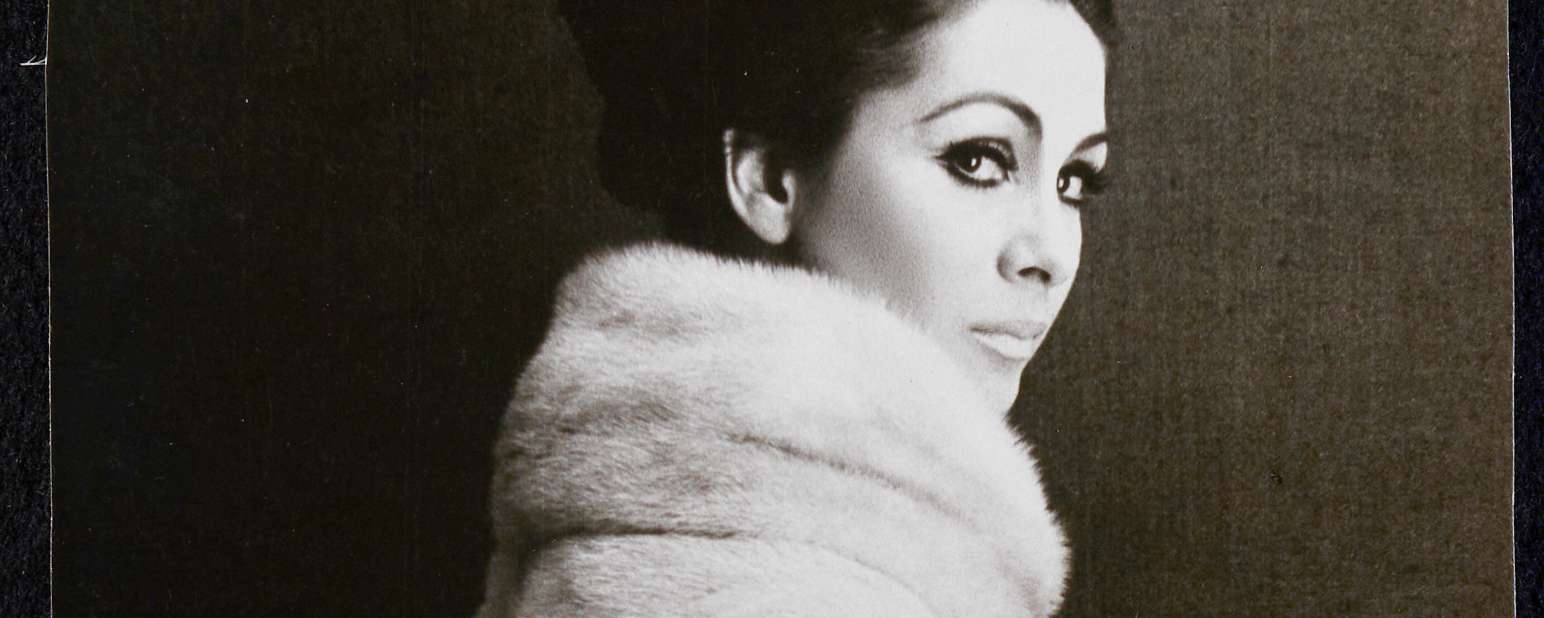
When April returned to London, she quickly found success as a model and society figure. Our records show her appearing in runway shows, glamorous photoshoots and magazine advertising, including British Vogue. Only those close to her knew about her gender identity, and as her profile grew, so did April’s fear of being outed. This means that others would tell her story in public, for their own agendas, without her consent.

A selection of photographs from April’s modelling days, dated 1960. Catalogue reference: J 77/4537.
Public scandal and marriage
On 19 November 1961, the tabloid newspaper The Sunday People ran an article revealing April’s assigned sex at birth and gender-affirming surgery. This means that someone April knew had tipped them off and overnight everything changed for her. April’s name was removed from her recent film credit, and she stopped receiving modelling work. Due to this, she attempted to reclaim her story through a competitor tabloid, The News of the World.
During this period, April had met aristocrat Arthur Corbett, who became obsessed with her. After Arthur’s marriage broke down, they started a strained relationship. Despite April’s reservations, they married in 1963 in Gibraltar, but the relationship quickly ended. April later wrote to Arthur, ‘I know I should never have married you’.

NEWS OF THE WORLD, MAY 20, 1962
INTO THE WORLD TWILIGHT
Drugs, orgies, grotesque parties . . . then suddenly I came to my senses . . . the horror and the sadness dawned on me
THEY thought I was going mad. It was one more horror in my strange, frightening existence as a youth longing to become a normal man yet transforming slowly, inevitably into a woman.
I told you last week how I was rescued from the dark, swirling waters of the Mersey, my second attempt at suicide in just over a year. After that the doctors put me into a men’s ward of a North-Country mental institution.
A place, for me, of utter desperation.
I was not allowed to use a knife or fork. Even when I went to the lavatory two male nurses came with me.
And all around me were madmen. Real madmen.
One lay lashed to his bed. Another seemed normal enough by day but always started screaming and raving at dusk.
Several were victims of frequent, agonising fits.
Mercifully it was decided after a few days that I was not a mental case.
I was allowed to go home. Home to my mother, brothers and sisters from whom I was still hiding the real cause of my troubles.
I knew it couldn’t last much longer. I used to catch them staring incredulously at my softening features, my steadily rounding figure, my legs, arms and fingers, all fining into those of a woman.
‘My Strange Life’ by April Ashley, published in The News of the World, 6 May 1962. Catalogue reference: J 77/4536.
Struggling financially without her modelling work, April tried to claim financial support from Arthur. He argued it was not a valid claim, because their marriage was unlawful based on April’s gender. Arthur took the case to court which centred on whether the law recognised her as male or female.
Corbett v. Corbett
On 11 November 1969, this case began, marking the first time an English court was asked to determine a person's sex.
Sex on trial
Over 17 days, April’s body and mind were examined closely in an attempt to determine her legal sex. The court tried to decide April’s sex using biological factors, including chromosomes, reproductive organs and genital anatomy, instead of lived identity. She was subjected to invasive physical and psychological examinations, including measurements and X‑rays. April’s legal team argued she was medically intersex.
In the psychological tests she was determined to be ‘transsexual’, a term used at the time to describe transgender people. This was the only category of tests that acknowledged her gender not aligning with her assigned sex at birth.
Meanwhile, Arthur put on a show for the court. As someone who sometimes wore feminine clothes himself, Arthur presented himself as deviant but repenting, whereas April refused to apologise ‘for being myself’.
The verdict
The judgment for Corbett v. Corbett was delivered on 2 February 1970, after an agonising wait of several weeks. The court determined that April’s legal sex was male. This set a precedent that sex assigned at birth was a person's legal sex no matter how they identified, or what medical treatment they had undergone. This judgment affected the UK and cases globally for years to come.
April later said she wished she had appealed, but she was already exhausted by the intense process. Years later she visited Arthur on his deathbed where he apologised to her.
Gender Recognition Act 2004
The legal precedent set by April and Arthur’s annulment stayed in place for several decades. Many people campaigned tirelessly to change the law. April herself repeatedly wrote to government representatives, including personally appealing to her friend and past housemate John Prescott.
Eventually the Gender Recognition Act (2004) was passed, after a European Court of Human Rights judgment. It enabled people under certain circumstances to change their legal gender with panel approval. This act is now considered by many to need reform but was a significant step forward at the time.
A few months before her 70th birthday, April finally received legal recognition of her gender. She said she ‘felt free at last’.

Gender Recognition Act 2004
AN ACT
TO
Make provision for and in connection with change of gender.
Chapter 7, 1st July 2004
The Gender Recognition Act 2004. Catalogue reference: C 65/7811.
April Ashley MBE
In 2012, April became a Member of the Order of the British Empire (MBE) for ‘services to Transgender Equality’. In 2016 she was also awarded an Honorary Degree by the University of Liverpool for this work.
April died in December 2021 at the age of 86. She lived through many changes for the trans community. April left a legacy of visibility, campaigning and pride.
-
- From our collection
- RG 101/4390G
- Title
- 1939 Register (population survey) listing April and her family living in Liverpool
- Date
- 1939 Sept 29
-
- From our collection
- BT 382/869
- Title
- A record of April's time in the Merchant Navy
- Date
- 1941 Jan 01 - 1946 Dec 31
-
- From our collection
- PIN 43/590
- Title
- Statistics about 'change of sex cases' and national insurance
- Date
- 1952 Jan 01 - 1976 Dec 31
-
- From our collection
- J 18/443
- Title
- April's change of name by deed poll
- Date
- 1961
-
- From our collection
- PIN 43/592
- Title
- 'Change of sex cases' and issuing of national insurance cards
- Date
- 1952 Jan 01 - 1963 Dec 31
-
- From our collection
- J 77/4536
- Title
- One of April and Arthur's divorce case files
- Date
- 1960 Jan 01 - 1969 Dec 31
-
- From our collection
- PIN 61/27
- Title
- Discussions on the legal change of sex from the Ministry of National insurance
- Date
- 1958-1971
-
- From our collection
- C 65/7811
- Title
- Chapter 7 of the Gender Recognition Act 2004
- Date
- 2004 Jul 01


