
What was the Festival of Britain?
The 1951 Festival of Britain was a nationwide showcase of optimism and creativity. Its colour and modernity projected a confident, forward‑looking vision of British life after years of wartime austerity.
The Festival ran from 3 May to 30 September and had exhibition sites in Belfast, Cardiff and Glasgow and a touring exhibition on the ship Campania, but the main Festival site was on London’s South Bank. The area had suffered bomb damage during the war, but even before that, it was made up of largely derelict Victorian industrial buildings like the Lion Brewery and the Shot Tower.

London’s South Bank in 1949 before the Festival of Britain building work. Waterloo Bridge is on the left, with the Shot Tower in the centre. Catalogue reference: WORK 25/195 (1111)
The Festival transformed the area along the south side of the Thames from Waterloo Bridge to County Hall – the home of London County Council (LCC). On the opposite side of the river was Victoria Embankment, with the Houses of Parliament easily visible past Westminster Bridge.
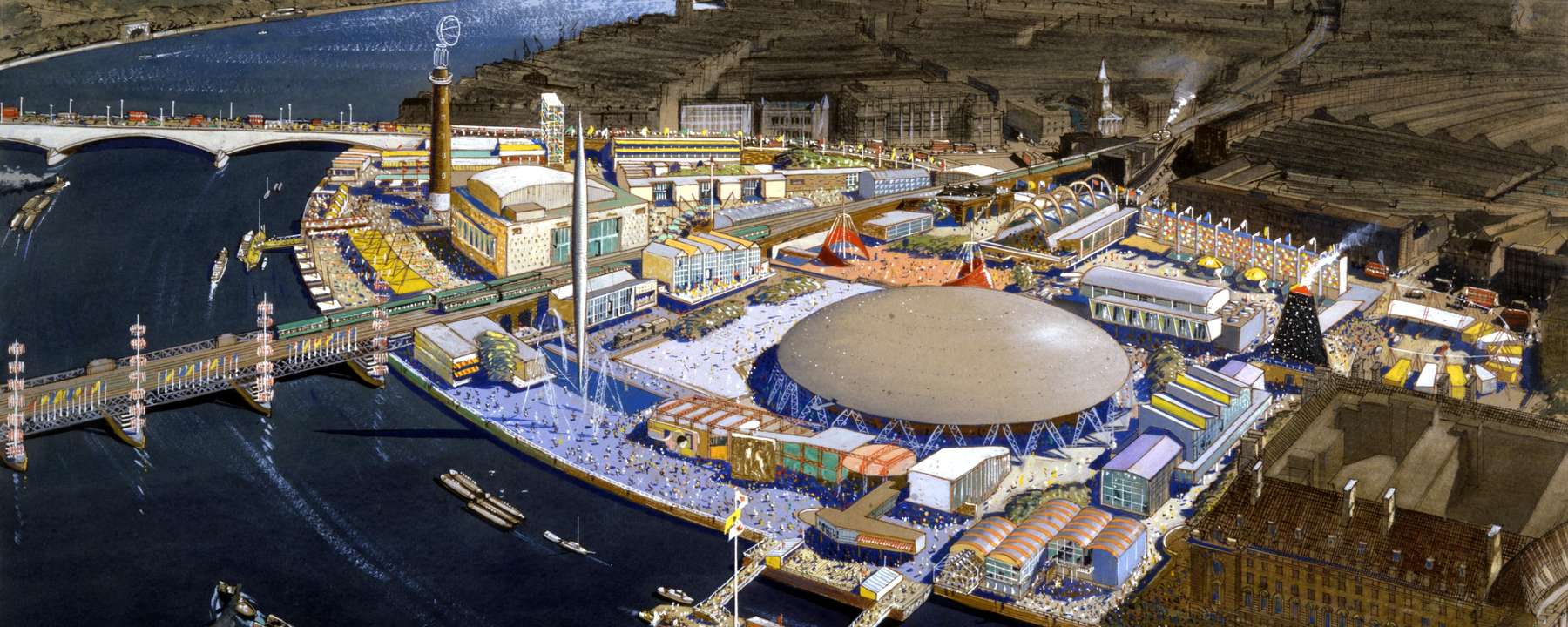
The site was split into two sections by the Hungerford Bridge running through the middle. The two largest structures, the Dome of Discovery and the Royal Festival Hall, were on opposite sides of the bridge and were interspersed with smaller exhibition pavilions. In and around the whole site were gardens, fountains, restaurants and promenades.
In addition, there was the Skylon – a futuristic, 90-metre tall, steel vertical structure. Its cigar-like shape was suspended from the ground by almost invisible cables attached to steel beams.

Panoramic painting of the Festival of Britain South Bank site by Eric Fraser. Left to right along the riverfront are the Shot Tower, the Royal Festival Hall, Hungerford Bridge, the Dome of Discovery, and the Skylon. Catalogue reference: WORK 25/64/B1/SB-Gen/24

A comparable view of the South Bank site in 2026, provided by Google Maps.
Imagery 2026 Google, Landsat / Copernicus, Data SIO, NOAA, U.S. Navy, NGA, GEBCO, Map data 2026 Google
The Festival was only open for five months, however. What was the plan for the site afterwards?
A range of ambitions
The whole South Bank area was owned by the London County Council.
The ‘upstream site’, where the Dome and the Skylon were built, was leased to the Ministry of Works. The ministry had plans to build government offices there after the Festival.
The ‘downstream site’ included the Royal Festival Hall, funded by the LCC, which was always intended to be a permanent venue. The council had plans to either extend it or to build a national theatre close to Waterloo Bridge once the Festival was over.
However, building materials were in short supply and the government prioritised housing and industrial reconstruction over leisure and entertainment. Those plans would have to wait.

Plan of the Festival of Britain site from the official guide to the exhibition. Catalogue reference: ZLIB 17/129A
On 17 July 1951 – while the Festival was still in full swing – Sir Ernest Pooley, Chairman of the Arts Council of Great Britain, wrote to the Minister of Materials, Richard Stokes, who was a Member of Parliament (MP) and Lord Privy Seal.
Sir Ernest was looking for a way to provide London with a temporary art gallery ‘similar to the Petit Palais or L’Orangerie in Paris’. He wrote:
I should like to … repeat the hope I expressed that the Government might reserve the Lion and the Unicorn building as an art gallery until such time as it has to be removed … I believe that it would be possible to fit up an existing temporary pavilion on the South Bank for a comparatively modest sum; and its use adjacent to the Royal Festival Hall would be assured now that the public have clearly formed the habit of visiting the South Bank.
Cabinet Office papers from 1951. Catalogue reference: CAB 124/229
The Arts Council’s suggestion reached Gerald Barry, Director General of the Festival, who wrote a comprehensive response to Richard Stokes on 19 July. Barry explained the complications of making decisions about the future of the buildings and the site, while also acknowledging the possibilities:

Dear Lord Privy Seal,
Thank you for your letter of July 16. I note what you say about the use of the South Bank site next year or in subsequent years. I am myself, as you know, greatly exercised in my mind about this question. I imagine we can assume that no new building will be undertaken on the site for the present, and perhaps for some years to come, and it is most desirable that plans should be agreed at a very early date for the use of the site in the interim period. I can imagine no more ironic and tragic monument to the Festival of Britain than that the South Bank site, rescued from dereliction by the Festival, should again become an eyesore in the heart of the Capital!
Letter from Gerald Barry to Richard Stokes. Catalogue reference: CAB 124/229
…as you know, the Arts Council have their eye on the Lion and Unicorn pavilion... I have, however, also received a proposal from another quarter for the re-erection of this particular building on another site for another purpose. Then there is the question of whether the Dome could not with advantage be retained as an all-purposes exhibition building in the centre of London…Again, the British Film Institute are anxious, I understand, to retain the Telekinema.
Letter from Gerald Barry to Richard Stokes. Catalogue reference: CAB 124/229
Arrangements for winding up
Suggestions for re-using different Festival buildings needed to be considered in a coordinated way. The decisions fell to the Festival organisers, who had responsibility for the buildings, and the London County Council, which had responsibility for the wider South Bank site.
A committee to oversee arrangements for winding up the Festival was established under Herbert Morrison, Lord President of the Council. The committee considered all elements of the Festival, from the buildings and exhibits to the infrastructure, fountains, trees, pools and gardens.
Pavilions
The Festival pavilions were always intended to be temporary, and adapting them for longer-term use wasn’t necessarily feasible or cost-effective. In its meeting on 3 August 1951, the committee recommended removing most of them.
-
- From our collection
- CAB 124/229
- Title
- Proposals for the future development of the Festival of Britain's South Bank site
- Date
- 1951
As well as the Arts Council’s proposal to temporarily use the Lion and Unicorn pavilion on its present site, the Royal College of Art had suggested relocating it to vacant land opposite the Victoria and Albert Museum. In addition, the Council of Industrial Design was considering making a proposal to use the Homes and Gardens pavilion.
The committee noted that for these pavilions to be repurposed on their existing site, 'some authority will have to take responsibility for management, for letting to suitable tenants, and for installing heating etc. which is likely to be costly.'
Ultimately the plans to reuse the Lion and Unicorn and Homes and Gardens pavilions proved unworkable, and these were also demolished. Only the Telekinema was successfully re-used, being occupied by the National Film Theatre until 1957.
Dome of Discovery
The Dome of Discovery was a more significant structure than the other pavilions, with its innovative design and impressive size. It was 111 metres in diameter and 28 metres high.

The Dome of Discovery, with the Skylon on the far right. Catalogue reference: WORK 25/208
The LCC considered dismantling it and re-erecting it at Crystal Palace at an estimated cost of £120,000. The authorities in Coventry, which was being rebuilt following heavy bombing during the Second World War, also proposed relocating it there.
A report in the Daily Mail claimed that 'an amusement park promoter wants to transport it piecemeal to Coney Island, America’s pleasure ground', and also that the Navy 'believe it would make a first-class indoor gunnery range.'
Despite the serious considerations given to finding a use for the Dome, in reality it was going to be costly and not straightforward. In the end its fate was the same as that of the pavilions, and it was demolished.
Skylon
The Skylon had become a riverside landmark, but if it was to stay on its original site, the committee wanted the LCC to commit to illuminating it at night. They felt that 'it was not a beautiful object by day and its charm lay in its lighting at night'.
Keeping and maintaining the Skylon in its riverfront position would be problematic once building work began on the offices behind it. The council was more interested in seeing whether the Skylon and the Dome could both be moved to Crystal Palace.

The Skylon, left, next to the Transport Pavilion. Catalogue reference: WORK 25/208
The Managing Director of the Festival Pleasure Gardens at Battersea initially wanted the Skylon to move there. He later withdrew the proposal following advice from the Gardens’ Coordinating Designer, James Gardner, who reported that he was 'strongly of the opinion that this device is meaningless without its association with the South Bank'.
The Daily Mail reported that the seaside resort of Morecombe wanted the Skylon for its illuminations, and Billy Butlin was considering using it in his holiday camp at Pwllheli or Filey.
-
- From our collection
- T 219/282
- Title
- Winding up of the Festival of Britain South Bank Exhibition: minutes and papers
- Date
- 1951
News Chronicle columnist John Bouverie wrote that 'an urge to buy The Skylon took me to 99 Regent Street yesterday', where the Disposals Branch of the Festival Office was based. Bouverie found a 'grey-haired civil servant who frankly admitted to me that he has never before sold a Skylon, nor yet a Dome of Discovery. However, he said he was “open to all offers” so I asked him for the necessary forms to fill in'.
Once again, despite interest from different quarters, practical and aesthetic considerations meant that ultimately, the Skylon suffered the same fate as the pavilions and the Dome of Discovery.
A new minister – and monarch
Soon after the Festival closed on 30 September 1951, the UK saw a change of government from Labour to Conservative following the general election on 25 October. The new Minister of Works was David Eccles.
A few months later, on 6 February 1952, King George VI died and the coronation of Queen Elizabeth was arranged for 2 June 1953. Eccles wanted to have the South Bank cleared in readiness for the planned celebrations.
Hansard reports show that Eccles faced questions in the House of Commons about the decision to demolish the Dome of Discovery. Labour MP Charles Key, a former Minister of Works, asked why the London County Council couldn’t be given more time to investigate options for re-siting the Dome (Hansard, 4 March 1952). Eccles explained his thinking:
Whatever may be the cost and technical difficulties in re-erecting the Dome of Discovery, I am unwilling to become the caretaker of empty and deteriorating structures, more especially because the site should be cleared and put to a good purpose in time for the Coronation.
David Eccles, in Hansard report from 4 March 1952. Catalogue reference: T 219/283
The following week, Labour MP Norman Dodds asked 'what action has been taken to get the best possible price for the Dome of Discovery?' (Hansard, 11 March 1952)
Eccles replied that once the London County Council had decided against moving the Dome to Crystal Palace, the contract to demolish it was put out to tender.
Demolition, salvage and sales
In April the Daily Mail reported that:
The Skylon and the Dome of Discovery have been sold to a London firm of metal and machinery merchants. But the price is not to be disclosed. Experts from the firm – George Cohen, Sons and Co. – are to begin dismantling the Skylon within the next few days.
The Daily Mail, 16 April 1952. Catalogue reference: T 219/283
Records from the Ministry of Works show that Cohen’s paid £65,408 for the main demolition contract and a further £200 for the Skylon, presumably based on their assessment of the value of the materials they could salvage.
From this they deducted a demolition charge of £33,393 so that in effect they paid £32,015 for the salvageable materials.

Costs relating to the contract with Cohen’s for demolition, and the settlement paid to the London County Council. Catalogue reference: WORK 22/65
When it came to the exhibits, decoration and furniture, the organisers sold whatever they could to government departments and directly to the public at specially arranged auctions.
This small excerpt from the accounts shows the sale of a record of grasshopper sounds to the Council for the Promotion of Field Studies, a Springbok chair to Miss E M Large, and an Austin car to the Ministry of Supply.

Sub Standard Film Finishes Ltd
Purchase of 16m.m. Spools & Cans 247 10 8
Council for the Promotion of Field Studies
Purchase of record of grasshopper sounds - 7 6
London County Council
Purchase of 30 Park seats & 20 Flower tubs 182 - -
Miss E. M. Large
Purchase 1 Springbok Chair 2 10 -
Harold Williams & Partners
Further proceeds of S. B. Auction 2541 8 -
Ministry of Supply
Purchase of Austin Car 189 - -
Accounts showing sales of Festival furniture and exhibits. Catalogue reference: WORK 25/32A
A continuing cultural centre
It has been argued that the change of government was the reason the Festival site was cleared without any further use being made of the buildings and pavilions. Files at The National Archives tell a more nuanced story, however.
Plans for a national theatre and government offices meant that eventually the site needed to be cleared. The impending coronation added to the need make sure it didn’t become an eyesore.
The practicalities and costs of adapting Festival buildings proved to be an obstacle. They were only overcome by the National Film Theatre (later renamed BFI Southbank), which used the Telekinema building for five years.
The site of the Dome of Discovery and Skylon now houses the Jubilee Gardens and the London Eye. The Royal Festival Hall was kept, and is part of a complex of cultural buildings including the National Theatre (on the other side of Waterloo Bridge).
Today, the South Bank’s riverside promenade offers visitors wonderful views and a variety of places to eat and drink – including one which keeps the memory of the Festival of Britain alive with its name: ‘Skylon’.


