





Teaching resource
Working with telegrams as sources
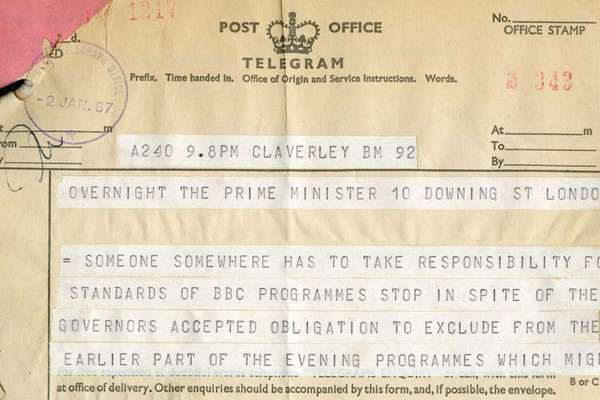
Telegrams were a form of instant communication. There are quite a lot of things you need to watch out for when using them as sources.
Teaching resource
There are quite a lot of things you need to watch out for when using photographs as sources. Just like documents they must be treated with caution. Seeing is not necessarily believing!
This resource has been designed to help students develop their skills when using photographs as sources.

Catalogue reference: COPY 1/452
In this video we take you through useful questions to ask about a photograph. The questions are below – try answering them yourself before watching the video!

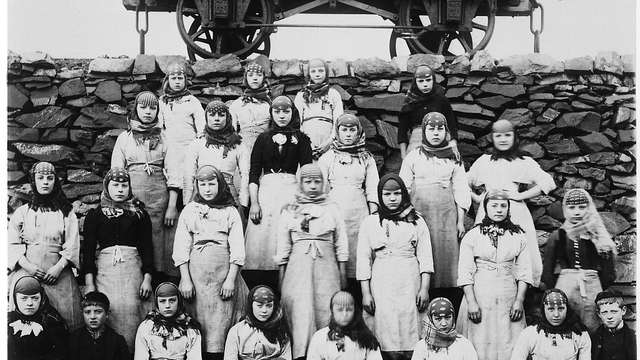
Photograph of Pit Brow Girls, just before starting their work, Photograph consisting of 27 girls & 2 boys. 1893. Catalogue reference: COPY 1/412
 Watch What can a photograph tell us? on YouTube
Welcome to 'what can a photograph tell us?' Take a closer look at this example. This has an original caption. Not all photographs do. This one says: 'Photograph of pit brow girls just before starting their work. Photograph consisting of 27 girls and two boys. COPY 1/412'.
Let's go through some questions to consider when looking at photographs.
What type of source is this? Well, we can see that it's a black and white photograph. We have a caption that says it shows pit brow girls before starting their work. The reference, COPY 1, means that the photograph was registered for copyright by the photographer meaning that he had created it and only he had the right to publish it.
Who produced it? We know from the paperwork with the photograph when it was registered that the photographer was called Thomas Taylor at Walthew Lane, Platt Bridge near Wigan. The image shows child workers at W. J. Turner's Colliery, or coal pit, at Wigan junction, so we can pinpoint the location.
Why was it produced? Turner's pit probably requested the photograph to be taken of their workers, possibly as publicity for the mine.
We know the date is 1893 from the original caption too. What can we infer from this photograph? It's certainly a formal picture.
This is suggested by the appearance of the girls and the two boys. They are posed, as they appear to have to hold their hands in a particular position.
This could be to suggest that they were obedient workers. One girl has not complied, however. Can you spot her?
All of the girls are wearing headscarves, which suggests that their work was dirty or that they had to cover their hair. They also wear aprons and clogs on their feet.
This infers that there were rules about clothing. The boys are not wearing protective clothing, maybe because they do different jobs to the girls.
Perhaps the boys work on the surface of the pit and the girls do dirtier jobs. Maybe these boys are too young to work underground. From looking at the photograph, all of the children look fairly young, however.
This suggests that they were not in school receiving an education, unless they worked part-time and there was a school nearby or on the pit premises.
The photograph also infers that the pit is fairly large, as the wagon is numbered 193. That's a lot of wagons!
On the wagon it actually says Wigan Junction Colliery so this implies that the pit is located near a railway.
The photograph also gives us some insight into technology at that time. Coal was moved in wagons on railways at the surface of the pit.
What values or attitudes does the photograph suggest?
It seems to be suggesting that it was acceptable for children to work in mines rather than be involved in full-time education.
Again, maybe it's suggesting the value of hard work for poor children.
These are quite likely to be working class children. It would have been unlikely that children from middle class or upper class homes would be working in this way. It also reveals perhaps the idea that the concept of childhood itself didn't really exist for these children at this time.
The photograph resembles a sort of formal family photograph and infers that the leadership of the company is rather paternalistic.
This means it has a dominant approach and treats workers as though they are members of a large extended family, and in exchange the owner of the mine expects loyalty, obedience, hard work and trust from its employees. How does the photograph relate to a historical situation?
The Coal Mines Act was passed in 1842 as a result of Lord Shaftesbury’s report into the employment of women and young children in coal mines.
The law stopped all females and boys under 10 years from working underground. Parish apprentices between the ages of 10 and 18 could continue to work in the mines. For many mining families the loss of income from working women was a disaster. However, the Mines Act did not forbid girls and women from working on the surface of the mine and they became known in Lancashire as pit brow lasses.
They worked at various jobs ranging from loading wagons to sorting and cleaning coal. In the 1911 Mines Act the law was changed so that boys had to be 14 years and over to work underground and miners gained an eight hour day. Relating the photograph to this background of laws about mining it would suggest that the boys are too young to work underground and the girls work as pit brow lasses above ground doing dirty labouring jobs but not mining below the surface. It's not obvious what type of jobs the boys do though.
Are there any clues about the audience for the photograph?
The photograph could be publicity for the company. Perhaps it was to appear in a local paper with a story. Maybe it was to attract local workers.
Perhaps it existed to suggest that Wigan Colliery looked after its employees or was taken as evidence for a mines inspection.
How reliable is the photograph? Does it have any limitations?
The source is reliable in the sense it shows real people in a genuine location in typical work dress clothing of the period.
It is in a sense propaganda for the company. The workers are posed well-presented, orderly and obedient. It's not cropped. It's not naturalistic.
The nature of camera technology at the time meant that photographers could not really take action or candid shots so it is inevitably posed.
It's valuable for all these reasons and there's also much to infer from it in terms of its attitudes and values towards education for children and child labour.
How does it relate to other sources from this period? Does it share the same ideas or arguments?
This type of question is popular in assessments where you are given several sources on the same topic. There are similar photographs showing pit girls at work on the surface of mines. However, comparisons could also be made to other pits in the country. Different local newspapers would be good sources to contrast working conditions in other pits that employ children.
Accidents would also be reported in these papers. Government reports on mining conditions and safety inspections at the time could also be used to provide more context for this source. These could show more detail on working conditions against the view presented here and could offer a government view on conditions. Finally, perhaps the census for 1891 for Wigan could be used to assess the extent of child labour in this colliery and how far whole families were employed in working for the mines in the area.
It is important to establish the context of a photograph in order to work out the truth of its caption. You may, for example, conclude that a photograph is propaganda once you know its origin or have assessed it as posed. However, even if this is the case, it does not reduce the value of the image as evidence for the past. It still offers insight into the motives for producing the image in the first place.

Catalogue reference: COPY 1/452
Answer below in the Teachers' notes.
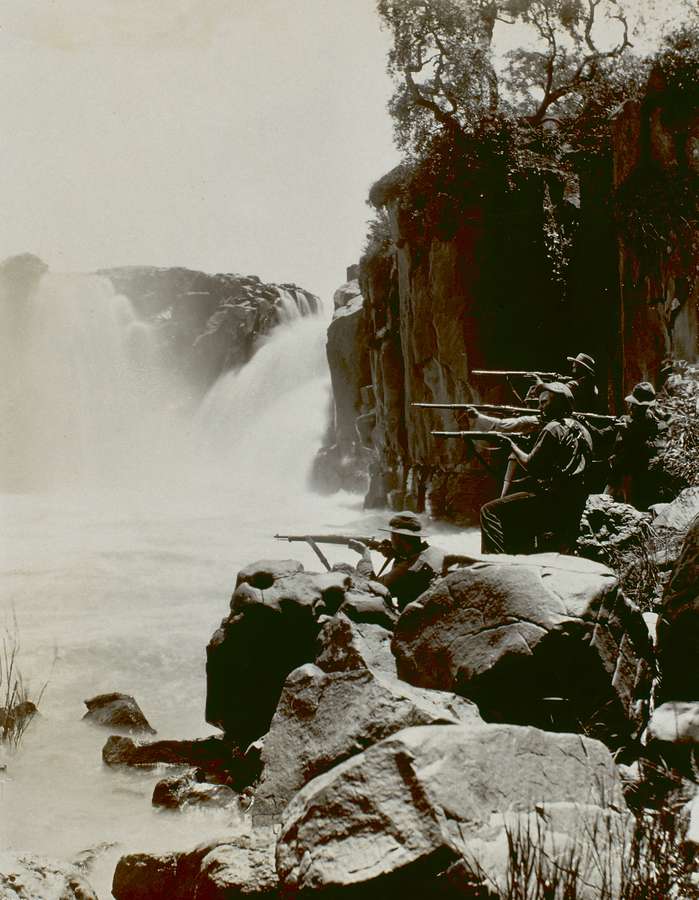
The First Anglo-Boer War – also known as the First Transvaal War of Independence – was a conflict from 1880 to 1881 between the British colonizers and the Boers from the Transvaal Republic. The second conflict, from 1899 to 1902, is known as the South African War.
Reginald Sheppard was in the Boer Commando in Pretoria (a guerrilla military unit in South Africa). He was a professional photographer who used his camera in the conflict. Some of his photographs, like this one, were posed.
How can we tell?

A matter of outposts, Boer snipers exchanging shots with British outposts below Tugela Falls, Reginald Sheppard. 1900. Catalogue reference: COPY 1/450/476
Do not dismiss a photograph if you detect that it has been altered or staged. Take, for example, this source. Clearly, this photograph has been taken in a studio. This interior scene is setup with typical props – an ornate screen, a pot plant (possibly an aspidistra) on a stand and some luxurious draped fabric.
What do these props suggest? A well-dressed woman is kneeling on the left with a small boy wearing expensive looking clothes standing on the right. They seem to be in conversation. Perhaps they are mother and son? The caption for this original photograph reads like a set of instructions from the photographer about the pose required, and is perhaps revealing about the production of the image.
Our photograph here can be seen as an ‘interpretation’ of two people.

Photograph of lady & boy – lady kneeling behind screen – holding up right hand, in attitude of listening – boy standing against screen – hands behind back, February 1888. Catalogue reference: COPY 1/391 f.164
When using a photograph for research, one of the most important things you need to understand about it is the context and the circumstances that produced it. Be prepared to do further research if necessary.
Historical photographs cover a huge range of themes including portraiture, technological change, conflict, travel, leisure or reflecting political propaganda. Use these questions to help you understand what photographic sources can reveal:
If you are trying to work out if a photograph has been staged:
The original caption is: Three members of R F Scott’s 1901 Antarctic Expedition at East India Docks.
This photograph was taken in 1901 and shows members of the National Antarctic Expedition led by Captain Robert Falcon Scott. He was the first British explorer to reach the South Pole, and explored Antarctica extensively by land in the early 1900s.
In this case it is very useful to have the original caption with the date, as some of the other made up captions here might have seemed appropriate. Don’t forget that a caption can change the meaning of a photograph.
Working with historical primary sources
The National Archives has over 8 million photographs in its collection. They have been taken for many different purposes by different government departments.
They range from propaganda photographs taken by the Ministry of Information in the Second World War, to photos from the Foreign and Colonial offices or those held in Metropolitan Police files.
The largest collection of photographs, however, comes from the copyright records, called COPY 1. From 1862 to 1911, any image that an artist wanted to copyright was registered with the Government at Stationer’s Hall.
The earliest photographs were called daguerreotypes, invented by Louis Daguerre in 1839. The image was created by exposing a silver-plated copper sheet to iodide, which made a light sensitive coating. The plate was then exposed to light for up to an hour and then treated with other chemicals to fix the image. This meant that anyone photographed in this way had to sit still for some time. The process to create a daguerreotype was very expensive and only wealthier people could have afforded them.
From 1853, the development of ‘tintype plates’ made photography inexpensive and faster. People were able to go to photographic studios from the 1860s to have their photographs taken. Later developments in photographic printing and the invention of cheaper cameras meant that, by 1900, people could take their own photographs.
Teaching resource
Telegrams were a form of instant communication. There are quite a lot of things you need to watch out for when using them as sources.
Teaching resource

This resource is intended to help students learn how to use cartoons as historical sources, including examples of useful questions to ask when using cartoons.
Teaching resource
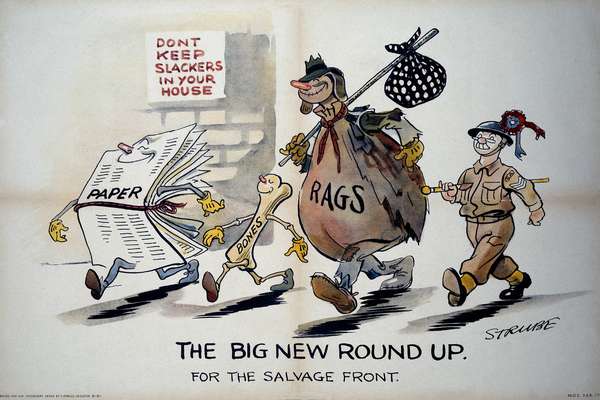
This resource includes various posters produced by the government during the Second World War with questions to help students interrogate them as sources.
Teaching resource

This lesson shows us how we can use photographs, with examples from the Victorian period and more recent times, to uncover the past.