
Service phase: Beta

This is a new service. Help us improve it and give your feedback (opens in new tab).

Teaching resource

Working with Second World War posters as sources

This resource includes various Ministry of Information posters produced by the government during the Second World War. We have provided questions to help students learn how to interrogate them and a series of extension activities for them to take their work with posters further.

Age ranges
Key stage 4 (Ages 14–16)
Key stage 5 (Ages 16–18)
About this image

Poster entitled ‘Is your journey really necessary?’ Artist: Bert Thomas, 1942. Catalogue reference: AN 2/1126 f35

About this resource

Time period

  • Early Twentieth Century (1901–1945)

Themes

  • Archive skills
  • War and revolution

Investigate the sources

  1. Source 1: Starter activity: Is your journey really necessary?

    This source can be used as an introduction to the kind of questions students can ask about a government poster.

    See the teachers' notes below for example answers to these questions.

    1. A soldier, wearing a khaki uniform, stands in front of a railway ticket counter. His body is strapped with equipment pouches, and he holds a rifle. He points his finger at the viewer.

      Is your journey really necessary?

      Railway Executive Committee

      Poster entitled ‘Is your journey really necessary?’ Artist: Bert Thomas, 1942. Catalogue reference: AN 2/1126 f35

      Image details for "Working with Second World War posters as..., source 1: Starter activity: Is your journey really necessary?" | Download image: "Working with Second World War posters as..., source 1: Starter activity: Is your journey really necessary?"

    Investigate the source

    • How does this poster use questions or slogans?
    • How does it use language to make its message?
    • How does it appeal to feelings and emotions?
    • Why does this poster use different font sizes?
    • How does this poster use colour to help make its point?
    • Why was this poster produced?
  2. Source 2: Salvage posters

    These three posters were used to persuade people to save waste. Use the questions to examine them and explain your answers.

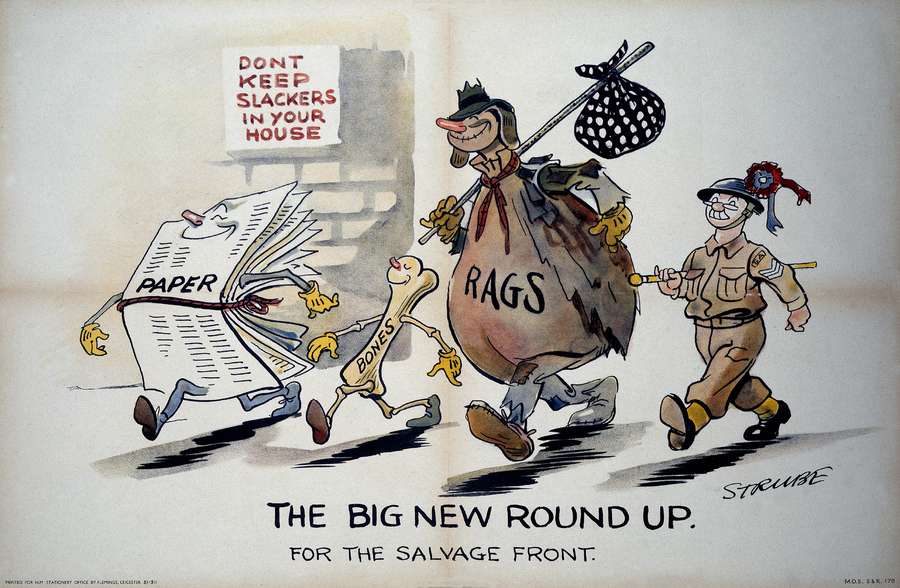
    1. Four characters are shown walking in line with a sense of purpose. They include a newspaper with legs, arms and hands with yellow gloves, a bone with legs, arms and hands with yellow gloves and large cloth bag with a head made out from rags.

      Don’t keep slackers in your house

      The big new round up for the salvage front

      Poster from the Ministry of Information by artist Sidney Conrad Strube entitled ‘The big new round up for the salvage front’, 1939-1949. Catalogue reference: INF 3/148

      Image details for "Working with Second World War posters as..., source 2a: Salvage posters" | Download image: "Working with Second World War posters as..., source 2a: Salvage posters"

    2. A large ship with billowing smoke which is sinking at sea is shown on the horizon to the right. There is a submarine further away on the left. In the foreground there is a lifeboat which bobs about on choppy waters.

      Salvage saves shipping

      Poster from the Ministry of Information by artist E. Oliver, entitled ’Salvage saves shipping’. Catalogue reference: INF 3/207

      Image details for "Working with Second World War posters as..., source 2b: Salvage posters" | Download image: "Working with Second World War posters as..., source 2b: Salvage posters"

    3. The front part of a house with a curtained window and front door. Outside the building is a dustbin with three separate piles of material for salvage.

      Here's what you do to help.

      Dustbin should contain neither paper, metal nor bones. They must be separate.

      Paper clean and dry, tied into a parcel. Include cardboard of all kinds.

      Metal scrap. Put all metals together – rust does not matter. Include tins & other metal boxes.

      Poster from the Ministry of Information entitled: ‘Here’s what you do to help’. Catalogue reference: INF 13/148

      Image details for "Working with Second World War posters as..., source 2c: Salvage posters" | Download image: "Working with Second World War posters as..., source 2c: Salvage posters"

    Investigate the sources

    • How do the posters use slogans or questions? Are they effective?
    • How is language used to convey their message?
    • In what ways do they appeal to feelings and emotions?
    • Do any of the posters use humour, if so, how?
    • Why do the posters use different font sizes?
    • How do the posters use colour to help make their point?
    • Which is the most persuasive poster in your opinion?
    • Are the posters aimed at different types of audience (men, women, children or all groups)?
    • How effective would these posters be without their words?
    • Discuss the differences between using visual messaging [colour and artwork] over the written word with a partner.
    • Why was this group of posters produced?
    • Can you find out about any of these war artists?
    • Can you think of any other evidence these posters provide about life during the Second World War?
  3. Source 3: Careless talk posters

    These five posters were used to persuade people that ‘careless talk costs lives.’ Use the questions to examine them and explain your answers.

    1. A large ghostly black hand at the top right of the poster draws a black sheet over half of the image which shows three ships at sea under a nearly cloudless blue sky.

      Keep it dark

      Careless talk costs lives

      Poster from the Ministry of Information for the ‘Careless talk costs lives’ campaign – 'Keep it dark'. Catalogue reference: EXT 1/119 (6)

      Image details for "Working with Second World War posters as..., source 3a: Careless talk posters" | Download image: "Working with Second World War posters as..., source 3a: Careless talk posters"

    2. A large torpedo with ears and swastika markings for eyes, leans against a red public telephone box listening to the sailor talking on the telephone inside.

      The torpedo is listening! Careless words may cost both lives and ships.

      Poster from the Ministry of Information for the ‘Anti-rumour and careless talk’ campaign entitled ‘The torpedo is listening – careless words may cost both lives and ships’. Catalogue reference: INF 3/233

      Image details for "Working with Second World War posters as..., source 3b: Careless talk posters" | Download image: "Working with Second World War posters as..., source 3b: Careless talk posters"

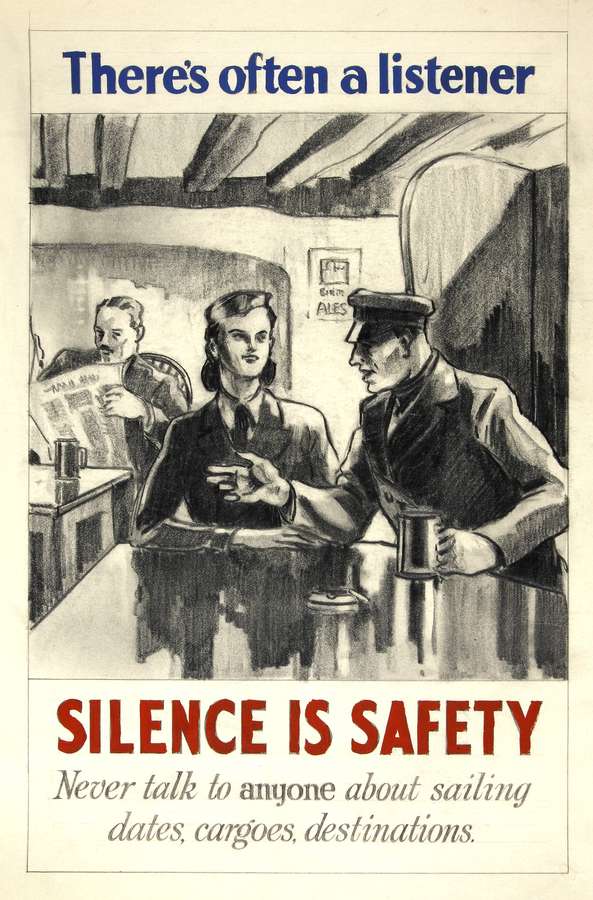
    3. Two sailors are talking in a public bar while seated at a table. There is another man seated behind them. He appears to be listening to them as he reads a newspaper.

      There's often a listener - silence is safety.

      Never talk to anyone about sailing dates, cargoes, destinations.

      Poster from the Ministry of Information as part of the ‘anti-rumour and careless talk’ campaign entitled: ‘There’s often a listener – silence is safety’ Catalogue reference: INF 3/247

      Image details for "Working with Second World War posters as..., source 3c: Careless talk posters" | Download image: "Working with Second World War posters as..., source 3c: Careless talk posters"

    4. Four illustrations of pairs of people talking. One person from each pair is in the next illustration, showing information passing along a chain of people.

      Telling a friend may mean telling the enemy.

      Poster from the Ministry of Information ‘Careless talk costs lives’ campaign entitled: ‘Telling a friend may mean telling the enemy’. Catalogue reference: EXT 1/119 Pt.2

      Image details for "Working with Second World War posters as..., source 3d: Careless talk posters" | Download image: "Working with Second World War posters as..., source 3d: Careless talk posters"

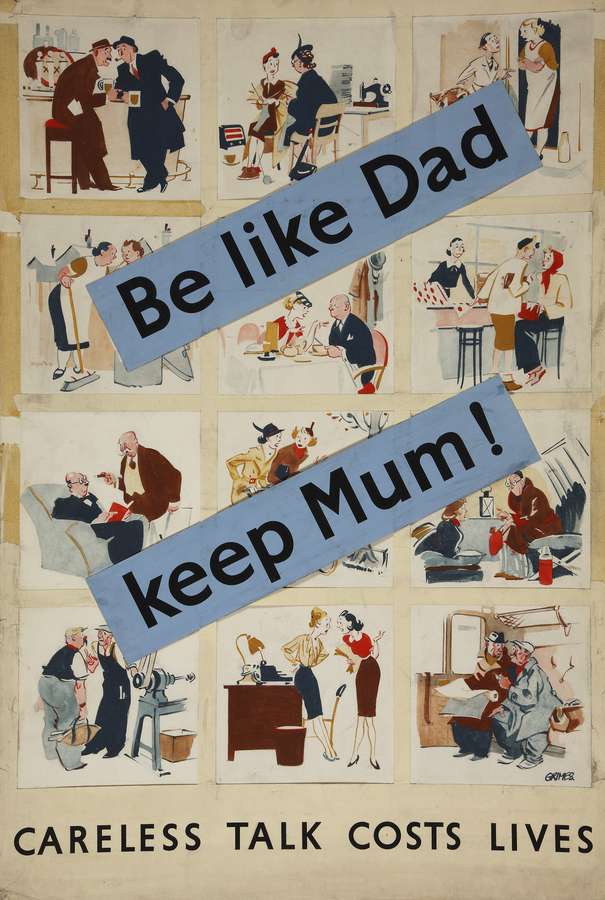
    5. The poster is divided into twelve squares each showing human figures talking in different settings including a pub, an office, a cafe and a train.

      Be like Dad keep Mum!

      Careless talk costs lives.

      Poster from the Ministry of Information part of the ‘Careless talk costs lives’ campaign entitled: ‘Be like dad – keep mum!' By artist and cartoonist Leslie Grimes. Catalogue reference: INF 3/231

      Image details for "Working with Second World War posters as..., source 3e: Careless talk posters" | Download image: "Working with Second World War posters as..., source 3e: Careless talk posters"

    Investigate the sources

    • Which posters show the results of 'careless talk'? Give examples to explain this.
    • In what situations, according to these posters, must you be careful about what you say?
    • Which posters warn about being careful who to trust? Can you explain how the poster makes this clear?
    • Explain how certain posters could be used to target a particular audience, for example: men/women/children/all groups.
    • Which is the most persuasive poster in your opinion? Comment on visual messaging (colour and artwork) and language.
    • Can you think of any other evidence these posters provide about life during the Second World War?
  4. Source 4: Ministry of Health posters

    These two posters were used among many to persuade people of the importance of remaining fit and well during wartime. Use the questions to examine them and explain your answers.

    1. A man, with part of his face covered. is shown sneezing into a handkerchief. Below his face are nine small heads belonging to different people with roles in the war effort.

      A handkerchief in time saves nine and helps to keep the nation fighting fit.

      Coughs and sneezes spread diseases.

      Issued by the Ministry of Health.

      Poster from Ministry of Information entitled: ‘A handkerchief in time saves nine’, part of a campaign by the Ministry of Health. Catalogue reference: INF 13/189

      Image details for "Working with Second World War posters as..., source 4a: Ministry of Health posters" | Download image: "Working with Second World War posters as..., source 4a: Ministry of Health posters"

    2. Four women munitions’ workers stand in front of a conveyor belt covered with artillery shells in a weapons factory. One woman in line sneezes violently and does not cover her face with a handkerchief. The other women look at in her shock.

      Ministry of Health says:-

      Coughs and sneezes spread diseases

      Trap the germs by using your handkerchief

      Help to keep the nation fighting fit.

      Poster from the Ministry of Information entitled: ‘Coughs and sneezes spread diseases’, by artist H.M. Bateman, part of a campaign by the Ministry of Health. Catalogue reference: INF 13/188

      Image details for "Working with Second World War posters as..., source 4b: Ministry of Health posters" | Download image: "Working with Second World War posters as..., source 4b: Ministry of Health posters"

    Investigate the sources

    • Why was reducing the spread of disease so important for the war effort at home according to Source 4a?
    • How has Source 4a especially used language to convey its message?
    • Towards which audience is Source 4b targeted? Can you explain why this was considered important?
    • How do both posters try to appeal to the population to behave responsibly?
    • Which is the most persuasive poster in your opinion? Comment on visual messaging (colour and artwork) and language.
    • Can you think of any other evidence these posters provide about life during the Second World War?
  5. Source 5: Dig for victory posters

    These three posters were used to persuade people that growing your own food was important for the war effort. Use the questions to examine them and explain your answers.

    1. A man and woman kneeling with their two children on a rug. They all look at a poster illustrating various vegetables. Below, the same family seated at a table, and the woman serves food to their plates.

      Planned crops for garden wealth

      Assure the family’s winter health

      Poster from Ministry of Information entitled: ‘Plan and grow for winter’ by artist Paul Falconer. Catalogue reference: INF 3/99

      Image details for "Working with Second World War posters as..., source 5a: Dig for victory posters" | Download image: "Working with Second World War posters as..., source 5a: Dig for victory posters"

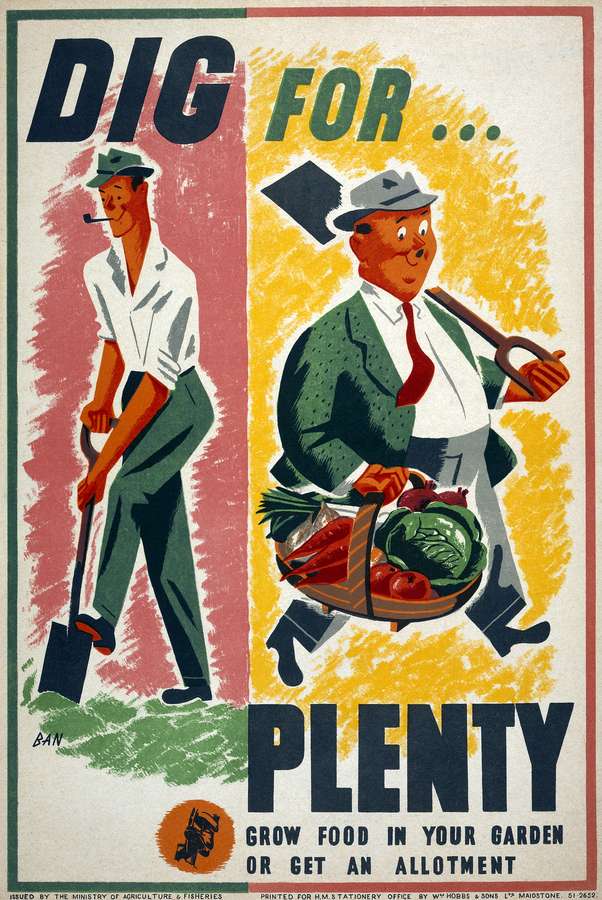
    2. A tall thin man smokes a pipe and digs in the ground. A large plump man carries a spade over his shoulder and holds a basket filled to the brim with vegetables.

      Dig for plenty.

      Grow food in your garden or get an allotment.

      Poster from Ministry of Information entitled ‘Dig for plenty’ with artist’s signature ‘BAN’ (1939-1945). Catalogue reference: EXT 1/57 (17)

      Image details for "Working with Second World War posters as..., source 5b: Dig for victory posters" | Download image: "Working with Second World War posters as..., source 5b: Dig for victory posters"

    Investigate the sources

    • Which posters show the benefits of growing your own food? Give examples to explain this.
    • Which poster encourages workers in the services to help with food production? Can you explain how the poster makes this clear?
    • Explain how certain posters could be used to target a particular audience, for example: men/women/children/all groups.
    • Which is the most persuasive poster in your opinion? Comment on visual messaging (colour and artwork) and language.
    • Can you think of any other evidence these posters provide about life during the Second World War?

Teachers’ notes

Government posters can be valuable sources for understanding and interpreting past events in history. This resource examines various Ministry of Information posters produced by the government during the Second World War. To understand the messages they intended to communicate, it is vital to examine their language, inferences and visual techniques.

This type of critical questioning can be used when examining posters from any period considered to be propaganda or intended to influence public opinion and behaviour.

We can see how the language of these government posters is used to affect peoples’ thinking. They include devices such slogans, humour, emotive language or even pose questions. The language aims to gain attention, influence or inform. It can be adapted for different audiences and purposes. It is also worth noting that these sources can provide other ‘unwitting’ evidence about life during the Second World.

Example answers to Source 1 enquiry questions

How does this poster use questions or slogans?

The title of the poster is a direct question to the viewer from a soldier: ‘Is your journey really necessary?’ It is very effective and designed to make anyone stop and think and possibly feel guilty that it would not help the war effort to make a personal rail journey. The railways were essential transport for the military services and supplies.

How does it use language to make its message?

The poster uses powerful words. For example, it uses the word ‘really’ and stresses the point by changing the colour of the word in the question posed by the poster. The words emphasise the need to take personal responsibility and support the war effort.

How does it appeal to feelings and emotions?

Perhaps the poster aims to make people feel guilty about non-essential travel. Visually the soldier implies a personal appeal as he points to the viewer. This is also an address to the country in its time of need making it an emotional appeal.

Why does this poster use different font sizes?

The title question ‘Is your journey really necessary’ uses a large sized font and capital letters to grab attention, stop people in their tracks and make them think. A smaller font is used at the bottom for the words Railway Executive Committee who produced the poster.

How does this poster use colour to help make its point?

The colour red is used for the word ‘Really’ to make it standout and this colour also signifies a command to ‘stop’. Red, white and blue used in the poster, these colours are perhaps intended to reflect the British flag and inspire a sense of patriotism.

Why was this poster produced?

It was part of a series of posters produced by artist and cartoonist Bert Thomas in 1942 for the Railway Executive Committee. This was a government body set up during wartime to control the running of the railways. It was designed to persuade people to think before they travelled. The government wanted to save fuel, including coal and petrol for the war effort. Coal was used for steam trains and petrol for other transport. Coal was also vital for use in factories manufacturing weapons, tools, equipment and other supplies.

Connections to the curriculum

Key stage 4 (Ages 14–16)

Edexcel GCSE History

  • C 1900– present: Warfare and British society in the modern era
    • Experience of war: The impact of war on civilians, including recruitment and the organisation of a Home Front during Second World Wars. Government use of censorship and propaganda in wartime.
    • The historic environment: London and the Second World War, 1939–45

OCR GCSE History

  • The First and Second World Wars: the beginnings of ‘total war’, including the impact on people’s lives, increased state power and the changing relationship between the state and the people.

Key stage 5 (Ages 16–18)

AQA GCE History

  • The People’s War and Peace, 1939–1951
    • The social and cultural impact of ‘total’ war: conscription; women and children; civil liberties and restrictions; propaganda; the Blitz.

Extension activities

Finding out the historical context

  • Research the time when a poster was created, and the content featured.
  • Find other primary sources which give background

Identifying the artists' techniques

  • Find several posters from a range of historical periods and look at different artistic techniques.
  • List what makes a persuasive poster and find examples for your choices.
  • Find five posters dealing with one event, person, or issue. Select from range of online archival/museum collections. Explain which poster uses the most effective techniques. This activity can also help you to determine contemporary attitudes.
  • Find a poster. Remove its caption or labels and then replace with your own suggestions.
  • Create your own poster about a topic that you are studying using one or more artist’s techniques.
  • Find a poster. Note down what you find out about your poster and its date, content, producer, and background. Work with a partner:
    • What points do they make about the value of the poster selected?
    • Share all your information about the poster.
    • Has your partner pointed out anything new in their evaluation?
    • Why is it important to have information about the context/background when looking at posters?
  • Research the biographies of Second World War artists:
    • Laura Knight
    • Grace Golden
    • Terence Cuneo
    • Rowland Hilder
    • Fougasse (Cyril Kenneth Bird)
  • Explore different health and safety campaigns.

Working out the perspective

  • Select a poster from a particular point of view. Design (or describe) a poster to show a different point of view.

Evaluating a poster

  • Establish the historical context of a poster, identify techniques used and work out the artist’s point of view. Then summarise the main message and support your interpretation by referring to evidence in the poster.

Background information

During the Second World War, all men and women were encouraged to support the war effort. Like the armed services, the people at home had to do their bit. The government used posters, leaflets, film, and radio broadcasts to get its message over to the public without any social media, internet, or television.

Some posters encouraged people to grow their own food and save waste. This was because it was difficult to import food from other countries during wartime. Kitchen waste could be fed to animals. People were also encouraged to salvage materials as such as wastepaper, metal or bones which could be used to make aeroplanes and ammunition.

Posters were also used to encourage morale or wartime spirit. They made it clear that everybody was in this war together and everybody had an important part to play. This also helped the public to feel involved. This really mattered if Britain wanted the workers in the factories to make as many planes, bombs, and tanks as they could or farmers to grow as much as possible.

The population faced many dangers such as the bombing of cities, ports, and factories. They also had accidents caused by the blackout regulations. These meant that all windows had to be covered at night to ensure that no light escaped that could help enemy bombers to find their targets. Streets were unlit and car headlights partially covered. Health, during the war was an important concern. The public needed to keep fit and healthy to work and keep up production in the factories and on the land. Again, the Ministry of Information produced many posters on these subjects.

Posters were displayed in shops, official buildings, and village halls. Government films were shown in cinemas to persuade people to behave in certain ways and reinforce campaign messages and encourage the war effort on the home front expressed through its posters.

Further information