





Teaching resource
Working with photographs as sources

There are quite a lot of things you need to watch out for when using photographs as sources. Just like documents they must be treated with caution.
Teaching resource
This lesson shows us how we can use photographs, with examples from the Victorian period and more recent times, to uncover the past. See what you can discover about past lives from five different photographs from collections at The National Archives.

Photographing New York City above Fifth Avenue, Arthur Westrop, 1908. Catalogue reference: COPY 1/528
What do these photographs reveal about life in the past? What is the value of photographs as sources for finding out about the past?
The largest collection of photographs at The National Archives can be found in a collection called COPY 1. This is a collection of photographs and pictures that artists and photographers have chosen to copyright. This means they have recorded their right to control the copying or sharing of their work.

Photograph of the Jubilee Singers from Fisk University, United States of America, four male figures standing and seven females sitting’, 2 June 1874. Catalogue reference: COPY 1/25 f.182
Men standing at the back: from left to right Edmund Watkins; I. P. Dickerson; Benjamin M Holmes; Thomas Rutling.
Women seated, from the left to right: Georgia Gordon; Mabel Rosa Lewis; Maggie L Porter; Jennie Jackson [centre] Ella Sheppard; Julia Jackson, Minniver U. Yates.

Photograph caption: ‘Photograph of woman standing by a can of lemonade drink, with a boy drinking out of glass, other figures.’ September 1884. Catalogue reference: COPY 1/369/ f.269
From the age of 14, Mary Wheatland (1835–1924) worked as a bathing machine operator, gave swimming lessons to children, and acted as lifeguard in the seaside town of Bognor. She stopped swimming in 1906 owing to rheumatism. She was awarded two medals from the Royal Humane Society for saving over thirty people from drowning. Mary became famous with visitors to Bognor and was also pictured on postcards.

Photograph of Mary Wheatland, the Bognor bathing woman, 1903. Catalogue reference: COPY 1/465/f.33
This photograph is part of a collection showing ‘Housing and living conditions’ for workers in British coalmines. The miner pictured worked at the Penallta Colliery near Hengoed, in the Rhymney Valley in South Wales.

Photograph titled ‘Miner and wife and children at mealtime’, 1938. Catalogue reference: COAL 80/2062/11

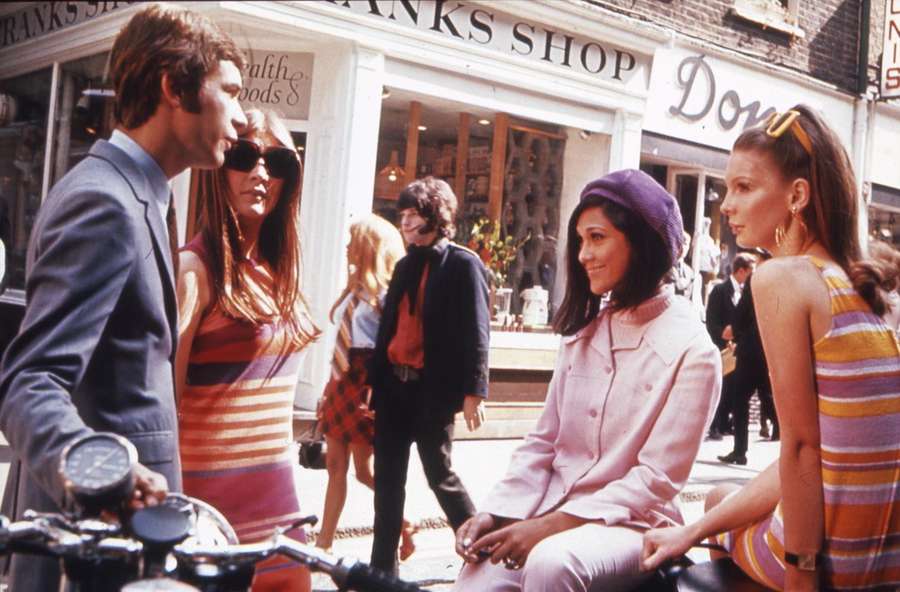
Photograph titled ‘London: shopping: streets and shops: Teenagers in Carnaby Street’, 1969. Catalogue reference: INF 14/147
Photographs are an enjoyable way to get children to engage with sources without having the difficulty of text. They provide an important means for developing observational skills and appreciation of the difference between past and present or similarity and difference. Working with photographs is also good for developing their confidence in language skills.
To establish the idea that we can find out things from photographs and to get children practiced in looking, start this activity by sharing different photographs in groups and let children talk about what they can see in the different photographs. These photographs can be taken from magazines or books, or the web. You could use old school photographs or those provided by the children themselves.
Discuss different types of photographs. Certainly, early photographs were posed and formal, but photography became more informal as camera technology advanced. It is now possible to take images quickly on our phones, a big change from the formal photographs of the early Victorians.
Finally explain what the term ‘caption’ means. All the photographs in this lesson have an original caption, but not all photographs do. Why are these useful to historians? Try the caption exercise suggested here in the activities below after you have tried the lesson.
More detail on each photograph used in the lesson can be found in the Background notes.
This lesson introduces pupils to five different photographs. Print out copies of the photographs from the website, or a project large image version of it on a whiteboard. Encourage pupils to work in pairs to make observational comments based on who and what they see. Ask them to describe the content and appearance of the image. Use the questions provided as prompts. Then encourage pupils to become more analytical in order to make sense of their observations. Is the photographed posed in any way? Why might this photograph have been taken? Who could have been the audience for it?
You may wish to split this lesson depending on time available or focus on fewer photographs as each photograph task is free standing.
The first photograph to explore is the oldest and shows a group of black singers. It is worth discussing with learners that photographs of black people are an important visual record of their presence as 19th century written records often lack details about their lives. For example, census material gathered every ten years in the 19th century, only provided information about place of birth, not ethnicity. It is worth pointing out too that to find out more about black lives, historians need to research other sources including newspapers, wills, marriage, birth and death certificates and artwork.
The second photograph to be investigated shows a female street lemonade seller from 1884. Students are encouraged to think how it could be used as evidence for lives of men and women; children and childhood; clothing or even leisure. In the photograph everyone is clearly looking at the camera. We see that the boy is barefoot and woman thin and gaunt. Can they describe their clothing? Are the other people better dressed? There is an opportunity to discuss with the students that we could find other photographs to help us find out more about lives in the past that could show difference between the rich and poor, types of jobs or the differences between living in the rural and urban settings too.
The third photograph shows Mary Wheatland in 1903. She was born in 1835. Make sure that your students understand the details of her story given on the webpage before looking at her photograph. They should also be able to work out the age she stopped swimming. The photograph seems to be in the style of ‘portrait painting’ as well as in its actual orientation. What can they learn from this photograph about changing roles of women?
The fourth photograph examined comes from 1938 and shows teatime at the home of a miner at the Penallta Colliery near Hengoed in the Rhymney Valley in South Wales. Show the class the location on map if possible and any photographs that you can find which depict coal mines and miners at work. Use the photograph in the lesson to make comparisons between past and present, similarity and difference in home life and domestic settings.
Our final photograph, from more recent times, is a scene from Carnaby Street in 1969. As well as encouraging the class to examine this photograph, teachers could work with them to create a timeline for the 1960s. They could find out about key events in Britain. Introduce them to the value of oral history by encouraging them to ask family and friends if they remember what life was like in the 1960s. Do they recall the events recorded on their timeline?
Pupils should develop an awareness of the past, using common words and phrases relating to the passing of time. They should know where the people and events they study fit within a chronological framework and identify similarities and differences between ways of life in different periods. They should use a wide vocabulary of everyday historical terms. They should ask and answer questions, choosing and using parts of stories and other sources to show that they know and understand key features of events. They should understand some of the ways in which we find out about the past and identify different ways in which it is represented.
Pupils should continue to develop a chronologically secure knowledge and understanding of British, local and world history, establishing clear narratives within and across the periods they study. They should note connections, contrasts and trends over time and develop the appropriate use of historical terms. They should regularly address and sometimes devise historically valid questions about change, cause, similarity and difference, and significance. They should construct informed responses that involve thoughtful selection and organisation of relevant historical information. They should understand how our knowledge of the past is constructed from a range of sources
The National Archives has over 5 million photographs in its collections. They have been taken for many different reasons by different people working for the government. They include photographs from the Ministry of Information during the Second World War, photos from the Foreign and Colonial Offices or those held in police files. The largest collection of photographs, however, can be found in a collection called COPY 1. This is a collection of photographs and pictures that artists and photographers have chosen to copyright. This means they have recorded their right to control the copying or sharing of their work.
The Fisk Jubilee Singers performed in London in May 1873 for Queen Victoria. This was the start of their tour in Britain. It was a significant musical event. George L. Cole was the musical director of the group, a white ex-soldier from the American Civil War and who does not appear in the photograph shown here.
Fisk University in Nashville, Tennessee was founded in 1866 by the American Missionary Association. The university aimed to educate freed African Americans after the abolition of slavery in 1865. The Jubilee Singers grew out of an early singing class held at the university aimed at fundraising for the college. The youngest was 14-year-old Minniver Tate. From the start their musical repertoire was wide-ranging and included popular songs as well as classical compositions. They went on to incorporate slave songs and black spiritual music, which audiences loved.
The photograph of the lemonade seller provides some information about the daily lives of adult street sellers. It was commissioned by Charles H Spurgeon, a Baptist minister who wanted to create lantern slides of working people for his sermons.
In the 1880s there were roughly 30,000 street sellers or costermongers in London. It is possible to find out more about the lives of street sellers in the Victorian period from London Labour and the London Poor by contemporary investigative journalist Henry Mayhew. His four-volume collection of interviews and engravings captures the lives of London’s working classes in the mid-19th century.
The Royal Humane Society is a charity that grants awards for acts of bravery in the saving of human life and for the restoration of life by resuscitation. The society awarded Mary Wheatland her bronze and silver medals. A Blue Plaque is planned to remember Mary Wheatland on Bognor Regis Pier.
Another image of Mary Wheatland can be located online at the National Portrait Gallery.
The photograph of the mining family in 1938 having a teatime meal comes from the National Coal Board collection of photographs and albums. They relate to all aspects of the British coalmining industry, which included housing and living conditions.
The first pit head baths in North East Derbyshire were opened at Grassmoor Colliery in 1929.
According to the National Coal Mining Museum, by the end of the Second World War, pithead baths were available to 63% of the workforce, an important improvement for mining families. Before baths were provided at the coal mine, miners went home dirty from their work. They washed in a tin bath in front of the fire or outside in the back yard. Everyday their wives had to boil heavy buckets of water for these baths and wash the miners’ work clothes. This was an exhausting job.
The final photograph belongs to a collection (1939–1979) from the Publications Division for the Ministry of Information and Central Office of Information. Selected official photographs were used for publicity material issued by this government department.
This photograph was part of a series covering shopping streets in London. It included Oxford Street, showing its fruit and flower sellers and department stores, Orchard Street, and New Bond Street. In this collection, Carnaby Street was described as 'the headquarters of the world famous “mini”'.
Teaching resource
There are quite a lot of things you need to watch out for when using photographs as sources. Just like documents they must be treated with caution.
youtube.com
This short video tells their story with early recordings and photographs. It explains how they introduced African American music and black religious traditions to the public in America and abroad.