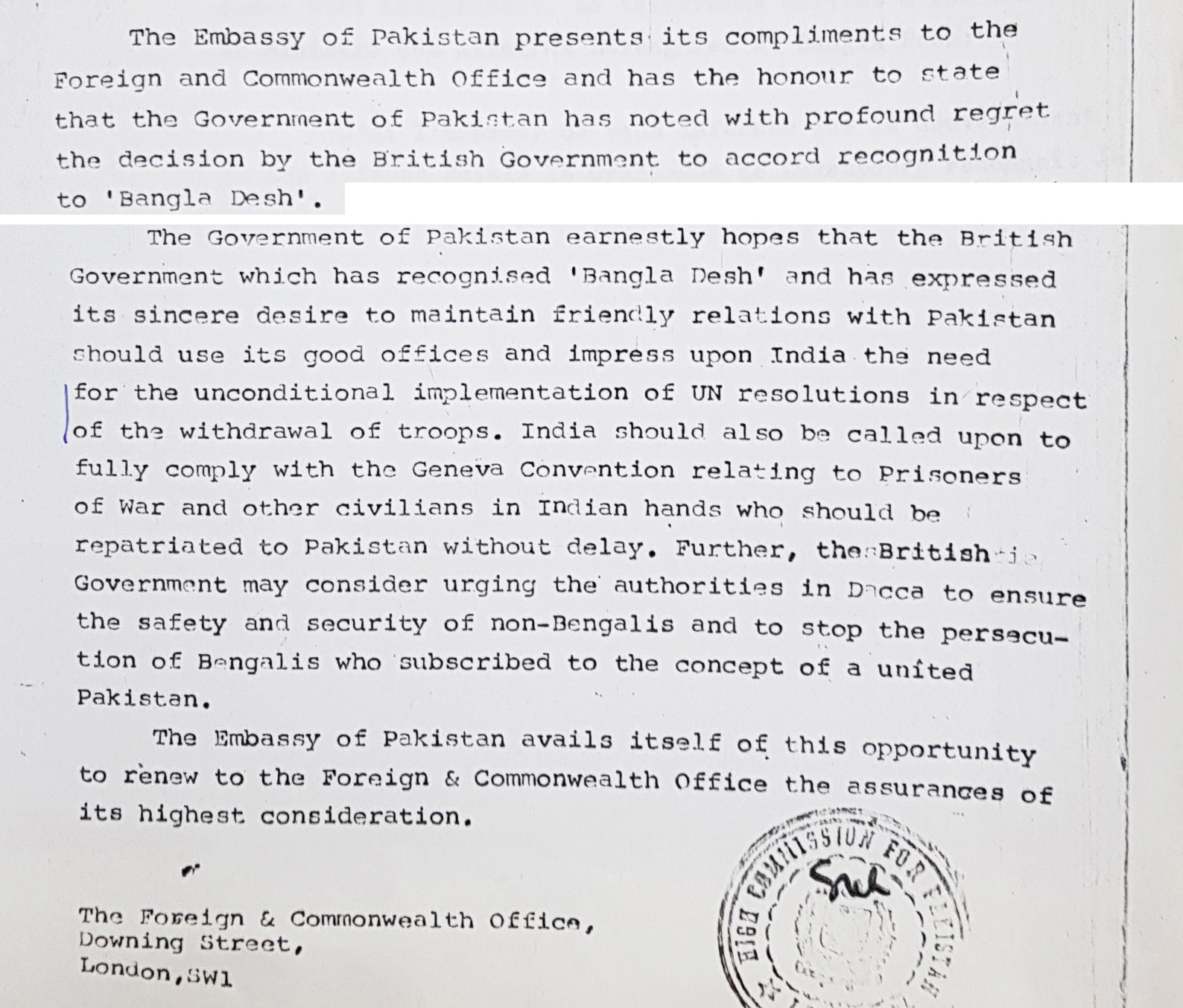
This is a letter from the Embassy of Pakistan sent after Britain officially recognised Bangladesh as a country.
Letter from Embassy of Pakistan to Foreign & Commonwealth Office, 15 February 1972. Catalogue ref: FCO 37/1025
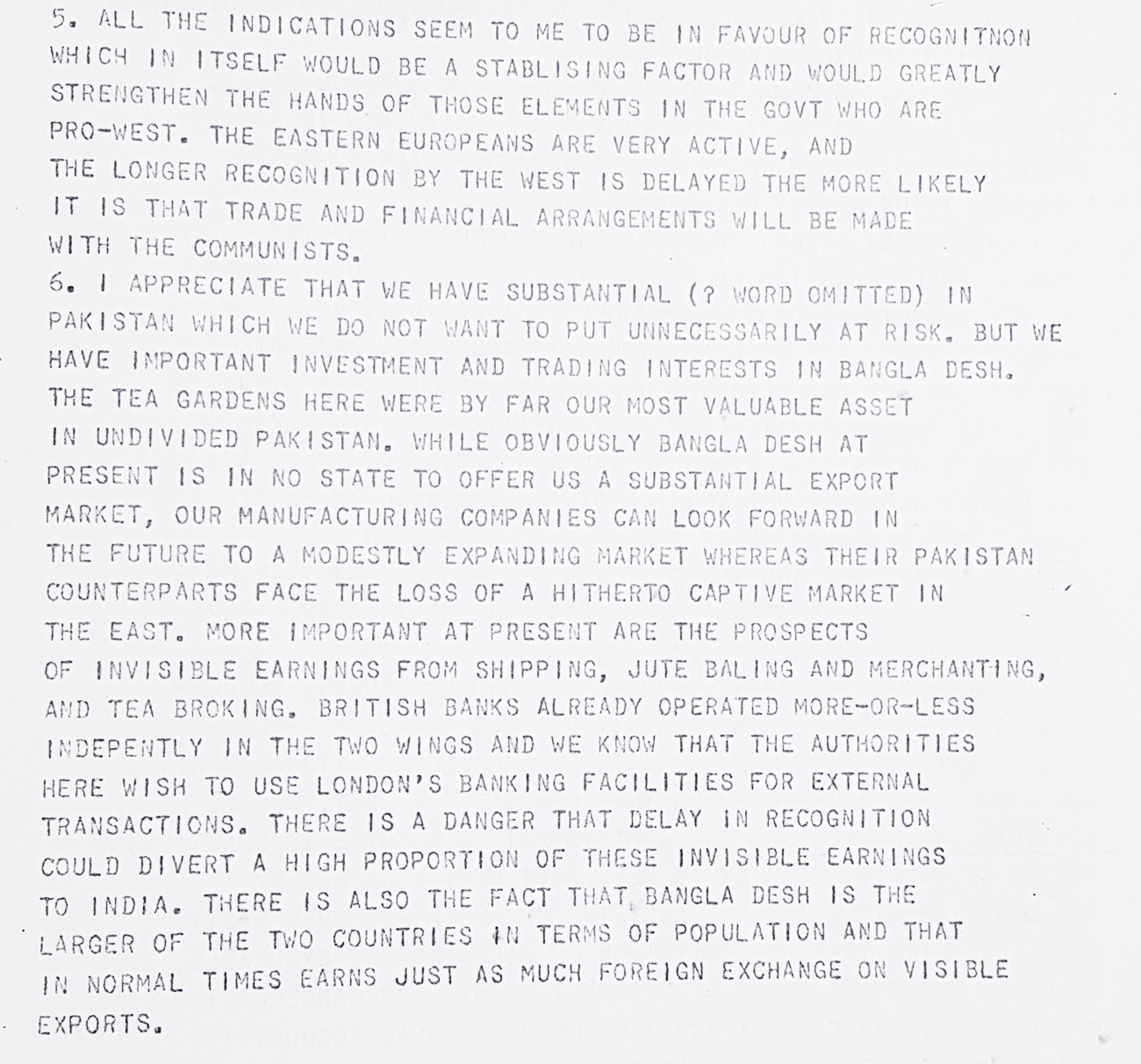
Britain recognised Bangladesh as an independent country on 4 February 1972. There was a lot of internal discussion before this date on the advantages and disadvantages that might come with recognition. Britain wanted to maintain good relationships with both Bangladesh and Pakistan.
This telegram shows British political and financial interests in the 1971 conflict.
Telegram on the recognition of Bangladesh for distribution within the Foreign & Commonwealth Office. 6 January 1972. Catalogue ref: FCO 37/1019
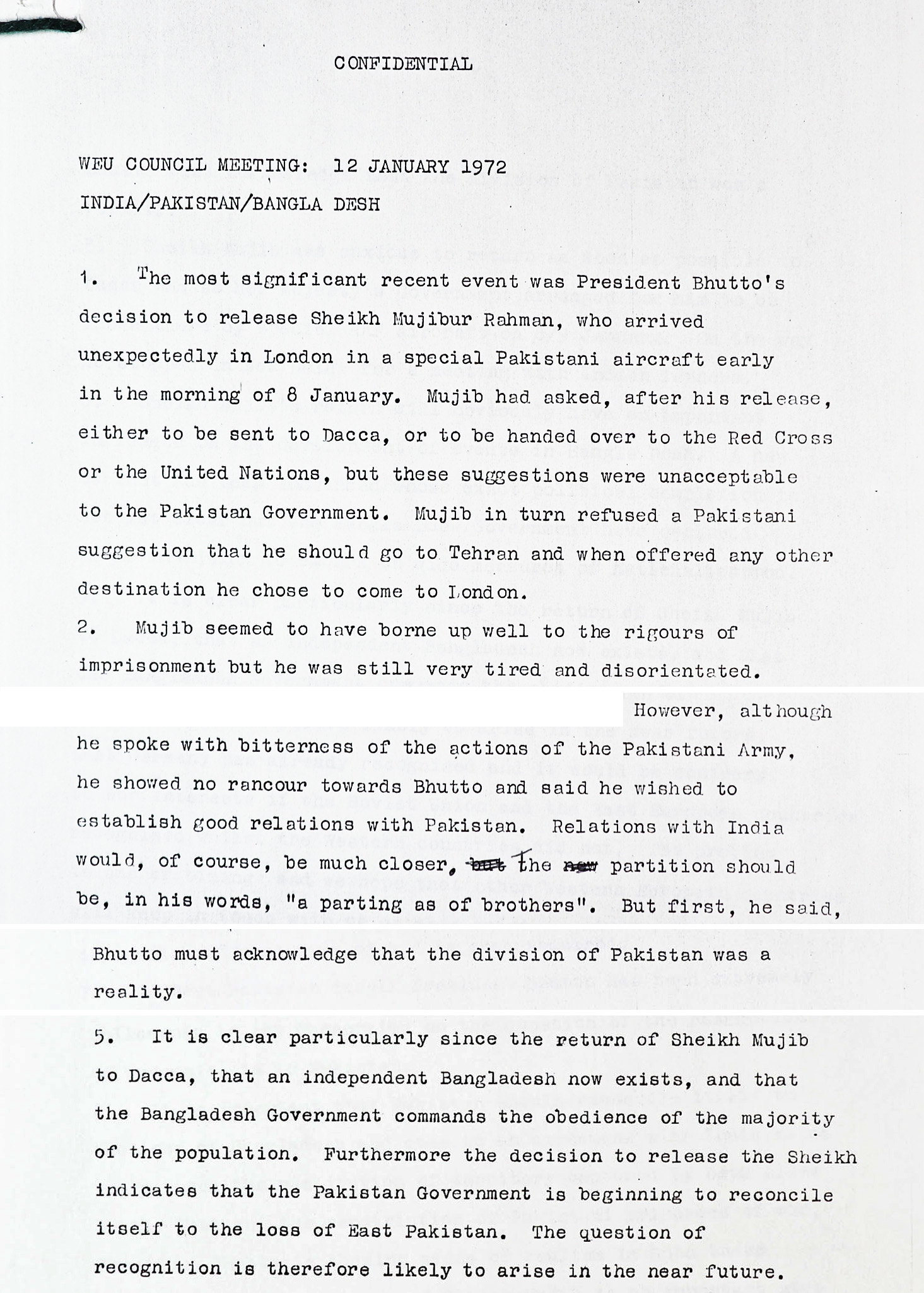
This report shows Sheikh Mujibur Rahman’s surprise appearance in London in January 1972 after being imprisoned by West Pakistan during the war.
WEU Council Meeting notes, 12 January 1972. Catalogue ref: FCO 37/1019
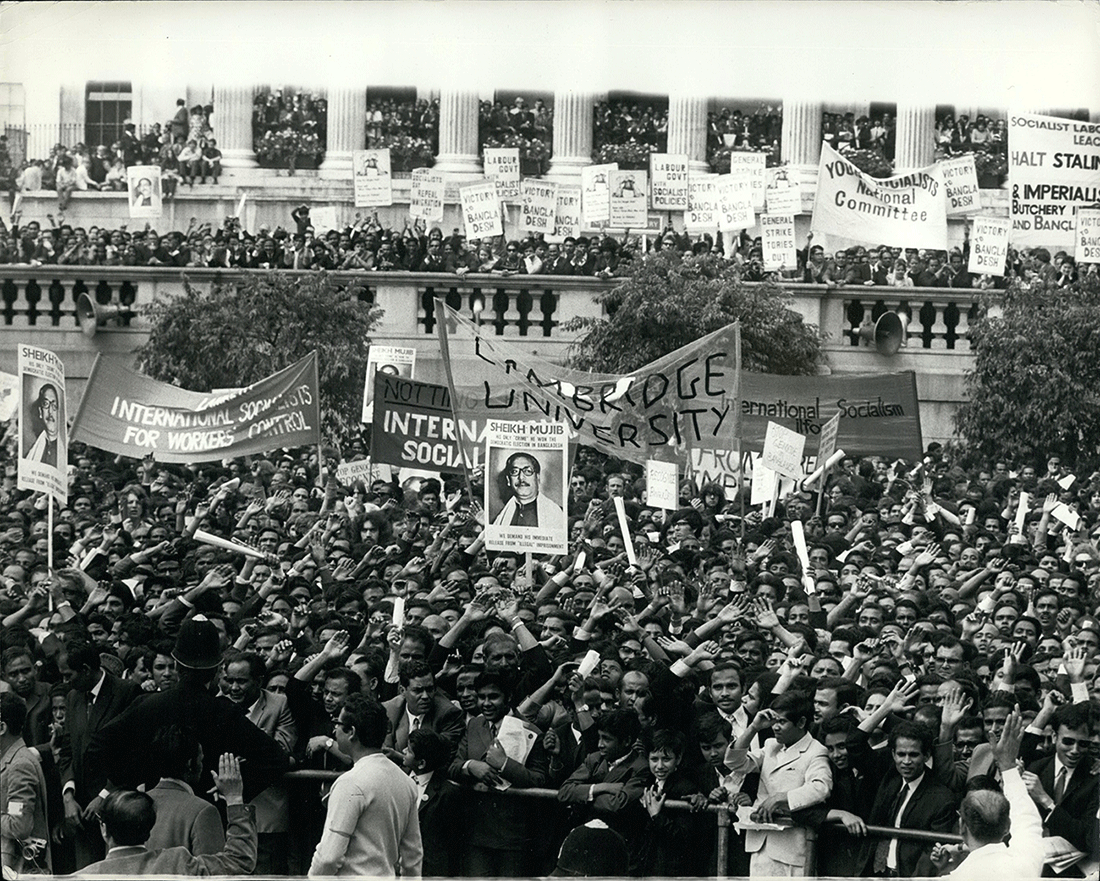
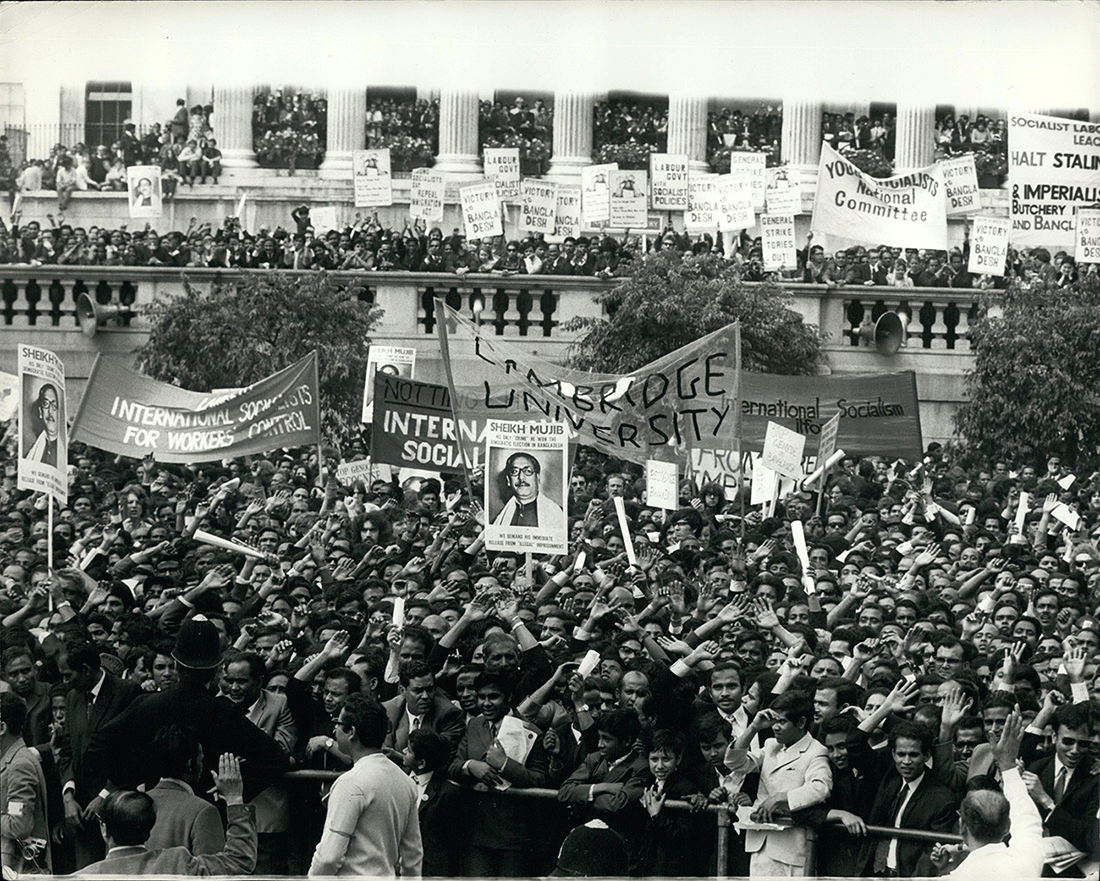
Source 5a is a photograph of the ‘Recognise Bangla-Desh Rally’ in Trafalgar Square, 8 August 1971. Source: Keystone Press/Alamy
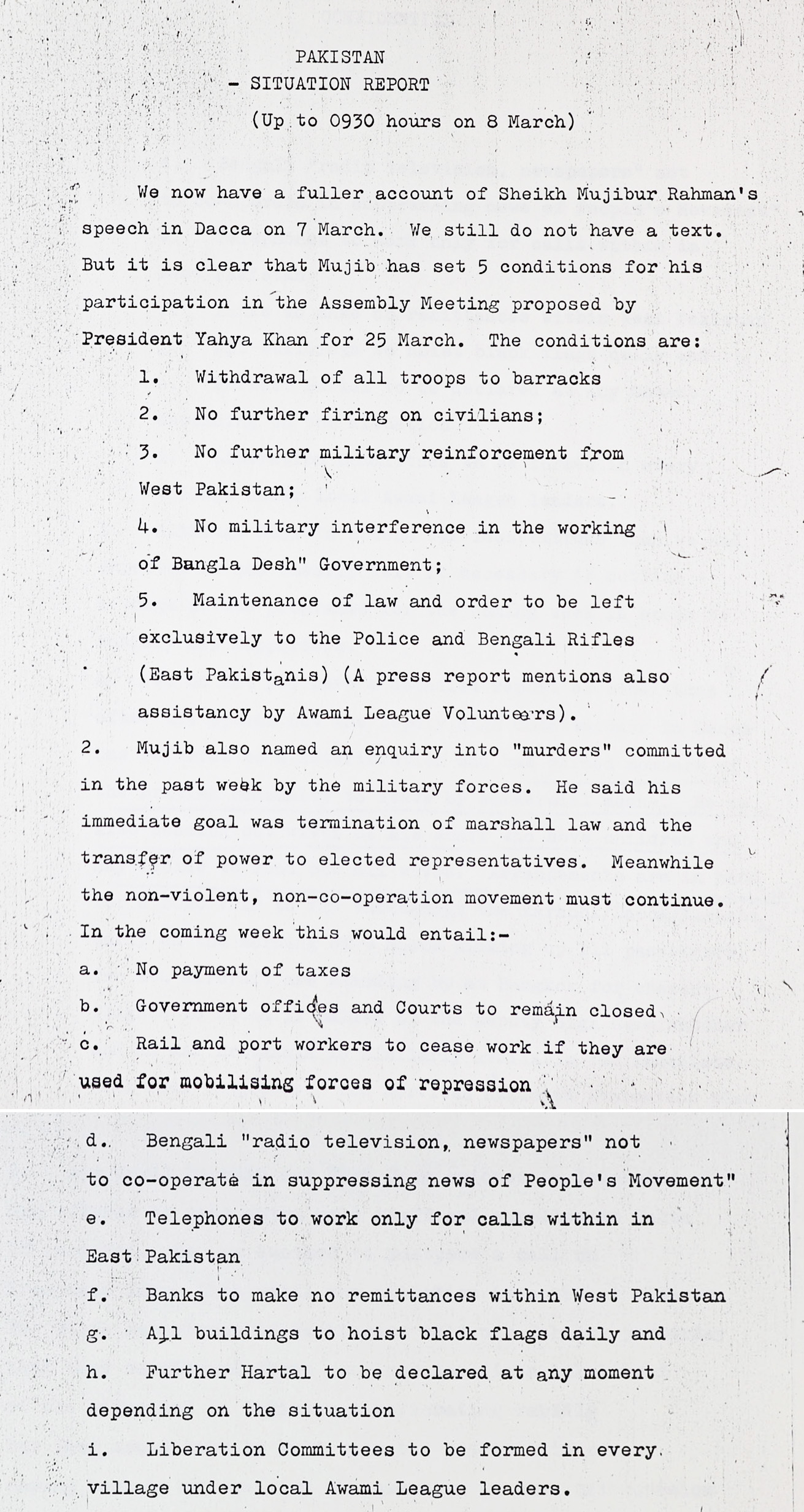
West Pakistan did not accept the 1970 election results (in which the Awami League, led by Sheikh Mujibur Rahman, won), leading to escalating protests in East Pakistan. On 7 March 1971, Sheikh Mujibur held a speech, reported on in source 4.
Pakistan situation report from the British government – up to 0930 hours on 8 March 1971. Catalogue ref: PREM 15/567
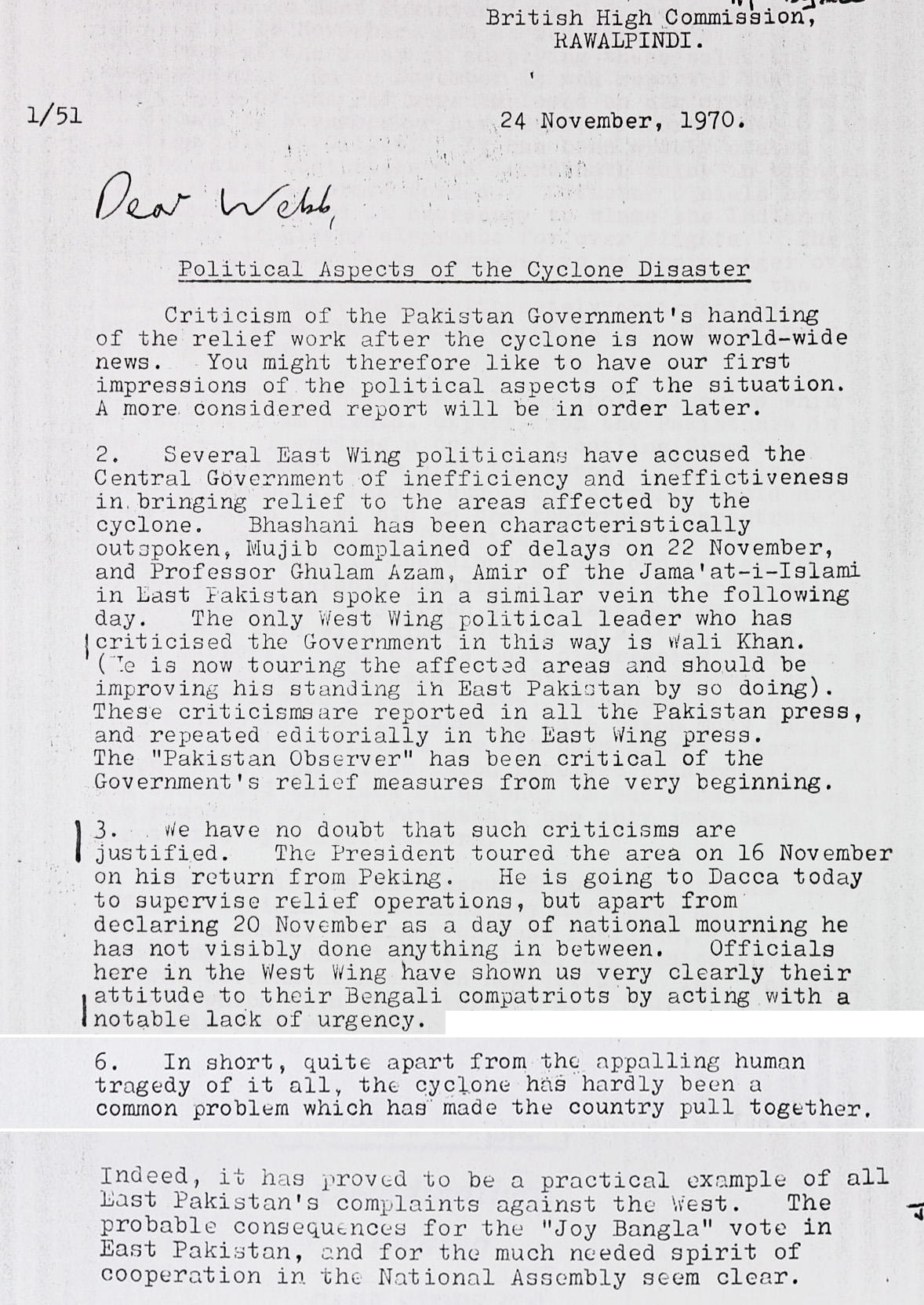
In 1970, the Bhola cyclone struck East Pakistan, killing an estimated 3-500,000 people. This is a British report on how the Pakistan government responded to the disaster.
Letter from the British High Commission in West Pakistan to the Foreign & Commonwealth Office. 24 November 1970. Catalogue ref: FCO 37/719
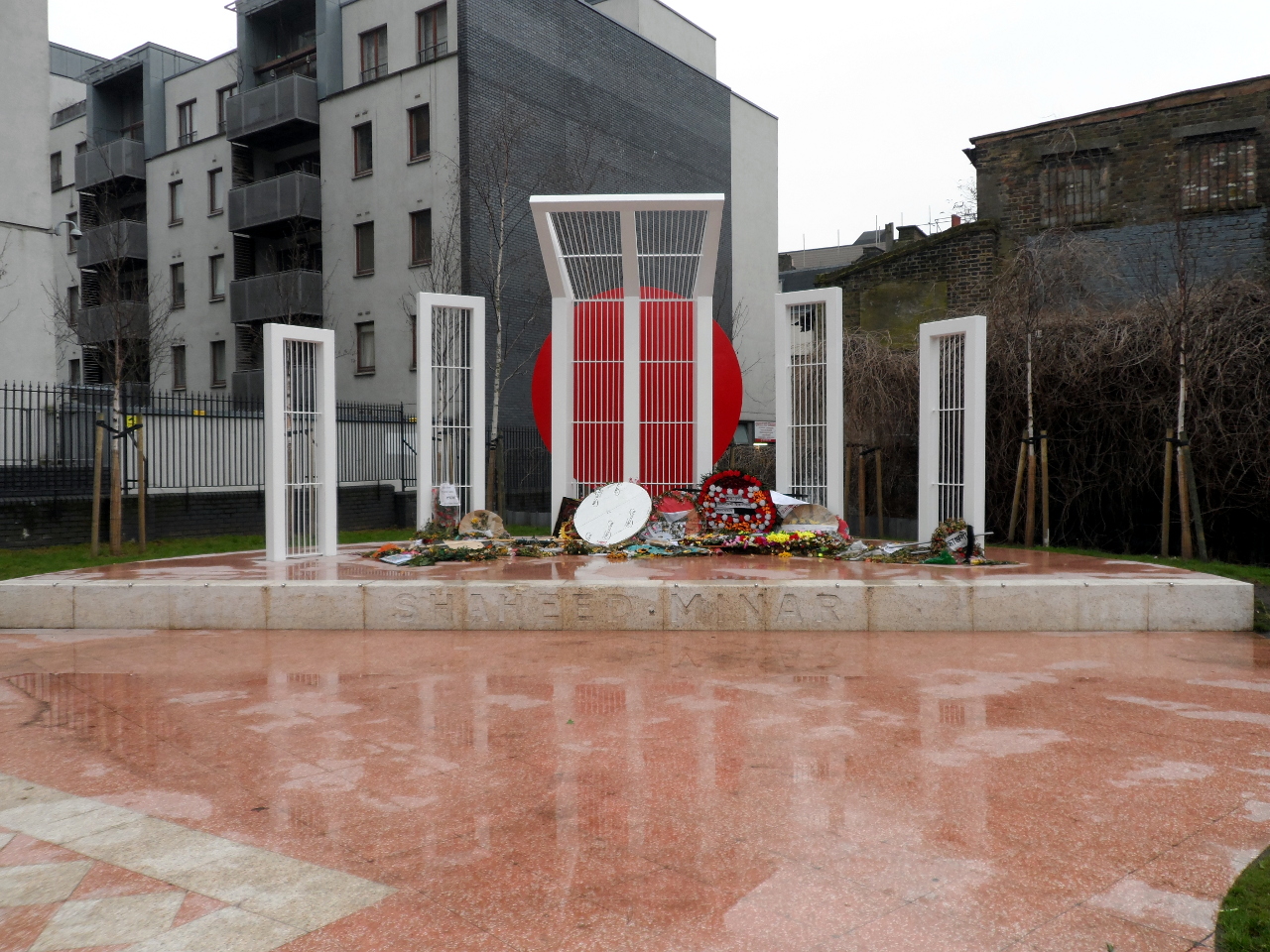
Source 2b is a photograph of the Shaheed Minar (martyrs’ monument) in Altab Ali Park in Whitechapel, London. It is a replica of the same monument in Dhaka, Bangladesh. Photo: Nicholas Jackson, CC BY-SA 3.0.

There are other monuments like this in the UK – try to find out if there’s one near you!
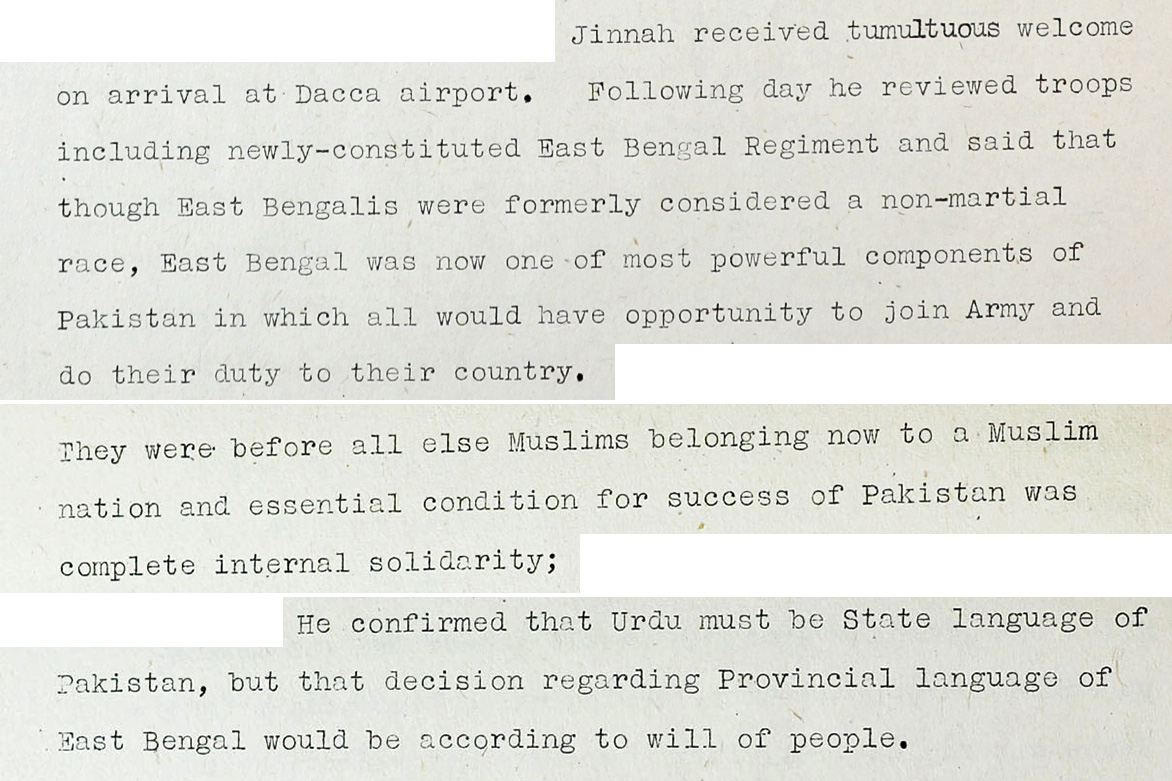
Source 2a describes the moment in 1948 when Urdu was confirmed to be the State language of both West and East Pakistan. This meant that all official business would be done in Urdu.
Report from the British government on the political situation in Pakistan, March 1948. Catalogue ref: DO 142/423
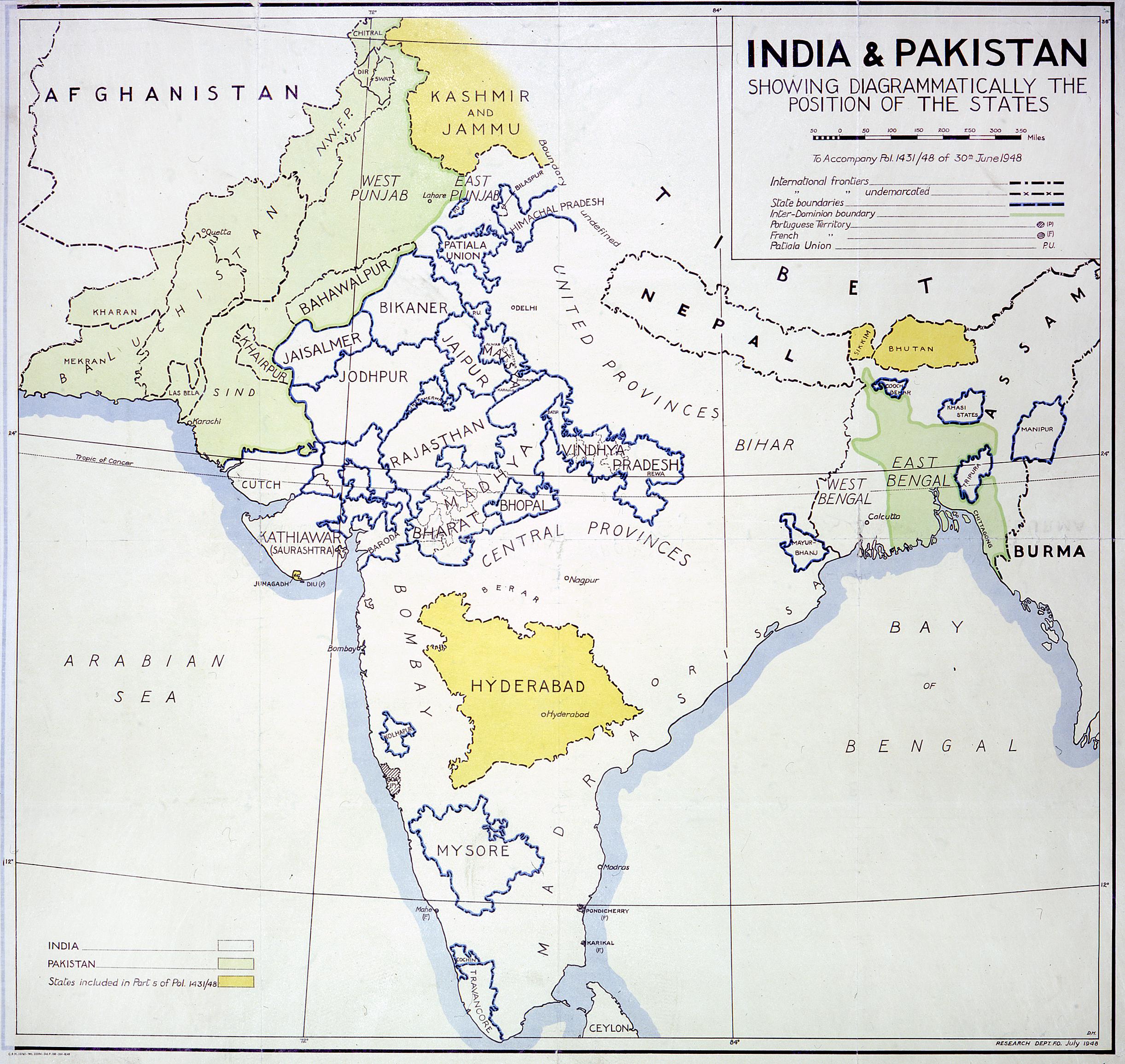
This map shows how British India was divided up after the 1947 partition: into India (majority non-Muslim) and Pakistan (majority Muslim).
India and Pakistan, showing States, and areas allocated to neither new country, 1948. Catalogue ref: MFQ 1/1145
‘British India’, also referred to as the ‘British Raj’ or ‘Direct rule in India’, was part of the British Empire from 1858 until independence in 1947. This independence process was called ‘partition’, because the colony was divided up into two countries: India and Pakistan.
Partition was not inevitable and happened because of long and complicated talks between the British government and elite Indian figures, each with their own political interests. The final borders of the new nations were created in only six weeks by Sir Cyril Radcliffe and were based on Muslim and non-Muslim majority areas. Learn more about partition here.
The new Pakistan was split into two regions that were more than 1,000 miles away: West Pakistan and East Pakistan (today’s Bangladesh). The distance and difference in culture, language, and identity between the two regions, and the fact that West Pakistan held more political and economic power, led to strong tensions and eventually protest movements in East Pakistan.
In 1971, West and East Pakistan fought in the Bangladesh Liberation War. This led to the creation of Bangladesh on 16 December 1971. How can we trace this road to independence through the British reports in The National Archives?
What can British documents tell us about the creation of Bangladesh?We can start the story of the 1971 Bangladesh Liberation War with the poorly planned and tragic ‘Partition’ of British India in 1947, based on religion. The separate north-eastern and north-western areas of the country, which were mostly Muslim, became a ‘united’ Pakistan. The rest of the country, mostly non-Muslim, became known as India. (See source 1: MFQ 1/1145.)
West and East Pakistan shared a religion, but not much else. For decades after Partition, the East Pakistanis (present-day Bangladeshis) were treated unfairly by the West Pakistani government over 1,000 miles away. East Pakistan had more people than West Pakistan but got less money and resources from the government. From the early 1950s, the amount of money earned per person in West Pakistan grew three times as much each year compared to East Pakistan.
In 1948, Urdu became the only state language of both West and East Pakistan (see source 2: DO 142/423). It was imposed on millions of Bengali-speaking people. This led to the rise of the Bengali Language Movement, resulting in mass protests and deaths in Dhaka in 1952.
Bengalis have a rich and proud history and culture focused around language, art, food, fashion, community, family and religion. The 1971 Liberation War can be seen as a struggle to preserve and protect this heritage.
A few key events leading up to 1971 sped up the start of the war:
- Cyclone Bhola in November 1970 devastated East Pakistan. Around 3-500,000 people were killed and many more made destitute. Relief efforts from West Pakistan were minimal (see source 3: FCO 37/719).
- Many East Pakistanis were feeling unhappy and resentful. This led to civil disobedience [refusal to obey the government] and the imposition of martial law [temporary rule by the military]. For many, these were uncertain and scary times.
- There was prejudice and violence between Bengalis and Urdu-speaking minorities (Biharis) in early March 1971.
Maybe the most important event leading up to the war was the 1970 election. The winning Awami League Party was led by Sheikh Mujibur Rahman, who wanted more freedom and independence for East Pakistan. He won the national elections by a clear majority, as East Pakistan had a much larger population than West Pakistan. However, the centralised government in West Pakistan did not accept Rahman as leader. They declared the election results void. This led to the famous and emotional ‘Joy Bangla’ (‘victory to Bengal’) speech by Rahman on 7 March 1971 at a rally attended by thousands, in which he declared an ‘independent’ Bangladesh (see source 4: PREM 15/567). He was later arrested. There were more and more protests by his supporters.
On 25 March 1971, the West Pakistani army invaded East Pakistan, trying to stop these protests. It launched Operation Searchlight, killing many Bengali civilians, intellectuals, students, politicians, and armed forces.
The brutal war that followed lasted for nine months. Estimates for the total number of civilian and military deaths range from 500,000 to over 3 million. Millions of refugees fled to neighbouring India. Groups of Bengali guerrilla fighters (‘mukti bahini’) and regular soldiers – helped by the Indian military – fought back against the West Pakistani army. West Pakistan eventually surrendered on the 16th of December 1971 (known as ‘Victory Day’), leading to the creation of Bangladesh.
You can see how complex the 1971 war was by looking at the many terms used to describe it: Bangladesh War of Independence, Liberation War, genocide, Civil War, or, by many Bangladeshis, ‘mukti juddho’/‘shongram’ (battle and resistance). The war has been immortalised in the symbolism of the national flag of Bangladesh – a dark green background with a red (bloody) circle in the middle.
Britain played an important role in bringing global attention to the war. During 1971, as members of the Commonwealth, many thousands of Bengalis were living and working in Britain. It was a harrowing time for many, as they were living far away and were worried about family and kin in East Pakistan. Foreign journalists were expelled from the region before the suppression started, so there was little international coverage of the events of 1971 (see Pakistani journalist Anthony Mascarenhas’ article ‘Genocide’ for a rare example). However, Bengalis in the UK raised funds to help the resistance. They organised peaceful campaigns and demonstrations to bring international attention to the war, such as the ‘Recognise Bangla-Desh Rally’ in Trafalgar Square on 8 August 1971, which drew thousands of people (see source 5a). The British government formally recognised Bangladesh as an independent nation on 4 February in 1972.
Background written by Dr Aminul Hoque MBE (Goldsmiths College, University of London)