
This is a petition sent to Philippa of Hainault by Jacques de Artevelde, burgess [townsman] of Ghent. 16 January [1343] Catalogue ref: SC 1/56/57

Medieval women’s lives were as varied as they are today, but unlike today, most women (and men) lived in the countryside and worked the land on what were known as manors, estates on which tenants rented their properties from the lord and often performed services for him at harvest time. Women can also be found living and working in towns and cities, or in religious communities. There were extremely rich and powerful women, such as queens and noblewomen, but there were also countless ordinary women, whose names we do not always know, who emerge from the archives.
Use this lesson to find out about their lives in medieval England and Ireland from records held at The National Archives.
What roles did women play in Medieval times?Women’s lives in medieval times were most often shaped by the family they were born into and their economic, social and legal position. One of the most important differences between women’s position today concerned the law. Medieval women were treated differently under the law to men depending on whether or not they were married. In medieval English law, an unmarried woman was under the authority of her father or brother, or another male relative, and they represented her in any court case, or business matter. A married woman and her husband were treated as one person legally, usually represented by the husband even when it related to his wife’s interests or property. However, a widow whose husband had died could act on her own and manage her own business and lands. Many medieval widows were socially very powerful because of this.
Women appear in the records alongside male relatives, by themselves and with other women. The most obvious examples of groups of women living and working together are in convents as nuns. Some convents were particularly known for education and their libraries, but most were quite small. The head of a convent, the abbess, managed the community and its finances. We also find women running businesses in towns, often after the deaths of their male relatives. Sometimes women might receive formal training as apprentices, but often their education was informal. Instead, they were expected to fit in any paid work they did around family life, usually for less money than men, although there are times in the sources when men and women received the same rate of pay.
Powerful women, including members of the nobility and royal family, managed large and complex households. They might be responsible for feeding and supplying
hundreds of individuals at any one time. These households would include servants, both men and women, as well as young women who were there as ladies-in-waiting to be educated in the ways of a large, busy organisation.
Many girls would have experienced a period of being sent away for their education, whether they were noble girls sent to other noble families, or peasant girls sent to another farm to learn there as servants. In family workshops in towns and cities, the wife of the head craftsman would probably be involved in teaching apprentices as well as working alongside male family members when needed.
Our word ‘spinster,’ meaning an unmarried woman, comes from spinning wool. This was a job that was generally done by women during ‘the Middle Ages’. Another largely female job was brewing ale, which most people drank rather than water because it was cleaner and safer. Ale might be made at home for a family or as a small business supplying neighbours. Women also appear in the archives as immigrants, moving to England either by themselves or with family members.

According to this Latin charter from the records of Alvingham Priory from the late twelfth century, Pupelina and her son from her first marriage, gave six acres of land nearby to an abbey in Lincolnshire. Catalogue ref: Bodleian Library MS Laud Misc. 642 folio 86r.
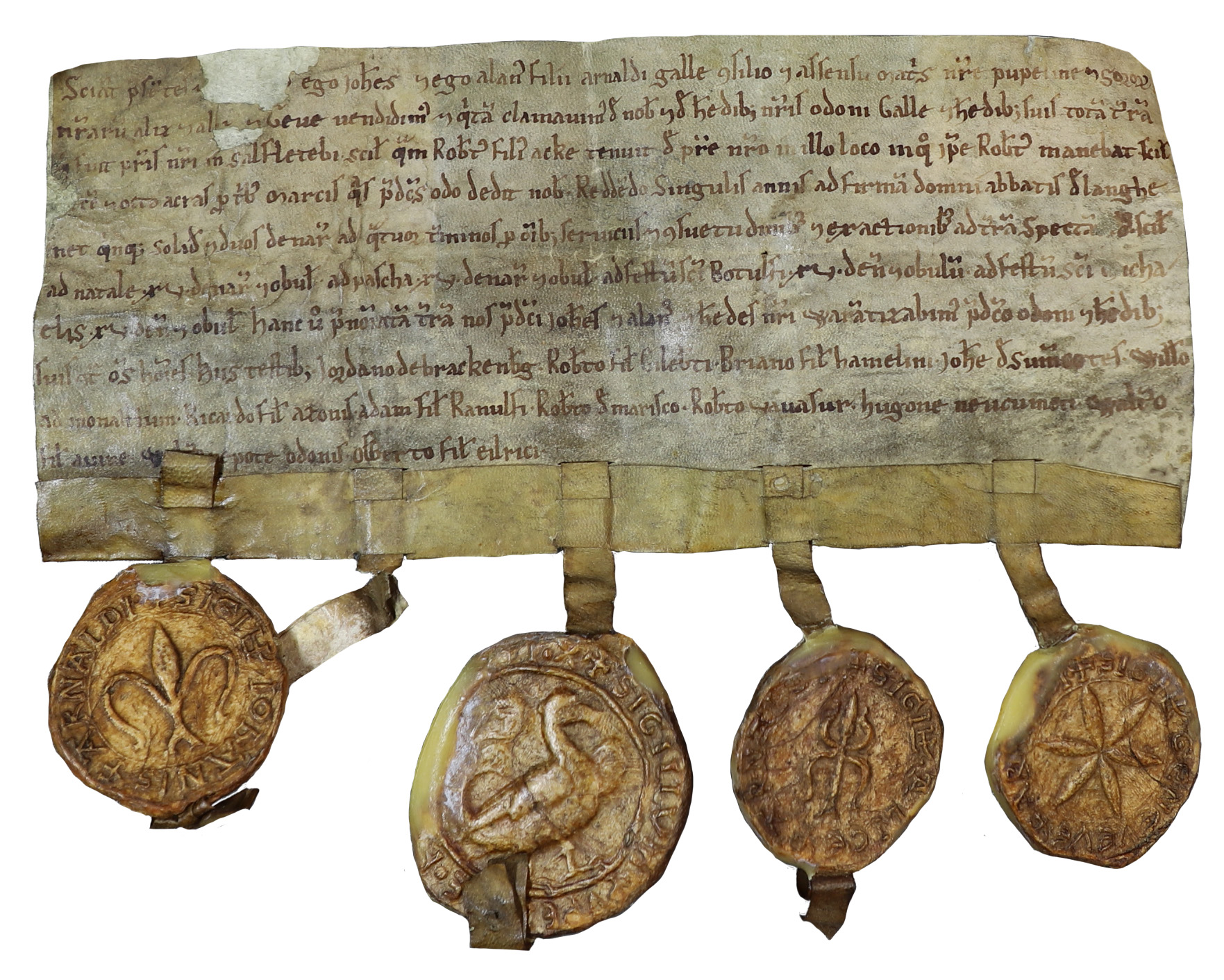
This document from the late 1100s concerns the sale of some family land with a mill on it in Lincolnshire. Catalogue ref: DL 25/2719
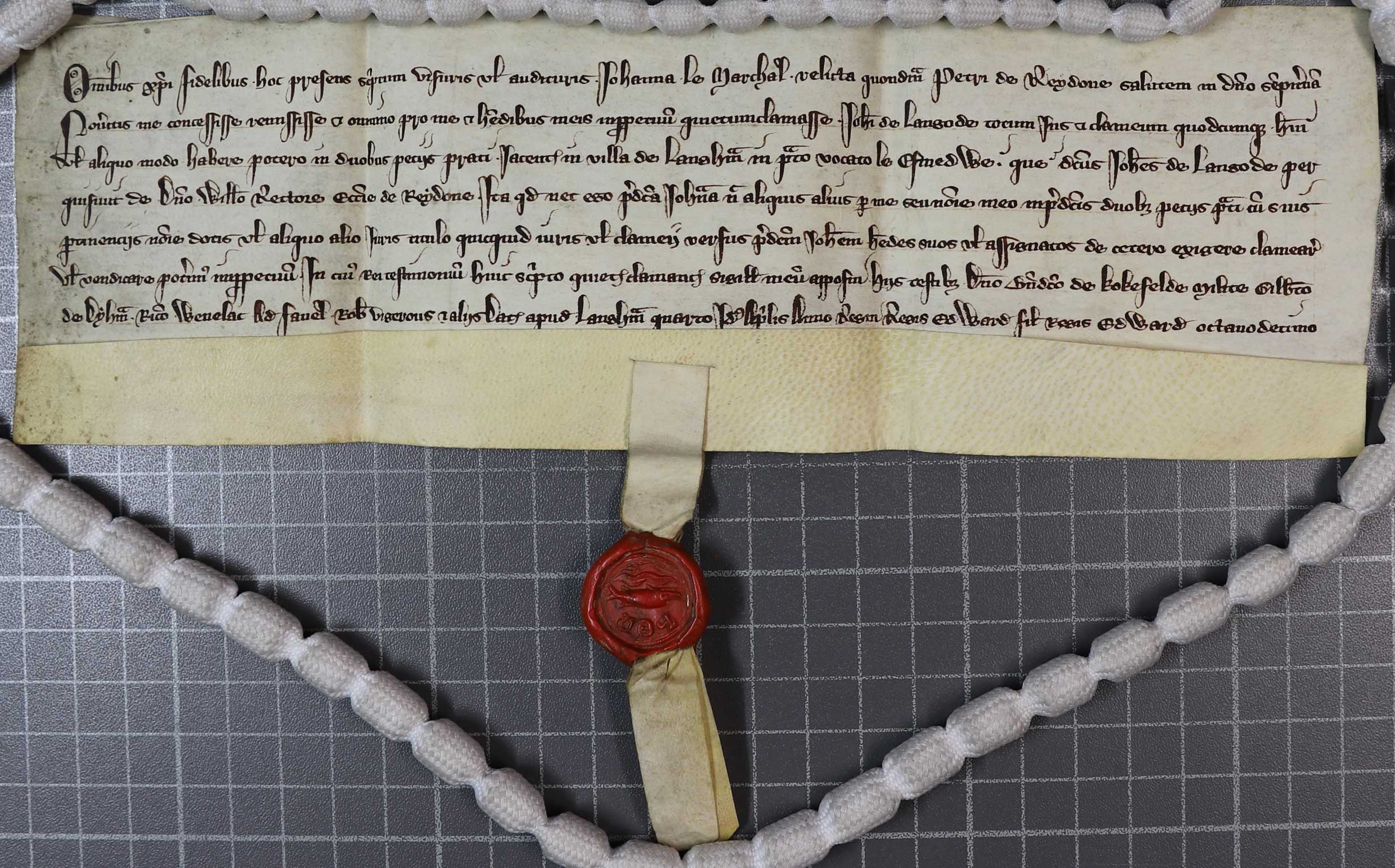
This deed or grant of land shows that it is genuine as Joan Marshal’s own seal with an image of a dolphin is attached to the document. Joan had some claim to part of a field called ‘the east field’ in Langham, Essex probably as part of her dowry, usually a third of her husband’s money and lands set aside for her to live on after his death, 10 April 1325. Catalogue ref: DL 25/1515.
From Conflict to Peace – 25 Years On
The National Archives has created a set of resources for use in secondary level school assemblies to mark the 25th anniversary of the signing of the Belfast or Good Friday Agreement which ended the conflict in Northern Ireland.
A 7-minute video gives an overview of the conflict and the peace process that brought it to an end, plus details about what the Agreement did and the results of it. This can be used as part of an assembly presentation which should take around 15-20 minutes depending on the amount of time allowed for discussion at the beginning about what students know already about Northern Ireland and the Agreement.
There are additional resources designed to embed knowledge about the Agreement and support student discussion about how it successfully brought an end to the violence and established a new era of peace in Northern Ireland.
Download the BGFA25 Resource Pack (.zip 277MB)
Or click the image below to watch the video on YouTube, then follow the activities below.
Belfast (Good Friday) Agreement Teaching Resources

Further to these assembly resources, you can now find our set of lesson resources for Key Stages Three, Four and Five. These lessons investigate the documents created in the process of the design and implementation of the Belfast (Good Friday) Agreement.
From Conflict to Peace - 25 Years OnHere is some additional information if you are interested in learning more about the historical background to Northern Ireland and its relationship to the United Kingdom and to Ireland.
British Rule in Ireland
England, and later Britain, ruled over part or all of the island of Ireland for nearly 800 years and during that time there had, to varying degrees, always been some form of resistance to that rule. This was either demonstrated through violence, or through politicians taking up issues in Parliament. In 1798 there was a major rebellion against British rule led by Wolfe Tone and the Society of United Irishmen. The rebellion was overthrown and the Irish Parliament in Dublin was closed down. Ireland was made a formal part of the United Kingdom of Great Britain and Ireland in 1801.
Home Rule for Ireland
By the late 19th Century there were two political viewpoints in Ireland. Irish nationalists, most of them from the majority Catholic population, tried to get Home Rule (or self-government) for Ireland, and this idea gained more and more support in Parliament and became a real possibility during the last decades of the 19th century. MPs in the Irish Parliamentary Party, led by Charles Stewart Parnell and later by John Redmond, had support from many in the British Liberal Party and two attempts at passing an Irish Home Rule Bill nearly succeeded in 1886 and 1893. At the same time there were militant nationalist groups known as republicans, such as the Irish Republican Brotherhood, who used violence to try and overthrow British rule.
There was also a large Protestant minority in Ireland, located largely in the north-eastern province of Ulster, who believed that Ireland should remain a part of the United Kingdom. These Unionists actively resisted calls for Home Rule, fearful that, as a Protestant minority, should Home Rule be granted, they would be ruled by a Catholic majority. Militant unionist groups known as loyalists also formed to use violence against the threat of Home Rule. Both sides reached the brink of civil war by 1914. Private armies known as the Irish Volunteers and Ulster Volunteers were prepared to fight for and against the idea of Home Rule for Ireland.
From Home Rule to War 1914-21
In 1914 the Third Irish Home Rule Bill was passed by Parliament, but its introduction was suspended because of the First World War. In 1916 there was an uprising in Dublin by militant Irish Nationalists who declared Ireland to be independent. The Easter Rising was put down but demands for independence continued. Sinn Fein, an Irish Nationalist party that demanded full independence from the U.K., won most of the Irish seats at the 1918 General Election. They declared Ireland to be an independent republic and established their own Parliament in Dublin in January 1919 and began to fight a war of independence against the British Army. Violence also broke out between republicans (militant nationalist) and loyalists (militant unionists) in the North. To try and stop Ireland breaking away the U.K. Parliament passed the Government of Ireland Act in 1920 to create separate parliaments for Northern Ireland and Southern Ireland, but the war continued until December 1921.
The Partition of Ireland 1922
In December 1921 Patrick Collins and Arthur Griffiths of Sinn Fein, negotiated a treaty with the U.K. government to end the war. It created the Irish Free State, which was a self-governing country within the British Empire and eventually it became the Republic of Ireland in 1949. However, 6 of the 9 counties in Ulster, which had Protestant majorities, had already elected The Parliament of Northern Ireland on 24th May 1921 and these six counties formed Northern Ireland and remained part of the United Kingdom. The three counties of Ulster that had Catholic majorities joined the Free State. Ireland was now partitioned but a large minority of the population in Northern Ireland were Catholic and retained their wish to be part of an independent Ireland.
Northern Ireland Before “The Troubles”
From 1921 until the 1960s Northern Ireland was relatively peaceful but tensions between the two communities remained. The Protestant Unionist community wanted to protect their traditions and ensure they maintained control of the government in Northern Ireland which was dominated by Unionists. The voting system was changed from proportional representation, so nationalists had less representation in the parliament and on local councils.
RUC police were mostly Protestant, and the Special Powers Act of 1922 allowed them to ban meetings, parades and newspapers that they considered dangerous. This law was used mainly against members of the Catholic Nationalist community.
Catholics also felt discriminated against in jobs, housing and education. Nationalists began to protest against their unfair treatment. When violence broke out between protestors and the police, this became the beginnings of “The Troubles”.
“The Troubles”
In the 30 years before the Agreement was signed, violence between the two communities grew and armed groups known as paramilitaries attacked each other and members of the police and army. Groups such as the Irish Republican Army, the IRA, wanted to force Northern Ireland to become united with the rest of Ireland, while those such as the Ulster Volunteer Force, the UVF, fought for it to remain part of the U.K. The government of the U.K. sent troops to try and maintain peace, but they became the focus for many attacks as their presence was seen as a form of repression. Over 3,500 people were killed, communities attacked and businesses continually damaged. Paramilitaries even sometimes attacked members of their own communities. Attempts to stop the fighting and find a peaceful solution were unsuccessful until 1998 with the signing of The Belfast (Good Friday) Agreement.
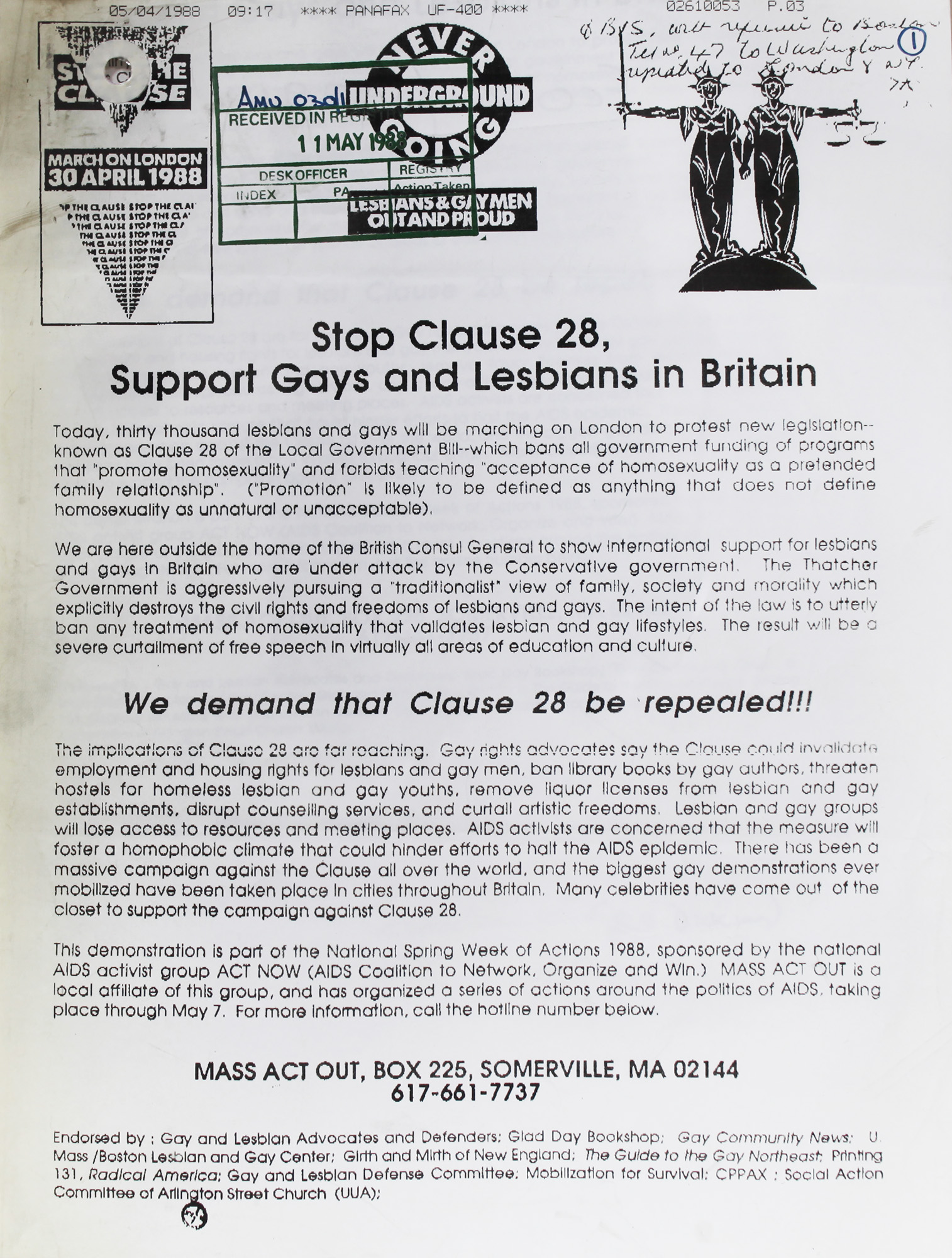
1988: Clause 28 protest leaflet. Catalogue ref: FCO 82/1979
Clause 28, or Section 28 of the Local Government Act, was a law introduced by Margaret Thatcher’s Conservative Government in 1988. It followed controversies about sex education and objections, mainly from Conservative MPs, about the championing of gay causes by Labour-led councils. LGBTQ+ people were becoming more confident and visible in the worlds of pop music, television and film, but there was still a great deal of prejudice present in the national discourse.
This law banned local authorities from ‘promoting homosexuality’. This meant for example that state schools and local councils could not teach about or discuss LGBTQ+-related topics.
Clause 28 was in place until 2003.