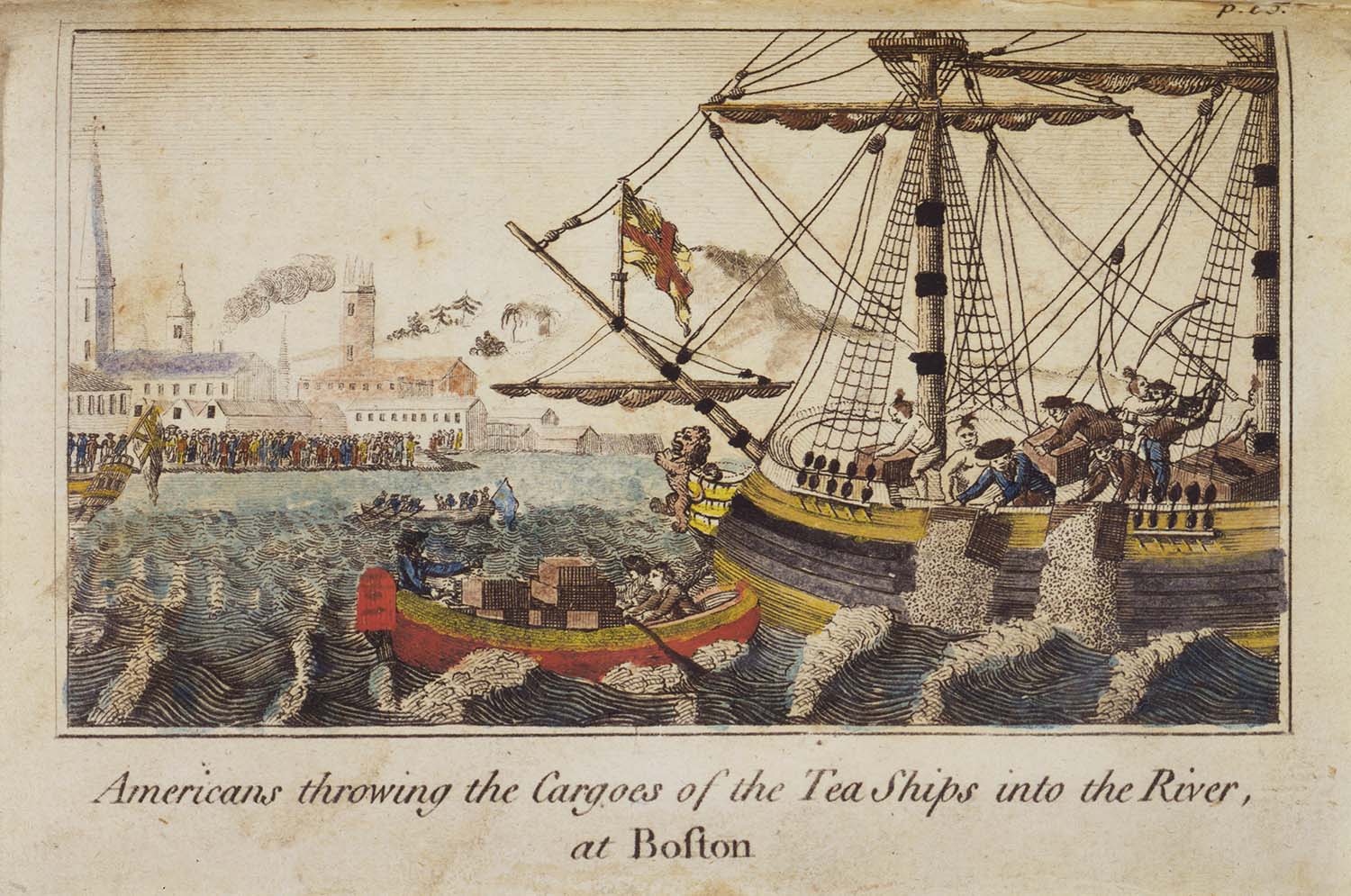
The Boston Tea party marked a critical moment in the history of the American Revolution as an act of colonial defiance against British rule. In Boston harbour, on 16 December 1773, British colonists, wearing disguises inspired by Mohawk clothing, boarded three tea ships and threw 340 chests of tea owned by the East India Company into the water. It was a protest about the tax on tea, levied without representation in the British Parliament and against the monopoly of the East India Company.
The earlier Townshend Acts placed duties on a range of imports to the colonies. These had been repealed; however, the tax on tea remained. A Tea Act was passed in the spring of 1773 to help the East India Company, which faced financial difficulties, and enabled its control of the trade in tea. To further assert its authority over the colonies, and in response to the Boston Tea Party, the British Parliament passed several acts known as the Coercive Acts. To the colonists, these became known as the Intolerable Acts and paved the way for further resistance and the American Revolution.
Use the documents in this lesson to explore context for the Boston Tea Party and see what some of the documents from the British side reveal about this event and beyond.
How was the 1773 Boston Tea Party significant for the American Revolution?On the night of 16 December 1773, 340 chests of tea were destroyed in Boston Harbour, an event that has gone down in history as the Boston Tea Party. This political and mercantile protest was one of the key events in the lead up to the American Revolutionary War and, ultimately, American independence.
Those involved in the protest were against the British tax on tea in the Americas and the monopoly of the East India Company on tea there, both expressed by the 1773 Tea Act.
Tensions regarding taxation in America had been rising since 1763, when Great Britain signed the Treaty of Paris, ending the Seven Years’ War and making Britain the dominant imperial power in North America. After this date, the British Parliament sought to tax their subjects in America to recover from a costly war with France and to better defend these colonies from future invasion.
However, doing so uncovered deeply opposing views regarding the way in which the North American colonies should be taxed. Parliament believed that they had the right to levy taxes upon all subjects within King George III’s dominions. British subjects living in America thought differently. They were not represented in the British Parliament, making decisions thousands of miles away about their livelihoods. They were not against paying taxes to the British Crown and believed that they should set those taxes.
Protests in America over the 1765 Stamp Act, which imposed a direct tax on almost every form of paper used in the colonies, showed that Americans would not back down over this issue. Parliament was forced to repeal the intolerable Stamp Act in March 1766. However, to ensure that they would be able to enforce laws and taxes on the colonies in future they enacted the 1766 Declaratory Act, which asserted the government’s right to pass laws in the colonies ‘in all cases whatsoever’.
In 1767 and 1768, Parliament enacted the Townshend Duties – named after the Chancellor of the Exchequer Charles Townshend – which proposed new taxes on all lead, glass, paint, and tea imported into the colonies. Again, Americans protested; in Boston, hundreds refused to purchase any of the taxed British imports. Following protests in Boston, George III authorised the dispatch of troops to the area to deal with this rising lawlessness. This ultimately resulted in bloodshed, when on 5 March 1770 nine British soldiers fired at a crowd of hundreds of Bostonians, resulting in the deaths of five American colonists. To ease tensions in America, all the Townshend Duties were repealed, except the one on tea. This meant that tea suddenly became a focus of protest in America. The Sons of Liberty and similar groups, initially established to protest the Stamp Act, encouraged Americans to avoid legally importing tea. This resistance led to a drop in demand for East India Company Tea. The fortunes of this British joint-stock company were closely tied to those of the British State, as they had taken out a significant loan from the Bank of England.
To save the Company, and to encourage the payment of tea duties in America, Parliament passed the 1773 Tea Act. This act allowed the East India Company to export tea directly to North America, without first going through London. As with the Stamp Act, many in America opposed this for validating Parliament’s right to directly tax American subjects.
Most American colonies simply protested this act by returning the tea to Britain. However, in Boston, Governor Thomas Hutchinson refused to let the ships leave the harbour, and those that opposed the Tea Act in the town refused to let the ships unload.
On 28 November 1773, a ship carrying East India Tea, the Dartmouth, arrived at Griffin’s Wharf in Boston. According to the Townshend Duty, if the tax was not paid within twenty days of the ship’s arrival, then the ship and its cargo was to be seized by the authorities. That meant that the people of Boston had until December 17 to decide what to do. Over the next few weeks, thousands of concerned citizens attended meetings organised by the Boston Committee of Correspondence and the Sons of Liberty, where they decided that the tea should be sent back. Meanwhile, two more ships of tea, the Eleanor, and the Beaver, arrived in Boston. However, Governor Hutchinson still refused to release the ships. On the night of December 16th, following another meeting where Governor Hutchinson had refused to budge, a group of people, some disguised as Mohawks, flocked to Griffin’s Wharf, boarded the three ships, and destroyed the entire shipment of tea.
News of the Boston Tea Party reached London in January 1774. In response, the British Government firstly tried to identify and prosecute the individuals involved. Once that failed, they instead passed a set of repressive acts, colloquially referred to in America as the Intolerable Acts, designed to punish the people of Boston and compel them to compensate the East India Company for the loss of their tea, and to send a message to other North American colonies of the consequences for protests such as the Boston Tea Party. These acts halted trade to Boston, brought Massachusetts under British governmental control, granted immunity to British soldiers and officials to criminal prosecution in the state, and required colonists to house British soldiers.
The Intolerable Acts only served to bring the American colonies together against Great Britain. In September 1774, representatives from twelve of the thirteen colonies assembled in Philadelphia for the First Continental Congress aimed to settle the concerns and frustrations of the Americans with the British King and Government before relations broke down even further.
The Suffolk Resolves, accepted by the congress on September 17th, encouraged the continued protest of the Intolerable Acts by stockpiling military supplies and boycotting British goods. The Declaration of Rights also developed at this congress, outlining the need for a rebellion if the Intolerable Acts were not repealed.
These attempts at a peaceful reconciliation failed, however, and in April 1775, less than eighteen months after the Boston Tea Party, American Patriot forces went to war with Great Britain.
On 4 July 1776, when the Thirteen United States of America declared independence from Great Britain, they referenced the Intolerable Acts – passed in response to the Boston Tea Party – when justifying their actions. They no longer wished to be subject to a king who obstructed the Administration of Justice, cut off their trade, and who imposed taxes on them without their consent.

Extract from a Cabinet meeting, 8 August 1972, Catalogue ref: CAB 128/50


Extracts from debate including comments made by Mr Timothy Raison M.P. (Aylesbury 1970 -1992), in the House of Commons about the Government’s handling of the Ugandan Asians expulsion on 6 December 1972. Catalogue ref: T353/27 f2
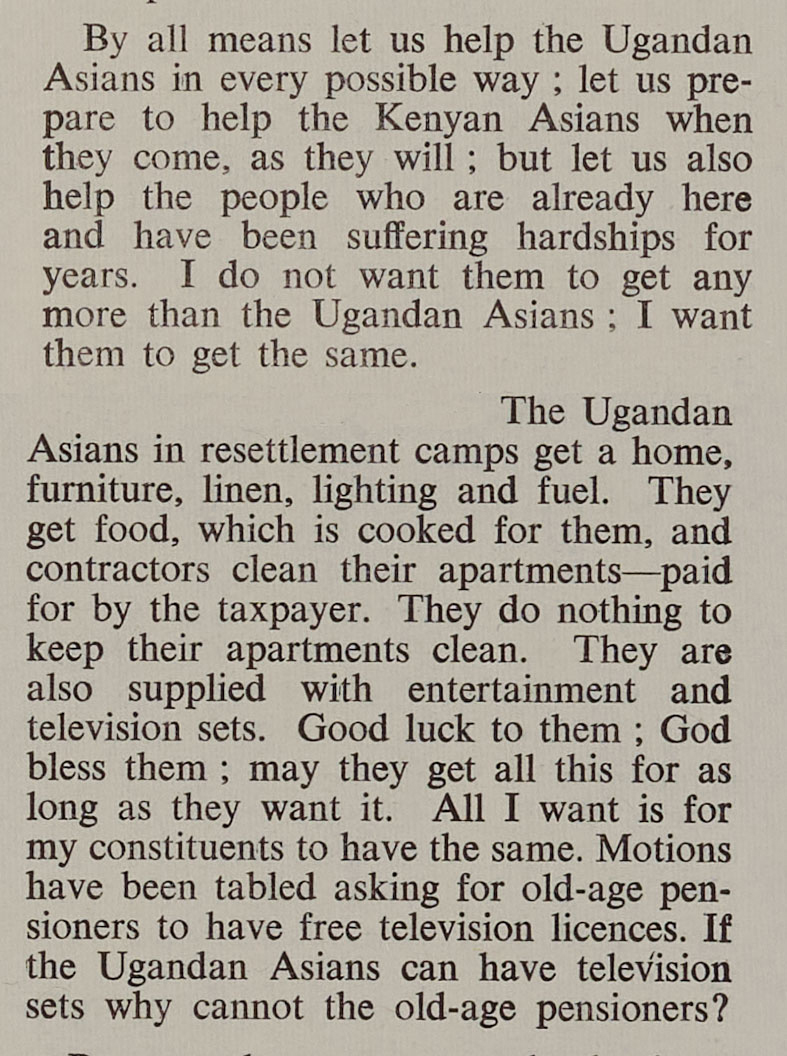
Extracts from debate including comments made by Arthur Lewis M.P. (West Ham North from 1950 to 1974.) in the House of Commons about the Government’s handling of the Ugandan Asians expulsion on 6 December 1972. Catalogue ref: T353/27 f6

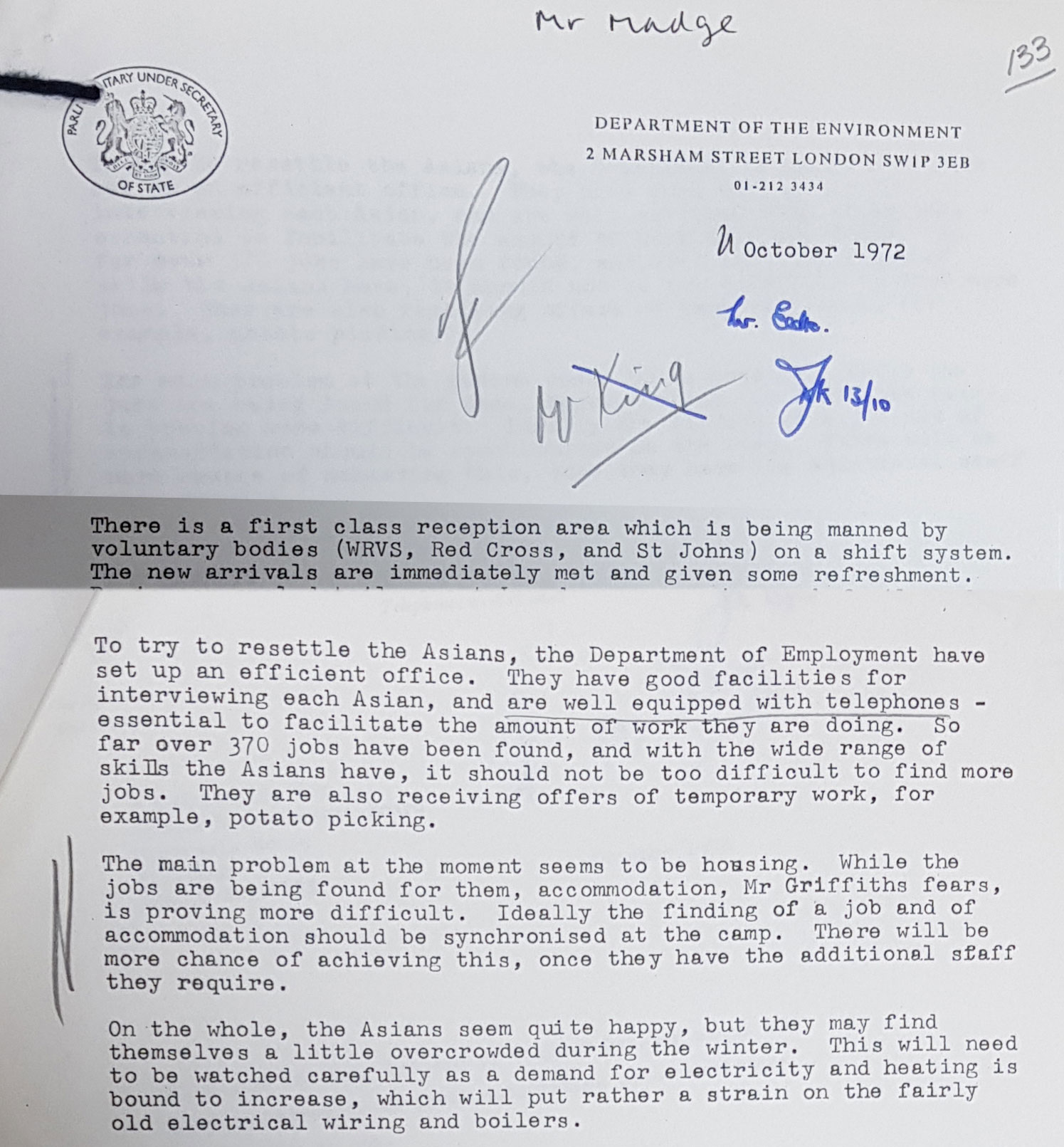
Extracts from a letter dated 11 October 1972, from the Department of Environment recounting the impressions of Minister Eldon Griffiths after a visit to Hemswell resettlement centre, Catalogue ref: HLG 118/2933.


Extracts from an article in The Times newspaper with photograph. It provides insight into the challenges faced by families separated, and information about the red and green settlement areas, 26 September 1973, Catalogue ref: T353/112

Extract from a letter from the Uganda Resettlement Board requesting addresses for Ugandan Asian families so that ‘life skills’ visits could be arranged by local voluntary groups, 15 March 1973, Catalogue ref: T353/63.