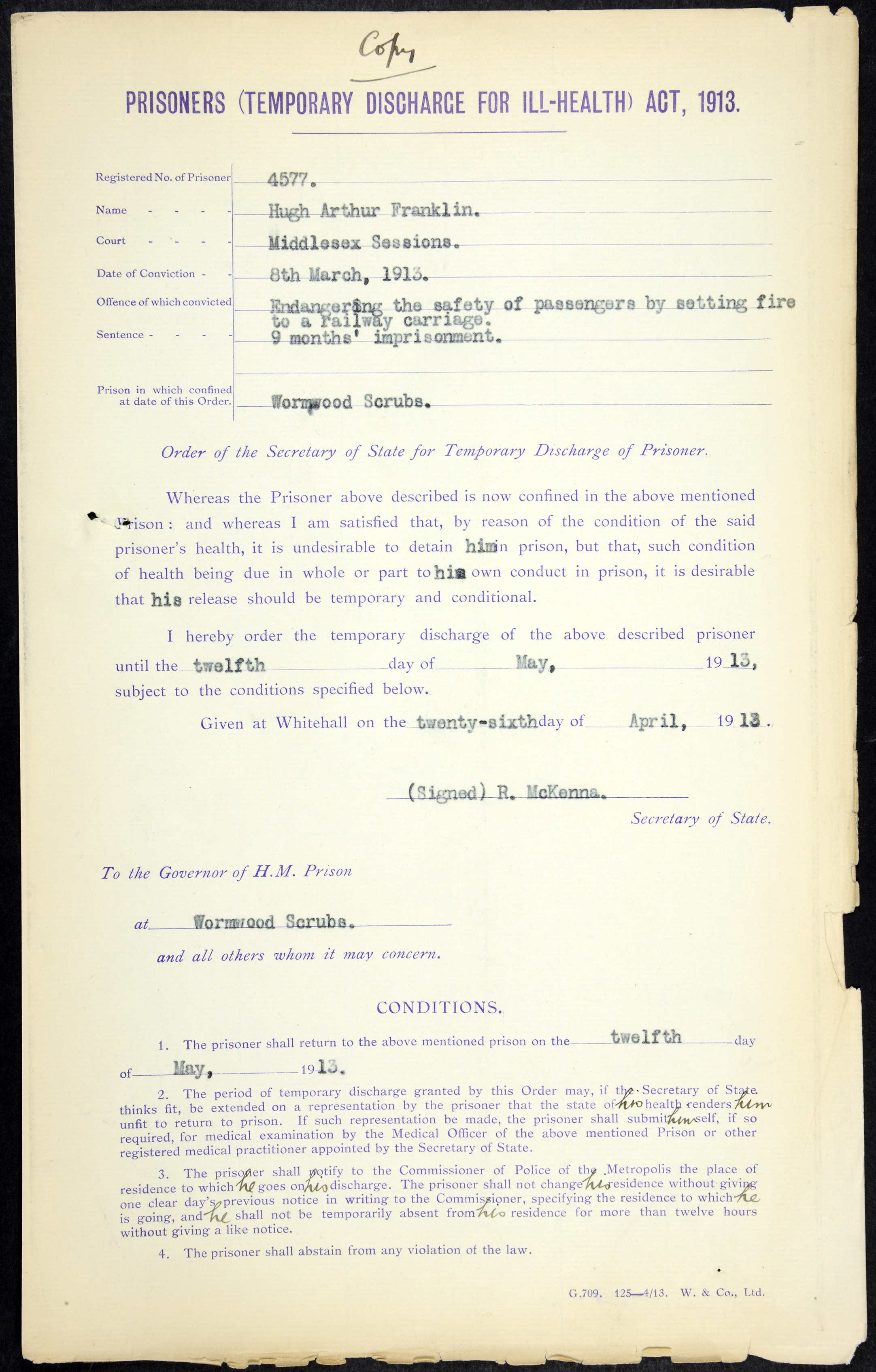
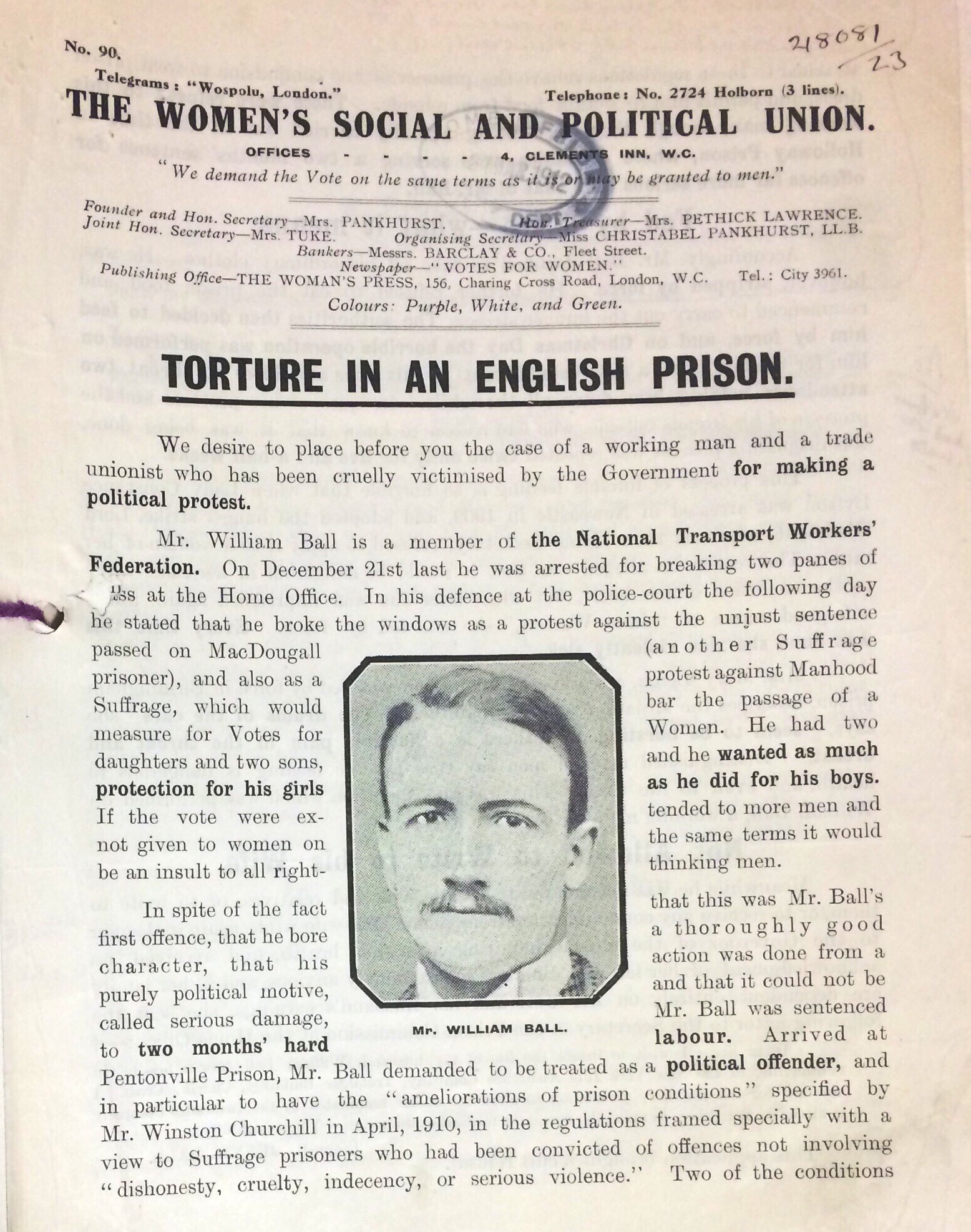
An extract from a warrant, a document giving a royal command. Catalogue ref: SP 15/28 f79
 Why did the Cold War emerge?
Who first coined the phrase “Cold War”? The general consensus among historians is that it was the celebrated author and journalist, George Orwell, in his essay ‘You and the Atom Bomb’ published in the Tribune magazine on 19 October 1945 (though one biographer has traced his use of the phrase back to 1943). In the 1945 article Orwell reflected on the repercussions of ‘a state which was at once unconquerable and in a permanent state of “Cold War” with its neighbours’. He envisaged ‘the prospect of two or three monstrous super-states’ dominating the world, and possessing weapons which can kill millions in seconds. Orwell concluded that the atomic bomb was likely ‘to put an end to large-scale wars at the cost of prolonging indefinitely a “peace that is no peace”.
Seeing into the future
Looking back at Orwell’s predictions, he possessed amazing foresight. The Cold War (1945-1991) was a confrontation, both military and ideological, between two superpowers, the capitalist United States and the communist Soviet Union (and their respective allies), made all the more tense by the threat of nuclear war. This highly charged stand-off was a thread running through historic developments such as the iron curtain, the Cuban missile crisis and the construction and dismantling of the Berlin Wall.
Because there was so much at stake – arguably, the very future of civilisation – the superpowers avoided direct confrontation but fought a series of savage proxy wars, in Asia, Africa and Latin America, supporting local factions. Orwell’s “peace that is no peace” prediction was borne out.
Revelations
Contemplating the Cold War from today’s perspective, one aspect cannot be predicted – the surprises that can emerge from documents you haven’t seen before. Many narratives are available for the Cold War: it is the subject of many books, documentaries and films. However, this package of documents from The National Archives shows us that archives still have the capacity to surprise us about this period in history. There are many instances of this. For example, it is well-known that Churchill’s famous quotation “from Stettin in the Baltic to Trieste in the Adriatic, an iron curtain has descended across the Continent” was part of a speech given in Fulton, Missouri, USA, on 5 March 1946. But did you know that he used the phrase ‘iron curtain’ almost a year earlier, in a personal telegram to President Truman on 12 May 1945? This is a heartfelt message in which Churchill expresses his ‘deep anxiety’ about Russian intentions in Eastern Europe.
Another surprise is a report by the Joint Planning Staff which puts forward a plan, (little known today) entitled ‘Operation Unthinkable’, advocating an attack on Soviet Forces in order to push them out of East Germany and Poland in July 1945. This document has real ‘shock value’: ‘If they [the Russians] want total war, they are in a position to have it’. The strident language of this document is striking: the intention was ‘to impose on Russia the will of the United States and the British Empire’. However, it is acknowledged that ‘to win would take us a very long time’.
Dramatic language is also a feature of a report called ‘The Threat to Western Civilisation’ from the Foreign Secretary to the British Cabinet in March 1948. This refers to the possibilities of the Soviet Union establishing a ‘world dictatorship’ or the ‘collapse of organised society over great stretches of the globe’. The writing style is so powerful, the words leap from the page. Yet another example of vivid writing can be seen in a Foreign Office telegram reporting back to London about the uprising in Hungary on 25 October 1956: ‘the populace are terrified of massive reprisals’.
In some cases, document content is not dramatic in itself but is, none the less, surprising. A great example of this is the last paragraph of Atomic Spy Klaus Fuch’s confession on 27 January 1950, when he suddenly begins to ‘wax lyrical’ about his admiration for English people: ‘since coming to Harwell I have met English people of all kinds, and I have come to see in many of them a deep rooted firmness which enables them to lead a decent way of life. I do not know where this springs from and I don’t think they do, but it is there’. This incongruous piece of reflectiveness at the end of a confession statement shows how Fuchs was somewhat detached from reality at the time he made it – the does not seem to realise the import of what he had just confessed to, the giving of vital atomic secrets to the Soviet Union.
As well as the textual documents, visual sources can also tell a powerful story. Grainy black and white photographs of the early days of the construction of the Berlin Wall make us reflect on the predicament of Berliners, looking on at the partially constructed wall, the barbed wire, the turrets, and the ‘death strip’. For another striking example of visual material, see the illustrations in the leaflet advising householders on protection against nuclear attack (1963), which are strangely cosy, hinting at elements of normality even during fall-out conditions.
Value of archives
The National Archives is the nation’s memory – we preserve the integrity of the public records, stretching back some 1,000 years. George Orwell truly understood the value of authoritative records: Winston Smith, the anti-hero of Orwell’s 1984, worked in the ‘Ministry of Truth’, falsifying back-numbers of The Times so that the information contained in them corresponded with the current pronouncements of Big Brother’s regime. The corollary of this imagined scenario, of course, is that archives you can trust are essential for a true understanding of the past.
Mark Dunton
Principal Records Specialist
The National Archives
Holding History is a stop motion animated film created by students during a week-long workshop at The National Archives. The film was designed to highlight key historical stories from within our collection and covers a variety of time periods and themes. Many thanks to the Friends of The National Archives for their support on this project.
When making the film, students were asked to consider:
What is The National Archives? How has it changed and developed over the centuries? And what are the challenges, threats and importance of an archive in today’s world?
Each student was then given a specific story to research within our records before they could storyboard, design, create and capture their stop motion sets.
These finished film clips can now be used by teachers and students as brief overviews, introductions or interest points for the various topics explored within the film. These accompanying questions are designed to work alongside the film clip, to guide students in thinking about what they have learned from the clip or from their lessons and previous knowledge. Some questions can be answered from the film itself, others are intended to be answered after class discussion or independent thought.
The clips can also work as a model for student’s creative exploration of history, allowing students to see what can be done to tell stories from history and inspire their own creative work – either through animation, drawing, storytelling or other creative exploits.
NOTE TO STUDENTS
You will need to listen to the narrator of the film clip to answer some of these questions. Other questions require you to study images included within the film clip or require your own ideas and opinions based on your own knowledge.
Read through the questions before you view the clip.
You can now view the video in full here, or download our lesson pack complete with questions and clips using the button above.
What is 'The National Archives'?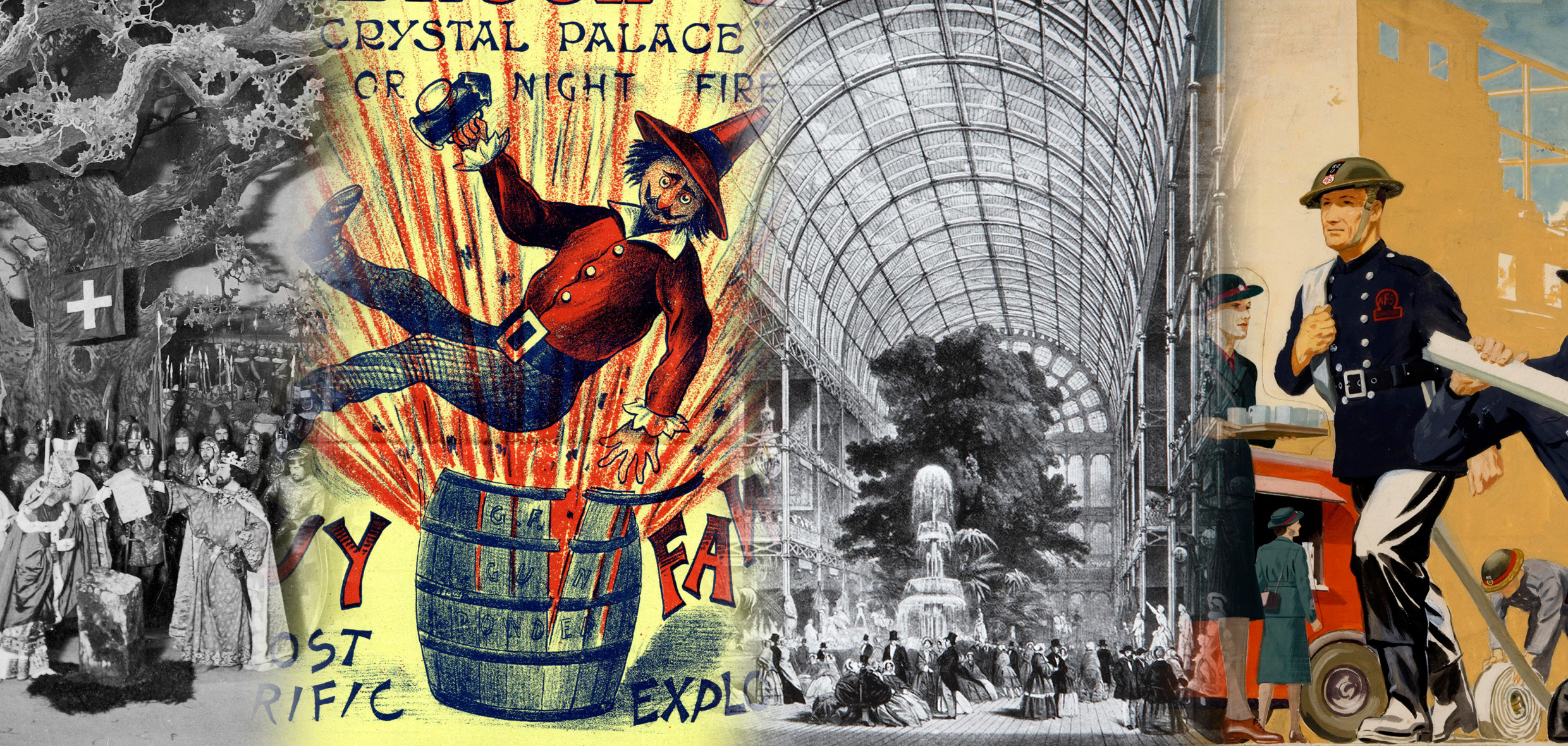 What happened then?
From the sealing of Magna Carta, the coming of the Armada, the Great Fire of London, a Christmas ceasefire on the Western Front in 1914 to Decimalisation in 1971, this selection of sources, based on records held at The National Archives, can be used in the primary classroom to support the National Curriculum element ‘significant events’ beyond living memory. The collection is by no means exhaustive, but contains some of the popular choices and other suggestions for teaching this topic. We hope to add to the collection over time. In addition, we have provided links to other useful resources for ‘significant’ events.
The sources can be used within any scheme of work which is based on developing a sense of chronology where pupils can see that a particular ‘significant event’ fits into a time frame. Again working with sources in this way will help pupils to register similarities and differences between aspects of life between periods, for example comparing the Great Exhibition of 1851 with the Festival of Britain in 1951. Other ‘events’ sources can be used to consider questions of what we are remembering and why? Have things always been the same? Why have some things changed?
 Who is who?
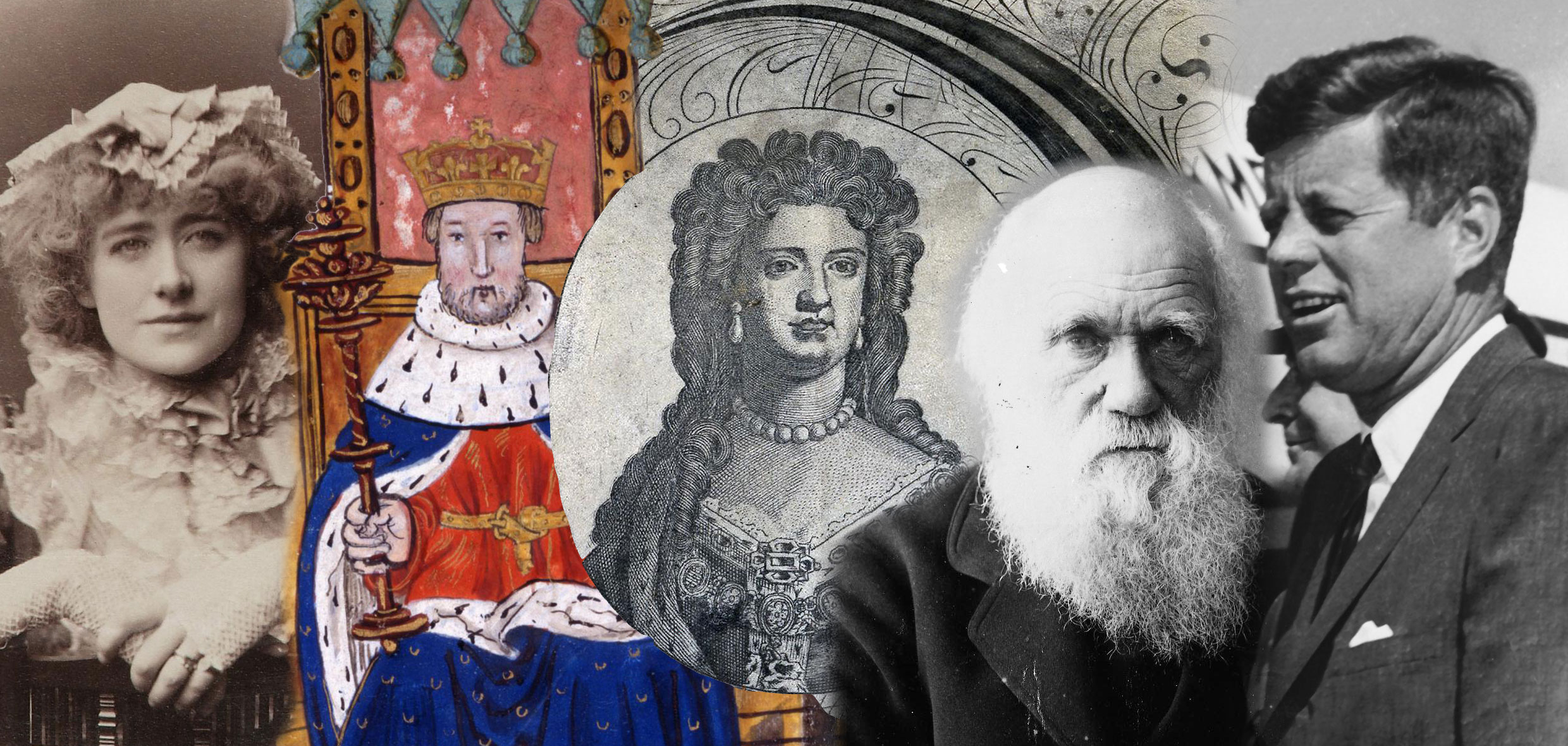
From writers to royals, politicians, artists, inventors or campaigners, this selection of sources, based on records held at The National Archives, can be used in the primary classroom to support the National Curriculum element ‘significant individuals’ who have contributed to national or international achievements. The collection is by no means exhaustive but contains some of the popular choices and more for teaching this topic. We hope to add to the collection over time. In addition, we have provided links to other useful resources for ‘significant’ figures.
The sources can be used within any scheme of work which is based on developing a sense of chronology where pupils can see that a particular ‘significant individual’ fits into a time frame. Again working with sources in this way will help pupils to register similarities and differences between aspects of life between periods, for example comparing Queen Anne to Queen Victoria or Florence Nightingale to Edith Cavell. Other ‘people’ sources can be used to consider questions of what we are remembering and why? Have things always been the same? Why have some things changed?
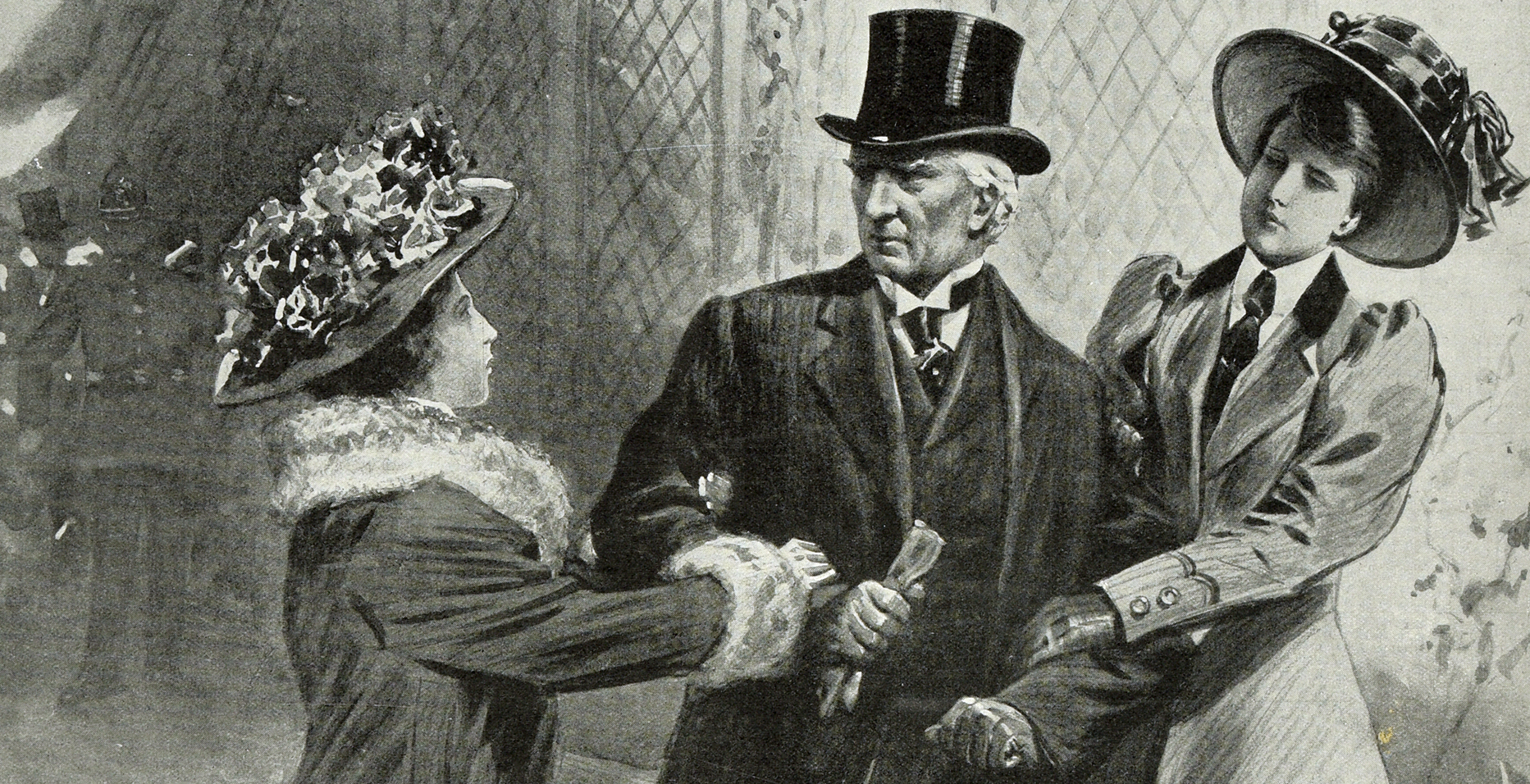
While the fight for votes for women has been long been regarded as a movement led and supported by women, it is important to recognize that men participated in the struggle, both in and outside Parliament.
Also, men’s suffrage societies contributed to the general campaign with the Men’s League for Women’s Suffrage (1907) and The Men’s Political Union for Women’s Enfranchisement (1910).
With the coming of the First World War the National Union of Women’s Suffrage Societies and Women’s Social and Political Union called off their fight for enfranchisement.
In 1918, women were given limited voting rights with the Representation of the People Act. Universal suffrage, that is, the vote for men and women on equal terms, was finally achieved with the Equal Franchise Act in 1928 when all men and women were given the vote at 21 years. In 1969 the voting age for men and women was lowered to 18.
Use the sources in this lesson to investigate the role played by male supporters, or ‘suffragettes in trousers’ during the campaign for votes for women.
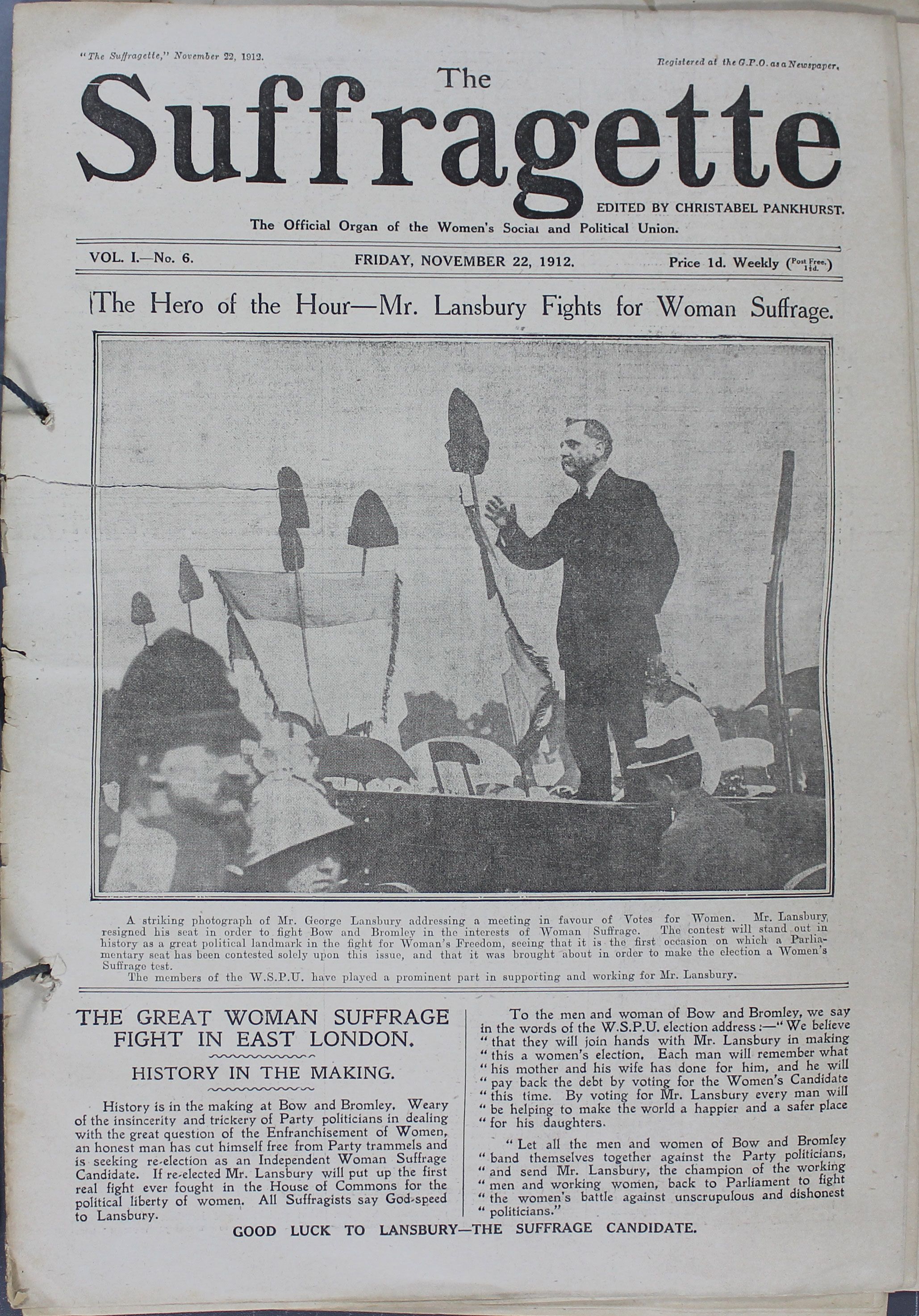
How did men support votes for women?In the nineteenth century, John Stuart Mill had presented an amendment to the Second Reform Bill in 1866 to include votes for women when the issue of the franchise was aired. Henry Fawcett, reformer of the Post Office, was also a keen supporter of the suffrage movement. He worked with his wife Millicent on her campaigns with the National Union of Women’s Suffrage Societies and provided financial backing. Similarly, barrister Frederick Pethick-Lawrence worked with his wife Emmeline, leading suffragette campaigner and publicist. Labour M.P. Kier Hardie often raised the issue in the House of Commons and fellow member George Lansbury resigned his seat in 1912 so that he could fight a by-election on the suffrage question, although he did not regain his seat until 1922. He served time in prison for making speeches in support of members of the Women’s Social and Political Union who committed criminal acts. Whilst serving time in Pentonville Prison he went on hunger strike.
Other high profile male supporters included philosopher Bertrand Russell- who had stood at the Wimbledon by-election in the 1907 on the votes for women ticket. In his campaign pamphlet he said: “I consider that the exclusion of women from direct political action is unjust and inexpedient, and that no reason exists for prolonging this exclusion. If elected I should urge the claims of women to enfranchisement at every opportunity.” He argued in an article entitled Liberalism and Women’s Suffrage (1908) that “it is plain that no man can call himself truly a democrat if he is in favour of excluding half the nation from all participation in public affairs”.
Dr Richard Pankhurst, in 1883 had stood as an Independent candidate for a by-election in Manchester for universal adult suffrage. Later he concentrated on the struggle for women’s rights and in 1889 helped form the Women’s Franchise League with his wife Emmeline. The organisation’s main objective was to secure the vote for women in local elections.
Victor Storr and Thomas Bayard Simmonds started a series protests in Parliament later called the ‘Grille Protest’, vividly described in the London Illustrated News at the time. From the public gallery they called for justice for women and showered the M.P.s below with suffrage leaflets. As part of this coordinated protest, some women chained themselves to the metal grille which concealed them from the chamber, Some men called for the protection of women at public meetings and spoke out against the brutality of their treatment by the authorities. Others were ridiculed or forcibly removed from political meetings for protesting against the exclusion of women from the franchise.
Support for the female franchise also came from male writers such as E.M. Foster, H.G. Wells, George Bernard Shaw, Thomas Hardy and the economist John Maynard Keynes. Henry Selfridge also supported votes for women, there must have been some self-interest here in wanting to secure the female market for his department store, but nevertheless he promoted the Women’s Social and Political Union with a flag on the building and advertised in the suffragette paper Votes for Women and used the suffragette colours in his department store’s windows.
Of course the campaign was not just supported by those men who had the advantage of making themselves heard through access to political power, money or privilege. There were ordinary working class and middle class men who wanted the vote for their female relatives and friends. There were whole suffrage families that showed shared commitment to the cause. Documentary evidence exists for men going on hunger strike, publishing suffragette campaign material and supporting pressure groups such as The Men’s League for Women’s Suffrage (1907) and The Men’s Political Union for Women’s Enfranchisement (1910) founded by Victor Duval who in the same year published a pamphlet entitled An Appeal to Men. Duval prior this had been active supporter of The Women’s Social and Political Union and the Women’s Freedom League. He was also charged in July, 1909 for “Aiding and abetting Marion Wallace Dunlop, in wilful and malicious damage to the stone work of St. Stephen’s Hall, House of Commons, by stamping it with an indelible rubber stamp, to the value of ten shillings.”
Men’s Committee for Justice to Women was founded in 1909 after the Women’s Freedom League deputation to parliament was arrested and imprisoned. The Committee watched cases where women were prosecuted for suffrage protests. Albert Dawson was its chairman. One of their petitions is included as a source for this this lesson.
According to Israel Zangwill, member of The Men’s League for Women’s Suffrage, “the petticoat no longer makes the Suffragette. We are suffragettes – suffragettes in trousers.” The men who set up and joined these pressure groups wanted to use their position as voters to secure the vote for women. However, there were differences between the organisations. The Men’s League favoured a more legalistic approach and discussed the ethical arguments in favour of votes for women. The Men’s Political Union, formed later, favoured more direct action. Another organisation, founded by Mrs Arncliffe-Sennett in 1913, was The Northern Men’s Federation for Women’s Suffrage and sent a delegation of Scotsmen to meet the Liberal Prime Minister, Herbert Henry Asquith. Some suffrage societies allowed men to be members; the Women’s Social and Political Union however, did not.
The Representation of the People Act passed in 1918 did not give all women the right to vote. Only those aged 30 or over and were home owners could vote. This meant that a further 8.4 million women attained the right but working class women did not get the right to the ballot. Full suffrage for all women over the age of 21, on equal terms as men, was granted ten years later with the Second Representation of the People’s Act in 1928.
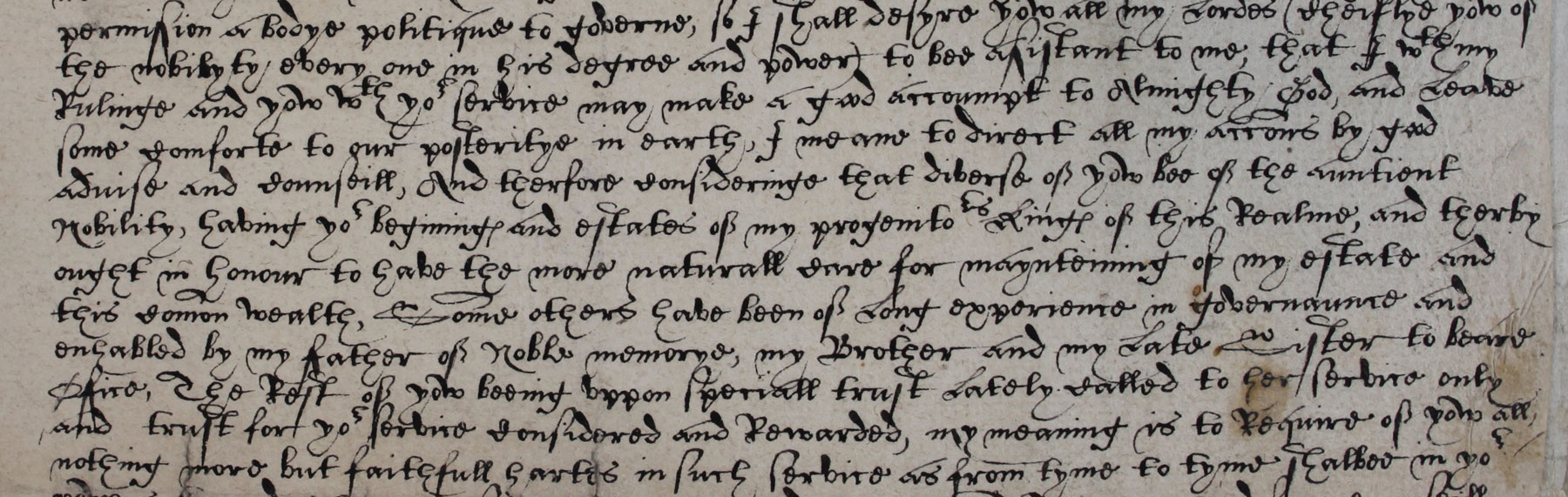
Palaeography is the study of old handwriting. This web tutorial will help you learn to read the handwriting found in documents written in English between 1500 and 1800.
At first glance, many documents written at this time look illegible to the modern reader. By reading the practical tips and working through the documents in the Tutorial in order of difficulty, you will find that it becomes much easier to read old handwriting.
This tutorial has been developed in partnership with the School of Library, Archive and Information Studies (SLAIS), University College London
This resource has been archived as the interactive parts no longer work. You can still use the rest of it for information, tasks or research. Please note that it has not been updated since its creation in 2005.
You can find handwriting to practice on in our other resources:
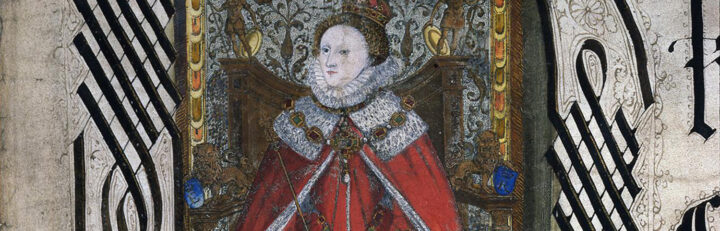
- Elizabeth I’s monarchy
Rule of a ‘weak and feeble’ woman? - English Reformation c1527-1590
How did state and people respond to religious change? - James I
What were the key areas of dispute?