














Teaching resource
Magna Carta 1214–1225

This set of documents relates to King John’s acceptance of Magna Carta in 1215 and King Henry III’s agreement to a revised version of Magna Carta in 1225.
Teaching resource
This set of documents relates to the baron's reform movement that began in 1258 and the opposition faced by Edward I when he attempted to raise taxes in 1297. Use these original documents to develop your understanding about Magna Carta and its legacy.

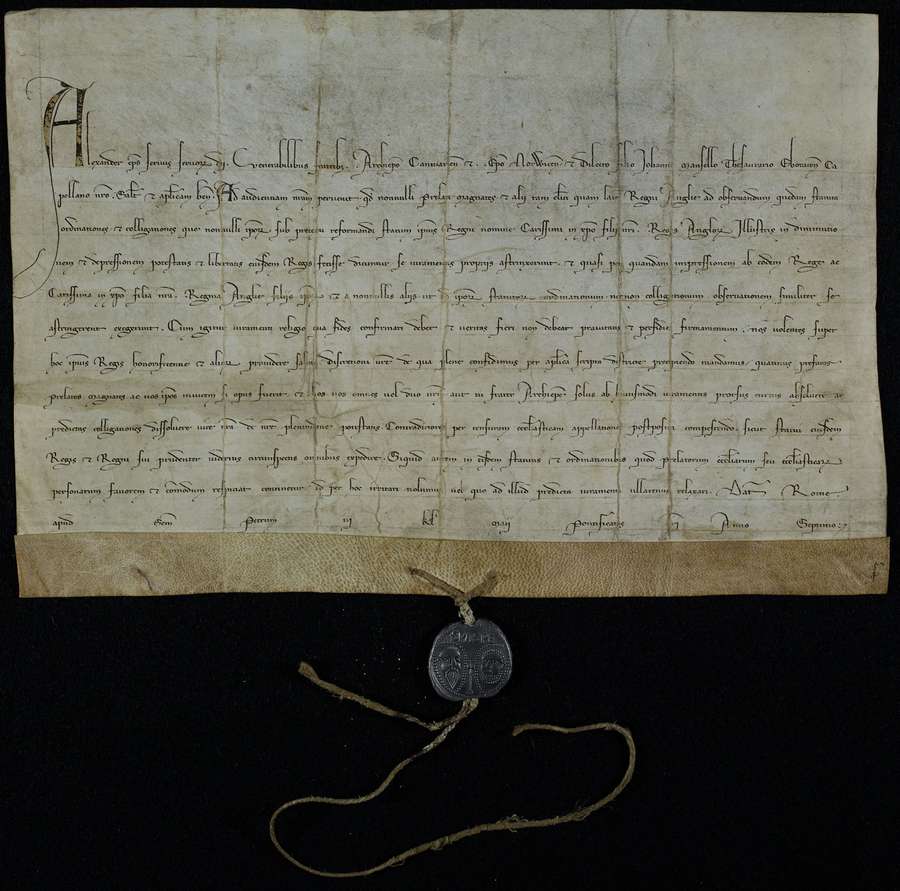
Papal Bull, 1261. Catalogue reference: SC 7/3/29
Was Magna Carta a medieval revolution?
The first set of documents on this page relate to the baron's reform movement that began in 1258 and lasted until the defeat and death of Simon de Montfort in 1265. The second set relates to the baron's opposition to Edward I raising taxes in 1297 without the agreement of Parliament. Notably, the barons tried, and failed, to have a number of new chapters added to Magna Carta.
Discover more original documents in our related themed collections Magna Carta 1214–1225 and Modern use of Magna Carta 1914–1981.
The Ordinance of the Magnates was issued in the parliament of February 1259. In it, the barons accepted restrictions on their own power, rather than merely seeking to restrict the power of the king.

Henry, by the grace of God, king of England, lord of Ireland, duke of Ireland, of Aquitaine, and count of Anjou, to all his faithful subjects, clergy and laymen, of the county of York, greeting. This is to make it known that our councillors, by common consent, and for the betterment and relief of the state of our realm, have granted, for themselves and their heirs, that they will always observe towards their subjects and their men the good laws and good customs which we, for ourselves and our heirs, have granted to our subjects: and they have drawn up their charter to this effect, which we have seen, in the following form.
‘The king’s council and the twelve elected by the community of England greet all men. Since our lord the king wishes and desires that swift justice be observed and done to all in common throughout his realm, and also wishes that whatever wrongs have been committed by his officers and by others in former times should be redressed, we will, grant, and offer, on our part, that all wrongs which we and our bailiffs have done to our subjects or to our neighbours shall be corrected by the king and by his justiciar, or by those whom he shall appoint for this purpose, without hindrance or opposition from us and ours. If what is found by complaint can properly be pleaded by writ according to the law of the land, such as freehold and anything pertaining to freehold, it shall be pleaded by writ as it should be, and in the customary place. And we will hinder no one by threats, nor by power, nor in any other manner, from freely making complaint of us and of our men, and from prosecuting his complaint of us and of our men, and from prosecuting his complaint, nor will we remember it against him, nor attempt any reprisal against him by reason of his complaints and prosecutions.
Moreover we will and have granted, for us and for our heirs, that the articles in the charter of liberties which the king has granted regarding himself and his officers, and to those who hold of him in chief, we will observe as regards ourselves towards our tenants and our neighbours, both in our demesnes and in our liberties. Moreover, whatever the king’s council has established or shall establish between now and All Saints’ next [November 1], regarding the king and his subjects, with respect to suit of court, amercements, wardships, socage, and his farms and other sorts of liberties, and anything else thereafter which shall be for the reform of the state of the realm, we will uphold it as between ourselves and our subjects, both we ourselves and our heirs. Moreover, that same oath which the king caused his sheriffs and his other officers to take, we will make our officers swear, both those of our demesnes and those of our liberties, in our full courts before the four knights elected in each county or any other persons appointed by the council to act as knights, on condition that our franchises and free customs shall in no wise be infringed, and that this cannot disinherit us or our heirs. And we will do this at every change of officials ; that is to say, they shall swear that they will loyally serve the king in what pertains to him and to his liberties, and us in what pertains to our franchises and demesnes ; and that they will do right commonly to all people, according to the powers vested in their offices ; and that they will not falter in this for fear, nor for affection, nor for hatred, nor for greed ; and that from no one will they take anything, either directly or indirectly, or by any kind of trick or device, by reason of their office, whereby justice is delayed or wrong done, saving only such food and drink as is customarily brought to table in a single day at most.
Full transcript taken from RE Treharne and I.J Sanders (eds), Documents of the Baronial Movement of Reform and Rebellion, 1258-1267 (Oxford, 1973).
Ordinance of the Magnates, 1259. Catalogue reference: C 66/73
Listen
Henry, by the grace of God, king of England, lord of Ireland, duke of Ireland, of Aquitaine, and count of Anjou, sends greetings to all his faithful subjects, clergy and laymen, of the county of York. Our councillors, for the betterment and relief of the state of our realm, have drawn up a charter in the following form:
The king’s council and the twelve elected by the community of England greet all men. Since our lord the king wishes that swift justice be observed throughout his realm, and wishes that wrongs committed by his officers should be corrected, we grant that all wrongs which we and our bailiffs have done to our subjects or to our neighbours shall be corrected by the king and his justiciar, or by those whom he shall appoint for this purpose without opposition from us and ours.
Moreover we will and have granted, for us and for our heirs, that the articles in the charter of liberties which the king has granted regarding himself and his officers, and to those who hold of him in chief, we will observe as regards ourselves towards our tenants and our neighbours, both in our demesnes and in our liberties.
And since we wish that this ordinance be firmly kept henceforth, we have ordered all our sheriffs to cause it to be kept everywhere throughout their jurisdictions as is provided. And in testimony of this we have caused our seal to be set to these letters patent.
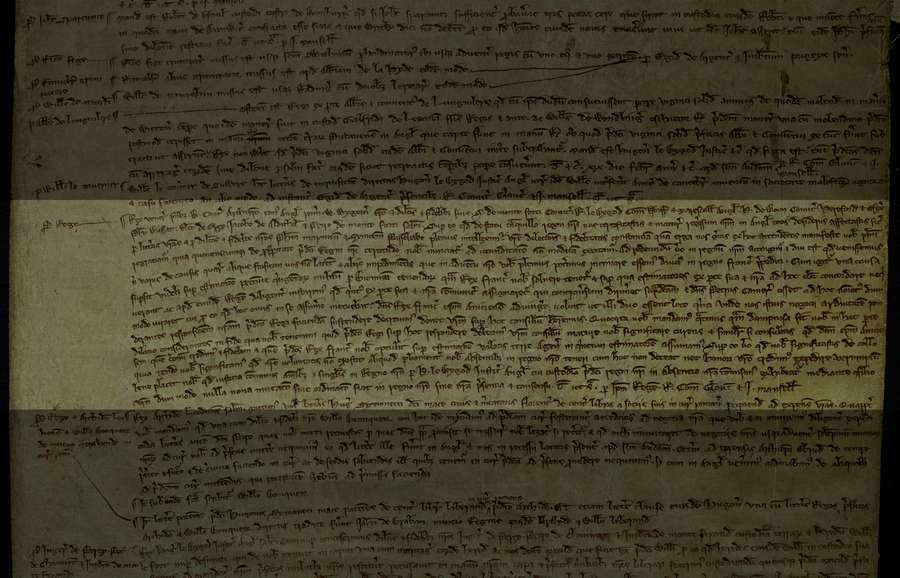
Letter from the king, who was at St Omer in France, ordering the Archbishop of Canterbury and the government in England to prohibit any parliament being held in the absence of the king. The king also prohibited any further reforms in his absence. Dated 19 February 1260.

The king to the venerable fathers, Boniface, archbishop of Canterbury, primate of all England, and Walter, bishop of Worcester, and to his well-loved and faithful subjects, Earl Simon de Montfort, Roger Bigod, earl of Norfolk and marshall of England, Humphrey de Bohun, earl of Hereford and Essex, Philip Basset, Richard de Grey, James de Audley and Peter de Montfort, greeting.
We thank you very much for what you have told us about the peaceful state of our realm and your own eager desire for our speedy return to England, as we have learned from your letters and from our well-loved and faithful servants, Philip Marmion and Simon Passelawe, and we plainly understand from all this the constancy of your love and of the fealty which you bear towards us. Indeed, as often as we receive trustworthy report of the prosperity of our realm, we are moved to no small measure of joy. We are all prepared for returning home, and we would have been home long ago but for various causes, some of which, perhaps, are not unknown to you, and also other hindrances, of which we shall be able to tell you more when we return, all of which things have held us back longer in France. One cause still remains, – that is, the assessment of the money which the king of France is bound to pay us for maintaining 500 knights for two years, on which the assessors chosen on his behalf and ours have been unable to agree, so that we urgently begged King Louis that a fifth should be assigned commonly for both of us, to put an end to this deadlock, and that Peter the Chamberlain should be named for this, provided he would take the oath. But since he shrank from undertaking this responsibility alone, the king of France wished to join the bishop of Le Puy with him, that they two should act in place of a fifth assessor ; whereupon we, having in mind the difficulty of this matter, decided to withhold our reply to King Louis until we have your advice on it. Therefore we order you that, bearing in mind how much we are losing by delay in this matter, you should bestir yourselves, in the fealty in which you are bound to us, to let us know quickly your advice on what we ought to reply to King Louis. And at the same time, would you advise us to accept the bishop of Le Puy – whom the king of France has offered to us, and whom we believe to be good and trustworthy – as the fifth assessor in the assessment of the value of the Agenais?
And for what you wrote to us about holding parliament, we tell you that it is not our will that any parliament should be held in our realm while we are absent, since that would be unfitting, and we think it would not accord with our honour. It is our good pleasure that, without the help of your advice, common justice should be done to each and all in our realm by Hugh Bigod, justiciar of England, to whom we committed the custody of our realm during our absence, provided always that no new change or ordinance be made in our realm without our presence and consent.
Witness as above, 19 February in the year, etc., at St Omer, by the king himself, Richard, earl of Gloucester, and John Mansel.
Full transcript taken from RE Treharne and I.J Sanders (eds), Documents of the Baronial Movement of Reform and Rebellion, 1258-1267 (Oxford, 1973).
Parliament prohibited, 1260. Catalogue reference: C 54/76
Listen
Letter from the king to the archbishop of Canterbury, 19 February 1260
The king sends greetings to the venerable fathers, Boniface, archbishop of Canterbury, primate of all England, and Walter, bishop of Worcester, and to his well-loved and faithful subjects, Earl Simon de Montfort, Roger Bigod, earl of Norfolk and marshall of England, Humphrey de Bohun, earl of Hereford and Essex, Philip Basset, Richard de Grey, James de Audley and Peter de Montfort.
In reply to what you wrote us about holding parliament, we tell you that it is not our will that any parliament should be held in our realm while we are absent, since that would be unfitting, and we think it would reduce our honour.
It is our desire that, without the help of your advice in parliament, common justice should be done to every person in our realm by Hugh Bigod, justiciar of England, to whom we committed the custody of our realm during our absence. We also order that no new ordinance or change to the law should be made in our realm without our presence and consent.
Pope Alexander IV issued this declaration on 29 April 1261. It condemned the reform movement, and absolved the barons and bishops of England from any oaths they had taken in support of the reforms. This gave Henry III authority to reclaim power against the barons who stood against him.

Bishop Alexander, the servant of the servants of God [sends] greeting[s] and his apostolic benediction to our venerable brothers, the Archbishop of Canterbury and the bishop of Norwich, and to our beloved son John Mansell the Treasurer of York, our chaplain.
It has come to our ears that some prelates, magnates, and others, both clerics and laymen, of the kingdom of England have bound themselves by personal oaths to observe certain statutes, ordinances, and regulations, which some of them are said to have written, under the pretext of reforming the state of this kingdom, in the name of the illustrious king of the English, our most beloved son in God , for the diminution of the power and to the detriment of the freedom of that same king, and as if by some force, they demanded from the same king and our most beloved in God queen of England, and their children, and from some others that they similarly bind themselves to the observation of these statutes, ordinances, and regulations.
Since therefore religion should not be made the support of depravity and perfidy through an oath (through which faith and truth ought to be confirmed), we, wanting because of this to make provisions for the honour of this king and for the salvation of others, strictly command to your discretion (in which we have complete faith) through our apostolic writings, that you all, or you two, or you, brother Archbishop, alone, should take care to entirely absolve from this oath the aforementioned prelates, magnates, and you yourselves in turn, if it is necessary, along with others, and to annul the abovementioned regulations, in our place, with the full amount of our power:
Objectors are to be suppressed by means of ecclesiastical judgment, all appeal having been put aside, just as it will have seemed expedient to you, after everything has been reviewed. If anyone however keeps himself to these same statutes and ordinances, because he cares for the favour and interest of the prelates, the churches, or the ecclesiastics, we do not wish for this to be made void through this, or that, with respect to this, the aforementioned oaths should be relaxed in any way. Given in Rome at St Peter’s, on the 3 Kal. May, in the seventh year of our pontificate.
Papal Bull, 1261. Catalogue reference: SC 7/3/29
Listen
Bishop Alexander, the servant of the servants of God sends greetings and his apostolic benediction to our venerable brothers, the Archbishop of Canterbury and the bishop of Norwich, and to our beloved son John Mansell the Treasurer of York, our chaplain.
It has come to our ears that some bishops, barons, and others, both clerics and laymen, of the kingdom of England, have bound themselves by personal oaths to observe certain statutes, ordinances, and regulations, which some of them are said to have written, with the intention of reforming the state of this kingdom. They demanded from the king and our most beloved in God, queen of England, and their children, the observation of these statutes, ordinances and regulations.
Since religion should not be made to support the depravity and faithlessness through an oath, which is something through which faith and truth or to be affirmed, we strictly command that you should entirely absolve from this oath the bishops, barons and you yourselves in turn, if it is necessary, along with anybody else, and we command that you act as our representatives and annul the statutes, ordinances and regulations with the full amount of our power.
Objectors to this command are to be suppressed by means of ecclesiastical judgement.
Given in Rome at St Peter’s, on 29 April in the seventh year of our pontificate.
Following discussions in the parliament of January 1265, a peace treaty between Henry III and Simon de Montfort was issued. This essentially revived the security clause in the 1215 version of Magna Carta (dropped from subsequent versions), which gave the king’s subjects legal justification to rebel.

The king to all of the county of York, greeting.
Because of the wars and disturbances which recently troubled our realm, by the unanimous agreement of ourselves, and of Edward our firstborn son, and also of the prelates, earls, barons, and of the community of our realm, it is by agreement provided for the peace of the realm, for the security of which Edward and our nephew Henry, the son of the king of Germany, had been given as hostages, that a certain ordinance made at London in June in the 48th year of our reign [1264] with the unanimous assent of ourselves, the prelates, earls, and barons concerning our state and that of our realm should be observed inviolably.
We now wish you all to know that we have sworn, on the holy gospels of God, that we will observe in good faith that ordinance and peace, and will maintain the tranquillity of our realm, and will no way work against them; with this addition specially and expressly made in the said oath, that we will not proceed against or seek to blame, by reason of whatever was done in the time of the said disturbances or of the war, any of those whom we denounced as enemies, or any of their supporters, that is to say, the earls of Leicester and of Gloucester and others supporting them and our barons and citizens of London, and of the Cinque Ports, nor to any of them will we do harm or order harm to be done, or permit harm to be done to them in any way by our bailiffs.
We have sworn also that we will inviolably observe all those things which were provided for the release of our son and nephew, and which were sealed with our seal, so far as they concern us, and that we will, to the best of our power, cause them to be observed by others.
And we wish and expressly agree that if we, or Edward our son, should in any way oppose our ordinance, provision, or oath, which Heaven forbid, or should disturb the peace and tranquillity of our realm, or, on pretext of things formerly done in the time of disturbances or of war, should proceed against any one of the aforesaid whom we denounced, or of their following, or should presume to inflict any harm upon any of them or cause them to be harmed, then it shall be lawful for all our realm to rise up against us, and to lend help and labour to our discomfiture, as much as they can. And we wish that by our present command each and every one shall be bound to this, notwithstanding the fealty and homage which they have done to us, so that they shall obey us in nothing, but do all that can work to our harm, as if they were in no way bound to us, until whatever in this matter has been wrongly done or committed has been restored to its due state, according to the terms of our ordinance, provision, and oath; and only when that is done should they obey as of old.
And if anyone else of our realm should presume to oppose these orders, or to disturb the peace and tranquillity of our realm, or to give help, counsel, consent, or any manner of aid to us, or to our son Edward, or to anyone else opposing the orders or any part of them, if this became known or if anyone be, or be not, convicted of this by the judgement of our council and the magnates of our land, he and his heirs shall be perpetually disinherited, and their lands and property shall be dealt with as are the lands of those convicted of felony, according to usual practice under the laws and customs of our realm.
Full transcript taken from RE Treharne and I.J Sanders (eds), Documents of the Baronial Movement of Reform and Rebellion, 1258-1267 (Oxford, 1973).
Form of Peace, 1265. Catalogue reference: C 53/54
Listen
The king sends greetings to all of the county of York.
Because of the wars and disturbances which recently troubled our realm, by the unanimous agreement of ourselves, and of Edward our firstborn son, and also of the bishops, earls, barons, and of the community of our realm, it is by agreement provided for the peace of the realm, that the following ordinance made at London in June in the 48th year of our reign [1264] should be observed without violation.
We now wish you all to know that we have sworn, on the holy gospels of God, that we will observe in good faith that ordinance and peace, and will maintain the tranquillity of our realm. We will not proceed against or seek to blame, by reason of whatever was done in the time of the said disturbances or of the war, any of those whom we denounced as enemies, or any of their supporters. That is to say, we will not proceed against the earls of Leicester and of Gloucester or any other people supporting them.
And we wish and expressly agree that if we, or Edward our son, should in any way oppose our ordinance, provision, or oath, which Heaven forbid, or should disturb the peace and tranquillity of our realm, or should proceed against anyone of whom we denounced in the time of the disturbances of war, or should presume to inflict any harm upon any of them or cause them to be harmed, then it shall be lawful for all our realm to rise up against us, and to lend help and labour to our discomfiture, as much as they can.
And so that in future no one may assert ignorance of these things, we order them to be read aloud in full county court at least twice every year.
And so that each and every one of the above enactments shall remain firm and unshaken, the reverend fathers, the bishops appointed to this realm, at our instance, have launched a sentence of excommunication against all who shall knowingly oppose or in effect attempt to oppose the orders or any of them.
This document was sent out to the counties of England, asking men to come to Parliament who were not as high ranking as the great barons and bishops. Dated 1265.

After the grave perils of the recent disturbances in our realm, my dearest firstborn son, Edward, was delivered as a hostage for securing and confirming the peace in our realm, but now, blessed be God, the disturbance has been settled.
In order to provide happily for his release, and also to confirm and finally complete the tranquillity and peace of the realm it is necessary that we should have discussion with our bishops and barons, and to that end we require your advice.
I ask, in the faith and love in which you are bound to me, and setting aside every other matter or reason, that you should be with us at London on 20 January 1265, to discuss these things, with us and with our bishops and barons, whom we have caused to be summoned there.
Summons to the Parliament, 1265. Catalogue reference: C 54/82
Listen
After the grave perils of the recent disturbances in our realm, my dearest firstborn son, Edward, was delivered as a hostage for securing and confirming the peace in our realm, but now, blessed be God, the disturbance has been settled.
In order to provide happily for his release, and also to confirm and finally complete the tranquillity and peace of the realm it is necessary that we should have discussion with our bishops and barons, and to that end we require your advice.
I ask, in the faith and love in which you are bound to me, and setting aside every other matter or reason, that you should be with us at London on 20 January 1265, to discuss these things, with us and with our bishops and barons, whom we have caused to be summoned there.
The Dictum of Kenilworth was, in essence, a peace treaty with the rebels following the death of Simon de Montfort. The document marks the end of the reform movement and the restoration of royal power, although many of the reforms passed by Simon de Montfort were accepted by the king. Dated 30 October 1266.

In the name of the Holy and Undivided Trinity, amen. To the honour and glory of Almighty God, the Father, the Son, and the Holy Ghost, of the glorious and most excellent Mother of God the Virgin Mary, and of all saints by whose merits and intercessions we are governed on Earth. To the honour of the Holy Catholic and Apostolic Roman Church, which is the mother and ruler of all the faithful; to the honour of the Most Holy Father and out lord Clement, ruler of that universal Church; to the honour and good prosperous and peaceable estate of the most Christian prince, lord Henry, illustrious king of the whole realm of England, and of the English Church. We, Walter, bishop of Exeter, Walter, bishop of Bath and Wells, Nicholas, bishop of Worcester, and Richard, bishop of St David’s, Gilbert de Clare, earl of Gloucester and Hertford, and Humphrey de Bohun, earl of Hereford, Philip Basset, John Balliol, Robert Walerand, Alan de la Zuche, Roger de Somery, and Warin de Bassingbourne have been given full power from the lord king, from other nobles, counsellors of the realm, and from the leading men of England according to the terms enrolled in letters published and sanctioned by the seals of the king and others, to provide for the state of the realm especially in the matter of the disinherited, favouring no person in this matter, but having God alone before our eyes, doing all things as in the sight of Almighty God and in order, rightly preferring the Head to the Members.
(1) We declare and provide that the most serene prince, lord Henry, illustrious king of England, shall have, fully receive, and freely exercise his dominion, authority, and royal power without impediment or contradiction of anyone, whereby the royal dignity may be offended contrary to approved rights, laws, and long established customs, and that full obedience and humble attention be given to the same lord king, to his lawful mandates and pre-cepts, by one and all, greater and lesser men of the king-dom. And one and all shall, through writs, seek justice and be answerable for justice at the court of the lord king as was the custom before the time of the disorder.
(2) Furthermore, we ask the same lord king, and with reverence urge him in his piety, that he appoint, for doing and rendering justice, such men as, seeking not their own interests but those of God and right, shall justly settle the affairs of subjects according to the praiseworthy laws and customs of the kingdom and thereby strengthen the throne and royal majesty with justice.
(3) Likewise we ask and urge the lord king that he fully protect and observe the liberties of the Church, and the charters of liberties and of the forest, which he is expressly bound to keep and hold by his own oath.
(4) Also the lord king shall provide that the grants which, up to the present, he has made freely and not under compulsion shall be observed; and he will establish firmly other necessary measures which are devised by his men at his pleasure. Furthermore, the English Church shall be fully restored to its liberties and customs which it had and should have had before the time of such dis-orders, and shall be permitted to exercise them.
(5) We declare and provide that the lord king shall completely excuse and pardon each and all of those who, from the beginning and up to the present time, because of the present disorders of the realm, have offended against or done any injury to him or the royal crown and who return to his peace within forty days after the publication of this our ordinance. The lord king shall in no way for any cause or reason, because of these past injuries or offences, bear any vengeance against these offenders nor shall he inflict any penalty or revenge against them in life, limb, imprisonment, exile, or fine. Excluded are those mentioned below in this our present ordinance.
(6) We also declare and provide that all places, rights, goods, and all other things pertaining to the royal crown shall be restored to that crown, and to the lord king, by those who detain them in their possession unless they can show that hold them by reasonable warrant from the lord king or from his ancestors.
Full transcript taken from RE Treharne and I.J Sanders (eds), Documents of the Baronial Movement of Reform and Rebellion, 1258-1267 (Oxford, 1973).
Dictum of Kenilworth, 1265. Catalogue reference: E 164/9
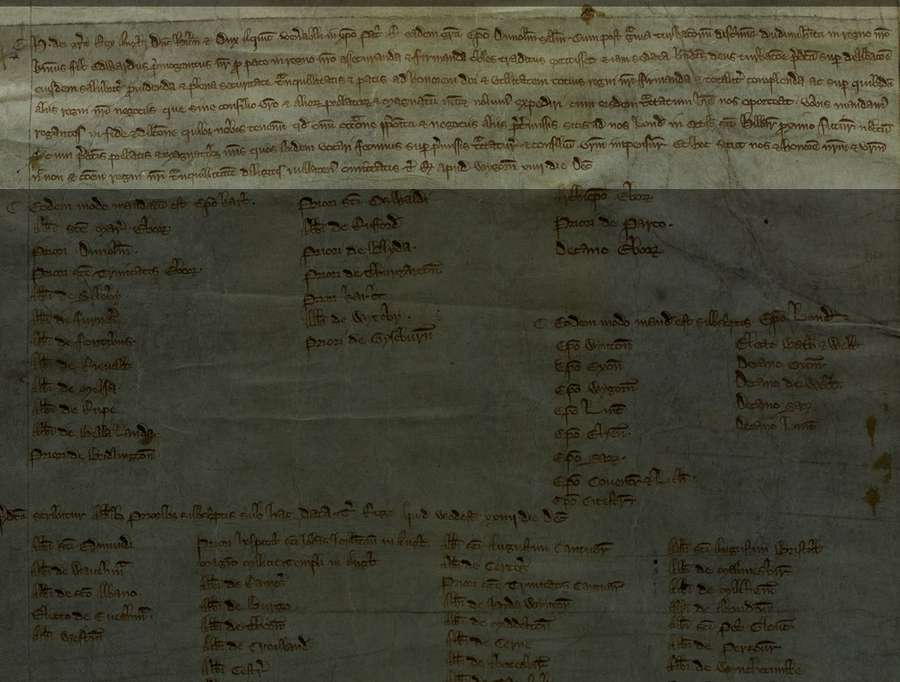
This document shows how tax, once agreed by Parliament, was collected throughout England. This order refers only to one county, but similar orders were sent all over the kingdom. The important point is that taxes were raised by the king with the support of Parliament, and the collectors of the tax were accepted by Parliament. Dated 1295.

Parliament approves the appointment of Robert de Flixthorpe and John de Wakerle, parson of the church of Weston, appointed to assess the amount of tax to be paid in the county of Rutland and collect the tax, which has been recently and graciously agreed to by Parliament in aid of the present war.
Tax agreed by Parliament, 1295. Catalogue reference: C 66/115
A statement made by barons Roger Bigod and Henry Bohun. Dated August 1297

Sire,
The Earl Marshal (Roger Bigod) and the Earl of Hereford (Humphrey Bohun) and several others wish to express, on behalf of all the community of the realm, great concern about the recent raising of taxes by the king.
In the orders that have been issued for collecting taxation on both property and wool, it is written that the taxation has been agreed by the earls and barons, knights and the community of realm. Yet we contend that the taxation has never been agreed.
Furthermore, the community say that if they are taxed at the will of king and without being consulted, they are no greater than a man of servitude. If the tax went ahead, it would diminish their rights, and cause the disinheritance of their heirs.
They also say that such a tax on property and wool as the king proposes would not be tolerable, nor would they tolerate it in any manner.
Statement by Roger Bigod and Henry de Bohun, 1297. Catalogue reference: E 159/70
Listen
Sire,
The Earl Marshal (Roger Bigod) and the Earl of Hereford (Humphrey Bohun) and several others wish to express, on behalf of all the community of the realm, great concern about the recent raising of taxes by the king.
In the orders that have been issued for collecting taxation on both property and wool, it is written that the taxation has been agreed by the earls and barons, knights and the community of realm. Yet we contend that the taxation has never been agreed.
Furthermore, the community say that if they are taxed at the will of king and without being consulted, they are no greater than a man of servitude. If the tax went ahead, it would diminish their rights, and cause the disinheritance of their heirs.
They also say that such a tax on property and wool as the king proposes would not be tolerable, nor would they tolerate it in any manner.
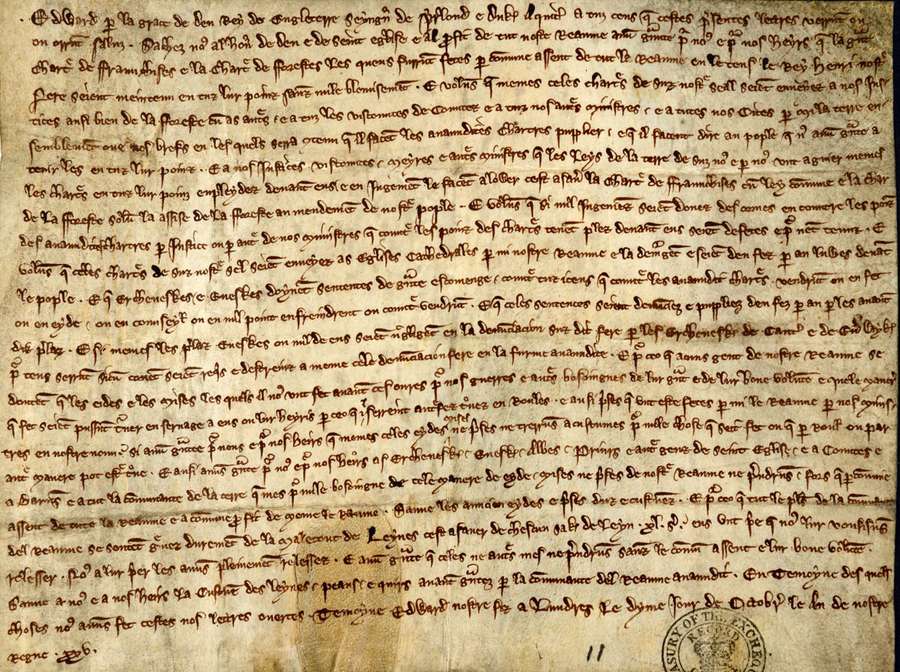
King Edward was not prepared to see new clauses added to Magna Carta, and negotiated the issuing of a separate document instead. He realised that if he allowed the barons to add new laws to Magna Carta, it would be very difficult to undo them without facing rebellion. If the king issued the new laws in a separate document, it would be easier to go back on his promises. King Edward later said that the barons forced him to issue this new document against his will, and it was revoked. Dated October 1297.

[1] Know that I, to the honour of God and of holy church and for the benefit of our whole realm, have granted that the great charter of liberties and the forest charter which were made by common agreement of all the realm in the time of king Henry, my father, be kept in all their points. And we order that these same charters be sent to all sheriffs of counties throughout the land.
[2] And I order that if any judgments are given by royal justices which contradict the charters those judgements shall have no value.
[6] And I have likewise granted that I will not take taxation from the realm from now on, except with the common agreement of all the realm.
[7] And because by far the greater part of the community of the realm feel themselves greatly burdened by the taxation on wool, at their request I have completely revoked this tax.
Edward I’s Confirmation of Magna Carta, 1297. Catalogue reference: E 175/1/11
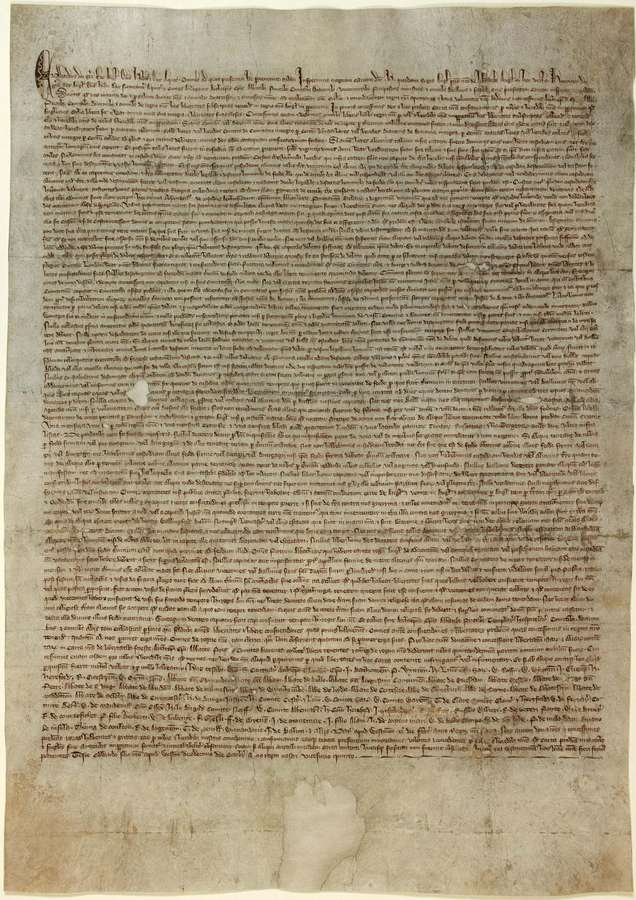
The 1297 Magna Carta is the version which was placed onto the Statute Book.

EDWARD by the grace of God, King of England, Lord of Ireland, Duke of Aquitaine, To all to whom these present letters shall come, Greeting. We have examined the Great Charter of the lord Henry, late King of England, our father, containing the liberties of England in these words:—
(The full text of Magna Carta 1225 follows.)
We, ratifying and approving these gifts and grants aforesaid, confirm and make strong all the same for us and our heirs perpetually, and by tenour of these presents do renew the same: willing and granting for us and our heirs, that the Charter aforesaid, in all and singular its articles for ever, shall be steadfastly and inviolably observed; and even although any article in the same Charter contained, yet hitherto hath peradventure not been kept. In witness whereof we have caused these our Letters Patents to be made. Witness, Edward our son, at Westminster, the twelfth day of October, in the twenty-fifth year of our reign.
Full transcript taken from An Historical Essay on the Magna Carta of King John, Richard Thomson (London, 1829), pp. 145-158.
EDWARD by the grace of God, King of England, Lord of Ireland, Duke of Aquitaine, sends greetings to all whom these present letters shall come. We have examined the Great Charter of the lord Henry, late King of England, our father, containing the liberties of England in these words:
(The full text of Magna Carta 1225 follows.)
We ratify and approve these gifts and grants and confirm and reinforce them, on behalf of us and our heirs forever. Even though some of the articles contained in the Great Charter before this time may not have been upheld, by the tenor of the present letters we renew these things, willing and granting on behalf of us and our heirs, that each and every one of its articles contained in the Great Charter, shall be steadfastly upheld without violation forever. In witness of this, we have caused these letters to be written up. Witness, Edward our son, at Westminster, the twelfth day of October, in the twenty-fifth year of our reign.
Magna Carta, 1297. Catalogue reference: DL 10/197
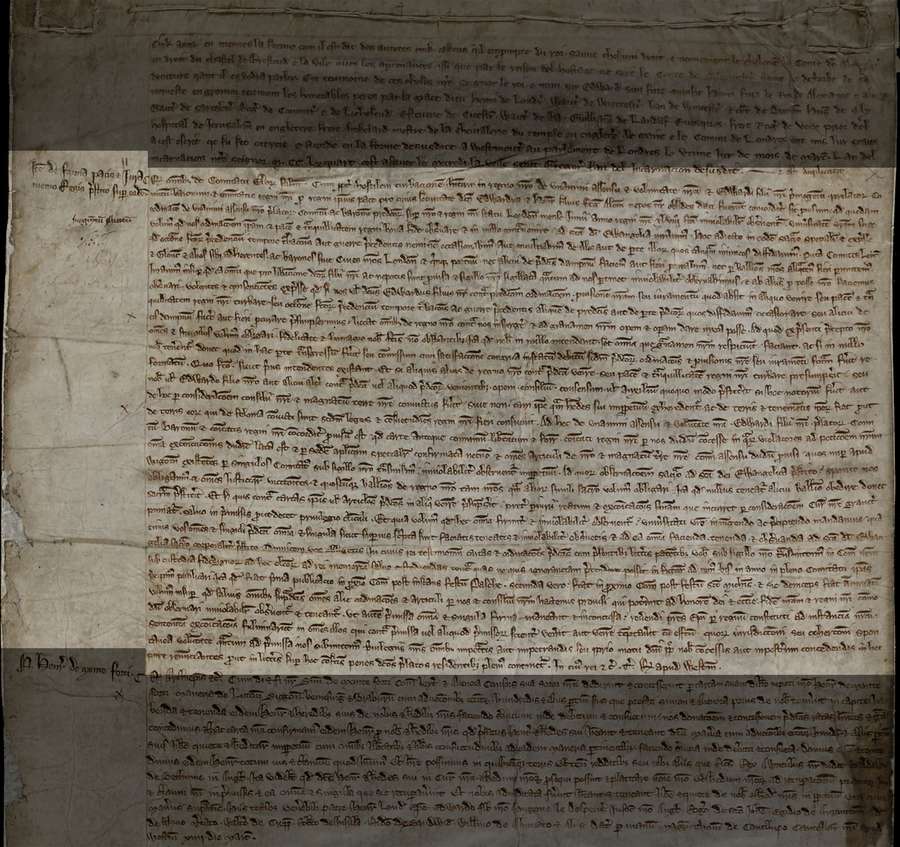
Following an attempt to tax his people without the assent of parliament, Edward I faced opposition to his plans to lead a military expedition to France. In this letter, which takes the form of a public address, Edward I attempts to justify the necessity of the recent taxation. Dated 1297.

Because the king desires always the peace and quiet and welfare of all the people of his realm and in particular desires that, after the journey he now proposes to make for the honour of God to recover his rightful heritage of which he has been more deceitfully defrauded by the king of France and for the honour and common profit of his realm, all reasons for the said peace and quiet being in any way disturbed may be completely removed, but some persons might say and give the people to understand things that are not true, whereby the same people might be moved to behave towards their liege lord otherwise than they ought, as about the withdrawal of the earl of Hereford and the earl marshall from him lately or about other matters, THE KING, on this and on the condition of himself and of the kingdom and how the affairs of the kingdom have been going for some time, makes known and wishes all to know the truth thereof, which is as follows.
Recently, when a large part of the men-at-arms of England, some by request others at the king’s summons, came to London, the king, wishing to provide for the deliverance of these same people and relieve their expenses and their discomforts, sent word to the said earls, as constable and marshal of England, to come to him on a certain day to arrange the deliverance of the said people; on which day the earl of Hereford and sir John de Segrave, who excused the earl marshal on account of illness, came to the king and in their presence and with their assent it was arranged that they should have it proclaimed throughout the city of London that all those who had come there on a summons or by request should be the next day at St Paul’s before the said constable and marshal for it to be known and put on record how and with how much each of them was willing to serve or help the king on this journey abroad; and the king said to them that, in accordance with the said arrangement which was given to them in writing, they should cause the said proclamation to be made. And they, on receiving the said command and the said writing, went away; then the same night the said earls sent to the king by sir John Esturmy knt a letter written in these terms:
“Because, dear lord, you sent word to the marshal by the constable, in writing, that he should have it proclaimed throughout the town of London that all those who have come at your summons or by request should be next day before them at St Paul’s at the hour of prime, and that they should have enrolled how many horses from everybody and then let you know this, your constable and your marshal pray you to agree to order someone else of your household to do this thing. And because, lord, you well know that they have come here at your request and not on a summons, if they did this they would be entering on their office to do service, wherefore they pray you to agree to give the order to someone else.”
Justification for taxation, 1297. Catalogue reference: C 66/117
Listen
Because the king desires always the peace and quiet and welfare of all the people of his realm, and some persons might give the people reason to understand things that are not true, whereby the same people might be moved to behave towards their liege lord in ways that they should not, we wish all people to know the truth, which is as follows:
The earl of Hereford and the earl marshall have delivered a letter to the king, wherein they refused to act upon an order of the king. And because it seemed to the king that they had written the letter without good advice, he made certain to know that the earl of Hereford and the earl marshall acknowledged their words. When this acknowledgement reached the king, the earls withdrew from the king and his court.
Now it may be that some persons have given the people of the realm to understand that the earls showed the king certain articles for the common profit of the people and of the realm, and that the king refused and denied them absolutely: of which the king knows nothing.
These articles include, according to rumour, complaints about some of the burdens that the king has placed on his kingdom. The king is well aware of these burdens, such as the taxes that he has often asked of his people, which were necessary because of the wars that have been waged against him in Gascony, Wales, Scotland and elsewhere. It grieves the king greatly that he has so burdened and exhausted his people, and he asks them to be willing to consider his excused for it, since he has not used the money to buy lands, castles or towns, but on defending himself, his people, and all the realm.
The barons who were with the king recently in London understood the demands of war, and in exchange for the confirmation of the great charter of the liberties and the confirmation of the charter of the forest, which the king has duly granted them, the barons have granted a common gift to the king, which he is very much in need of at the present moment. Wherefore, the king begs all men who own property, and all the people of his realm, who have never failed him, not to let this gift annoy them.
And let everyone consider how there has been great discord in the past in this realm through words bandied between the lord and his people, and the harm that has resulted from them. And if now these things are believed to be otherwise than they are, it could happen that a dispute would arise out of it, which would be more dangerous and more serious than any ever was in this land.
This document, ‘The articles in addition to the charters’, includes concessions granted by Edward I to the barons who opposed his attempt to raise taxation to fight a war in France. The king refused to allow them to be added to Magna Carta, knowing that if he did so, the concessions would be almost impossible to revoke without inciting rebellion. Dated 1300.

Because the points of the great charter of liberties and the charter of the forest, which king Henry, father of the present king, granted to his people for the benefit of his kingdom, have not been held or kept hitherto because up to now no penalty has been established for offenders against the points of the aforesaid charters, our lord the king has granted, renewed and confirmed them afresh; and at the request of the prelates, earls and barons in his Lenten parliament at Westminster in the 28th year of his reign, has ordained and established a definite form and penalty for all those in any way contravening the points of the aforesaid charters or any point of them, in the following form.
(1) Namely that from now on the great charter of liberties of England granted to all the community of England and the charter of the forest in like manner granted be held, kept and maintained in each article and each point as fully as the king has granted, renewed and by his charter confirmed it; and that these charters be given to each sheriff of England under the king’s seal to be read four times a year before the people in full county court: that is at the next county after Michaelmas, the next county after Christmas, the next county after Easter and at the next county after the feast of St John; and firmly to maintain these two charters in every point and in every article of them, where there was up to now no remedy at common law, let there be chosen in each county by the community of that county three men of standing, 1 knights or other upright, 2 wise and prudent men, to be sworn as justices and assigned by letters patent of the king under his great seal to hear and determine, without other writ than their common warrant, the complaints that shall be made of all those who contravene or offend in any of the said points of the aforesaid charters in the counties to which they are assigned, as well within liberties as outside them, as well of the king’s officers in their private capacities as of others; and determine summarily the complaints heard day by day without allowing the delays that are allowed at common law; and that these same knights have power to punish all those convicted of offending against any point of the aforesaid charters, whereas has been said there was previously no remedy at common law, by imprisonment or by fine or by amercement, according to what the offence demands. And by this neither the king nor any of those who were at the making of this ordinance intends that the aforesaid knights should hold any plea in virtue of the power that has been given them in a case where before now a remedy was provided at common law by writ, or that prejudice be done thereby to the common law or to the aforesaid charters in any of their points. And the king wills that if all three are not present or cannot every time attend to the performance of their office in the aforesaid form, that two of the three do it. And it is ordained that the sheriffs and the bailiffs of the king attend to the commands of the aforesaid justices in so far as they concern their office; and, besides these things granted on the points of the aforesaid charters, the king, of his special grace, in alleviation of the burdens that his people have had during the wars that have been and to amend their condition and in order that they may be readier in his service and more willingly helpful when they have the wherewithal to do it, has granted some articles which it is his intention shall hold as great a place in the estimation of his people and be of as great a benefit, or more, as the points afore granted.
Articuli super cartas, 1300. Catalogue reference: C 74/1
On 1 January 1306, Pope Clement V publicly revoked the concessions that had been forced upon Edward I in the Articuli super cartas. Had Edward I allowed these concessions to be added to Magna Carta, it would have been much more difficult to have them revoked in this way.

Bishop Clement, the servant of the servants of God sends greetings and his apostolic benediction to our venerable brother, the bishop of Worcester.
We order that you publish in your churches our revocation of the concessions forced upon Edward, king of England, whilst he was in Flanders and absent from the kingdom. Publish also in your churches the absolution of King Edward from sentences of excommunication incurred because of his failure to observe the aforesaid concessions.
Given in Lyon, on 1 January 1306.
Papal Bull, 1306. Catalogue reference: SC 7/10/36
The purpose of this document collection is to allow Key Stage 5 students and their teachers to develop their own questions and lines of historical enquiry on Magna Carta and its legacy throughout the Middle Ages and beyond.
The documents themselves are titled on the webpage so it is possible for teachers and pupils to detect different themes and concentrate on documents on similar topics if they wish. Some of the themes include: the relationship between the king and his barons; the relationship between Magna Carta, war and taxation; the intervention of the Pope; and the emergence of parliament as a fundamental part of political life.
Students could work with a group of sources or source type on a certain theme or linked themes. It is hoped that the documents will offer them a chance to develop their powers of evaluation and analysis. Alternatively, teachers may wish to use the collection to develop their own resources or encourage students to ‘curate’ their own exhibition of the most significant sources on the topic or they could attempt the enquiry question on Magna Carta: a medieval revolution? Other possible lines of enquiry could take the form of a debate, where a group of students constructs an argument (by selecting documents) that defends a particular perspective. Alternatively, a group of students could be asked to construct an argument that defends the perspective of either the barons or the king.
All of our sources have been provided with a translation and most have audio files and transcript. Original translations are by Maroula Perisanidi and Marianne Wilson. Each source is captioned and dated to provide a sense of what the document is about. We hope too that Key Stage 3 teachers may be interested in working with this material in the classroom.
AQA:
A2 Unit 3: The Angevin Kings of England: British Monarchy, 1154–1216
This document collection provides documentary content for section on:
John the barons and Magna Carta; feudal authority and royal finance; John’s loss of his continental lands and the battle of Bouvines; antisemitism and baronial hostility towards the Jews
OCR:
Specification for A level History H505 from 2015:
Unit F965: Historical Interpretations and Investigations
This document collection provides documentary content for section on:
Option D: The reign of King John 1199–1215
The reasons why, and with what results, John quarrelled with his barons
By adding his seal to Magna Carta on 15 June 1215, King John forever changed the nature of kingship in England. No longer could a king be seen as acting on the impulse of his own convictions. His exercise of power was to be regulated by an established set of rules. In 1215, however, Magna Carta failed. King John quickly worked to undo Magna Carta, which he thought of as a peace treaty rather than as a collection of laws, and he convinced the Pope to condemn Magna Carta. Yet, as this document selection shows, time and time again throughout the thirteenth century, English kings were held to account by their barons and forced to accept the restraints that Magna Carta placed upon their kingship.
Magna Carta meant a new way of doing things. This is because Magna Carta encouraged the barons to seek new political concessions whenever they felt the king was ruling unwisely. In practice, this usually meant that the barons felt they were not being consulted enough by the king. Also, when the king needed money to fight wars in France, he often found himself compelled to reaffirm his commitment to Magna Carta and find solutions to new complaints put forward by his barons. The exchange of taxation for political concessions became the main topic of discussion in medieval parliament, and contributed to the growing importance of parliament in medieval England.
In the century after Magna Carta, parliament became a fundamental part of political life. An important part in this development was played by Simon de Montfort, who led a baronial rebellion against Henry III. Following the battle of Lewes in 1264, where Montfort took Henry III captive, Montfort summoned knights and burgesses (representatives from English towns) to parliament in order to discuss the terms of the king’s release. Although knights and burgesses had been summoned to parliament on previous occasions, Simon de Montfort needed broad political support for his plan to establish a new form of government that would significantly reduce the power of the king. Therefore, Montfort encouraged the knights and burgesses (the ‘commons’) to participate directly in the political discussions, and this established a trend that would continue throughout the Middle Ages. By the end of the thirteenth century, it was no longer acceptable for a king to tax his people without consulting parliament first, and when King Edward I attempted to do so, he faced rebellion.
Background information written by Dr Matthew Phillips.
King John sails for La Rochelle to begin a military campaign against the French. Many of his barons refuse to accompany him, or send knights to serve in his army.
John’s barons from Poitou (France) desert his army. With his path blocked by the French Prince Louis, John is unable to join his allies in Flanders, and is forced to retreat to La Rochelle.
King John’s allies, the Flemings, Germans and an English contingent led by the earl of Salisbury, are defeated by the French at the Battle of Bouvines (Northern France).
John returns to England following the failure of his military campaign in France that he had spent years planning.
Facing baronial revolt, John declares his intention to go on crusade to the Holy Land. It is hoped that this will secure support from the Pope against his rebellious barons.
The barons renounce their fealty (allegiance) to John, and name Robert fitz Walter as their leader.
The city of London welcomes the rebel barons, dashing John’s hopes for a quick victory and end to the civil war.
John meets the rebel leaders at Runnymede meadow by the River Thames near Staines.
King John sets his seal to a draft of Magna Carta, thereby accepting its terms.
The rebel barons formally make peace with King John, and renew their allegiance.
The pope excommunicates the barons who have rebelled against their king.
Papal bulls (letters) declare Magna Carta null and void.
Civil war breaks out between King John and the rebel barons.
King John dies at Newark.
Henry III is crowned king of England at Gloucester.
Magna Carta is reissued, with some changes to its contents, by royal government on behalf of the young Henry III.
A third version of Magna Carta is issued. All laws relating to the administration of royal forests (which cover around a third of all land in England), are issued in a separate charter: the Charter of the Forest.
The French King invades the territories of Henry III in Poitou and Gascony (France).
Henry III ‘confirms’ Magna Carta and the Charter of the Forest. This means that he reaffirms his intention to govern England in accordance with the laws contained in the charters.
Henry III arranges with the pope that his son, Edmund, should become king of Sicily. He agrees to pay £90,000 to the pope, but parliament refuses to raise the sum.
The pope threatens to excommunicate Henry III if he does not pay £90,000 to the papacy. Henry III had promised this sum so that his son could become king of Sicily.
Henry III desperately seeks advice from his barons concerning the £90,000 he owes to the pope. Henry’s barons agree to help their king, if he agrees to accept major political reforms. Discussions take place at the ‘Mad Parliament’ held at Oxford.
Henry agrees to the Provisions of Oxford. The king is forced to rule with the advice of a council. It is also decided that parliament should meet three times a year to review political developments.
Henry agrees to the Provision of Westminster, a series of twenty–four major legal reforms similar to Magna Carta in their scope and importance.
The pope condemns the reforms that have been forced upon Henry III. All barons in England are absolved from any oaths they have taken to ensure that the reforms are upheld.
Simon de Montfort and the rebel barons defeat a royal army at the battle of Lewes, taking King Henry III captive. Simon de Montfort is now the unofficial ruler of England.
Simon de Montfort calls a parliament to discuss the terms for the king’s release. He orders knights from each of England’s shires, and representatives from England’s towns, to attend.
King Henry III defeats Simon de Montfort and the rebels at the battle of Evesham. Simon de Montfort is killed, marking an end to the reform movement that had begun in 1258.
Dictum of Kenilworth marks the royalist recovery, but in a manner of reconciliation. Many of the reforms issued since 1258 are now issued in the name of the king.
Henry III dies, and is succeeded by his son, King Edward I.
King Philip IV of France declares Edward I’s territories in Gascony forfeit, because Edward refused to attend the French court up following a summons by Philip. War breaks out between England and France.
Two important barons, Roger Bigod and Humphrey de Bohun, refused Edward I’s order to draw up a muster list – those summoned by the king for military service. The king was forced to offer wages for military service, instead of relying on feudal obligations.
Royal writs (instructions) order the collection of tax set at a very high rate. The king falsely claimed that the tax had been granted with the assent of the whole laity of the realm. In reality, the king ordered the collection of a tax without the assent of parliament.
Roger Bigod and Humphrey de Bohun appeared at the exchequer – which managed the kingdoms finances – and stated that the people of England would not pay the tax.
The king’s ‘bad’ tax was cancelled, and replaced with a new tax, which was set at a lower rate and properly granted by parliament.
Edward I confirmed Magna Carta, and agreed to a new set of political reforms put forward by the rebel barons in a document known as ‘Articuli super cartas’, which means ‘Articles in addition to Magna Carta and the Charter of the Forest’. This document set out in detail how Magna Carta could be enforced to prevent the king from breaking its laws.
The pope condemns the ‘Articuli super cartas’, releasing Edward I from his obligation to follow the rules set out in this new document.
Teaching resource
This set of documents relates to King John’s acceptance of Magna Carta in 1215 and King Henry III’s agreement to a revised version of Magna Carta in 1225.
Teaching resource

These documents demonstrate the lasting legacy of Magna Carta in the modern world, both as a set of laws and as a historical artefact.
magnacarta800th.com
This site provides information about the 800 year celebrations across the country and more education resources
magnacarta.cmp.uea.ac.uk
The University of East Anglia investigates Magna Carta in 1215 and 1225. The website includes details of an itinerary for King John in the year leading up to the issue of Magna Carta in 1215