







Teaching resource
Magna Carta 1214–1225

This set of documents relates to King John’s acceptance of Magna Carta in 1215 and King Henry III’s agreement to a revised version of Magna Carta in 1225.
Teaching resource
These documents demonstrate the lasting legacy of Magna Carta in the modern world, both as a set of laws and as a historical artefact.

Charles H Sims, 'King John Assents to the Magna Carta, 1215'. Painted between 1925 and 1927. Photo courtesy: UK Parliament, accession number: WOA 2602, heritagecollections.parliament.uk
UK Parliament
Was Magna Carta a medieval revolution?
These original documents reflect 20th-century attitudes towards Magna Carta, both as a document and a symbol.
Discover more original documents in our related themed collections Magna Carta 1214–1225 and Magna Carta 1259–1306.
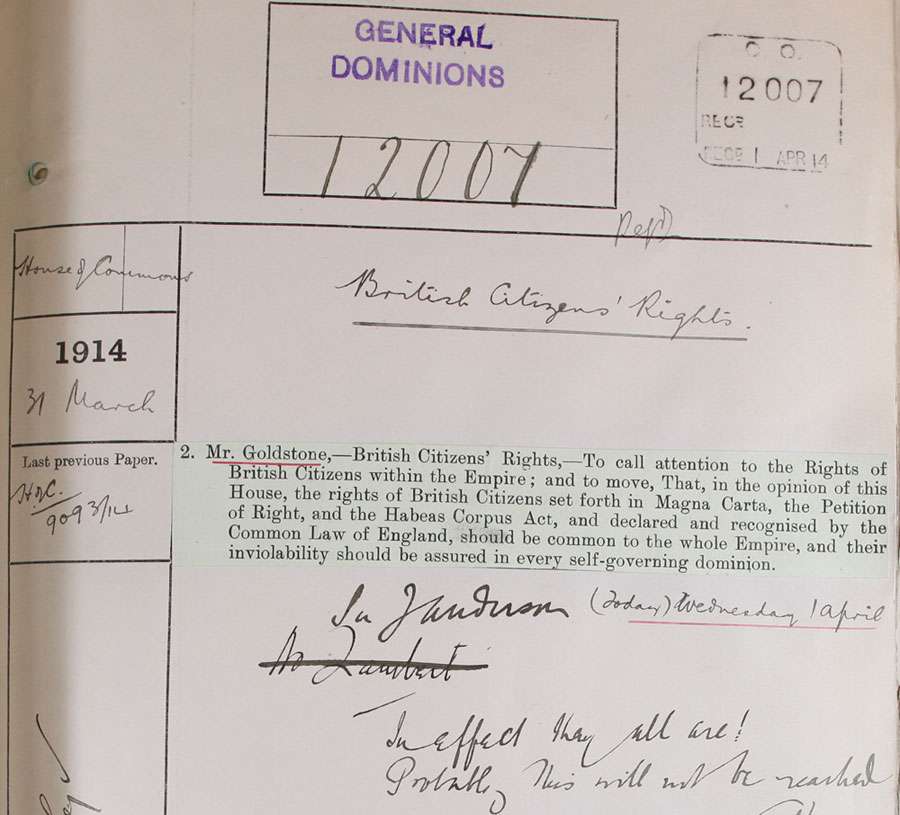
Parliamentary question, proposing that the rights set out in Magna Carta should apply throughout the British Empire.

2. Mr. Goldstone, – British Citizens’ Rights, – To call attention to the Rights of British Citizens within the Empire ; and to move, That, in the opinion of this House, the rights of British Citizens set forth in Magna carta, the Petition of Right, and the Habeas Corpus Act, and declared and recognised by the Common Law of England, should be common to the whole Empire, and their inviolability should be assured in every self-governing dominion.
Parliamentary question, April 1914. Catalogue reference: CO 323/629/16
Charles H Sims, 'King John Assents to the Magna Carta, 1215'. Painted between 1925 and 1927. Photo courtesy: UK Parliament, accession number: WOA 2602, heritagecollections.parliament.uk

Charles H Sims, 'King John Assents to the Magna Carta, 1215'. Painted between 1925 and 1927. Accession number: WOA 2602
UK Parliament
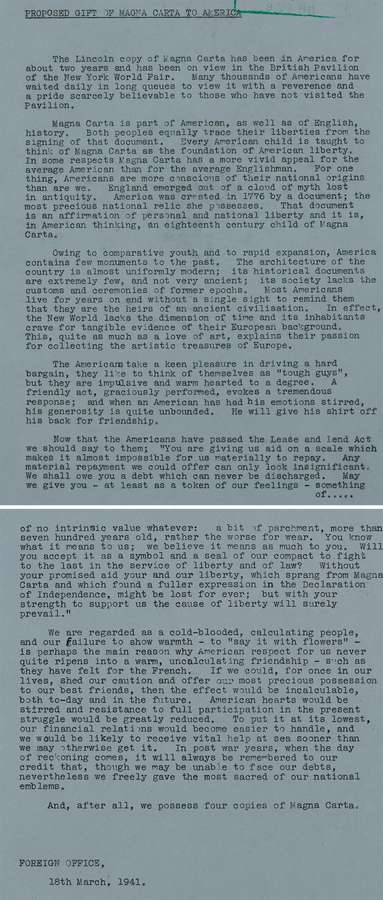
Foreign Office document with annotations by Winston Churchill, proposing that the Lincoln copy of the 1215 Magna Carta should be granted to the USA. It was hoped that such a gift would increase American support for the British cause in the Second World War. The proposal was eventually rejected.

Lincoln copy of Magna Carta
On the 11th March the Government of the United States passed an Act which has as its wider purpose the furtherance of personal and national freedom throughout the world. Based on enlightened self-interest, this Act none the less represents a landmark in the history of liberty, and under its provisions the British Empire stands to be the principal beneficiary.
It would be peculiarly fitting if at this juncture we were to offer the Lincoln copy of Magna Carta to the American nation as a token of the history and traditions which the two countries have in common.
Magna Carta has been in American for about two years and for the last two summers it has been on view in the British Pavilion of the New York World Fair. Many thousands of Americans have waited daily in long queues to view it with a reverence and pride scarcely believable to those who have not visited the Pavilion. Magna Carta is a part of American, as well as of English, history and both peoples equally trace their personal liberties from the signing of that document. In some respects Magna Carta has a more vivid appeal for the average American than for the average Englishman. For one thing, Americans are more conscious of their national origins than are we. England emerged out of a cloud of myth lost in antiquity. America was created in 1776 by a document; the most previous national relic they possess. That document is an affirmation of personal and national liberty and it is, in American thinking, an 18th century child of Magna Carta. Owing to comparative youth and rapid expansion, American contains few monuments of the past. The architecture of the country is almost uniformly modern; its historical documents are extremely few and not very ancient; its society lacks the customs and ceremonies of former epochs. Most Americans live for years on end without a single sight to remind them that they have a past. In effect the New World lacks the dimension of time; its inhabitants live almost entirely in the present and they crave tangible evidence of their early European background much as the nouveau riche crave ancestors.
The gift of Magna Carta would be at once the most precious of gifts and the most gracious of acts in American eyes; it would represent the only really adequate gesture which it is in our power to make in return for the means to preserve our country.
The immediate effect of such an action would be greatly to heighten the emotional interest of Americans in this country, which would thereby assist the President in his task of carrying public opinion with him in giving us increasingly greater assistance. [it will be remembered that the Lease-Lend Act does not actually give us anything; it empowers the President to assist us within the practical limits set by public opinion]. At any time previously to the passage of this Act such a gift might well have been interpreted as a form of propaganda. However, the passing of the Act is widely regarded by Americans as a final decision to support our Cause and therefore, if Magna Carta were to be given now, our motives would not be taken amiss.
The long time benefit of the proposed gift is likely to be even more important than its immediate effect, for we have (possibly not quite fairly) acquired a reputation for a lack of generosity in our national, as distinct from personal, dealings; which the debt controversy has done nothing to improve. This reputation has a tendency to make Americans suspicious and “tough” in their dealings with us. But after the war the future of the world will greatly depend on the cordiality of Anglo-American relations and a really good example of unsolicited generosity on our part would go far towards assisting us in this respect.
Proposed gift to the USA, 1941. Catalogue reference: FO 371/26169
Foreign Office document proposing that Magna Carta be gifted to the USA during the Second World War. The document notes that Magna Carta holds no ‘intrinsic value’. The proposal was eventually rejected.

Proposed Gift of Magna Carta to America
The Lincoln copy of Magna Carta has been in America for about two years and has been on view in the British Pavilion of the New York World Fair. Many thousands of Americans have waited daily in long queues to view it with a reverence and a pride scarcely believable to those who have not visited the Pavilion.
Magna Carta is part of American, as well as of English, history. Both peoples equally trace their liberties from the signing of that document. Every American child is taught to think of Magna Carta as the foundation of American liberty. In some respects Magna Carta has a more vivid appeal for the average American than for the average Englishman. For one thing, Americans are more conscious of their national origins than are we. England emerged out of a cloud of myth lost in antiquity. American was created in 1776 by a document; the most precious national relic she possesses. That document is an affirmation personal and national liberty, and it is, in American thinking, an eighteenth century child of Magna Carta.
Owing to comparative youth and to rapid expansion, America contains few monuments to the past. The architecture of the country of the country is almost uniformly modern; its historical documents are extremely few, and not very ancient; its society lacks the customs and ceremonies of former epochs. Most Americans life for years on end without a single sight to remind them that they are the heirs of an ancient civilisation. In effect, the New World lacks the dimension of time and its inhabitants crave for tangible evidence of their European background. This, quite as much as a love of art, explains their passion for collecting the artistic treasures of Europe.
The Americans take a keen pleasure in driving a hard bargain, they like to think of themselves as “tough guys”, but they are impulsive and warm hearted to a degree. A friendly act, graciously performed, evokes a tremendous response; and when an American has had his emotions stirred, his generosity is quite unbounded. He will give his shirt off his back for friendship.
Now that the Americans have passed the Lease and Lend Act we should say to them; “You are giving us aid on a scale which makes it almost impossible for us materially to repay. Any material repayment we could offer can only look insignificant. We shall owe you a debt which can never be discharged. May we give you – at least as a token of our feelings – something of no intrinsic value whatever: a bit of parchment, more than seven hundred years old, rather the worse for wear. You know what it means to us; we believe it means as much to you. Will you accept it as a symbol and a seal of our compact to fight to the last in the service of liberty and of law? Without your promised aid your and our liberty, which sprang from Magna Carta and which found a fuller expression in the Declaration of Independence, might be lost for ever; but with your strength to support us the cause of liberty will surely prevail.”
We are regarded as a cold-blooded, calculating people, and our failure to show warmth – to “say it with flowers” – is perhaps the main reason why American respect for us never quite ripens into warm, uncalculating friendship – such as they have felt for the French. If we could, for once in our lives, shed our caution and offer our most precious possession to our best friends, then the effect would be incalculable, both to-day and in the future. American hearts would be stirred and resistance to full participation in the present struggle would be greatly reduced. To put it at its lowest, our financial relations would become easier to handle, and we would be likely to receive vital help at sea sooner than we may otherwise get it. In post war years, when the day of reckoning comes, it will always be remembered to our credit that, though we may be unable to face our debts, nevertheless we freely gave the most sacred of our national emblems.
And, after all, we possess four copies of Magna Carta.
FOREIGN OFFICE,
18th March, 1941.
Magna Carta has no ‘intrinsic value’, 18 March 1941. Catalogue reference: FO 371/26169
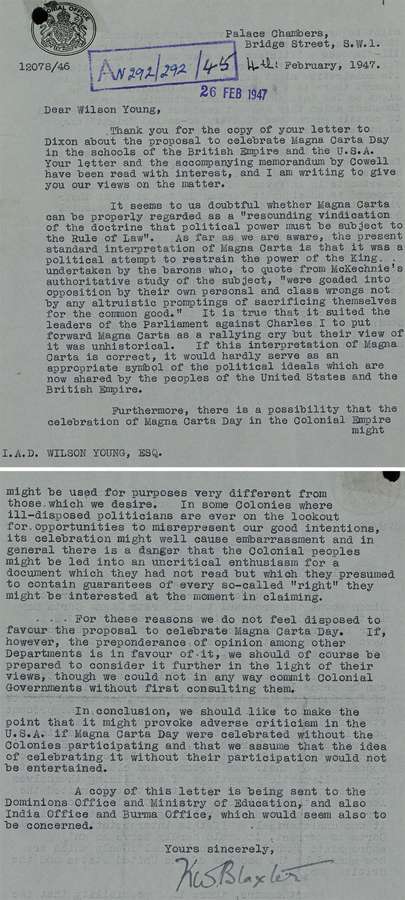
Foreign Office document outlining the reasons for the rejection of the proposal that schools in the USA and throughout the British Empire should celebrate Magna Carta day on 15 June.

4th February, 1947
Dear Wilson Young,
Thank you for the copy of your letter to Dixon about the proposal to celebrate Magna Carta Day in the schools of the British Empire and the U.S.A. Your letter and the accompanying memorandum by Cowell have been read with interest, and I am writing to give you our views on the matter.
It seems to us doubtful whether Magna Carta can be properly regarded as a “resounding vindication of the doctrine that political power must be subject to the Rule of Law.” As far as we are aware, the present standard interpretation of Magna Carta is that it was a political attempt to restrain the power of the King undertaken by the barons who, to quote from McKechnie’s authoritative study of the subject, “were goaded into opposition by their own personal and class wrongs not by any altruistic promptings of sacrificing themselves for the common good.” It is true that it suited the leaders of the Parliament against Charles I to put forward Magna Carta as a rallying cry but their view of it was unhistorical. If this interpretation of Magna Carta is correct, it would hardly serve as an appropriate symbol of the political ideals which are now shared by the peoples of the United States and the British Empire.
Furthermore, there is a possibility that the celebration of Magna Carta Day in the Colonial Empire might be used for purposes very different from those which we desire. In some Colonies where ill-disposed politicians are ever on the lookout for opportunities to misrepresent our good intentions, its celebration might well cause embarrassment and in general there is a danger that the Colonial peoples might be led into an uncritical enthusiasm for a document which they had not read but which they presumed to contain guarantees of every so-called “right” they might be interested at the moment in claiming.
For these reasons we do not feel disposed to favour the proposal to celebrate Magna Carta Day. If, however, the preponderance of opinion among other Departments is in favour of it, we should of course be prepared to consider it further in light of their views, though we could not in any way commit Colonial Governments without first consulting them.
In conclusion, we should like to make the point that it might provoke adverse criticism in the U.S.A. if Magna Carta Day were celebrated without the Colonies participating and that we assume that we assume that the idea of celebrating it without their participation would not be entertained.
A copy of his letter is being sent to the Dominions Office and Ministry of Education, and also India Office and Burma Office, which would seem also to be concerned.
Yours sincerely,
KW Blaxlen
Rejection of Magna Carta day, 1947. Catalogue reference: FO 371/26169
Submission by an anti-immigration campaign group to the Home Office following the Brixton riots in 1981. The group had appropriated the name Magna Carta as a representation of a traditional British way of life.

MAGNA CARTA CAMPAIGN FOR THE PROTECTION OF THE ETHOS OF BRITAIN
16th May, 1981,
Sir,
BRIXTON INQUIRY REF: L81/1953/RDM.
CONSIDERATION OF UNDERLYING CAUSES.
I wish to submit evidence under Part 2 as follows:
I remain, Sir;
Your obedient servant
Hon. Director of the Campaign
Retired Architect
Wartime Captain R.E., S.E.A.C.
Brixton riots, 1981. Catalogue reference: HO 266/119
The purpose of this document collection is to allow Key Stage 5 students and their teachers to develop their own questions and lines of historical enquiry on Magna Carta and its legacy throughout the Middle Ages and beyond.
The documents themselves are titled on the webpage so it is possible for teachers and pupils to detect different themes and concentrate on documents on similar topics if they wish. Some of the themes include: the relationship between the king and his barons; the relationship between Magna Carta, war and taxation; the intervention of the Pope; and the emergence of parliament as a fundamental part of political life.
Students could work with a group of sources or source type on a certain theme or linked themes. It is hoped that the documents will offer them a chance to develop their powers of evaluation and analysis. Alternatively, teachers may wish to use the collection to develop their own resources or encourage students to ‘curate’ their own exhibition of the most significant sources on the topic or they could attempt the enquiry question on Magna Carta: a medieval revolution? Other possible lines of enquiry could take the form of a debate, where a group of students constructs an argument (by selecting documents) that defends a particular perspective. Alternatively, a group of students could be asked to construct an argument that defends the perspective of either the barons or the king.
Each source is captioned and dated to provide a sense of what the document is about. We hope too that Key Stage 3 teachers may be interested in working with this material in the classroom.
The development of Church, state and society in Medieval Britain 1066–1509
Magna Carta and the emergence of Parliament
Society, economy and culture: feudalism, religion in daily life (parishes, monasteries, abbeys), farming, trade and towns (especially the wool trade), art, architecture and literature
The study of an aspect or theme of British history that consolidates and extends pupils’ chronological knowledge from before 1066
The changing nature of political power in Britain, traced through selective case studies from Iron Age to the present
AQA:
A2 Unit 3: The Angevin Kings of England: British Monarchy, 1154–1216
This document collection provides documentary content for section on:
John the barons and Magna Carta; feudal authority and royal finance; John’s loss of his continental lands and the battle of Bouvines; antisemitism and baronial hostility towards the Jews
OCR:
Specification for A level History H505 from 2015:
Unit F965: Historical Interpretations and Investigations
This document collection provides documentary content for section on:
Option D: The reign of King John 1199–1215
The reasons why, and with what results, John quarrelled with his barons
By adding his seal to Magna Carta on 15 June 1215, King John forever changed the nature of kingship in England. No longer could a king be seen as acting on the impulse of his own convictions. His exercise of power was to be regulated by an established set of rules. In 1215, however, Magna Carta failed. King John quickly worked to undo Magna Carta, which he thought of as a peace treaty rather than as a collection of laws, and he convinced the Pope to condemn Magna Carta. Yet, as this document selection shows, time and time again throughout the thirteenth century, English kings were held to account by their barons and forced to accept the restraints that Magna Carta placed upon their kingship.
Magna Carta meant a new way of doing things. This is because Magna Carta encouraged the barons to seek new political concessions whenever they felt the king was ruling unwisely. In practice, this usually meant that the barons felt they were not being consulted enough by the king. Also, when the king needed money to fight wars in France, he often found himself compelled to reaffirm his commitment to Magna Carta and find solutions to new complaints put forward by his barons. The exchange of taxation for political concessions became the main topic of discussion in medieval parliament, and contributed to the growing importance of parliament in medieval England.
In the century after Magna Carta, parliament became a fundamental part of political life. An important part in this development was played by Simon de Montfort, who led a baronial rebellion against Henry III. Following the battle of Lewes in 1264, where Montfort took Henry III captive, Montfort summoned knights and burgesses (representatives from English towns) to parliament in order to discuss the terms of the king’s release. Although knights and burgesses had been summoned to parliament on previous occasions, Simon de Montfort needed broad political support for his plan to establish a new form of government that would significantly reduce the power of the king. Therefore, Montfort encouraged the knights and burgesses (the ‘commons’) to participate directly in the political discussions, and this established a trend that would continue throughout the Middle Ages. By the end of the thirteenth century, it was no longer acceptable for a king to tax his people without consulting parliament first, and when King Edward I attempted to do so, he faced rebellion.
Background information written by Dr Matthew Phillips.
King John sails for La Rochelle to begin a military campaign against the French. Many of his barons refuse to accompany him, or send knights to serve in his army.
John’s barons from Poitou (France) desert his army. With his path blocked by the French Prince Louis, John is unable to join his allies in Flanders, and is forced to retreat to La Rochelle.
King John’s allies, the Flemings, Germans and an English contingent led by the earl of Salisbury, are defeated by the French at the Battle of Bouvines (Northern France).
John returns to England following the failure of his military campaign in France that he had spent years planning.
Facing baronial revolt, John declares his intention to go on crusade to the Holy Land. It is hoped that this will secure support from the Pope against his rebellious barons.
The barons renounce their fealty (allegiance) to John, and name Robert fitz Walter as their leader.
The city of London welcomes the rebel barons, dashing John’s hopes for a quick victory and end to the civil war.
John meets the rebel leaders at Runnymede meadow by the River Thames near Staines.
King John sets his seal to a draft of Magna Carta, thereby accepting its terms.
The rebel barons formally make peace with King John, and renew their allegiance.
The pope excommunicates the barons who have rebelled against their king.
Papal bulls (letters) declare Magna Carta null and void.
Civil war breaks out between King John and the rebel barons.
King John dies at Newark.
Henry III is crowned king of England at Gloucester.
Magna Carta is reissued, with some changes to its contents, by royal government on behalf of the young Henry III.
A third version of Magna Carta is issued. All laws relating to the administration of royal forests (which cover around a third of all land in England), are issued in a separate charter: the Charter of the Forest.
The French King invades the territories of Henry III in Poitou and Gascony (France).
Henry III ‘confirms’ Magna Carta and the Charter of the Forest. This means that he reaffirms his intention to govern England in accordance with the laws contained in the charters.
Henry III arranges with the pope that his son, Edmund, should become king of Sicily. He agrees to pay £90,000 to the pope, but parliament refuses to raise the sum.
The pope threatens to excommunicate Henry III if he does not pay £90,000 to the papacy. Henry III had promised this sum so that his son could become king of Sicily.
Henry III desperately seeks advice from his barons concerning the £90,000 he owes to the pope. Henry’s barons agree to help their king, if he agrees to accept major political reforms. Discussions take place at the ‘Mad Parliament’ held at Oxford.
Henry agrees to the Provisions of Oxford. The king is forced to rule with the advice of a council. It is also decided that parliament should meet three times a year to review political developments.
Henry agrees to the Provision of Westminster, a series of twenty-four major legal reforms similar to Magna Carta in their scope and importance.
The pope condemns the reforms that have been forced upon Henry III. All barons in England are absolved from any oaths they have taken to ensure that the reforms are upheld.
Simon de Montfort and the rebel barons defeat a royal army at the battle of Lewes, taking King Henry III captive. Simon de Montfort is now the unofficial ruler of England.
Simon de Montfort calls a parliament to discuss the terms for the king’s release. He orders knights from each of England’s shires, and representatives from England’s towns, to attend.
King Henry III defeats Simon de Montfort and the rebels at the battle of Evesham. Simon de Montfort is killed, marking an end to the reform movement that had begun in 1258.
Dictum of Kenilworth marks the royalist recovery, but in a manner of reconciliation. Many of the reforms issued since 1258 are now issued in the name of the king.
Henry III dies, and is succeeded by his son, King Edward I.
King Philip IV of France declares Edward I’s territories in Gascony forfeit, because Edward refused to attend the French court up following a summons by Philip. War breaks out between England and France.
Two important barons, Roger Bigod and Humphrey de Bohun, refused Edward I’s order to draw up a muster list – those summoned by the king for military service. The king was forced to offer wages for military service, instead of relying on feudal obligations.
Royal writs (instructions) order the collection of tax set at a very high rate. The king falsely claimed that the tax had been granted with the assent of the whole laity of the realm. In reality, the king ordered the collection of a tax without the assent of parliament.
Roger Bigod and Humphrey de Bohun appeared at the exchequer – which managed the kingdoms finances – and stated that the people of England would not pay the tax.
The king’s ‘bad’ tax was cancelled, and replaced with a new tax, which was set at a lower rate and properly granted by parliament.
Edward I confirmed Magna Carta, and agreed to a new set of political reforms put forward by the rebel barons in a document known as ‘Articuli super cartas’, which means ‘Articles in addition to Magna Carta and the Charter of the Forest’. This document set out in detail how Magna Carta could be enforced to prevent the king from breaking its laws.
The pope condemns the ‘Articuli super cartas’, releasing Edward I from his obligation to follow the rules set out in this new document.
Teaching resource
This set of documents relates to King John’s acceptance of Magna Carta in 1215 and King Henry III’s agreement to a revised version of Magna Carta in 1225.
Teaching resource

This set of documents relates to the baron's reform movement that began in 1258 and the opposition faced by Edward I when he attempted to raise taxes in 1297.