Photo credit: National Education Network (NEN)
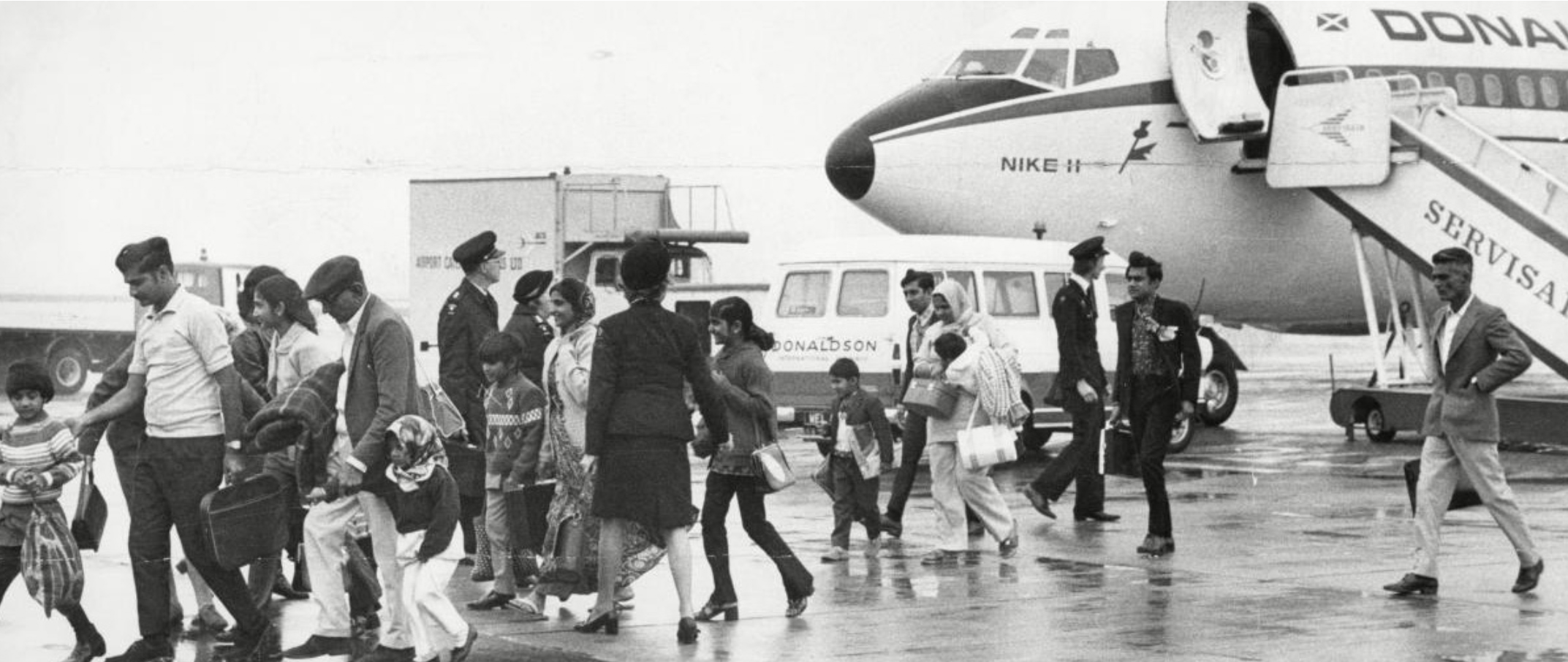
On the 4 August 1972, Ugandan President Idi Amin ordered the expulsion of all Asians from Uganda. Just over 28,000 men, women and children came to the UK, making them one of the largest groups of displaced people to enter the country.
50 years later, The National Archives worked with partners British Ugandan Asians at 50 to host a commemorative panel debate headed by leading British Ugandan Asians from the fields of media, medicine, politics and business.
The discussions, as well as a selection of documents, a children’s storytelling activity and links to further information can be viewed below.
Watch the panel event
Babita Sharma chairs discussions about the events of 1972 and the ongoing impact of the expulsion with Sukhpal Singh Ahluwalia, Lord Jitesh Gadhia, Dr Shezan Muhammedi, Dr Maya Parmar, Professor Akbar Vohra. Includes contributions from Dr Mohamed Keshavjee and Charles Powell.
Details of the panellists can be found by clicking on this link. This website will open in a new window.
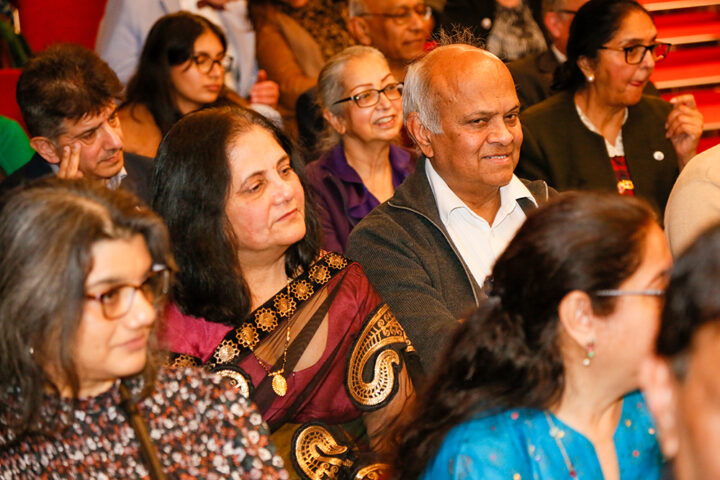
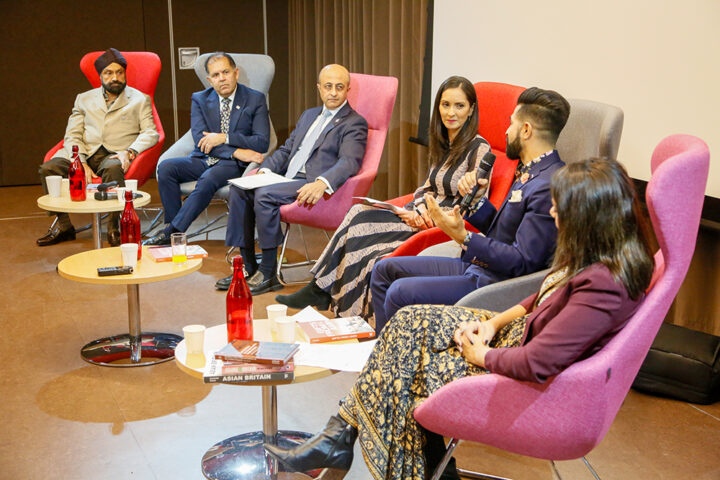
Photos: courtesy of BUA50: Paresh Solanki/Lucy Vickers
View the documents
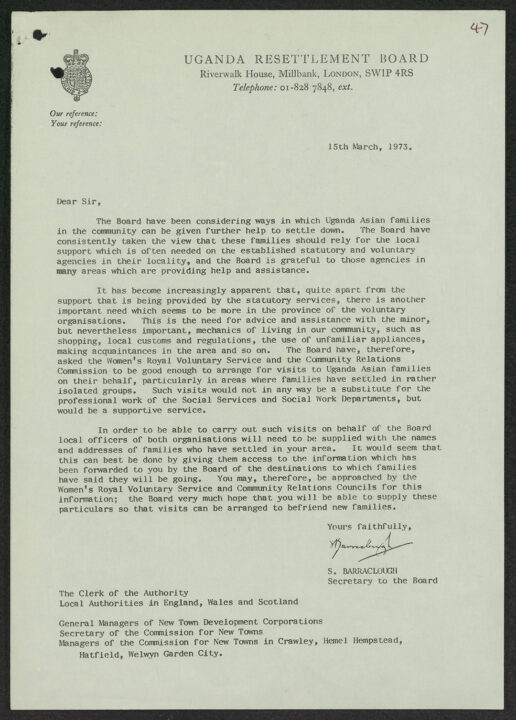
A letter, dated 15th March 1973, from the Uganda Resettlement Board requesting addresses for Ugandan Asian families so that ‘life skills’ visits could be arranged by local voluntary groups. (T353/63)
View a selection of documents about the expulsion by clicking on this link. This website will open in a new window.
Listen to the oral histories
Listen to the real stories of displacement and arrival first hand by clicking on this link. This website will open in a new window.
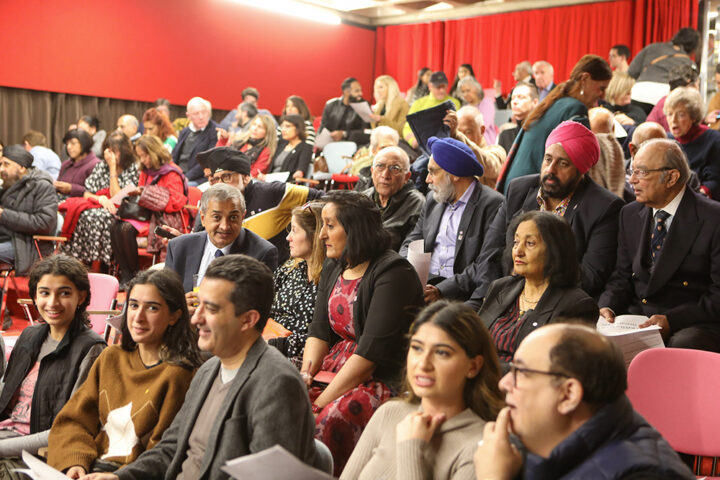
Watch ‘The Yellow Bicycle’
The National Archives’ Time Travel Club for families created a special video called ‘The Yellow Bicycle’. Watch Chandrika Joshi as she narrates a story about what it was like to live through this time.
Further links
These websites will open in a new window.
Watch the panel discussion from Leicester Curve
Ugandan Asians 40 years on at The National Archives
Carlton University Canada
Navrang Arts
ITREB Heritage Series: Ugandan Expulsion
Ugandan Asians in Stradishall RAF Base

This memorandum of 6th December 1972 outlines the issues and steps being taken by the Government following General Amin’s decision to expel the Ugandan Asians. (CAB 129/164 f.1-2)
Transcript
The decisions required under each of these heads are indicated at the appropriate points. I would ask my colleagues, in considering them, to bear in mind that we are dealing with a man, in the person of President Amin, who is fundamentally irrational and unreliable. We cannot tell how he will react if he thinks that we are provoking him too far; and here it is relevant to remember that we have substantial interests in Uganda and that some 7,000 British subjects (“Belongers”) are at present in that country. But considerations of this kind, which might suggest that we should do all that reasonably can to help President Amin to extricate himself without too much loss of face from the position which he has created, have to be weighed not only against the criticism which we are already attracting from our own supporters for what they regard as our ‘softness’ in dealing with the Ugandan Government but also against the risk that, if we are in fact too ‘soft’ and encourage other countries to suppose that they can deal with a similar problem in the same way, we may create a situation in this country which, in both political and social terms, we simply could not control.
R C
Home Office
6th December 1972.
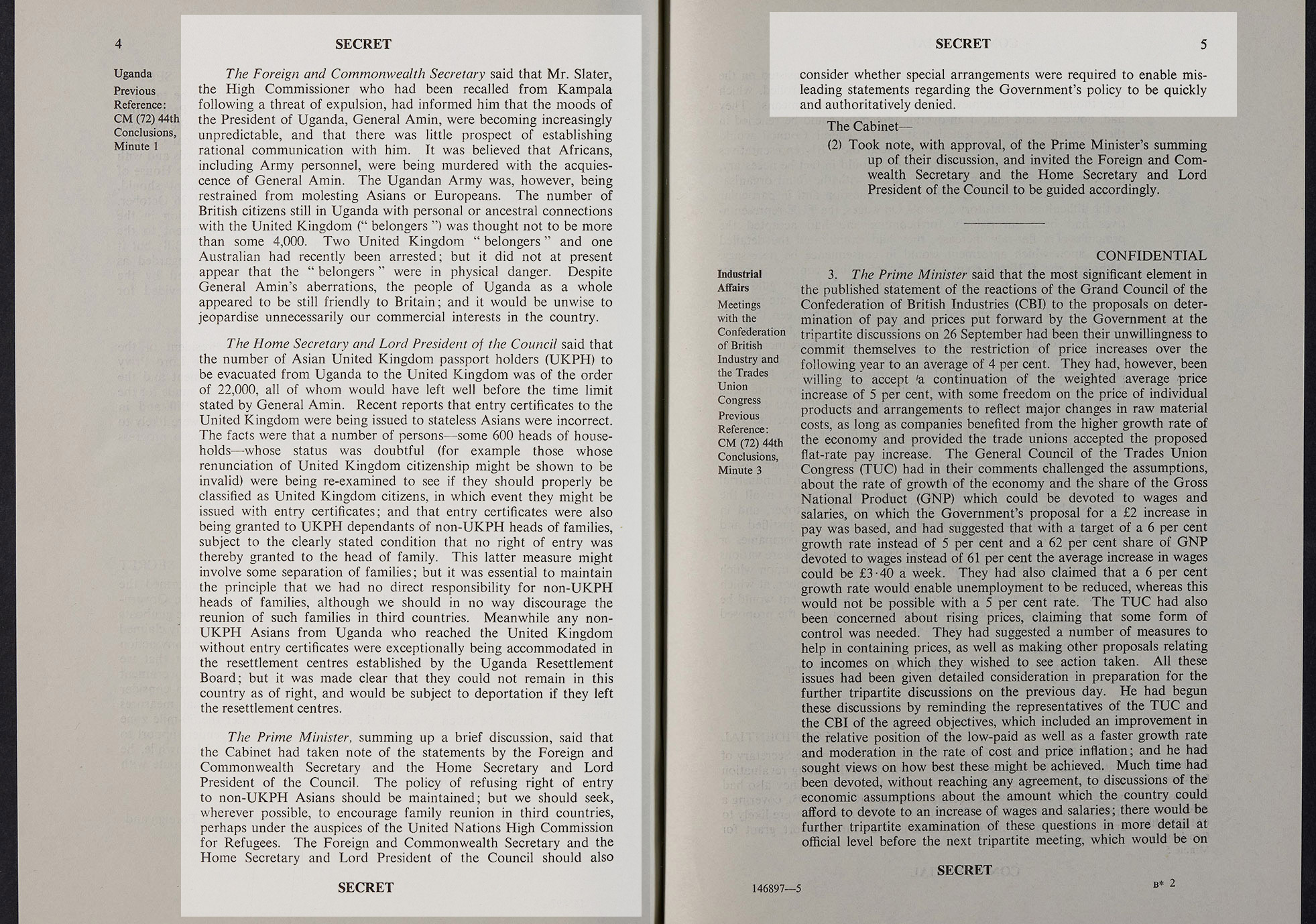
Ministers discuss resettlement outside the UK, but ultimately the Government accepted UK passport holders expelled from Uganda. Minutes from a Cabinet Meeting held on 17th October 1972. (CAB 128/50 f.15-16)
Transcript
The Foreign and Commonwealth Secretary said that Mr Slater, the High Commissioner who had been recalled from Kampala following a threat of expulsion, had informed him that the moods of the President of Uganda, General Amin, were becoming increasingly unpredictable, and that there was little prospect of establishing rational communication with him. It was believed that Africans, including Army personnel, were being murdered with the acquiescence of General AMIN. The Ugandan Army was, however, being restrained from molesting Asians or Europeans. The number of British citizens still in Uganda with personal or ancestral connections with the United Kingdom (“belongers”) was thought not to be more than some 4000. Two United Kingdom “belongers” and one Australian had recently been arrested; but it did not at present appear that the “belongers” were in physical danger. Despite General Amin’s aberrations, the people of Uganda as a whole appeared to be still friendly to Britain; and it would be unwise to jeopardise unnecessarily our commercial interests in the country.
The Home Secretary and Lord President of the Council said that the number of Asian United Kingdom passport holders (UKPH) to be evacuated from Uganda to the United Kingdom was of the order of 22,000, all of whom would have left well before the time limit stated by General Amin. Recent reports that entry certificates to the United Kingdom were being issued to stateless Asians were incorrect. The facts were that a number of persons-some 600 heads of households- whose status was doubtful (for example those whose renunciation of United Kingdom citizenship might be shown to be invalid) were being re-examined to see if they should properly be classified as United Kingdom citizens, in which event they might be issued with entry certificates; and that entry certificates were also being granted to UKPH dependants of non-UKPH heads of families, subject to the clearly stated condition that no right of entry was thereby granted to the head of family. This latter measure might involve some separation of families; but it was essential to maintain the principle that we had no direct responsibility for non-UKPH heads of families, although we should in no way discourage the reunion of such families in third countries. Meanwhile any non-UKPH Asians from Uganda who reached the United Kingdom without entry certificates were exceptionally being accommodated in the resettlement centres established by the Ugandan Resettlement Board; but it was made clear that they could not remain in this country as of right, and would be subject to deportation if they left the resettlement centres.
The Prime Minister summing up a brief discussion, said that the Cabinet had taken note of the statements by the Foreign and Commonwealth Secretary and the Home Secretary and Lord President of the Council. The policy of refusing right of entry to non-UKPH Asians should be maintained; but we should seek, wherever possible, to encourage family reunion in third countries, perhaps under the auspices of the United Nations High Commission for Refugees. The Foreign and Commonwealth Secretary and the Home Secretary and Lord President of the Council should also consider whether special arrangements were required to enable misleading statements regarding the Government’s policy to be quickly and authoritatively denied.
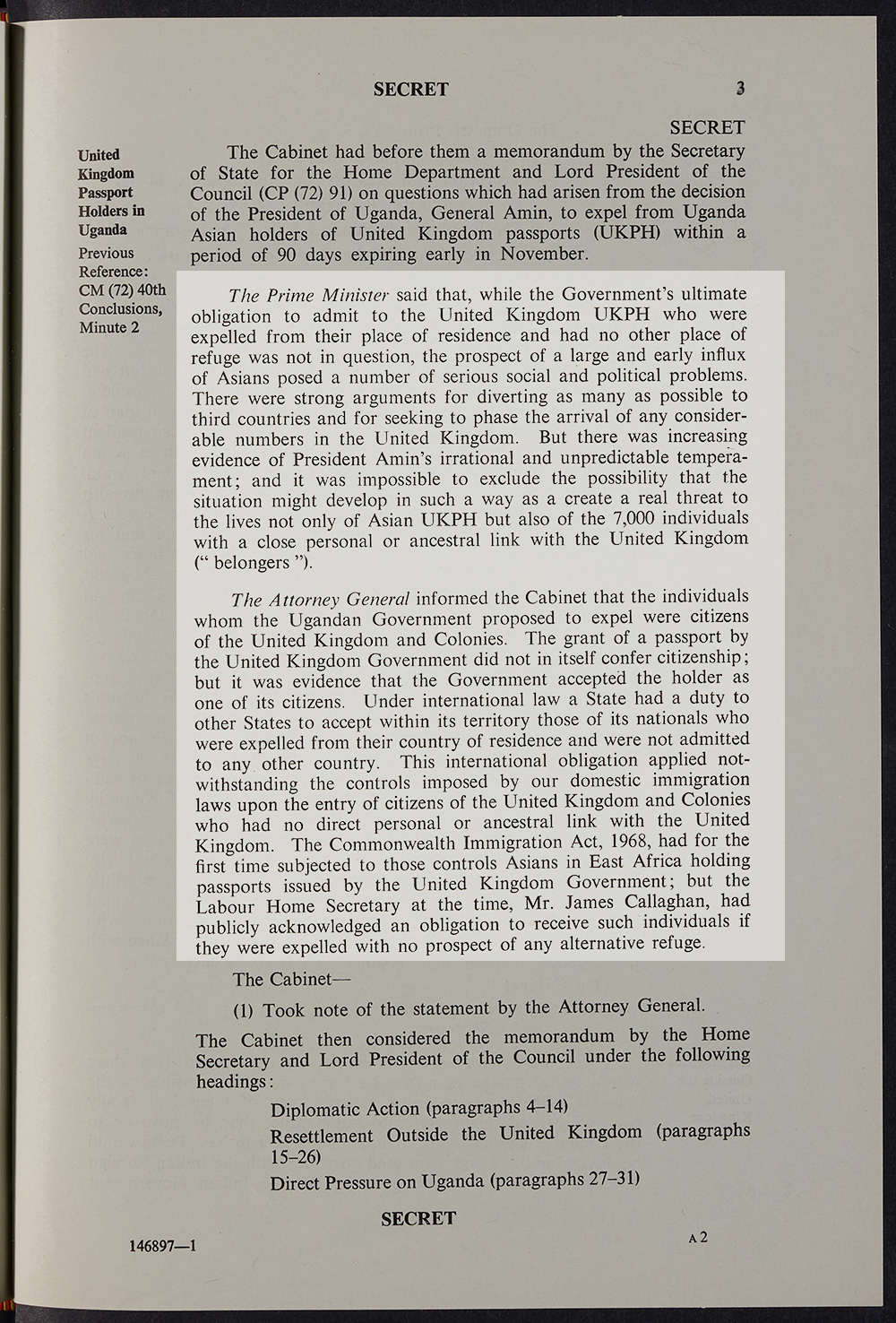
Ministers discuss resettlement outside the UK, but ultimately the Government accepted UK passport holders expelled from Uganda. Minutes from a Cabinet Meeting held on 7th September 1972. (CAB 128/50 f.7)
Transcript
The Prime Minister said that, while the Government’s ultimate obligation to admit to the United Kingdom UKPH who were expelled from their place of residence and had no other place of refuge was not in question, the prospect of a large and early influx of Asians posed a number of serious social and political problems. There were strong arguments for diverting as many as possible to third countries and for seeking to phase the arrival of any considerable numbers in the United Kingdom. But there was increasing evidence of President Amin’s irrational and unpredictable temperament; and it was impossible to exclude the possibility that the situation might develop in such a way as to create a real threat to the lives not only of Asian UKPH but also of the 7,000 individuals with a close personal or ancestral link with the United Kingdom (“belongers”).
The Attorney General informed the Cabinet that the individuals whom the Ugandan Government proposed to expel were citizens of the United Kingdom and Colonies. The grant of a passport by the United Kingdom Government did not in itself confer citizenship; but it was evidence that the Government accepted the holder as one of its citizens. Under international law a State had a duty to other States to accept within its territory those of its nationals who were expelled from their country of residence and were not admitted to any other country. This international obligation applied not-withstanding the controls imposed by our domestic immigration laws upon the entry of citizens of the United Kingdom and Colonies who had no direct personal or ancestral link with the United Kingdom. The Commonwealth Immigration Act, 1968, had for the first time subjected to those controls Asians in East Africa holding passports issued by the United Kingdom Government; but the Labour Home Secretary at the time, Mr James Callaghan, had publicly acknowledged an obligation to receive such individuals if they were expelled with no prospect of any alternative refuge.
On 4 August 1972, General Idi Amin, President of Uganda, declared that Britain needed to take on the responsibility of caring for British subjects who were of Asian origin. He announced that all Asian holders of British passports in Uganda would have to leave the country within ninety days. This was followed by an announcement that all Asian-owned properties and businesses would be confiscated, without compensation.
The British government’s reaction was ambiguous. It tried to persuade other countries to take the expellees (including approaches to India, Malawi and Canada) but ultimately the government made a clear commitment that all UK passport holders would be admitted. The government enabled some 27,000 to move to the UK through the Uganda Resettlement Board.
There were objections to the arrival of the Ugandan Asians in the UK from some quarters and undoubtedly there were some problems regarding conditions in some resettlement camps and securing decent accommodation in general. However, over time, this migration came to be seen, in broad terms, as a success story. In his autobiography, The Course of My Life, Prime Minister Edward Heath wrote that he never regretted to decision to take in the refugees, ‘for the Ugandan Asians have brought a wealth of endeavour, enterprise and natural talent to these shores’.
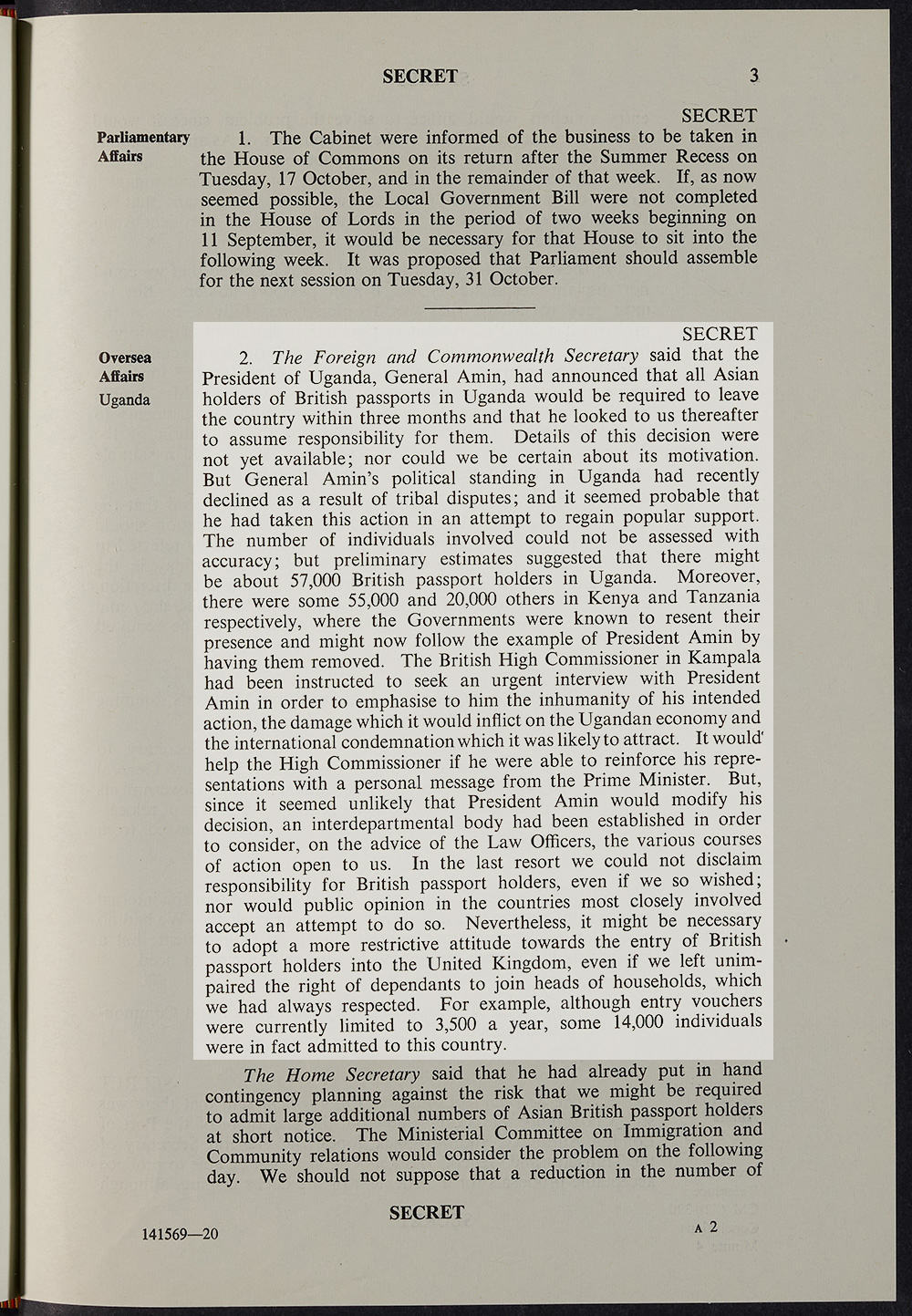
Ministers discuss resettlement outside the UK, but ultimately the Government accepted UK passport holders expelled from Uganda. Minutes from a Cabinet Meeting held on 8th August 1972. (CAB 128/50 f.3)
Transcript
Minutes of Cabinet Meeting, 8 August 1972
Secret
The Foreign and Commonwealth Secretary said that the President of Uganda, General Amin, had announced that all Asian holders of British passports in Uganda would be required to leave the country within three months and that he looked to us thereafter to assume responsibility for them. Details of this decision were not yet available; nor could we be certain about its motivation. But General Amin’s political standing in Uganda had recently declined as a result of tribal disputes; and it seemed probable that he had taken this action in an attempt to regain popular support. The number of individuals involved could not be assessed with accuracy; but preliminary estimates suggested that there might be about 57,000 British passport holders in Uganda. Moreover, there were some 55,000 and 20,000 others in Kenya and Tanzania respectively, where the governments were known to resent their presence and might now follow the example of President Amin by having them removed. The British High Commissioner in Kampala had been instructed to seek an urgent interview with President Amin in order to emphasis to him the inhumanity of his intended action, the damage which it would inflict on the Ugandan economy and the international condemnation which it was likely to attract. It would help the High Commissioner if he were able to reinforce his representations with a personal message from the Prime Minister. But, since it seemed unlikely that President Amin would modify his decision, an interdepartmental body had been established in order to consider, on the advice of the Law Officers, the various courses of action open to us. In the last resort we could not disclaim responsibility for British passport holders, even if we so wished; nor would public opinion in the countries most closely involved accept an attempt to do so. Nevertheless, it might be necessary to adopt a more restrictive attitude towards the entry of British passport holders into the United Kingdom, even if we left unimpaired the right of dependants to join heads of households, which we had always respected. For example, although entry vouchers were currently limited to 3,500 a year, some 14,000 individuals were in fact admitted to this country.
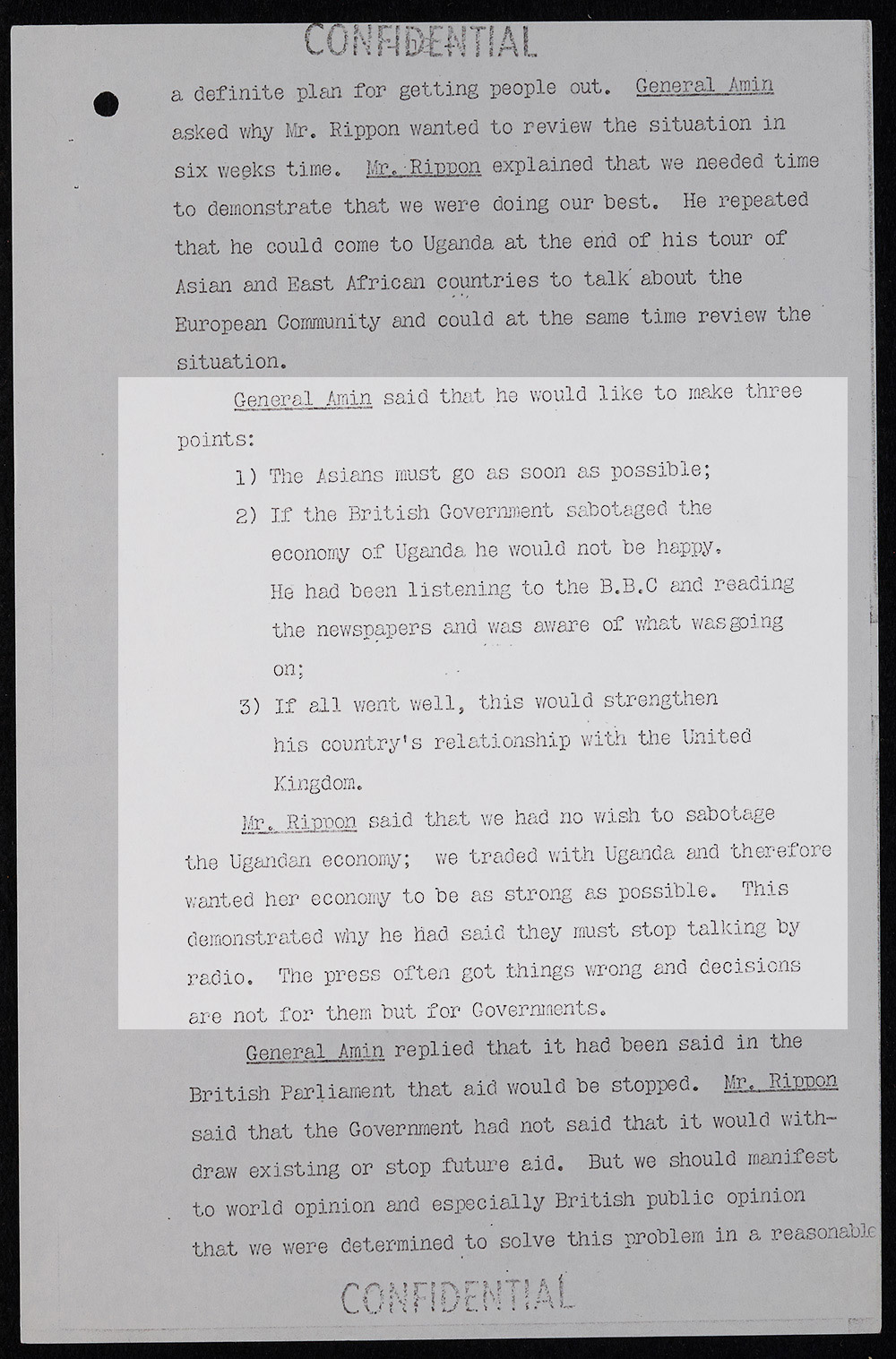
This account of a meeting held on the 15th August 1972 between Geoffrey Ripon and General Amin shows the difficulties in pursuing diplomatic relations between Uganda and the UK at the time of the expulsion of the Ugandan Asians. (FCO 89/10 f.12)
Transcript
General Amin said that he would like to make three points:
1. The Asians must go as soon as possible;
2. If the British Government sabotaged the economy of Uganda he would not be happy. He had been listening to the B.B.C. and reading the newspapers and was aware of what was going on:
3. If all went well, this would strengthen his country’s relationship with the United Kingdom.
Mr Rippon said that we had no wish to sabotage the Ugandan economy; we traded with Uganda and therefore wanted her economy to be as strong as possible. This demonstrated why he had said they must stop talking by radio. The press often got things wrong and decisions are not for them but for Governments.

This account of a meeting held on the 15th August 1972 between Geoffrey Ripon and General Amin shows the difficulties in pursuing diplomatic relations between Uganda and the UK at the time of the expulsion of the Ugandan Asians. (FCO 89/10 f.1)
Transcript
Confidential
Meeting between the RT. Hon Geoffrey Rippon Q.C. M.P., Chancellor of the Duchy of Lancaster and General Amin, President of Uganda, held at the Command Post, Kampala at 11.00 hours on Tuesday, 15 August 1972.
Present:
Rt. Hon. Geoffrey Rippon H.E. President Didi Amin
Mr R.N.K. Slater H.E. Mr Oboth Ofumbi (Minister
Of Internal Affairs)
Mr S.Y. Dawbarn H.E. Mr. E Wakhweya (Minister of Finance.
Mr D Walker H.E. Mr Lutara (Min of Commerce)
Miss C. Wheatley H.E. Mr Byagagaire(Acting Foreign
Minister)
Mr Etiang (Permanent Secretary, MFA)
General Amin welcomed Mr. Rippon and said that he had cancelled a holiday to be with him today. He invited him to lunch at the State House. He thanked him for his letter.
Mr Rippon said that he hoped the letter illustrated how we could deal with the Problem. He would like to make two things clear: firstly, that the Uganda Government was solely responsible for the way in which Uganda was run; secondly, that the Government of the United Kingdom accepted its responsibilities for United Kingdom passport holders.
Both governments had responsibilities and both had problems which each could appreciate. They must discuss how to solve the practical problems in a decent, orderly and humane way. They had very friendly relations as countries and many common interests. They were both practical men and would undoubtedly be able to sort this out.
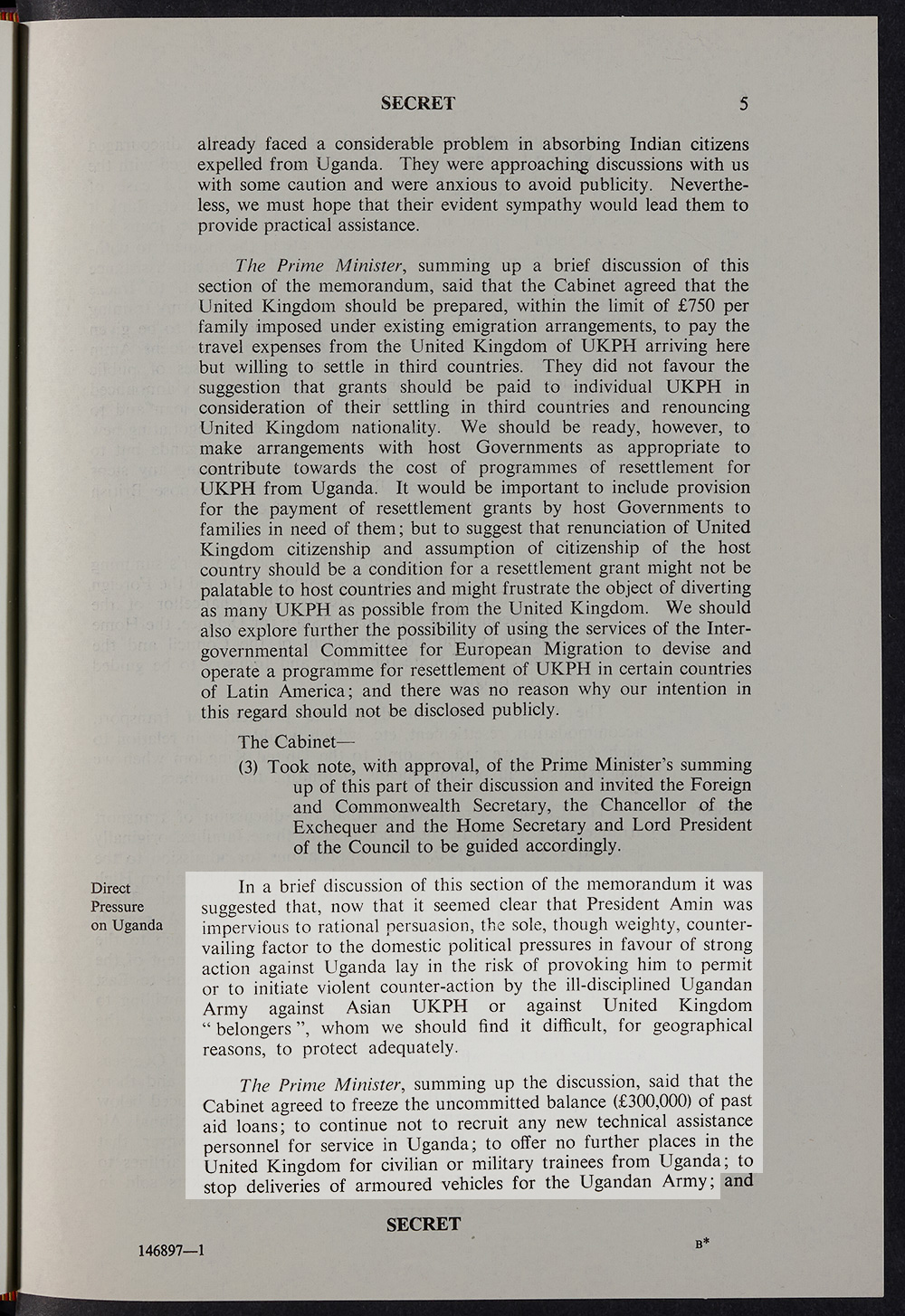
Ministers discuss resettlement outside the UK, but ultimately the Government accepted UK passport holders expelled from Uganda. Minutes from a Cabinet Meeting held on 7th September 1972. (CAB 128/50 f.9)
Transcript
Direct Pressure on Uganda.
In a brief discussion of this section of the memorandum it was suggested that, now that it seemed clear that President Amin was impervious to rational persuasion, the sole, though weighty, counter-vailing factor to the domestic political pressures in favour of strong action against Uganda lay in the risk of provoking him to permit or to initiate violent counter-action by the ill-disciplined Ugandan Army against Asian UKPH or against United Kingdom “belongers”, whom we should find it difficult, for geographical reasons, to protect adequately.
The Prime Minister summing up the discussion, said that the Cabinet agreed to freeze the uncommitted balance (£300,000) of past aid loans; to continue not to recruit any new technical assistance personnel for service in Uganda; to offer no further places in the United Kingdom for civilian or military trainees from Uganda; to stop deliveries of armoured vehicles for the Ugandan Army.
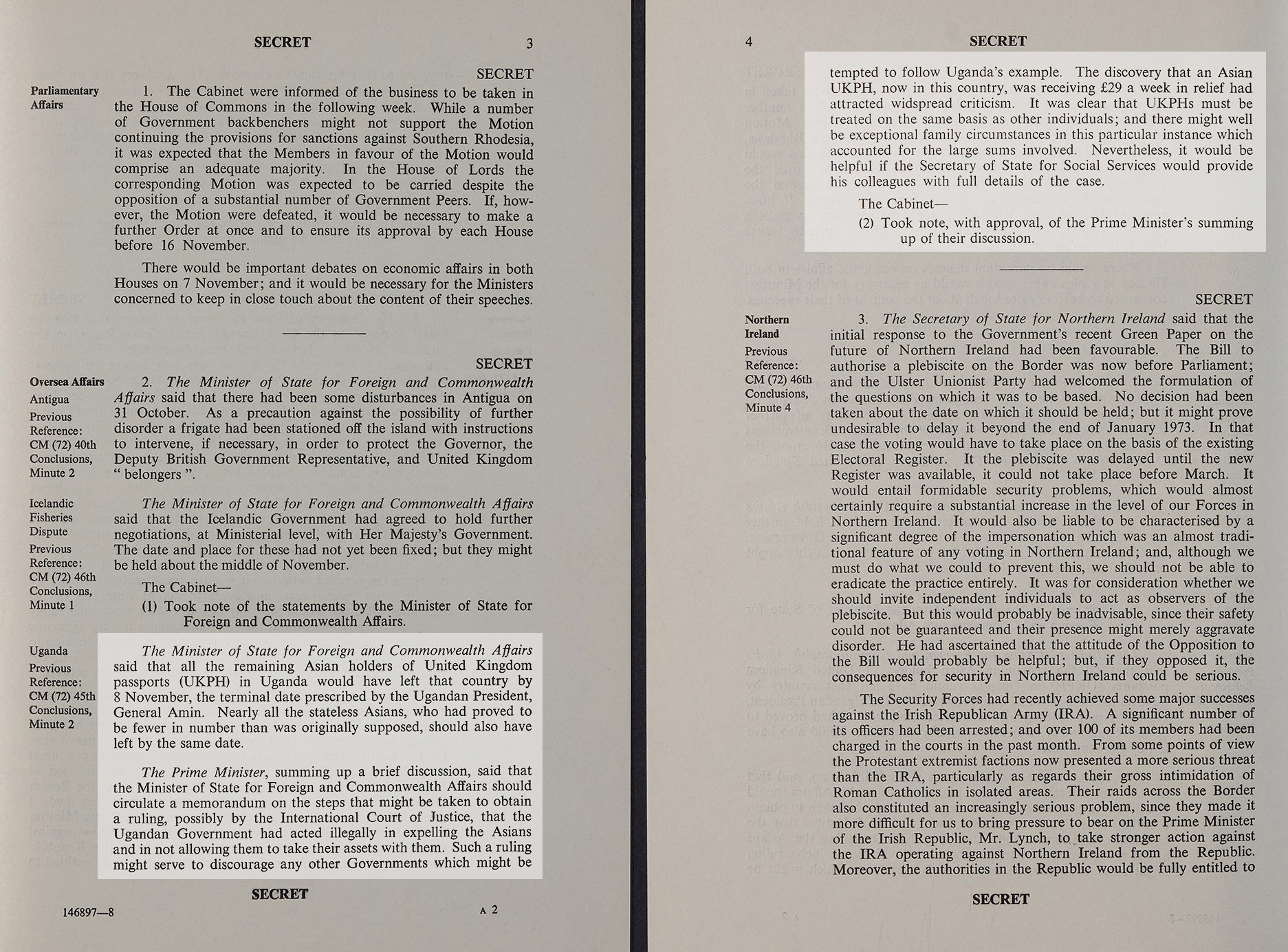
Ministers discuss resettlement outside the UK, but ultimately the Government accepted UK passport holders expelled from Uganda. Minutes from a Cabinet Meeting held on 2nd November 1972. (CAB 128/50 f.19-20)
Transcript
The Minister of State for Foreign and Commonwealth Affairs said that all the remaining Asian holders of United Kingdom passports (UKPH) in Uganda would have left that country by 8 November, the terminal date prescribed by the Ugandan President, General Amin. Nearly all the stateless Asians, who had proved to be fewer in number than was originally supposed, should also have left by the same date.
The Prime Minister, summing up a brief discussion, said that the Minister of State for Foreign and Commonwealth Affairs should circulate a memorandum on the steps that might be taken to obtain a ruling, possibly by the International Court of Justice, that the Ugandan Government had acted illegally in expelling the Asians and in not allowing them to take their assets with them. Such a ruling might serve to discourage any other Governments which might be tempted to follow Uganda’s example. The discovery that an Asian UKPH, now in this country, was receiving £29 a week in relief had attracted widespread criticism. It was clear that UKPHs must be treated on the same basis as other individuals; and there might well be exceptional family circumstances in this particular instance which accounted for the large sums involved. Nevertheless, it would be helpful if the Secretary of State for Social Services would provide his colleagues with full details of the case.
The Cabinet -Took note, with approval, of the Prime Minister’s summing up of their discussion.