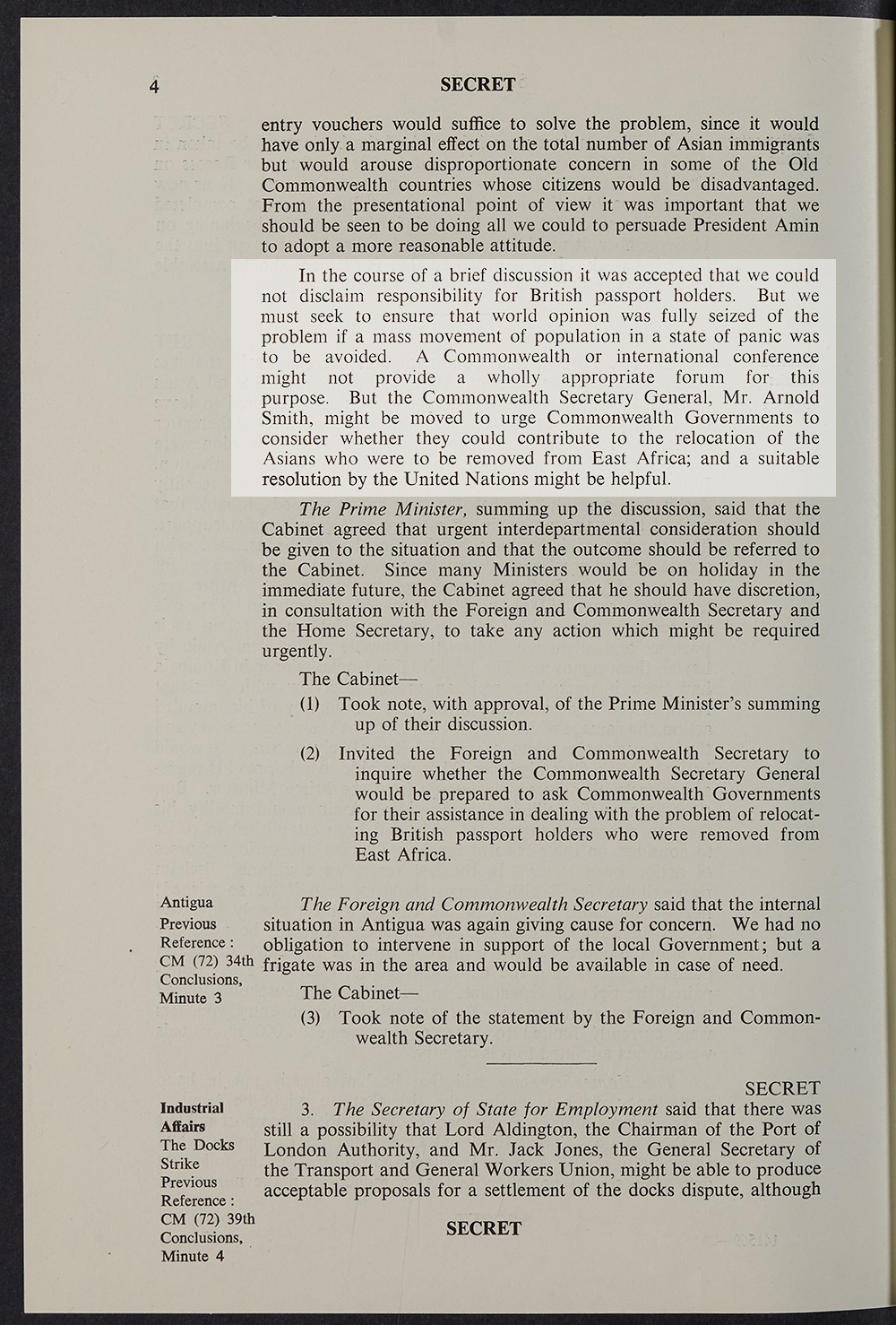
Ministers discuss resettlement outside the UK, but ultimately the Government accepted UK passport holders expelled from Uganda. Minutes from a Cabinet Meeting held on 8th August 1972. (CAB 128/50 f.4)
Transcript
In the course of a brief discussion, it was accepted that we could not disclaim responsibility for British passport holders. But we must seek to ensure that world opinion was fully seized of the problem if a mass movement of population in a state of panic was to be avoided. A Commonwealth or international conference might not provide a wholly appropriate forum for this purpose. But the Commonwealth Secretary General, Mr Arnold Smith, might be moved to urge Commonwealth Governments to consider whether they could contribute to the relocation of the Asians who were to be removed from East Africa; and a suitable resolution by the United Nations might be helpful.
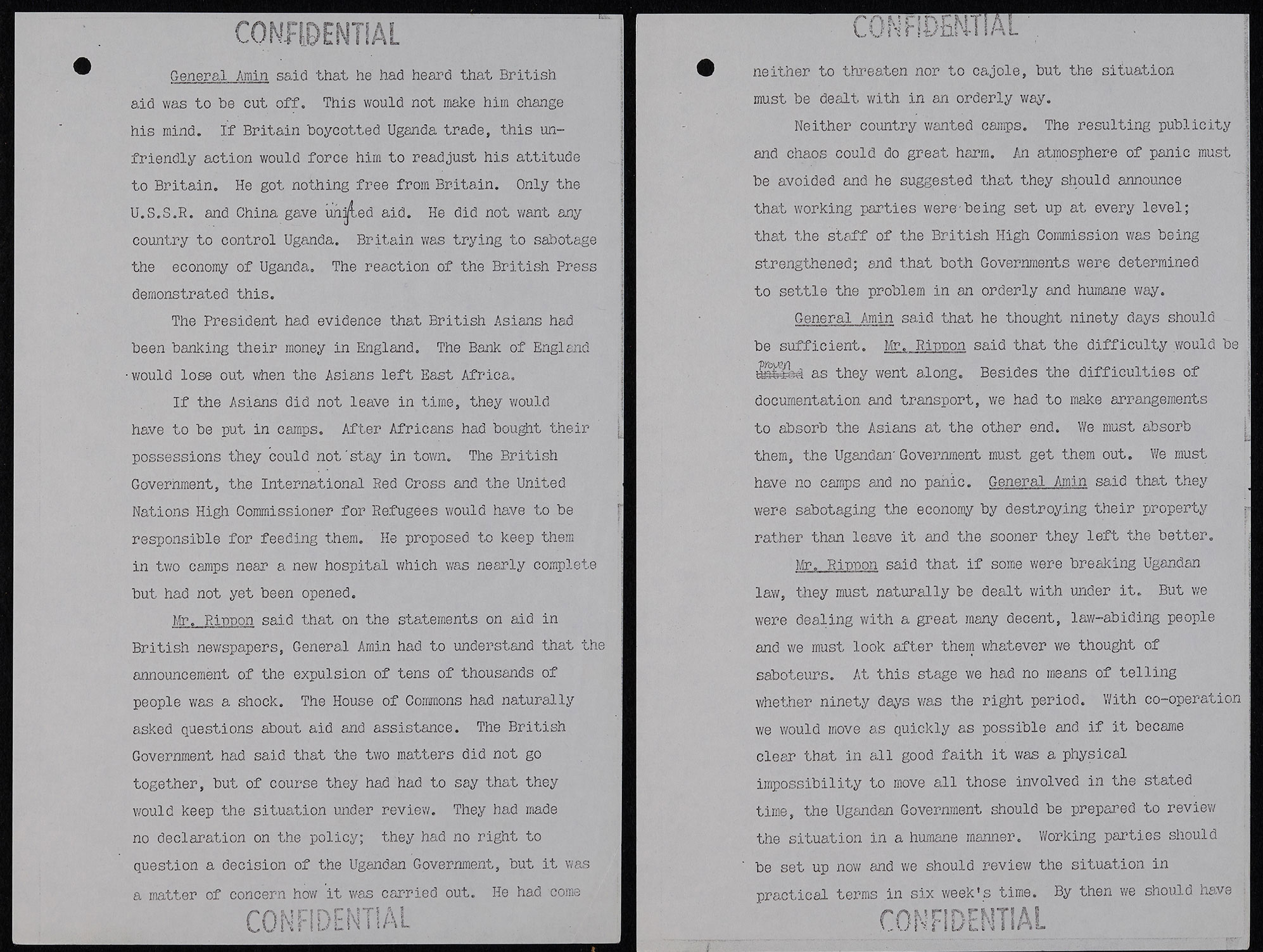
This account of a meeting held on the 15th August 1972 between Geoffrey Ripon and General Amin shows the difficulties in pursuing diplomatic relations between Uganda and the UK at the time of the expulsion of the Ugandan Asians. (FCO 89/10 f.10-11)
Transcript
General Amin said that he had heard that British aid was to be cut off. This would not make him change his mind. If Britain boycotted Uganda trade, this unfriendly action would force him to readjust his attitude to Britain. He got nothing free from Britain. Only the U.S.S.R. and China gave unlimited aid. He did not want any country to control Uganda. Britain was trying to sabotage the economy of Uganda. The reaction of the British Press demonstrated this.
The President had evidence that British Asians had been banking their money in England. The Bank of England would lose out when the Asians left East Africa.
If the Asians did not leave in time, they would have to be put in camps. After Africans had bought their possessions they could not stay in town. The British Government, the International Red Cross and the United Nations High Commissioner for refugees would have to be responsible for feeding them. He proposed to keep them in two camps near a new hospital which was nearly complete but had not yet been opened.
Mr Rippon said that on the statements on aid in British newspapers, General Amin had to understand that the announcement of the expulsion of tens of thousands of people was a shock. The House of Commons had naturally asked questions about aid and assistance. The British Government had said that the two matters did not go together, but of course they had had to say that they would keep the situation under review. They had made no declaration on the policy; they had no right to question a decision of the Ugandan Government, but it was a matter of concern how it was carried out. He had come neither to threaten nor to cajole, but the situation must be dealt with in an orderly way.
Neither country wanted camps. The resulting publicity and chaos could do great harm. An atmosphere of panic must be avoided and he suggested that they should announce that working parties were being set up at every level; that the staff of the British High Commission was being strengthened; and that both governments were determined to settle the problem in an orderly and humane way.
General Amin said that he thought ninety days should be sufficient. Mr Rippon said that the difficulty would be proven as they went along. Besides the difficulties of documentation and transport, we had to make arrangements to absorb the Asians at the other end. We must absorb them, the Ugandan Government must get them out. We must have no camps and no panic. General Amin said that they were sabotaging the economy by destroying their property rather than leave it and the sooner they left the better.
Mr Rippon said that if some were breaking Ugandan law, they must naturally be dealt with under it. But we were dealing with a great many decent, law-abiding people and we must look after them whatever we thought of saboteurs. At this stage we had no means of telling whether ninety days was the right period. With co-operation we would move as quickly as possible and if it became clear that in all good faith it was a physical impossibility to move all those involved in the stated time, the Ugandan Government should be prepared to review the situation in a humane manner. Working parties should be set up now and we should review the situation in practical terms in six week’s time.
Lord Jitesh Gadhia
Lord Jitesh Gadhia is an investment banker and businessman. He was Senior Managing Director at Blackstone before being appointed to the House of Lords in 2016. He currently serves on the Boards of Rolls-Royce and Taylor Wimpey and is Chair of The British Asian Trust, a charitable foundation established by HRH The Prince of Wales. Jitesh was born in Uganda and arrived in the UK with his family in 1972.
Mr Sukhpal Singh Ahluwalia
Sukhpal Singh Ahluwalia is one of the country’s most successful Ugandan Asian entrepreneurs. He founded Euro Car Parts and grew it to over £1.2 billion in revenue. Today, he is Non-Executive Chairman of property developer Dominvs Group. Passionate about India and his long-awaited return, he founded the Ahluwalia Family Foundation to support children’s causes. His family was accommodated at Greenham Common resettlement camp, and he remembers with affection the shepherd’s pie and apple tart he ate on visits to a local family.
Professor Akbar Vohra
Professor Akbar Vohra was born in Uganda and arrived with his family at Stansted Airport on 27 September 1972. He spent an initial two weeks at Stradishall camp before moving to Peterborough. He trained in medicine in Manchester and became a consultant in cardiac anaesthesia and intensive care, managing his department for five years. In this role he looked after more than 15,000 patients; dealt with the AIDS and COVID epidemics; taught students, nurses, paramedics, soldiers and doctors from around the world. He is still looking for the magnet and blue marble that he brought in his pocket from Uganda.
Dr. Shezan Muhammedi
Dr. Shezan Muhammedi is an Adjunct Research Professor in History and Researcher in Residence at Carleton University, Ontario. He also serves as a policy analyst at Immigration, Refugees and Citizenship Canada. His mother and her family came to Canada from Uganda in 1972, fuelling his passion as an advocate for those who have been forcibly displaced. His recently published book Gifts from Amin: Ugandan Asians Refugees in Canada includes over 50 oral histories with Ugandan Asians. Carleton University is hosting an academic and community-based conference titled ‘Beyond Resettlement: The History of the Ugandan Asian Community in Exile’ from November 14-16th 2022.
Dr. Maya Parmar
Dr. Maya Parmar leads the social enterprise Hadithi C.I.C. Her Ph.D in literary, cultural and postcolonial studies explores the way in which culture and identity is represented, having been displaced twice, from India to East Africa to Britain. In 2019 she published her book Reading Cultural Representations of the Double Diaspora: Britain, East Africa, Gujarat. She now directs ‘Hidden Heritages Cambridgeshire’, an intergenerational oral history project, supported by the National Lottery Heritage Fund. The daughter of twice migrants, Maya often visits her parental home to be welcomed by a plate of the Indian-East-African favourite chilli mogo.
MC/Panel Moderator Babita Sharma
Babita Sharma is an award-winning Author, Journalist and Broadcaster. Babita is the author of the award-winning book The Corner Shop and she has collaborated with the National Trust and The Migration Museum for two major projects about corner shop life in Britain. Babita has also spent more than a decade covering major news stories for BBC News and is a well-known face on TV and radio, presenting several television documentaries, including her landmark BBC Two series Dangerous Borders: The Story of India & Pakistan that charted the history of the Partition of India.
supported by:
Jasani Foundation Uganda