To manage digital continuity, you must understand your organisation’s specific issues and risks. As part of our service development, we’re undertaking a risk and opportunities assessment with all central government departments. The assessment will highlight specific risks to the continuity of your digital information, and opportunities that can be realised from mitigating these risks. This will result in recommendations tailored to specific departmental needs.
The assessment is part of a four-stage process to help you manage digital continuity. Carrying out a risk assessment forms part of Stage 3: Assess and manage risks to digital continuity.
For the wider public sector we have built a self-assessment tool that links to the digital continuity guidance and framework of solutions and services.
For more information on risks relating to cyber security, see our guidance on Information security.
For more information on managing your information through change, see our guidance on Machinery of government change.
Risk assessment guidance
Our risk assessment handbook will help you identify where your information is at risk and take active steps to manage these risks:
Risk Assessment Handbook (PDF, 0.33Mb)
For more guidance on assessing and managing risks to your digital continuity, including managing digital continuity loss, see Stage 3 guidance.
Self-assessment tool
The Information Management Assessment (IMA) programme has built an Information Management Self-Assessment Tool. This tool has been developed to assist government organisations in self-assessing the effectiveness of their approach to information and records management.
The tool is free to use and is divided into five modules which will give you the flexibility to target the assessment in the areas where you need it most. It has a section dedicated to Digital Continuity.
Click here to register for the tool.
There is a four-stage process which we recommend you use for managing digital continuity. You can tailor activities to suit your organisation’s specific requirements and priorities. If you have been appointed Senior Responsible Owner (SRO), you have been given overall responsibility for ensuring digital continuity and driving action forward in your organisation.
Digital continuity is the ability to use digital information in the way that you need, for as long as you need. If you do not actively work to ensure digital continuity, your information can easily become unusable. Digital continuity is about making sure that your information is complete, available and therefore usable for your business needs. Your information is usable if you can:
- find it when you need it
- open it as you need it
- work with it in the way you need to
- understand what it is and what it is about
- trust that it is what it says it is
Why digital continuity is important
Managing digital continuity protects the information you need to do business. This enables you to operate accountably, legally, effectively and efficiently. It helps you to protect your reputation, make informed decisions, reduce costs, and deliver better public services. If you lose information because you haven’t managed your digital continuity properly, the consequences can be as serious as those of any other information loss.
Digital continuity in practice
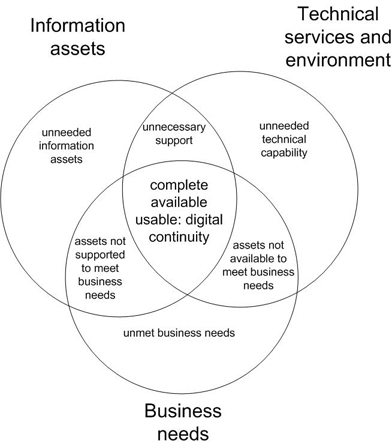
You must keep your information complete and available in the way you need to meet your usability requirements.
Usable
Your information meets your requirements for how you want to use your information (for example, to read, edit, or manipulate information).
Complete
You have everything you need to use, understand and trust the information, including the content, context and all the necessary metadata.
Available
You can find what you need and you have the correct technology to open it and work with it in the way you need. Digital continuity depends on understanding how you use your information to support business needs, and then making sure that your technical environment and your information asset management support that business use. Where they overlap, you have digital continuity; information that is cost-effective, efficiently managed, and usable.
Next steps
For more information please read our guidance below:
Understanding Digital Continuity (PDF, 0.29Mb)
This guidance is aimed at anyone who wants to know more about digital information management and digital continuity. Whether you have been given a specific role to fulfil, or if you are just reading to improve your knowledge, this is a good starting point.