Welcome to Archives Live: Whitechapel! This event was broadcast live on Monday, 13 October, 2025. While you cannot join the live Q&A, you can still watch the event and do the below activities with your students.
The stream lasts for 50 minutes and is aimed at Key Stage 4.
Below is the link to our resource pack. There are activities students can do before, during and after the event.
Introduction
This resource pack is designed to prepare and support students to take part in the Archives Live: Whitechapel live event. The resources and activities in this pack have been broken up into three different sections: before, during and after the live event.
The event itself has been designed for GCSE students with a focus on the Migration to Britain modules across all exam boards as well as the Crime and Punishment modules – particularly the Edexcel Whitechapel c1870-1900 site study.
Resource packCaribbean migration
During the event, students will learn a little about Caribbean migration to Britain in the 1800s. Migration from this area is often considered to have started with the major wave of the Windrush Generation in the 1940s, but many Caribbean communities established themselves in Britain during the 1800s with notable figures such as Mary Seacole and William Davidson featuring prominently elsewhere in History studies. As this is less of a major ‘wave’ of migration to Whitechapel than the Irish and Jewish stories it should be seen as an example of the connections and opportunities fostered by the docklands.
Crime, Punishment and Poverty in Whitechapel
Alec Munroe’s story should be seen as a case study of both crime and community in the area, working to reinforce some of the learnings students are likely to cover with the ‘Jack the Ripper’ murders while also challenging some preconceptions such as crime requiring isolation from community or helpless victims.
Alec lived in a common lodging house on Little Pearl Street run by Frederick Gehringer, whose family ran several lodging houses and pubs in the area. Gehringer is noted by George Duckworth and Sergeant French in their description of the area for Charles Booth’s poverty map, showing the police were aware of his businesses, which were known for overcrowding and drunken fights. An extract of the notebook has been provided for context on the area, however the investigators writing these notes had clear prejudices against the subjects they were observing, especially concerning race, migration, and poverty. Many comments are dehumanising in nature and should be examined critically.
Irish migration
During the live event, students will learn about the reasons for Irish migration, with a focus on the Driscoll family. At least three members of the family were match makers at the Bryant and May factory in Bow, East London. They were also leaders of the match women’s strike at this factory in 1888.
The 1888 match women’s strike was a pivotal labour movement event where approximately 1,400 female workers at the Bryant & May match factory in Bow, London, walked out to protest appalling working conditions, low wages, and unfair dismissal. Context of Irish migration to Britain Irish people migrated to Britain long before the 19th century, but the Great Famine led to an increased influx. Much of the population were reliant on the potato crop as the main source of food. When the crop failed due to a virus in 1845, mass starvation occurred. . This led to over 1 million deaths and an estimated further two million emigrated to Britain and the USA. Counties Cork and Kerry in the south of Ireland were among the worst hit places. Irish migrants chose to settle in places like Whitechapel for several reasons. There were many factories located in East London, and it was closer to the Thames, offering dock labourers a chance of employment.
Jewish migration
During the event students will be introduced to the Smiths, a Jewish family who emigrated from Poland to East London in the second half of the nineteenth century. They will learn about the reasons why so many Jewish people left Eastern Europe during this time, and why for many, the East End of London became their home. Through an exploration of original documents, students will learn about how this part of London became a cultural hub for the Yiddish speaking Jewish communities that settled there. This section of the broadcast will highlight the importance that culture, language and community played in the lives of migrant communities living in Whitechapel in the late 1800s.
Context of Jewish migration to Britain in the nineteenth century
The second half of the 19th century saw a period of largescale Jewish migration to the UK. This culminated in what became known as ‘The Great Migration’, a period around 1890-1914 when lots of Eastern European Jewish people emigrated to the UK, and especially to East London. By the end of this period, 150,000 Jewish immigrants had settled in the UK. At this time, Jewish people in Eastern Europe were facing a high level of antisemitic persecution and violence that meant it was no longer safe to stay in their mother countries. Alongside this was the general economic hardship for all Eastern Europeans. It was this, along with the promise of job opportunities available in the UK that led to so many Eastern European Jewish people settling in the East End of London in the nineteenth century. Concentrated in areas like Spitalfields and Whitechapel, they established a vibrant cultural and commercial centre with Yiddish theatres, synagogues, newspapers and institutions catering to their community.
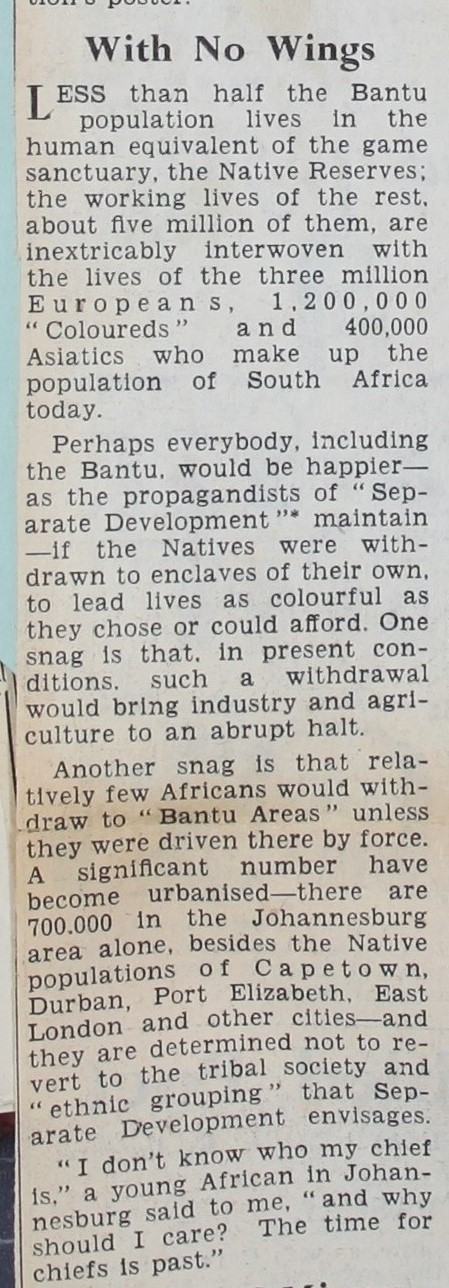
Extract from a Sunday Times article by Iain Lang entitled ‘Tragic South Africa: 2. Beyond the White Barriers’, 12 January 1958, Catalogue Ref: DO 35/6715
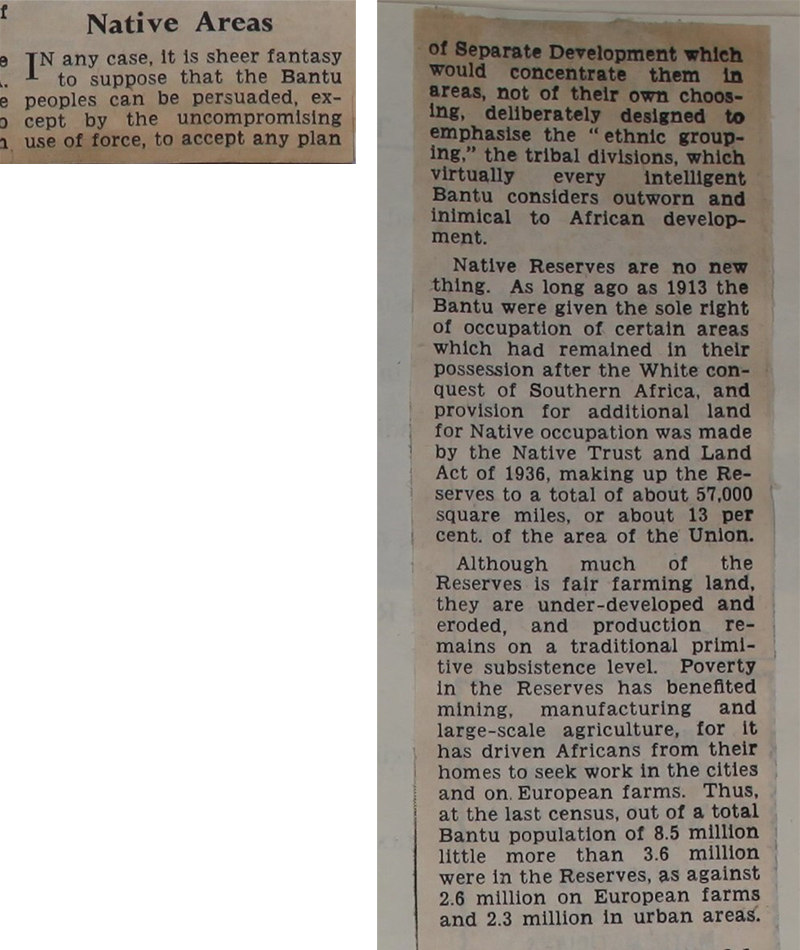
Extract from a Sunday Times article by Iain Lang entitled ‘Tragic South Africa: 1. Where Apartheid leads’, 5 January 1958, Catalogue Ref: DO 35/6715
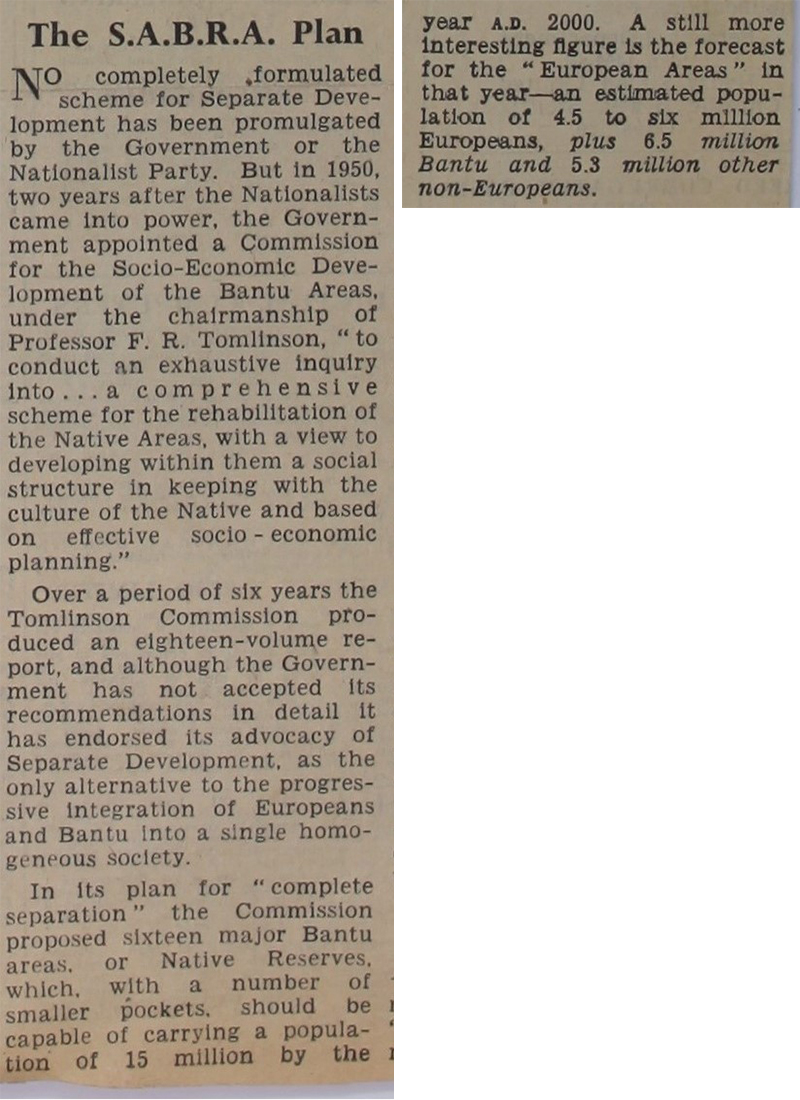
Extract from a Sunday Times article by Iain Lang entitled ‘Tragic South Africa: 1. Where Apartheid leads’, 5 January 1958, Catalogue Ref: DO 35/6715
The South African government Tomlinson Commission investigated the economic development of the native reserves, later formed as Bantustans or homelands. The Tomlinson report was published in 1954.
The South African Bureau for Racial Affairs (SABRA) was set up in 1948 at to provide an alternative to the South African Institute of Race Relations (SAIRR). The organisation provided academic justification for the apartheid policy.
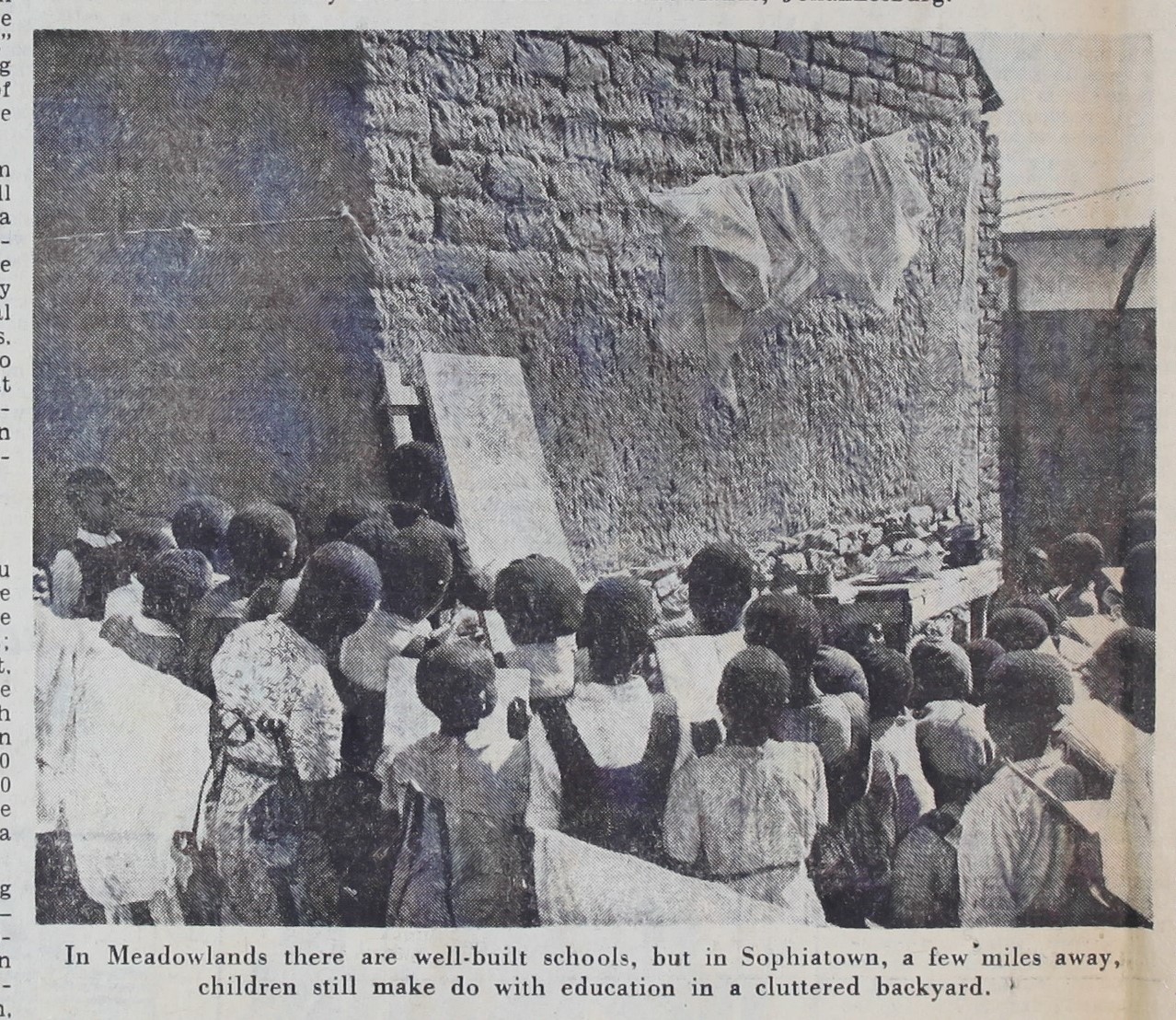
Photograph captioned ‘In Meadowlands there are well built schools, but in Sophiatown, a few miles away, children will make do with education in a cluttered backyard’.
This photograph appeared in a Sunday Times article by Iain Lang entitled ‘Tragic South Africa: 2. Beyond the White Barriers’, 12 January 1958, Catalogue Ref: DO 35/6715
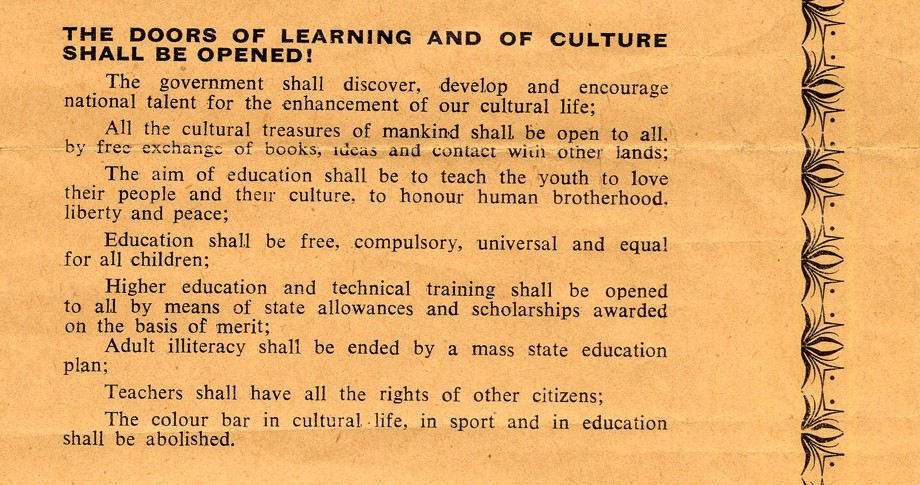
Extracts on the subject of education from the Freedom Charter © Courtesy of Historical Papers Research Archive, University of the Witwatersrand Library, South Africa.
The Freedom Charter was a charter of universal rights based on the wishes of the people. It meant a fundamental restructuring of South African society and outlined a list of freedoms and ideals in opposition to the apartheid government. In June 1955 the Freedom Charter was adopted by the Congress Alliance, the African National Congress (ANC), the South African Indian Congress (SAIC), the South African Coloured People’s Organisation, and the South African Congress of Democrats.
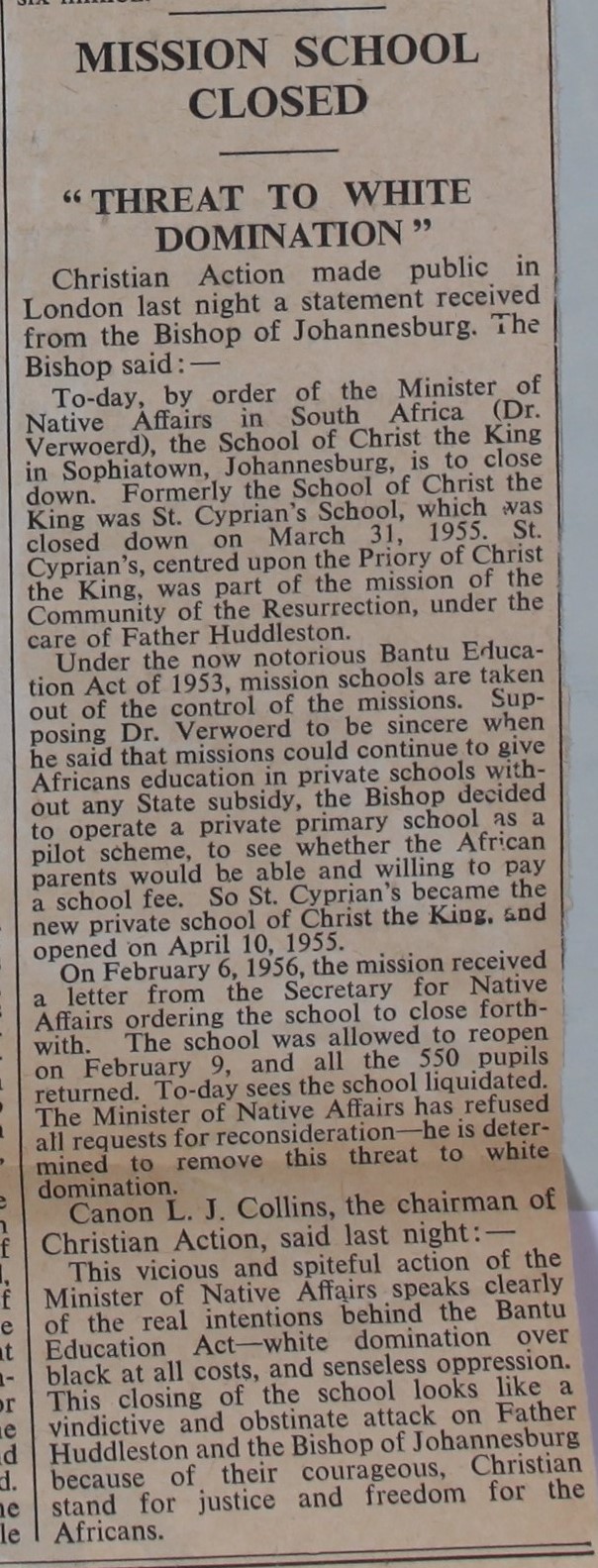
Extract from an article entitled ‘Plans for new S. African Black Communities’ from ‘The Times’, 28 March 1956, Catalogue Ref: DO 35/4382
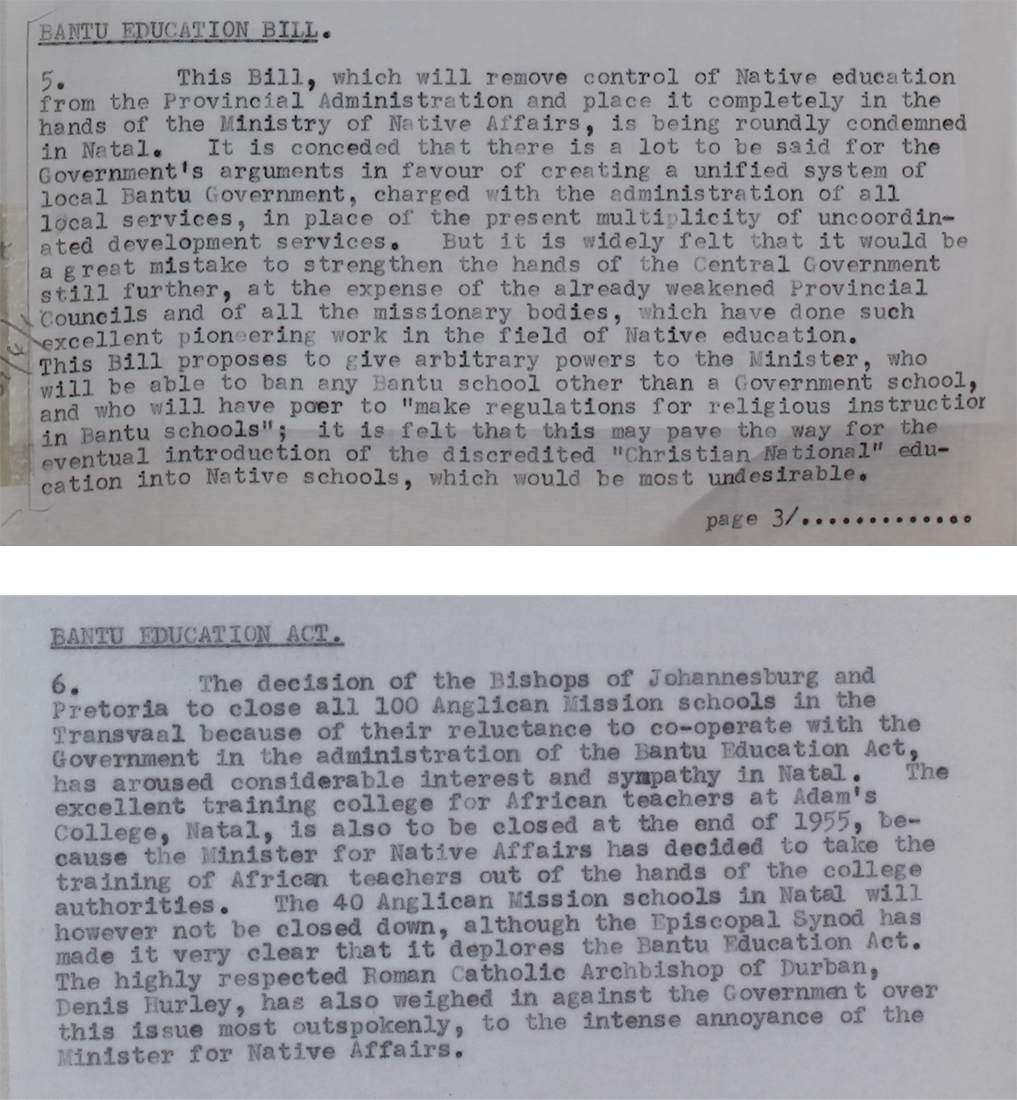
Extract from High Commissioner’s Report No.24 on the education Bill, 7 August 1953, Catalogue Ref: DO 35/6716
Extract from High Commissioner’s Report No.31 on the education Act, November 1954, Catalogue Ref: DO 35/6716
In 1949 Hendrick Verwoerd, Minister for Native Affairs and the Eiselen Commission investigated African education. This formed the basis of the later Bantu Education Act which enforced apartheid and created a limited vocational curriculum for African pupils. It meant complete separation of educational facilities for white, Black, ‘Coloured’ (mixed-race), and Indian populations, creating a huge divergence of opportunity.
African education was now controlled by the Minister for Native Affairs, not the Ministry of Education. Mission schools were no longer state funded and large numbers forced to close.
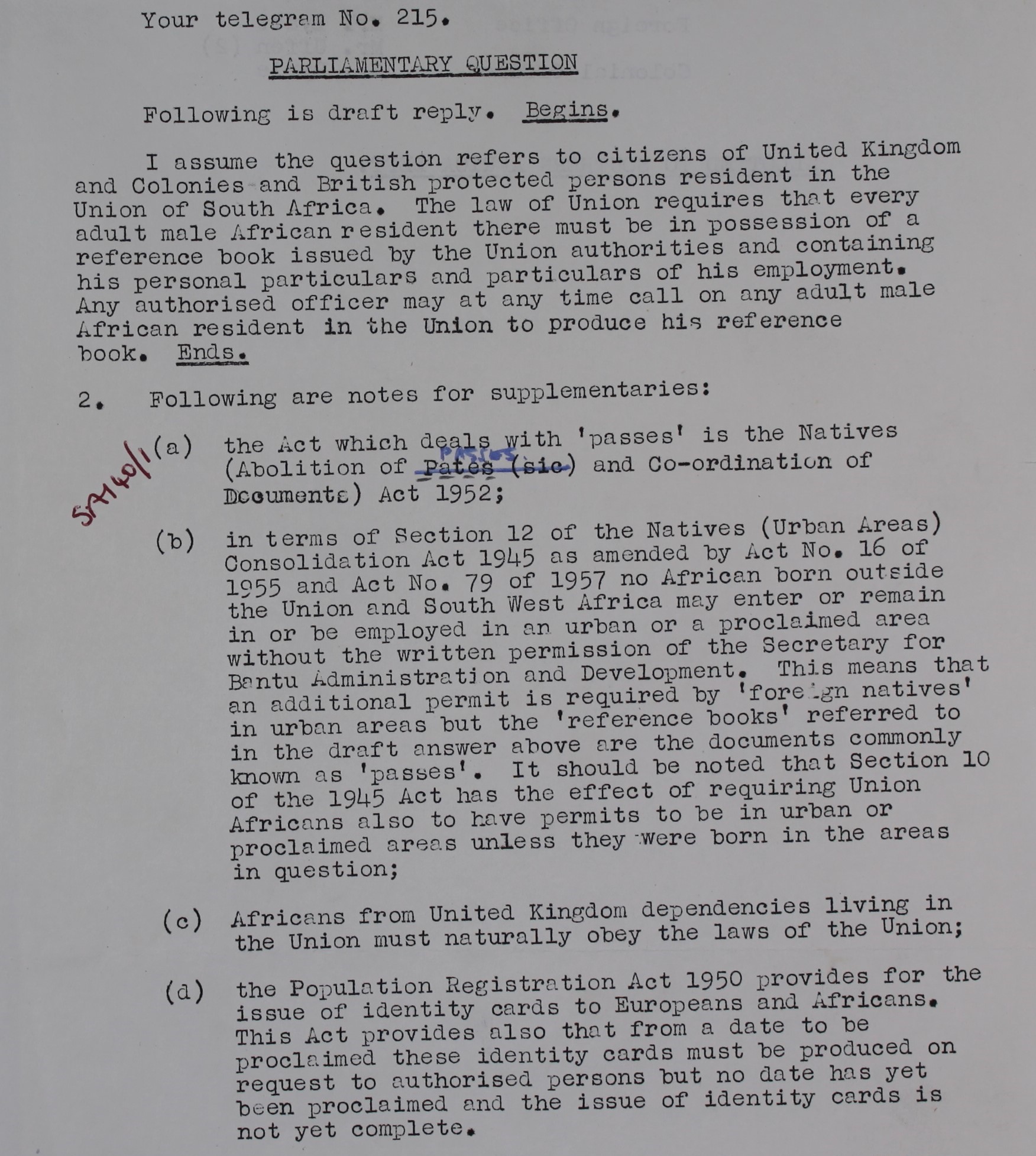
Parliamentary question in the House of Commons UK with supplementary notes, 26 March 1960, Catalogue Ref: DO 35/10578
The document refers to a question that was asked in the House of Commons about ‘citizens of United Kingdom and Colonies and British protected persons living in the Union of South Africa’. The document points out that the pass laws applied to adult male African residents and provides some ‘supplementaries’, or extra notes on the pass laws.
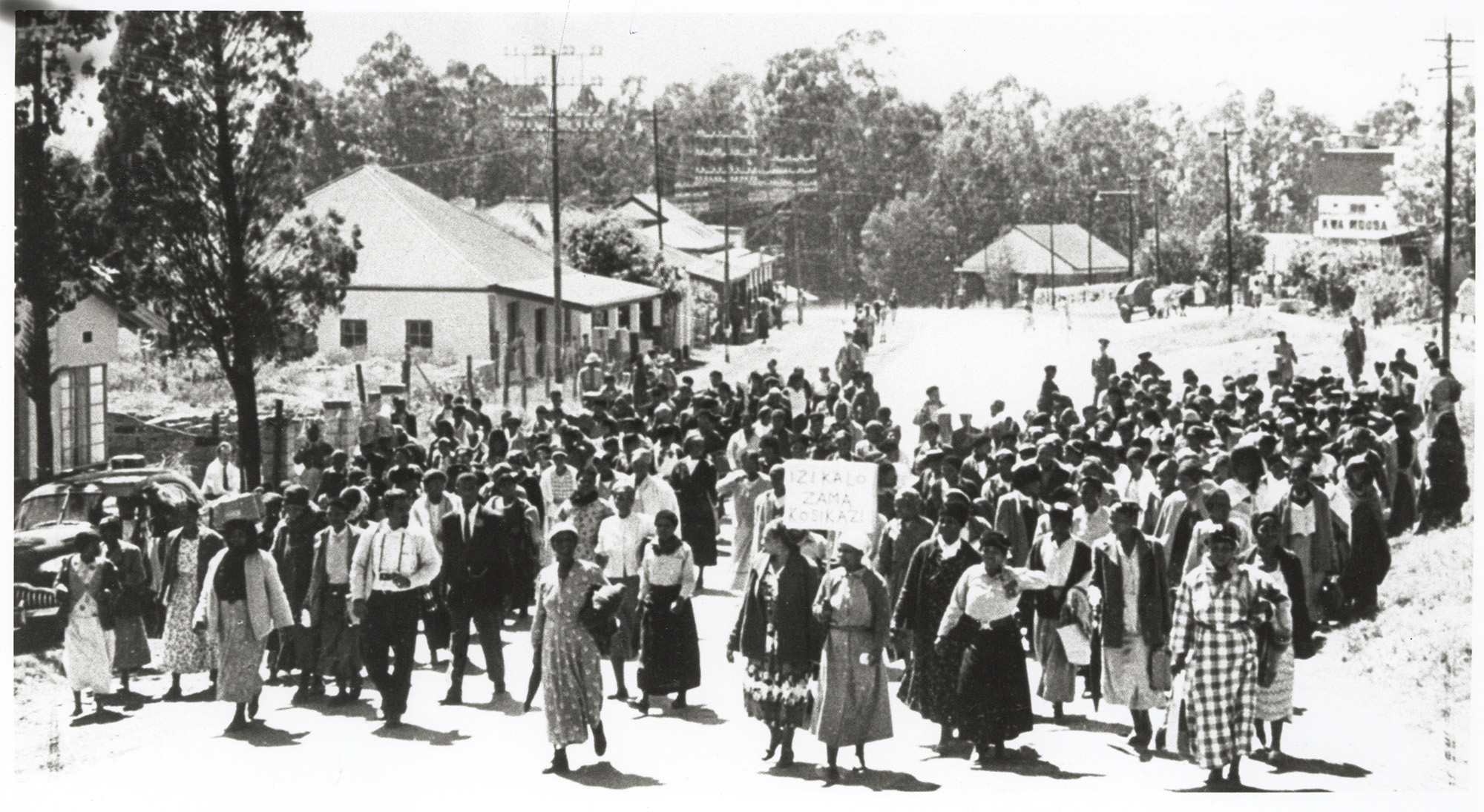
Photograph shows Women’s March of 1956 organized by the Federation of South African Women (FEDSAW). The march of around 20 000 women to the Union Buildings in Pretoria, Transvaal, South Africa, was in protest of the introduction of pass laws by the apartheid government. Eli Weinberg, ANC Archives © African Pictures Image Number: APN753315