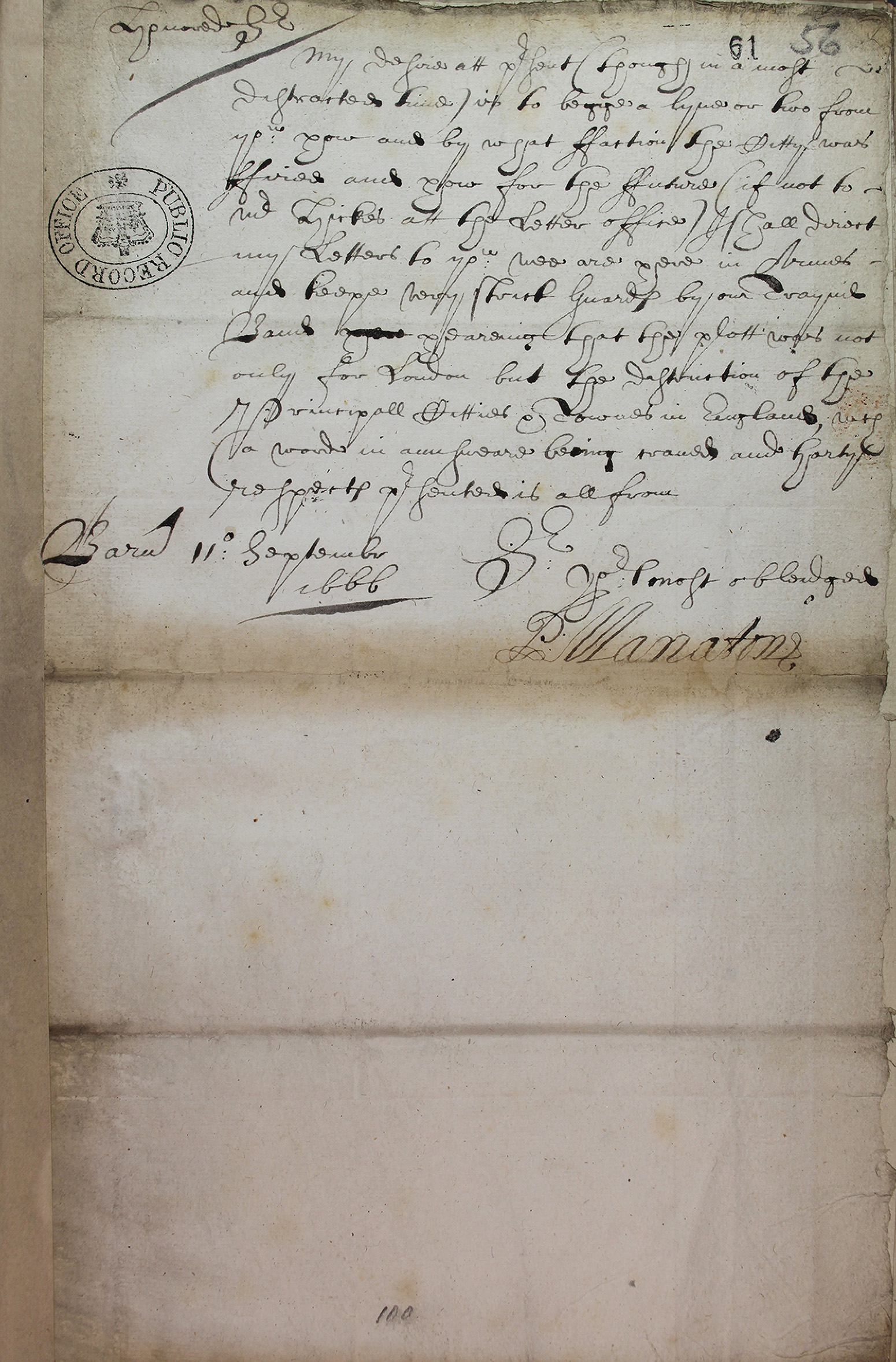
P. Manton from Barnstaple to Jospeh Williamson, 11 September 1666. Catalogue ref: SP 29/171 f56.
Joseph Williamson (1633-1701) was the Under-Secretary of State 1660-74 and Keeper of the State Papers which he reorganised from 1661-1701. He also started the ‘Oxford Gazette’ at the time of the Great Plague in 1665, which later became established as the ‘London Gazette’.
- Why did Manton write this letter?
- What does he believe about the cause of the fire?
- Why was the town of Barnstaple under armed guard
Transcript
Barnstaple
My desire at present (though in a most distracted time) is to beg a line or two from you: How and by what faction the city was fired and how for the future (if not to Master Hickes? at the weather office). I shall direct my letters to you: we are here in Arms and heap very strict guards by our trained band hearing that the plot was not only for London but the destruction of all cities and towns in England, such a word in answerance being craved and heartily respected presented is all from
Yours most obliged,
P. Manaton
Simplified transcript
My current desire is to beg a line or two of you, even in this most distracted time: how and by who was the city fired and what of the future? I shall direct my letters to you: we are here in arms and are keeping strict guard, hearing that the plot was not only for London but for the destruction of all the principal cities and towns in England, such a word or answer from you being craved an respected at this time.
P. Manaton
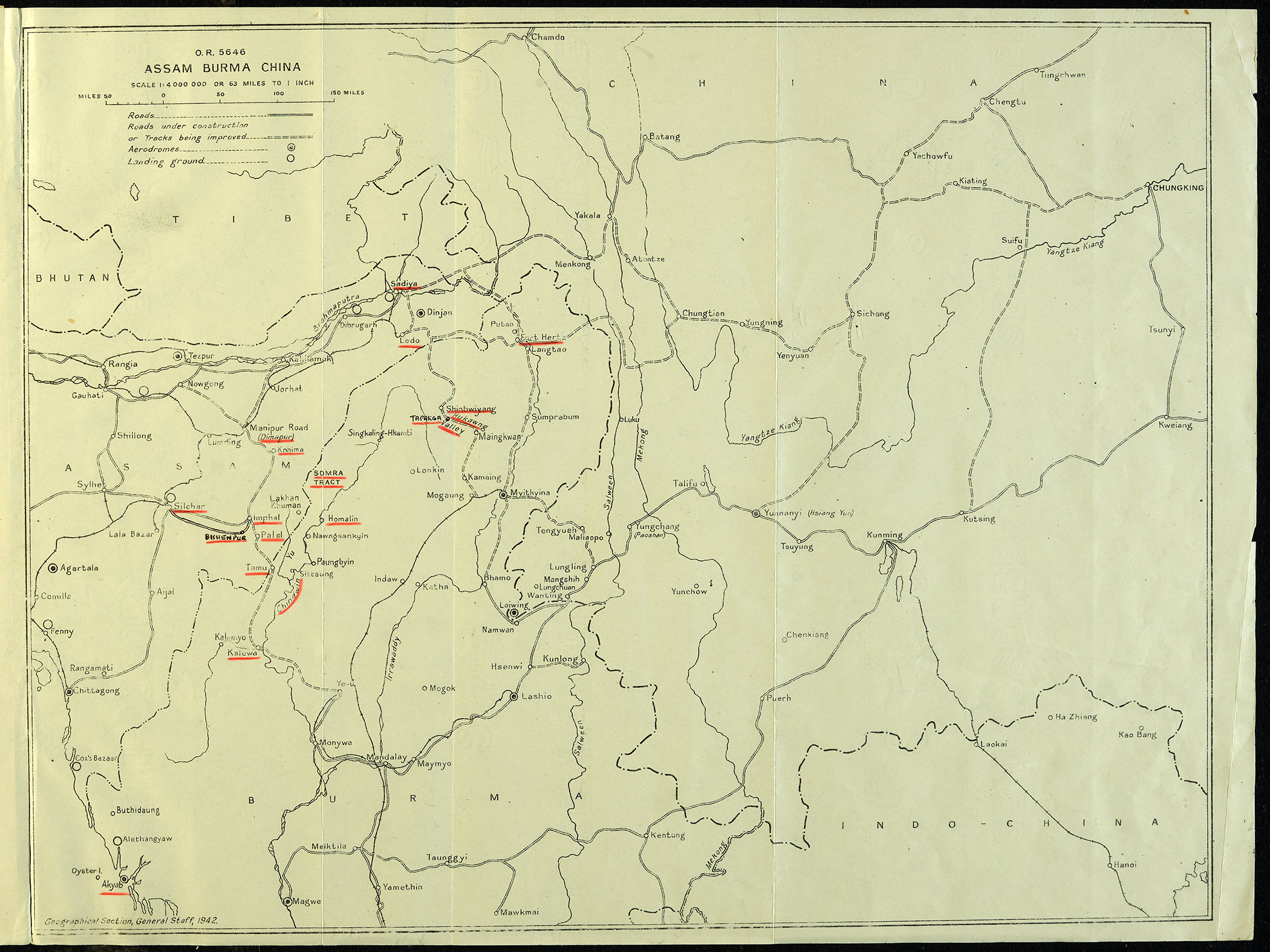
Map showing the routes taken by refugees travelling from Burma to India after Japanese bombing December 1941-February 1942, Catalogue ref: WO 106/3710
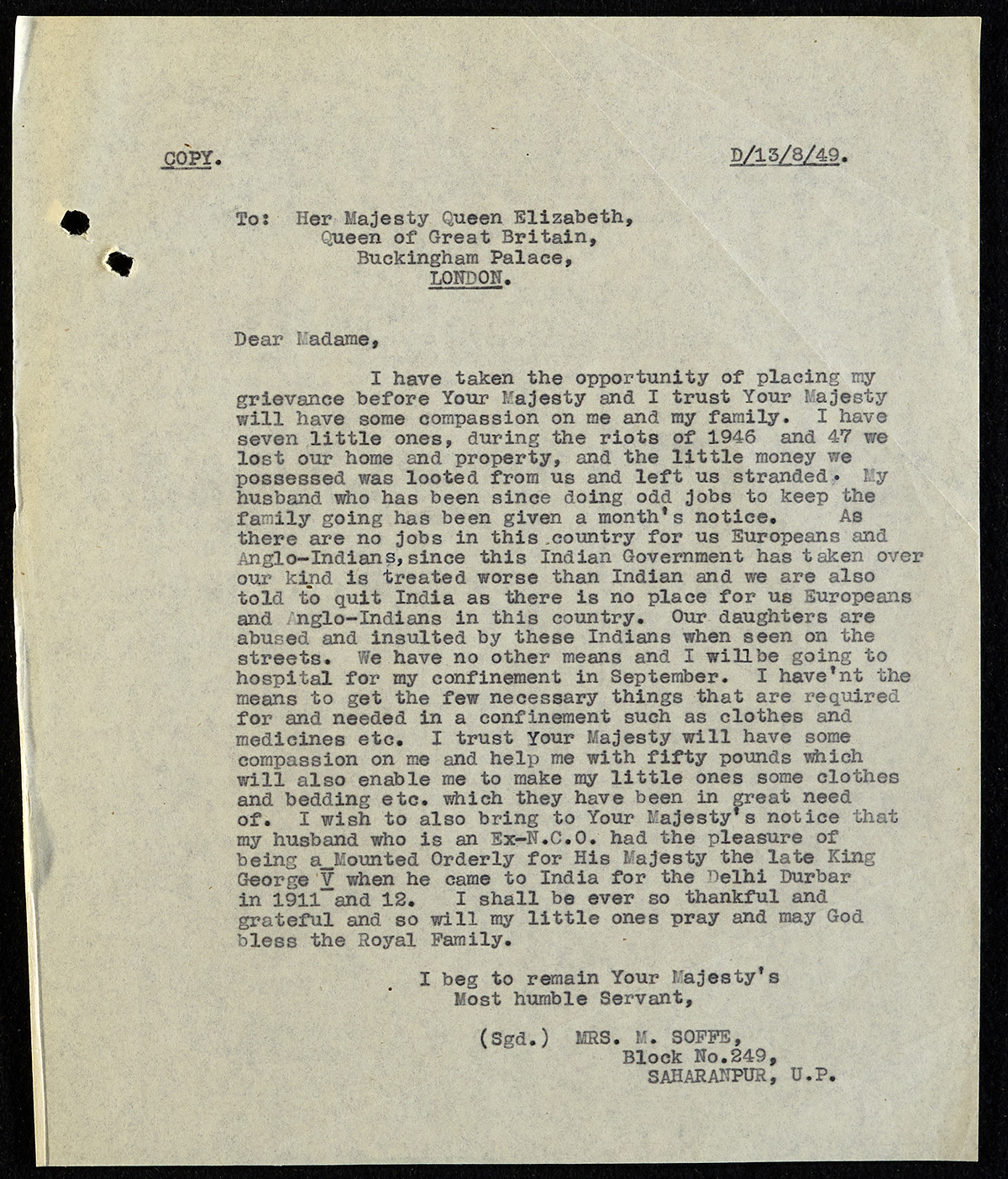
Letter to Queen Elizabeth II from Mrs Soffe in Saharanpur, Uttar Pradesh, India, 13 August 1949, Catalogue ref: DO 35/4191.
The Delhi Durbar of 1911 was a coronation ceremony held in Delhi on 12 December 1911 to mark the coronation of King George V and Queen Mary as Emperor and Empress of India.
N.C.O: An officer who does not hold a commission. He will have entered the ranks and earned his position through promotion, On the other hand, commissioned officers usually enter directly from a military academy or after some kind of training.
Mounted Orderly: A commissioned office assigned to an officer as a person man servant. In this case a member of the cavalry.
The period after the Second World War saw the rise of mass movements across India, reflecting the growing demand for independence.
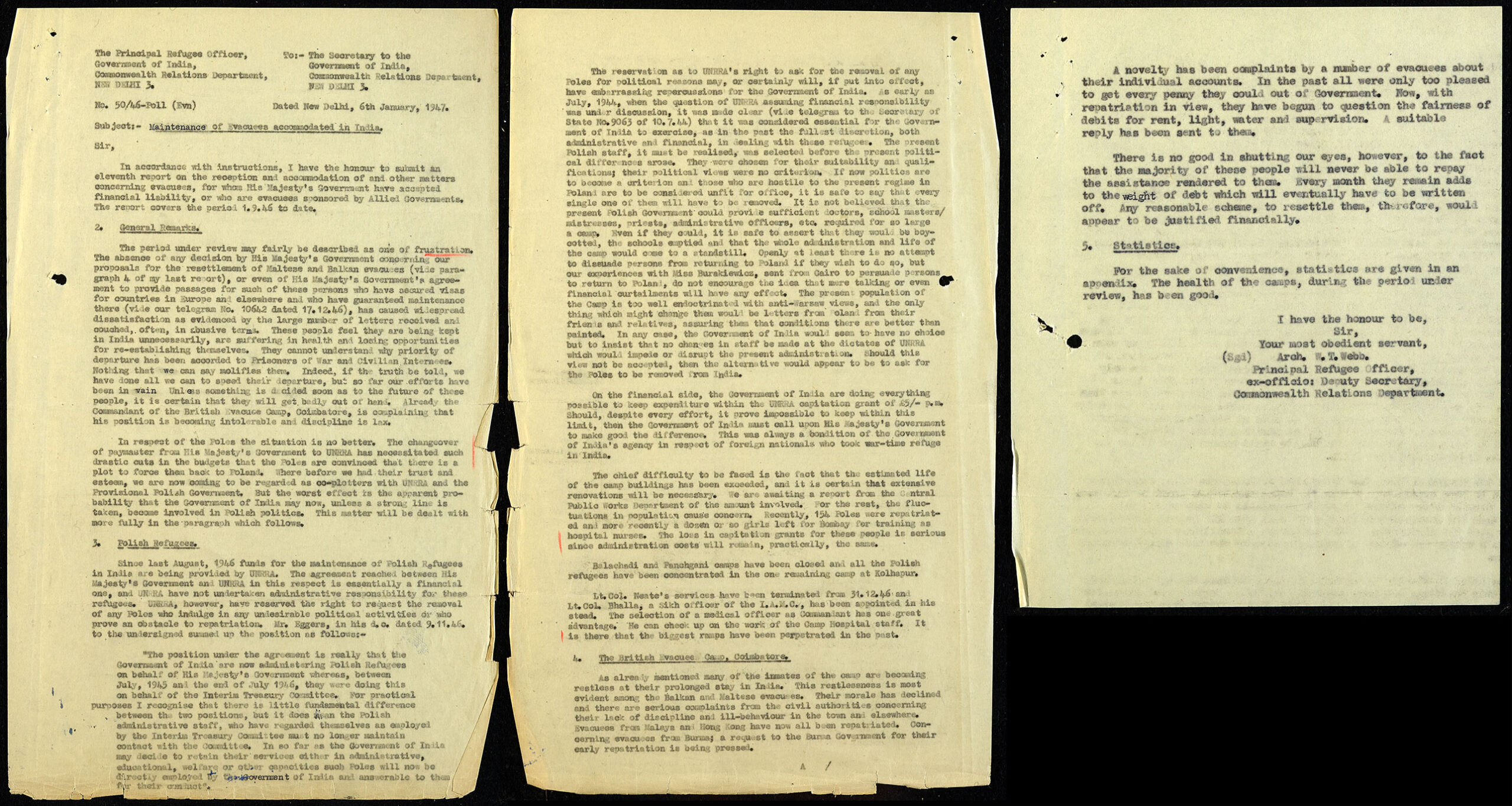
Report from the Principal Refugee Officer in New Delhi to the Secretary of the Government of India at the Commonwealth Relations Department, 6 January 1947, Catalogue ref: HO 213/1190
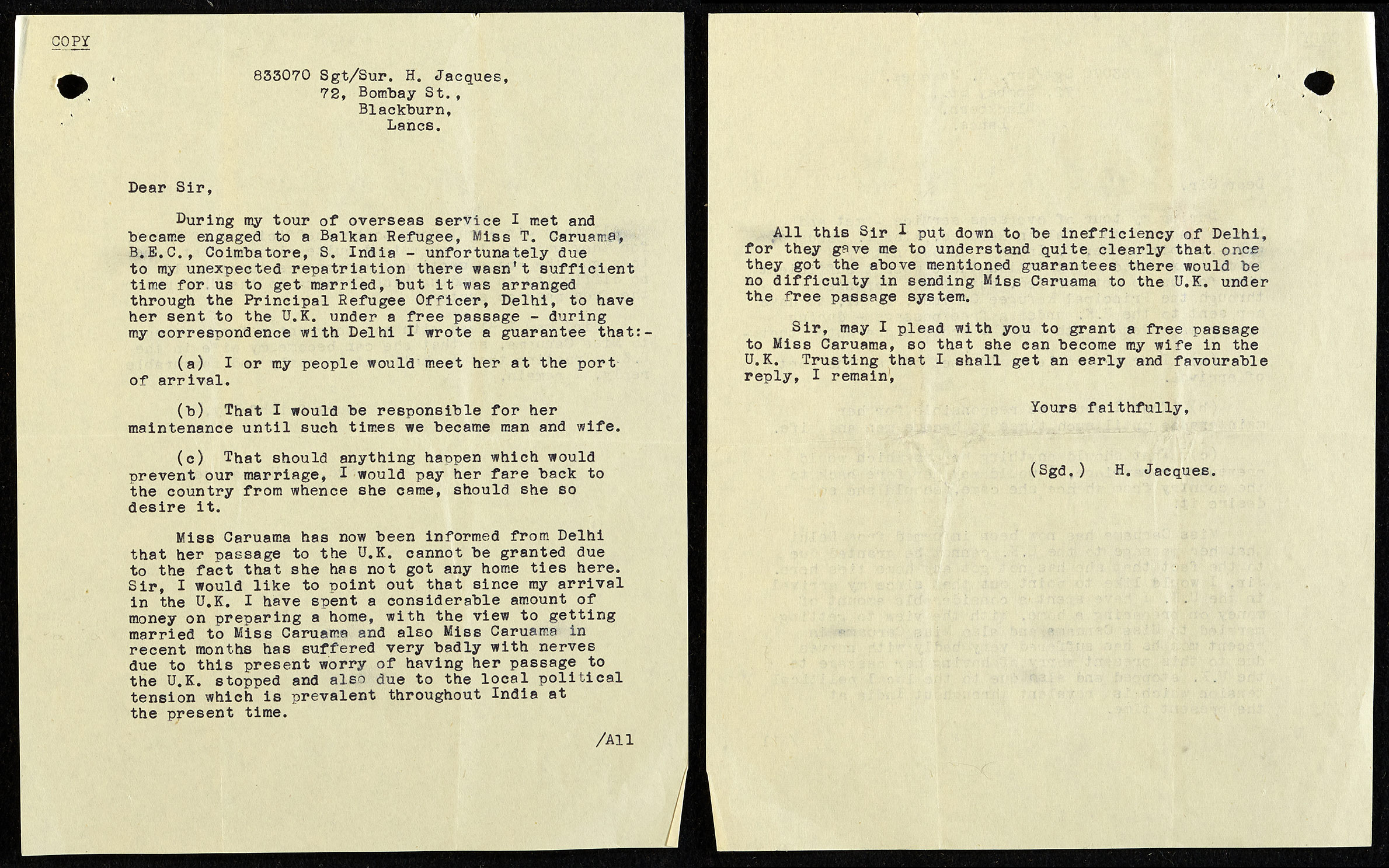
Letter from H. Jacques to the Foreign Office, 1946 Catalogue ref: FO 371/57815
[The ‘free passage system’ meant free passage by boat was provided by the Colonial Office. Balkan peoples today would include Greeks, Albanians, Macedonians, Bulgarians, Romanians, Serbs, Montenegrins, and Bosnian Muslims.]
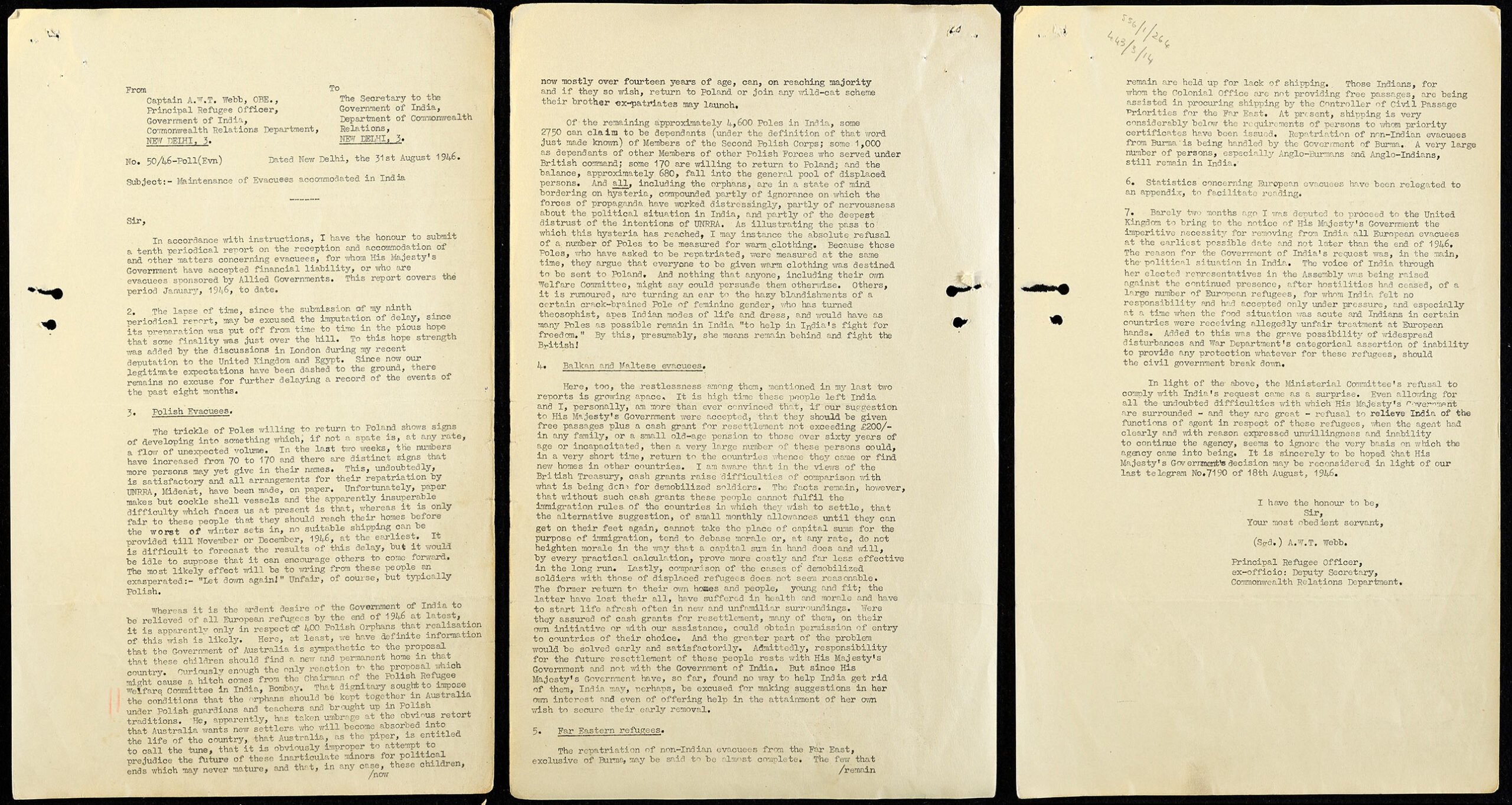
Report from A.W.T. Webb, Principal Refugee Officer, Government of India in New Delhi (who holds the role due to his status/another position) sent to the Secretary of the Government of India, Department of the Commonwealth, 31 August 1946, Catalogue ref: HO 213/1190
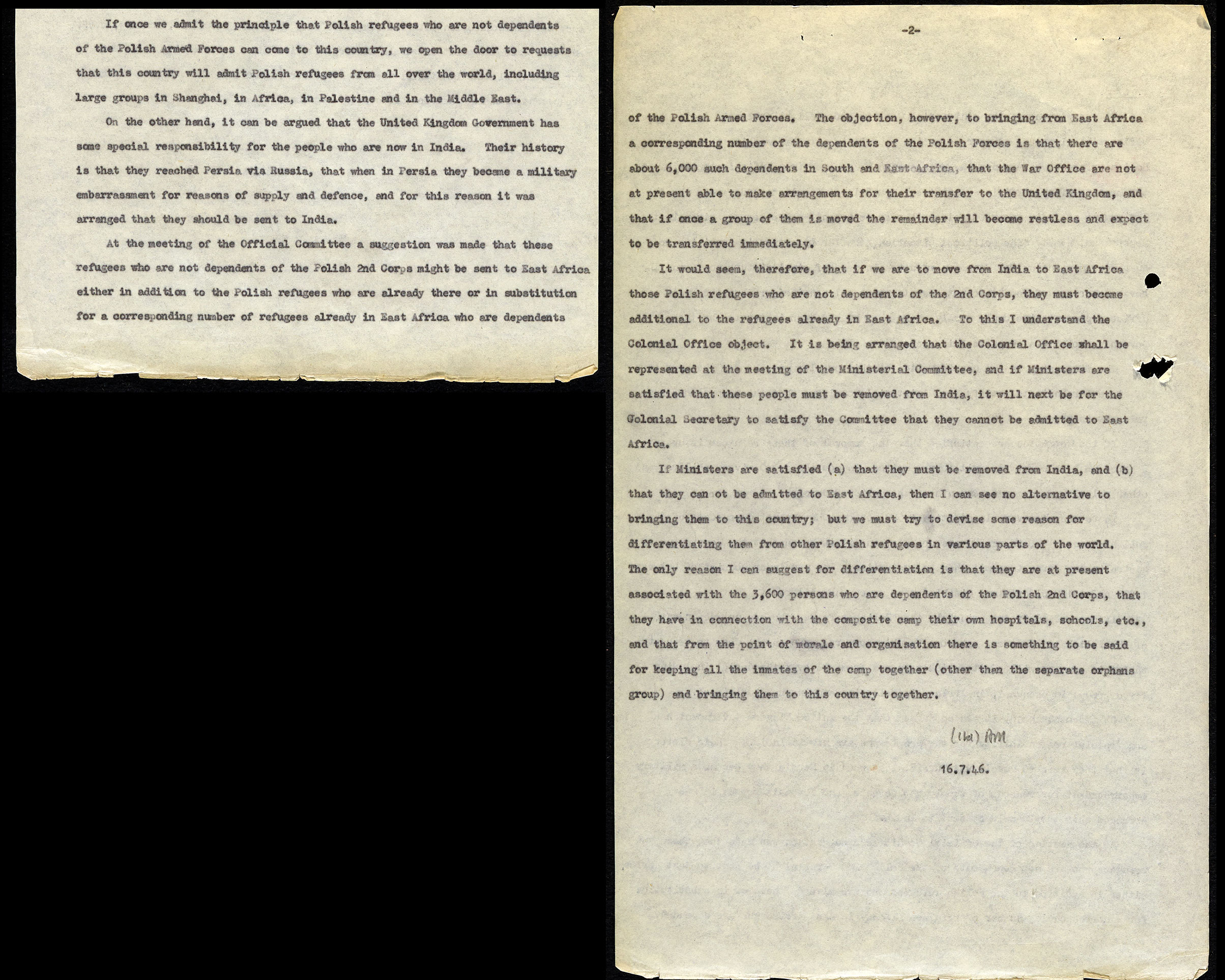
Notes for the Secretary of State relating to a Ministerial Committee on Polish Forces for the India Office, 16 July 1946, Catalogue ref: HO 213/1190
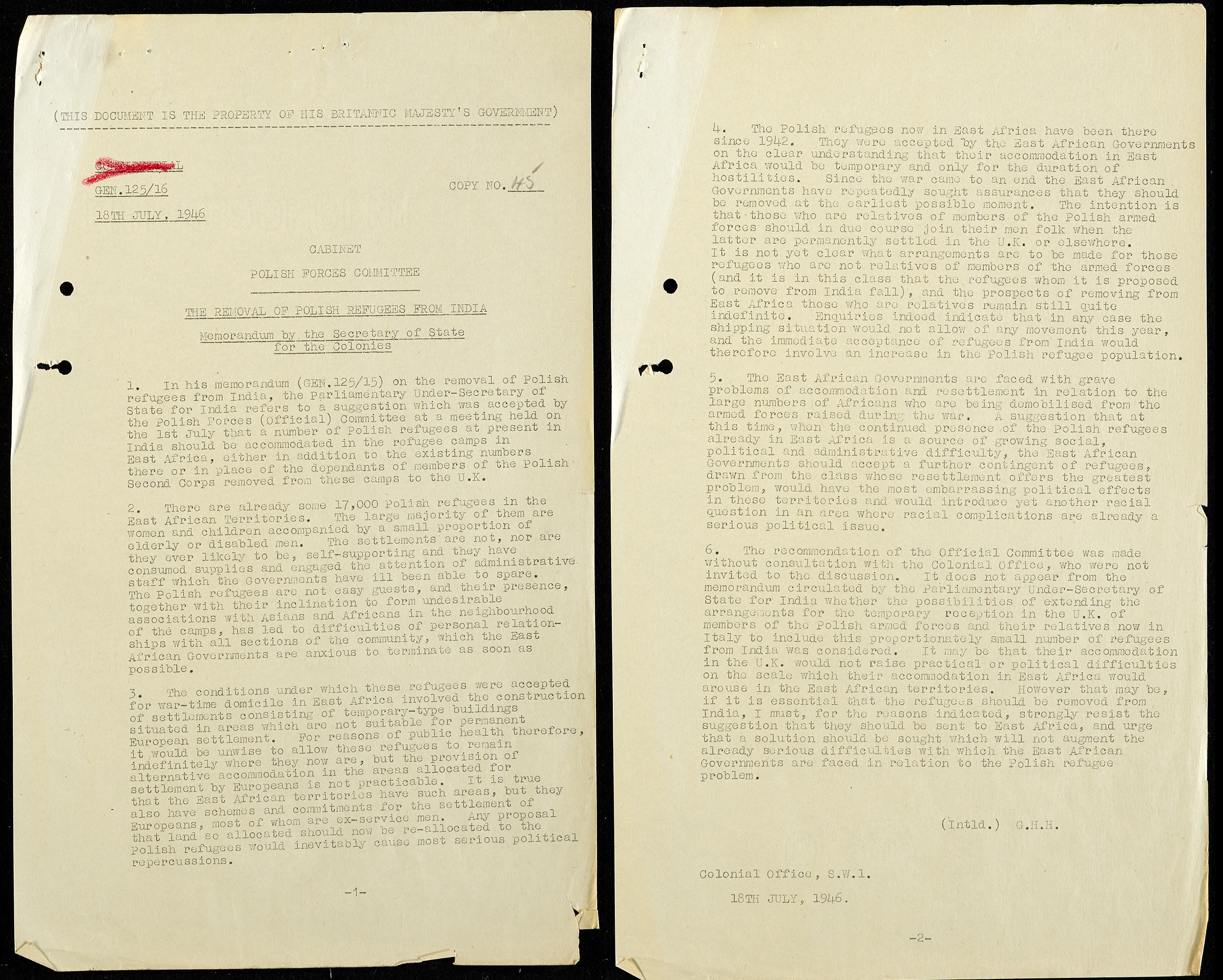
Report to the Cabinet from the Polish Forces Committee concerning the removal of Polish refugees from India, 18th July 1946, Catalogue ref: HO 213/1190
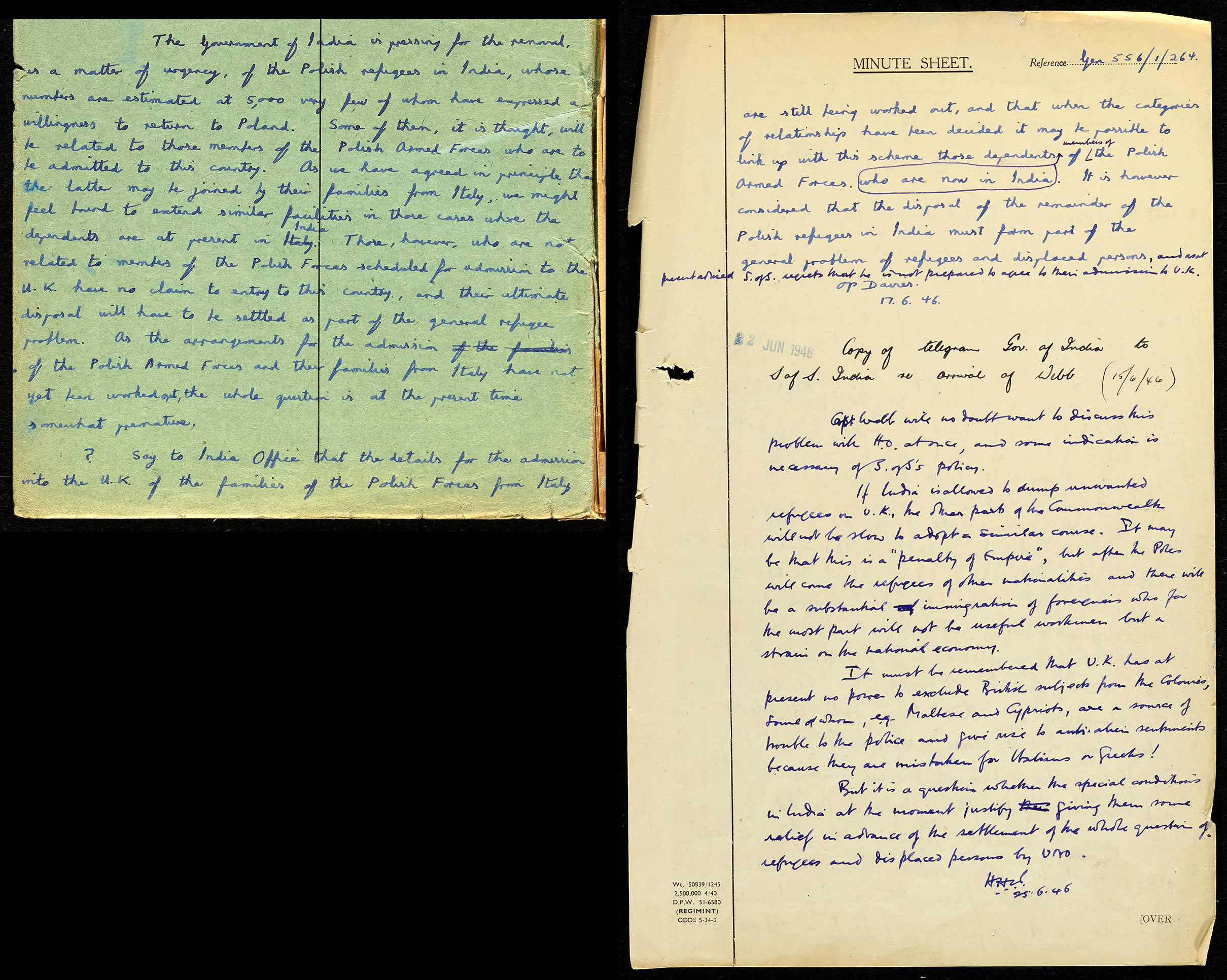
Extracts from a Home office minute sheet, 17-25 June 1946, Catalogue ref: HO 213/1190
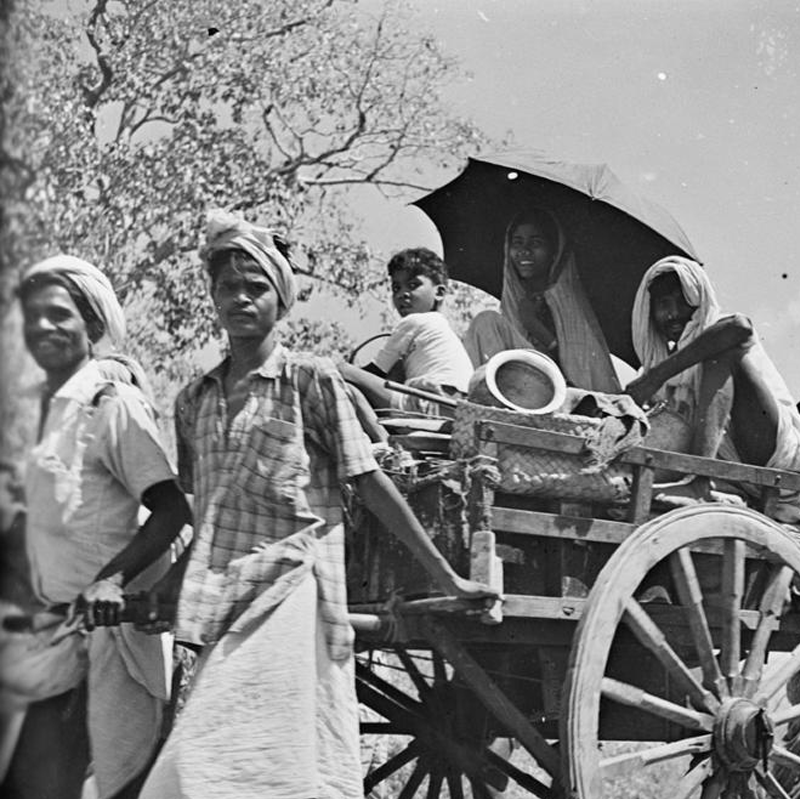
In contrast to dominant narratives about refugees from Asia and Africa arriving at the borders of Europe, between 1939 and 1945 thousands of European refugees took shelter in South Asia. They were joined by other war evacuees from Southeast Asia and refugees from China. This lesson looks at Polish and Jewish refugees who came to India from Europe and were joined by refugees from Malta and the Balkans. Alongside these refugees nearly half a million people fled from Burma and Southeast Asia as the Japanese advanced and sought shelter in colonial India. Thus, during the Second World War, India became home to thousands of refugees from Europe and Asia.
This lesson uses original documents to explore how these refugees were provided with relief, how they were treated, and what happened to them when the war ended.
How did Allied governments provide for them?To understand the modern refugee regime, we should study refugee movements beyond Europe, particularly during and after the Second World War. When the Second World War ended and the 1951 Geneva Convention defined who was a refugee, neither India nor Pakistan were signatories to it. This might seem surprising considering they had just had one of the largest mass migrations in human history during the process of Partition. Between 10-12 million people crossed the new border between India and Pakistan, and it is believed that over a million died. But the leaders of the new nations felt that European leaders had ignored their plight and that the new international refugee regime was overly focussed on the plight of European refugees, ignoring those displaced in Asia and Africa. If we are to understand the refugee regime of the present day differently, we need to think about not just refugees outside Europe, but also European refugees who found refuge in Asia and Africa during the Second World War. Large numbers of Polish refugees were sent to East Africa, and several thousand Jewish refugees ended up in Shanghai. South Asia which would see the massive refugee exodus of Partition, was also home to a large number of such war refugees and evacuees- in particular it housed several thousand Polish women and children, Jewish refugees from Austria and Germany, war evacuees from the Balkans and Malta, alongside those rescued from the Japanese advance through South East Asia, found themselves in South Asia.
Polish Refugees
During the war when both Nazi and Soviet armies invaded Poland, thousands of Polish men, women, and children were deported and resettled in labour camps in Siberia and central Asia under Russian control. The Germans and the Soviets had signed the Molotov-Ribbentrop Pact of non-aggression. In 1941 Germany violated this pact and launched Operation Barbarossa and attacked the Soviet Union, changing the balance of power. The Soviet Union joined the Allies, and the exiled Polish cabinet in London asked the Soviet Union to release Polish deportees. According to a Soviet and British plan the healthy men and women would form a Polish force under General Wladyslaw Anders. The rest, particularly women and children would be resettled as refugees.
The newly released Polish refugees were first moved to Iran, then under the control of Reza Shah. They were placed in makeshift camps in Iran run by the Middle East Refugee and Relief Administration. By mid-1942, nearly 100,000 Polish refugees were living in the Iranian cities of Tehran and Isfahan. Eventually, some of the refugees were moved out of Iran, and 4000 went to India, 7000 remained in the Middle East, and the largest number, nearly 19,000 went to East and Central Africa, with the bulk being given refuge in Tanganyika and Uganda.
In India there was initially reluctance to accept the refugees on the grounds that the weather was not suitable to those from Europe and that there could be espionage agents hiding amongst the refugees. The bulk of the refugees who came to India were Catholic, but there were a few Jewish refugees. Their care was coordinated by the Polish Consulate in Bombay through the Polish Relief Committee and the Jewish Relief Committee. The first batch of refugees landed in India in 1942, mainly orphans and young children. Maharaha Digvijaysinhji the ruler of Nawanagar, (called the Jamsaheb) agreed to host nearly 1000 orphans at a coastal camp in Balachadi. In 1943 a second group of 5000 refugees arrived and was housed in a camp in Valivade in Kolhapur state. These camps at Valivade and Balachadi had their own schools, hospitals, post office and even a fire brigade. The work of Mrs Kira Bansinska, who was the wife of the Polish consul general in India, was key to resettling the refugees. In India, the camp at Balachadi was maintained largely by charitable funds raised from the Indian public while the Valivade camp was financed by the Polish government in exile in London.
After the war, it was clear that Poland would fall under Soviet control and many of the refugees refused to return from India and Africa. From 1946 onwards the Polish refugees were the responsibility of the United Nations Relief and Rehabilitation Administration UNRRA. After 1947 the IRO or the International Refugee Organisation took over with the aim of getting the Polish refugees out of the camps and resettled. The IRO Sir Maurice Lush toured India and Africa relentlessly trying to persuade local governments to allow some Polish refugees to stay but with limited success. In his memoir, Lush says that Indian officials told him that the IRO had two choices, either to help India deal with millions of Partition refugees or to remove the several thousand European refugees in India. The IRO opted to do the latter and this became part of India’s reluctance to join the international refugee regime later.
The refugees themselves were reluctant to leave. In India, the Chief Refugee Office AWT Webb also reported that the refugees were refusing to leave afraid that there were plans to transfer them to the ‘clutches of the Russian government.’ Valivade camp in India was closed in March 1948 and the refugees were widely dispersed. Some went to the United Kingdom under a Polish Resettlement Scheme, some to Australia and Canada, while others were transferred from India to camps in east Africa to await their fate.
Maltese and Balkan refugees in Coimbatore
A second group of European war refugees came to India from the Balkans and Malta. In July 1941, the Government of India was told to take 58 Balkan refugees of various nationalities who could not be ‘disposed of’ in the Middle East or Africa, and who had to be interned whilst in the country. At the same time the Government of India was asked to take on 3000 Maltese evacuees from Turkey and another 2000 Europeans from Persia. This was a moment when there was also a growing demand to accept Polish women and children, especially orphans by November 1942. The Governor General indicated that he was concerned about the number of people being sent to the subcontinent and warned that officials should ‘resist attempts to convert India into a rubbish heap.’
Maltese refugees who had been evacuated from Turkey and Greece were sent hundreds of miles away to the Indian subcontinent. Most of them had forefathers who had in fact left Malta and settled in Turkey. Many had never been to Malta and nor did they speak the language, being conversant in Turkish and Greek. The Maltese in Turkey were affected by a change in Turkey’s nationality law in 1934 which prevented them from seeking employment as non-Turkish nationals. As a result of this they were dependent on Consular relief- handouts from the British Consul in Turkey. British officials were often sceptical about the Maltese refugees arguing that they were not fully British but had managed to ‘cling obstinately to their British nationality.’ The Balkan and Maltese refugees were sent to the British Evacuee Camp in Coimbatore where they joined several thousand people who had been rescued from South East Asia and Burma in the wake of the Japanese invasion and occupation of these areas.
Burmese Refugees
The Second World War in Southeast Asia caught the British off guard. On the morning of 8 December 1941, Japanese forces landed at Kota Bahru on Malaya’s east coast. It was just hours before the assault on Pearl Harbour. Within weeks European power in Southeast Asia had collapsed as Japanese forces moved into the Malayan peninsula and bombs rained down on Singapore. On December 10, 1941, Japanese bombers sank two British ships in Singapore harbour. The Dutch in Java and Sumatra surrendered quickly to the Japanese. From Thailand the Japanese now moved into southern Burma.
Rangoon was first bombed on 23 December 1941 with the British having mistakenly assumed that Burma’s eastern frontier would be impenetrable. Compounded by a chronic lack of air cover for the British, the Japanese bombed lower Burma with impunity and by February 1942 British air defences had almost totally collapsed. With the bombing of Rangoon and the advancing of the Japanese army, thousands of Indian refugees now began to flee the city. Their first destination was Prome and then to Taungup. But many never made it to Prome. In responses to appeals from Governor Sir Reginald Dorman-Smith, several prominent Indians patrolled the Prome road cajoling Indians to return to their jobs and promising them security in government camps. Dornan-Smith himself, slipped out of Burma to set up a provisional government in the hillside town of Simla in north India. Meanwhile, in these camps the Indians who came back waited patiently for work, but the Burma government issued orders that no adult Indian should be allowed to leave as a deck passenger which meant that only the wealthiest Indians could leave by ship. When the conditions in Rangoon deteriorated further and these men were forced to leave, there was little help available.
After the fall of the second port of Moulmein there was another exodus towards Prome to find safety via the Taungup pass. Nearly 200,000 Indians took this route that would eventually lead to Chittagong and thousands would die on the way. The rest of the refugees moved into middle and northern Burma and tried to escape to Manipur. They struggled on the road between Kalewa and Tamu. After Tamu, the hills and jungles loomed, and exhausted waited for transport that never materialised. The British had organised only a skeleton refugee organisation to help them and when the monsoons hit, the spread of malaria, dysentery and cholera meant an increasing death toll.
The chaotic nature of the evacuation and the squabbling amongst senior military figures foreshadowed accusations that the evacuation was racially discriminatory. In both Hong Kong and Malaya there had been accusations that those deemed to be of ‘pure British descent’ had been given priority. In March 1942 motor convoys carrying mainly European and Eurasian employees of the Burma Oil Company were allowed while the road was closed to Indian evacuees. In April 1942 both the Daily Mail and the Daily Herald carried stories about the Burma evacuation and the difference in treatment meted out to Indian and non-Indian evacuees. The Times carried a photograph of a group of refugees, all European, preparing to leave Burma by air. The press strongly suggested that the evacuation effort had been racially discriminatory, and the death toll seemed to bear out this accusation.
The Anglo-Burmans, the Eurasian minority that fled from were a significant portion of the European evacuee population from Burma. Many of these Anglo-Burmans ended up at the camp in Coimbatore joining other Eurasians from Singapore and Malaya. In Burma, the group included people of mixed race who might have had a European paternal male relative. They mainly worked in industry, and public administration. Of the 9000 or so Anglo-Burmans who were evacuated to India, many found themselves at the camp in Coimbatore. Many felt that alongside the Indian evacuees, they had been abandoned by the British. At a conference in Simla in 1944 they use recurrent themes of their heroism, loyalty and sacrifice to the British to argue for concessions and long term guarantees of employment. The Anglo-Burmans found themselves stuck between the British who viewed them with suspicion and Indian evacuees who felt that their ‘blood’ had given them an advantage in the evacuation process.
Conclusion
At the end of the war, all these groups had to be repatriated from India, a task made more difficult by the lack of easily available shipping options, and the reluctance of many groups including Jewish and Polish refugees to go back to where they came from. The British meanwhile knew that with the transfer of power in South Asia looming, they had to persuade and cajole people to leave these refugee camps as quickly as possible so they could be disbanded. Meanwhile at a global level, negotiations began about what to do about the millions of people displaced around the globe who did not fit within the new national borders that were emerging. As these discussions continued into the 1950s delegates from South Asia felt that their experience of housing war time refugees and dealing with the displaced of Partition, had been ignored. The 1951 Refugee Convention was adopted by the United Nations in 1951 and entered into force in 1954. It was originally intended to protect European refugees from World War II, but states could declare that it would apply to refugees from other places. However, countries like India felt that the Convention ignored the displacement they had dealt with, and to this day have refused to sign the Convention and its amended Protocol in 1967.
Antara Datta
Associate Professor in International Relations at Royal Holloway, University of London.
1 Telegram from the Middle East Department 25 July 1941, File no 10/1/115/41/Pol E- The question of accommodating certain Balkan refugees of various nationalities from Mideast, NAI
2 Note from M.K. Johnston, 12 November 1941, File no 10/1/115/41/Pol E- The question of accommodating certain Balkan refugees of various nationalities from Mideast, NAI