In early 1689, James II, King of England, Scotland, and Ireland, was deposed by Parliament and replaced by his daughter, Mary, and her husband, the Dutch prince William of Orange.
Since James II ascended the throne in 1685, he had fuelled the interconnected fears of Catholicism and arbitrary government within England, a deeply Protestant country. As a determined Catholic, James had granted Catholics many rights, including the freedom to worship openly, to hold public office, and even to be members of the privy council. His continuous use of the royal prerogative to achieve his own political and religious ends was central to his downfall.
In June 1688, James’ second wife Mary of Modena gave birth to a son, destroying English hopes that Mary, the king’s Protestant daughter, would ascend the throne after the death of James II. Instead, they faced the prospect of another Catholic king. This, combined with James II’s continued authoritarian behaviour, led to several peers (the ‘Immortal Seven’) asking the Dutch prince William of Orange to invade England. On 5 November 1688, William arrived with his army on English shores.
In December 1688, James II fled to France. After being presented with the Declaration of Rights, which stressed the need for a contractual model of kingship and government, William and Mary accepted the throne on the 13 February 1689.
Use documents in this lesson to explore the causes of Glorious Revolution and its impact on the British monarchy. Also find out about the effects of the Glorious Revolution on Ireland and the American colonies.
How did these events change the British Monarchy?The Glorious Revolution of 1688-89 replaced James II with the joint monarchy of his daughter Mary and her Dutch husband, William of Orange, both Protestants. James II’s behaviour from his ascension to the crown in 1685 suggested Catholic absolutism, which aroused fear in England, a deeply Protestant country. While James II’s determination to impose an authoritarian form of government was gently resisted, there were two key factors that urged a group of English peers (the Immortal Seven) to contact the Dutch prince William of Orange. The birth of James II’s son, James Edward Stuart, on 10 June 1688, scuppered hopes that James II’s protestant daughter Mary might soon occupy the throne. Secondly, the peers feared that James would revoke the Test Acts, which barred Catholics from public office.
William of Orange was well prepared. Despite his declared motivations for invading England as a merciful crusade, he had other pragmatic and political reasons to intervene. He was aware the Dutch Republic was under threat from the French King Louis XIV and wanted to further an English alliance to prevent the expansion of the French Empire.
Helped along by the ‘Protestant wind’, William landed at Torbay on 5 November 1688 with a substantial army. When he arrived, anti-Catholic riots broke out across the nation. Despite his initial control of capital, and a standing army of 53,000 men, James II fled London in December. He was captured by Kent fishermen near Sheerness, but was kept under purposefully light guard, and successfully fled the country on the 23 December. The path was now clear for William and Mary to take the throne. However, before they did so, a ‘Convention Parliament’ was held on 22 January 1689, where the details of the Declaration of Rights, later formalised in law as the Bill of Rights, was discussed and agreed. The Declaration of Rights was a pragmatic agreement that enshrined a constitutional form of monarchy in England, in which the principles of royal succession were abandoned, and the king was fiscally shackled to parliament, changing the face of the British monarchy irrevocably.
The revolution had far reaching consequences beyond England, as this lesson demonstrates. In Ireland and Scotland, the revolution was not, as the Whig historians would call it, ‘bloodless’. In both countries, it was religiously and politically divisive. William III’s expedition to Ireland and the Battle of the Boyne is a key example of Anglo-Irish conflict in the 1690s. The Irish were subject to the rule of Anglo-Irish landed gentry and an unpopular Episcopal church, cementing an Anglo-Irish resentment and hatred that would become entrenched in centuries to come.
The Glorious Revolution was also a transatlantic phenomenon, as American colonies experienced political unrest and the uneasy transfer of power. New York is a notable example. Originally founded as a Dutch colony, New York was actually allocated to James II as a proprietor when the English took it from the Dutch in 1664 and he was Duke of York (hence the name), so he had a longstanding relationship with the colony. In 1688 New York was not homogenously British, but was also home to the Dutch, French Huguenots, indigenous peoples, and a small Black population. The overthrow of the Jacobite government in New York and the establishment of the Dutch captain Jacob Leisler as the Governor of New York was the start of a significant political fracture in the colony. Some believed Leisler acted in William and Mary’s best interests to maintain stability in New York, while those against Leisler accused him of arbitrary and unprincipled behaviour. Eventually, Leisler was executed in 1691 for treason. The period entrenched existing divisions between the English and Dutch population in the colony, which would fester even beyond the American Revolution (1775-1783).
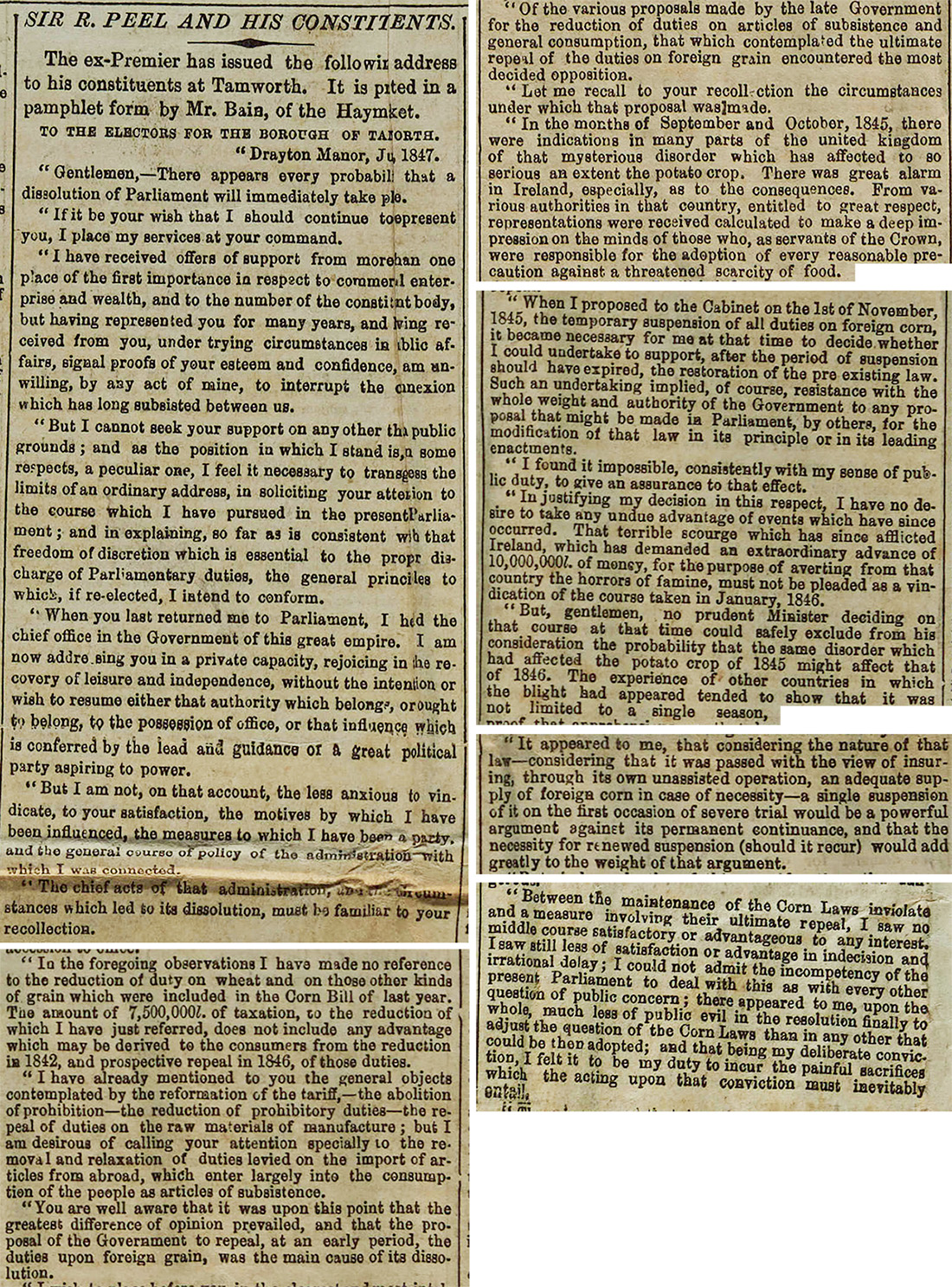
Extracts from the newspaper ‘The Times’ containing Sir Robert Peel’s letter to the Electors of Tamworth, July 1847. Catalogue ref: PRO 30/12/23/8.
[From the papers of Edward Law, 1st Earl of Ellenborough]
This newspaper extract relates to Robert Peel’s address to the electors of his constituency of Tamworth, Staffordshire, after his resignation as Prime Minister in 1846. He remained the MP for Tamworth until his death in 1850.
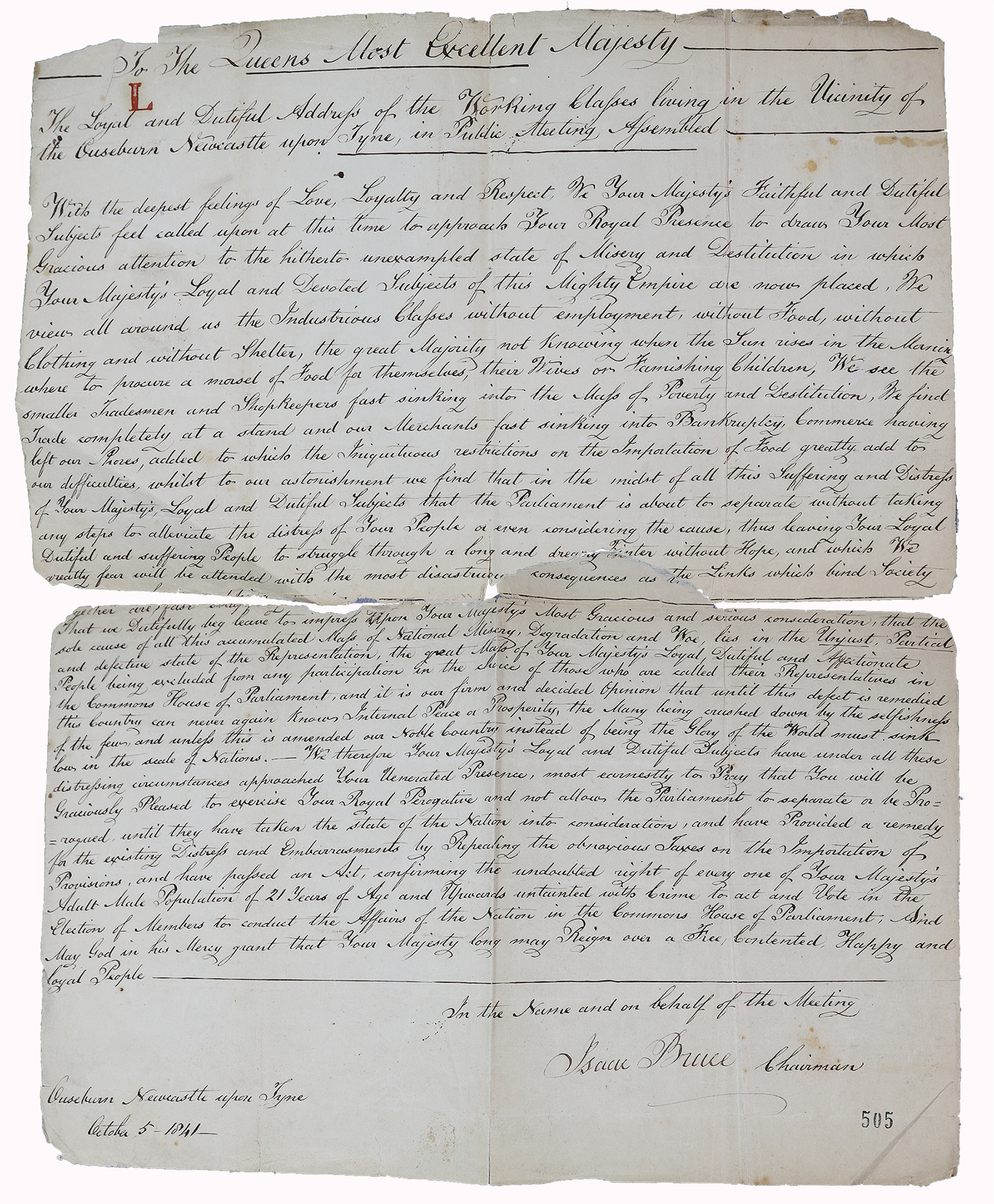
Anti-Corn Law petitions from the Ouseburn district upon Tyne, Newcastle, 5 October 1841. Catalogue ref: HO 44/52/60
This petition from the people of Ouseburn in North England is addressed to Queen Victoria and described the effects of the Corn Laws on their area.
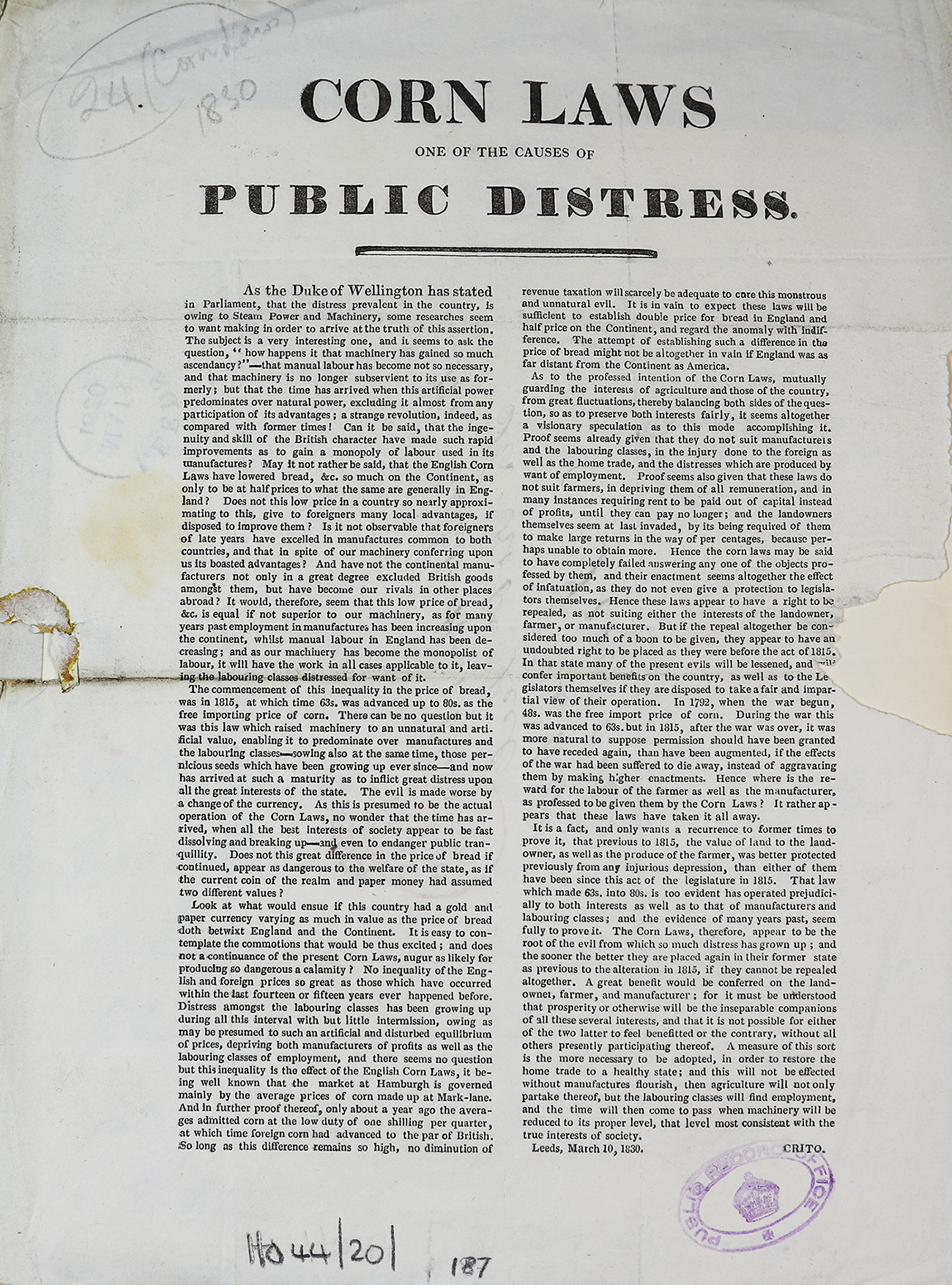
Printed broadside sheet entitled: ‘Corn Laws: one of the Causes of Public Distress’, 1830. Catalogue ref: HO 44/20/23
This printed broadside sheet describes the aims of the Corn Laws and the effects on the British public.
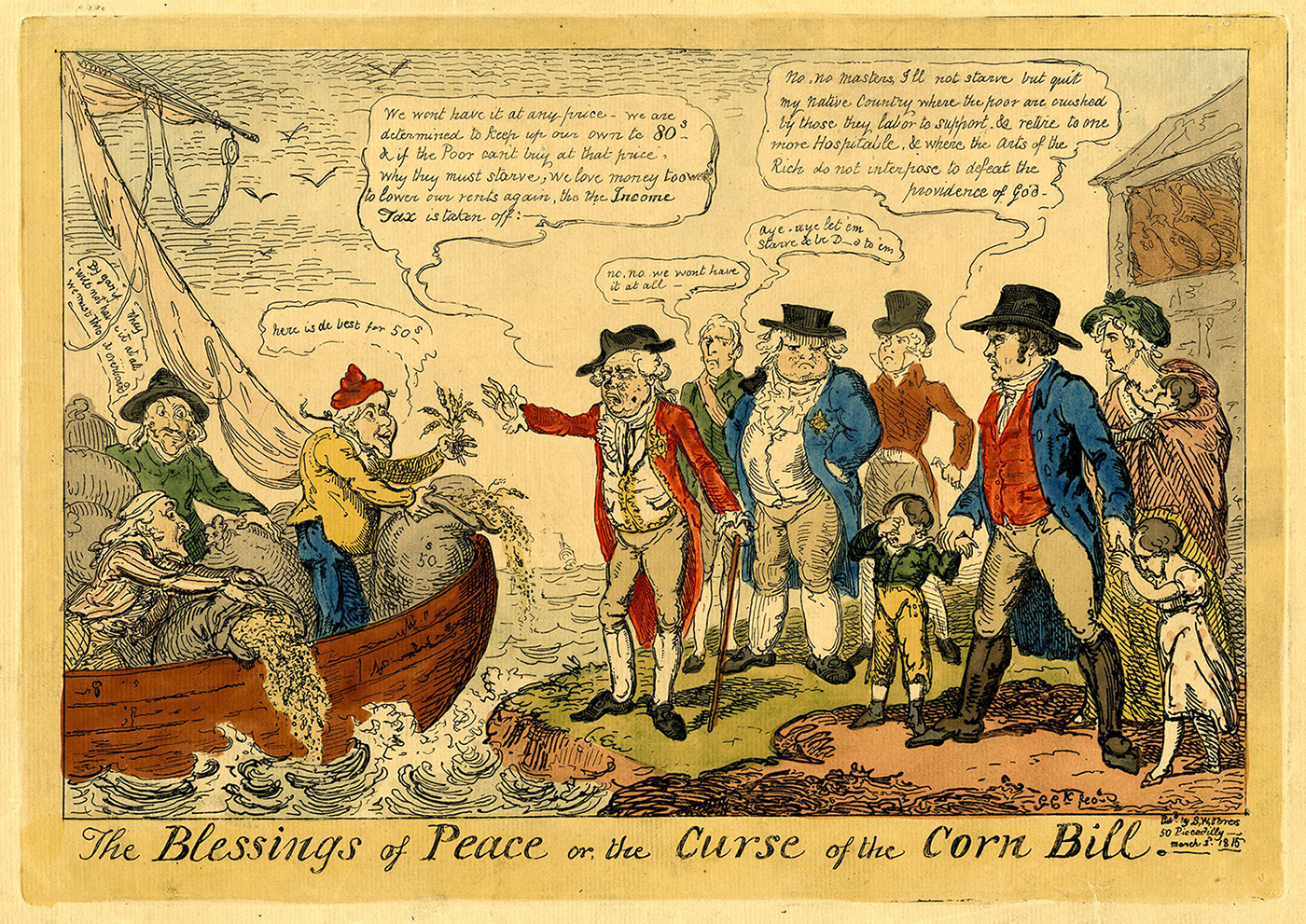
The Corn Laws were passed by the Conservative Prime Minister, Lord Liverpool, in 1815. These were measures brought in by the British government to protect landowners and farmers. They controlled the price of all grain crops, including wheat, barley and oats.
After the Napoleonic Wars, food prices were predicted to fall as Britain resumed its trade with Europe, and goods could once again be imported to Britain. However, further imports of cheaper foreign grain harmed the interests of British landowners and farmers. The Corn Laws were aimed to prevent this harm.
The laws placed tariffs on grain imported from other countries. The price of grain at home had to reach extremely high levels before duty-free grain from overseas was permitted. Harsh import duties made buying grain from abroad unaffordable. Therefore, the Corn Laws made it expensive to import grain, even when domestic grain was in very short supply.
The laws were met by fierce opposition from the public and there were frequent riots against them. The Anti-Corn Law League, founded in 1839, campaigned to repeal the laws. The Corn Laws remained in place until 1846; despite strong opposition from his own political party, Conservative Prime Minister Sir Robert Peel repealed them in 1846. Peel gives his reasons for doing so in a document here.
Use the original documents in this lesson to find out about the Corn Laws: how the British public reacted to them, and their eventual repeal in 1846.
What was the impact of the 1815 Corn Laws in Britain?The Corn Laws were passed in 1815 after the Napoleonic Wars. During these wars, Britain had been largely self-sufficient in grain production, but the return of peace brought further challenges. The country’s landowners and farmers were deeply concerned about increased foreign trade and imports to Britain, as they relied on high prices of grain to maintain their profits. By imposing tariffs on imported foreign grain, unless prices in Britain rose above a certain threshold, the welfare of domestic grain producers was secured. The Corn Laws signified a protectionist measure to protect this group of society, many of whom were extremely wealthy and held political power in Britain.
The enforcement of the Corn Laws damaged the welfare of many members of British society, as the price of bread and other staple foods remained high. Workers in towns and cities suffered greatly as they were forced to spend a higher proportion of their income on food as bread was a key staple of the urban worker’s diet. It wasn’t only the labouring classes who suffered. Merchants and industrial manufacturers were also dissatisfied. The Corn Laws made raw materials and labour more expensive. Protectionism stifled international trade at a time when manufacturers were keen to pursue to grow their businesses.
Opposition to the Corn Laws grew and calls for their repeal came from a wide variety of political and economic groups across Britain. In 1838, Richard Cobden and John Bright formed the Anti-Corn Law League, which argued forcefully for the detrimental effects of the Corn Laws across the nation; they advocated for lower food prices and free trade, highlighting how the Corn Laws had negative economic consequences for the nation’s economy. Both Bright and Cobden were elected to parliament in the early 1840s. The League was incredibly successful as a political pressure group, using public meetings and political lobbying to build a broad support base against the laws.
The movement for repeal gained a specific momentum in the 1840s, as the dates of Sources 2, 3 and 4 in this lesson suggest. The Irish Potato Famine of 1845-1849 led to a significant shortage of food in Ireland, and the British government’s response, which was dampened by the high cost of grain, was widely condemned. The Irish Potato Famine seemed to highlight the dangers of a protectionist agricultural policy and drew attention to the ways in which people across Britain were suffering from the Corn Laws.
In the early months of 1846, the Prime Minister Sir Robert Peel, decided to support the repeal of the Corn Laws, much to the distress of many in his political party. While Source 5 suggests the main factor for his repeal of the Corn Laws was the crisis in Ireland, it is likely that the growing power of the Anti-Corn Law League and the worsening economic conditions in Britain were also significant factors behind his decision. The laws were repealed on 25 June 1846.
The repeal of the Corn Laws had a significant impact on Britain’s economy and politics. It marked a shift towards a development of free trade and a shift away from protectionism; it also reoriented British politics as the interests of industrialists and urban workers became more influential in guiding government policy. The legacy of the repeal of the Corn Laws was significant – it gave way to a steadfast belief that British prosperity was inherently linked to free trade.
Chancery records: Glorious Revolution and the Declaration of Rights
We hope you enjoyed watching our Education Service video with Neil Johnston, Head of Early Modern Records at The National Archives, looking at the ‘Declaration of Rights’ from our Chancery records, catalogue ref: C212/18.
Now try and answer the following questions:
- When does the Chancery records collection date from in The National Archives?
- What was the role of the Chancery Office?
- What is the ‘petty bag’ section of Chancery?
- What do you understand by a document described as an ‘enrolment’?
- Why is our document considered to be dated from 1689 and not 1688?
- Give two reasons why James II faced opposition from parliament.
- Who was William of Orange?
- Which four demands were central to the ‘Declaration of Rights’ 1689?
Document 1
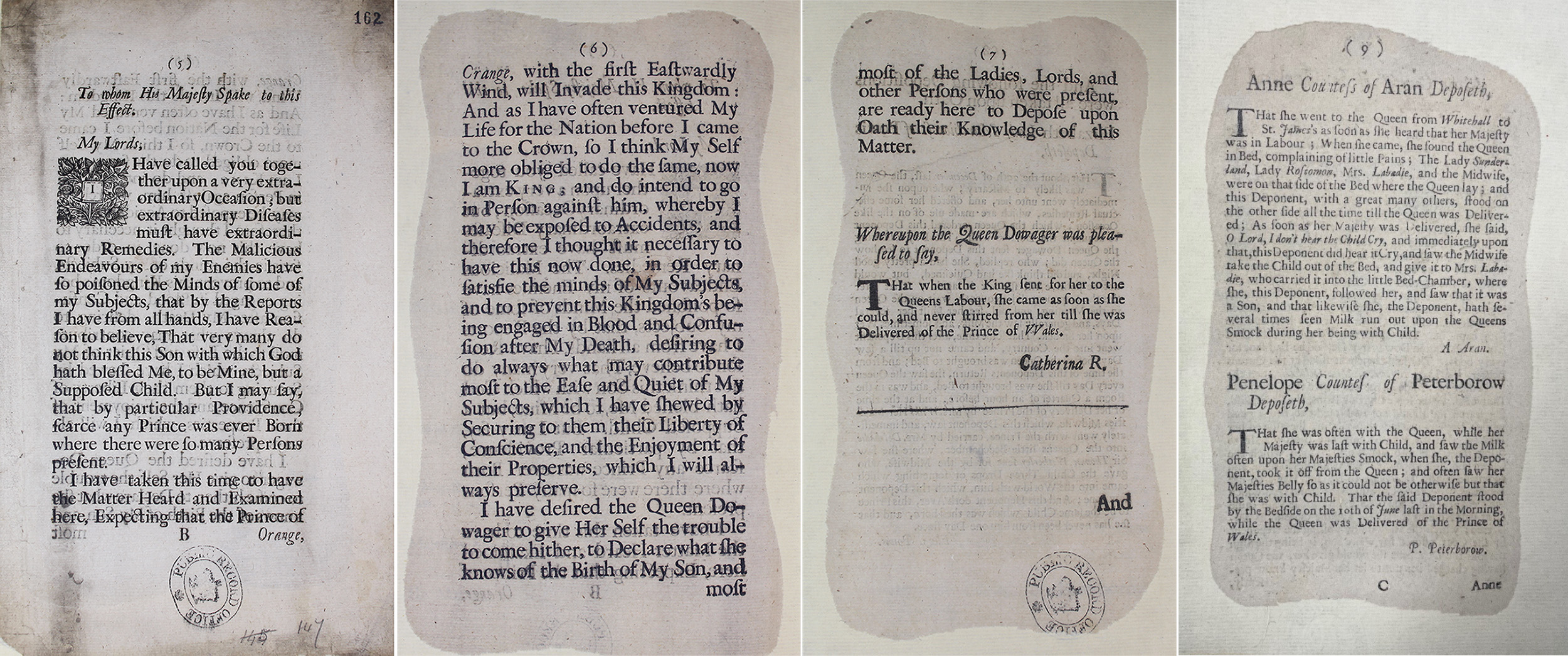
This document is a pamphlet written and circulated on behalf of James II addressed to Parliament, 1688, Catalogue ref: SP 31/4/217 f162
The King used this document to declare the legitimacy of his son, Prince James Francis Edward, born to his second wife, Mary of Modena. It was believed by many, that the baby had been smuggled into the birthing chamber to provide James II with a Catholic heir rather than Mary, his Protestant daughter from his first marriage to Anne Hyde. Mary was married to the Protestant William of Orange.
Catherine of Braganza was Queen Dowager of England, 1685–1692, the widow of Charles II, brother to James II.
Document questions
- Why has James II made this address in this pamphlet?
- What techniques of persuasion are used to appeal to the Lords in the pamphlet?
- What is James II’s opinion of William of Orange in this pamphlet?
- Why has James II included a statement from ‘Catherine R’ (Catherine of Braganza)?
- What is the purpose of including statements from other women about the birth of his son?
- What can we infer about James II’s views about kingship in the pamphlet?
- This document is printed, but it reads like a personal letter. What might this reveal about the document’s audience and circulation at the time?
- How did religion become such a contentious issue in the reign of James II? How does this relate to the Declaration of Rights featured in the video?
Document transcript
To whom His Majesty Spake to this effect.
My Lords
I have called you together upon a very extraordinary Occasion; but extraordinary Diseases must have extraordinary Remedies. The Malicious Endeavours of my Enemies have so poisoned the Minds of some of my Subjects, that by the Reports I have from all hands, I have Reason to believe, That very many do not think this Son with which God hath blessed ME, to be Mine, but a Supposed Child. But I may say that by particular Providence, scarce any Prince was ever Born where there were so many Persons present.
I have taken this time to have the matter Heard and Examined here, Expecting that the Prince of Orange, with the first Eastwardly Wind will Invade this Kingdom: And as I have often ventured My life for the Nation before I came to the Crown, So I think My Self more obliged to do the same, now I am KING, and do intend to go in person against him, whereby I may be exposed to Accidents and therefore I thought it necessary to have this now done in order to satisfy the minds of My Subjects and to prevent this Kingdom being engaged in confusion after My Death, desiring to do always what may contribute most to the Ease and Quiet of My Subjects which I have shewed by securing to them their Liberty of Conscience and the Enjoyment of their properties, which I will always preserve.
I have desired the Queen Dowager to give Her Self the trouble to give Herself the trouble to come hither, to declare what she knows of the Birth of My Son, and most of the Ladies, Lords and other Persons who were present are ready here to Depose upon Oath their Knowledge of this Matter.
Whereupon the Queen Dowager was pleased to say,
That when the King sent for her to the Queens Labour, she came as soon as she could, and never stirred from her till she was Delivered of the Prince of Wales.
Catherine R.
…
Anne Countess of Aran Deposeth [person making a statement under oath]
That she went to the Queen from Whitehall to St James’s as soon as she heard that her Majesty was in Labour; When she came, she found the Queen in Bed, complaining of little Pains: The Lady Sunderland, Lady Roscommon, Mrs Labadie, and the Midwife, were on the side of the bed where the Queen lay; and this Doponent, with a great many others, stood on the other side all the time till the Queen was Delivered; As soon as her Majesty was delivered, she said O Lord, I don’t hear the Child cry, and immediately upon that, this Deponent did hear it Cry, and saw the Midwife take the Child out of the Bed, and give it to Mrs Labadie, who carried it into the little Bed-Chamber, where she, this Deponent, followed her, and saw that it was a Son, and that likewise she, the Deponent, hath several times seen milk run upon the Queen’s Smock during her being with Child.
A. Aran
Penelope Countess of Peterborow, Deposeth
That she was often with the Queen, while her Majesty was last with child, and saw the Milk often upon her Majesties Smock, when she, the Deponent, took it off from the Queen; and often saw her Majesties Belly so as it could not be otherwise but that she was with child. That the said Deponent stood by the Bedside on the 10thJune of last in the Morning while the Queen was Delivered of the Prince of Wales.
P. Peterbrow.
…
Document 2
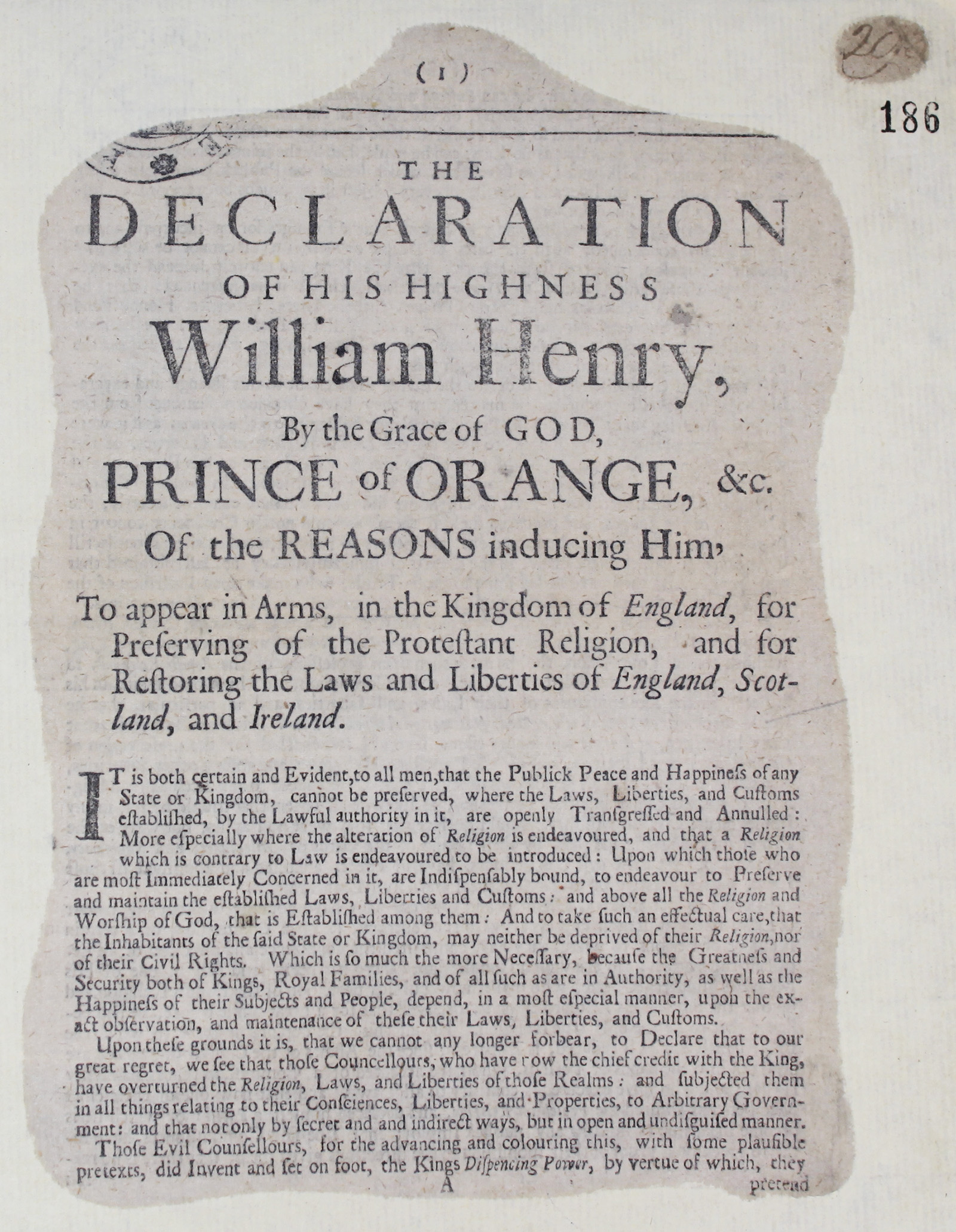
Pamphlet, entitled ‘The Declaration of His Highness William Henry, by Grace of God, Prince of Orange’. Catalogue ref: SP 31/4/217 f186
Document questions
- Why do you think William of Orange chose to publish this ‘Declaration’?
- How does he justify his decision ‘to appear in arms’ in England?
- Who does William of Orange suggest is responsible for overturning ‘the Religion, Laws, and Liberties’ of the country?
- How does this document relate to Document 1, the pamphlet from James II?
Document transcript
THE DECLARATION
OF HIS HIGHNESS
William Henry
by the Grace of GOD,
PRINCE of ORANGE, &c.
Of the REASONS inducing Him,
To appear in Arms, in the Kingdom of England, for
Preserving of the Protestant Religion, and for
Restoring the Laws and Liberties of England, Scotland, and Ireland.
It is both certain and Evident, to all men, that the Publick Peace and Happiness of any State or Kingdom, cannot be preserved, where the Laws, Liberties, and Customs established, by the Lawful authority in it, are openly Transgressed [violated] and Annulled [cancelled]: More especially where the alteration of Religion is endeavoured, and that a Religion which is contrary to Law is endeavoured to be traduced [disgraced]: Upon which those who are most Immediately Concerned in it, are Indispensably bound to endeavour to Preserve and maintain the established Laws, Liberties and Customs; and above all the Religion and Worship of God, that is Established among them; And to take such an effectual care, that the Inhabitants of the said State or Kingdom, may neither be deprived of their Religion, nor of their Civil Rights. Which is so much the more Necessary, because the Greatness and Security both of Kings, Royal Families, and all such as are in Authority, as well as the Happiness of their Subjects and People, depend, in a most especial manner, upon the exact observation, and maintenance of these their Laws, Liberties, and Customs.
Upon these grounds it is, that we cannot any longer forbear, to Declare that to our great regret, we see that those Councellours, who have row the chief credit with the King, have overturned the Religion, Laws, and Liberties of those Realms: and subjected them in all things relating to their Consciences, Liberties, and Properties, to Arbitrary Government; and that not only by secret and indirect ways, but in open and undisguised manner. Those Evil Councellours, for the advancing and colouring this, with some plausible pretexts, did Invent and set on foot, the Kings Dispensing Power, by virtue of which they pretend…
Document 3
Extracts 3a-3c from the Enrolment of the Declaration of the 12 February of the Lords Spiritual and Temporal and Commons [the ‘Declaration of Rights’] Catalogue ref: C 212/18/1
This document is the Declaration of Rights, also known as the Bill of Rights, which was created by the English Parliament in February 1689. It established the rights of the English citizens and the responsibilities of the monarchy.
Extract 3a
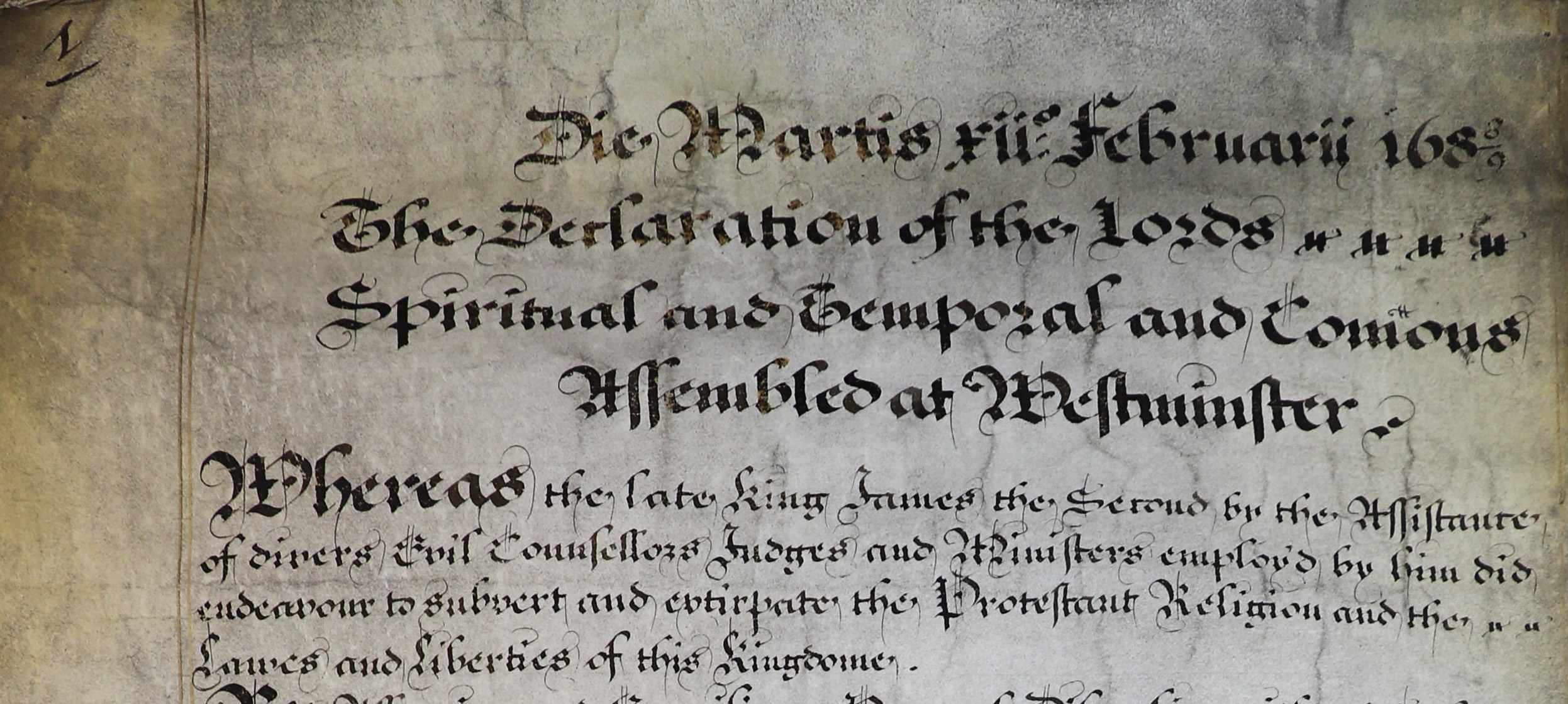
Extract 3a from the Enrolment of the Declaration of the 12 February of the Lords Spiritual and Temporal and Commons [the ‘Declaration of Rights’] Catalogue ref: C 212/18/1
This document is the Declaration of Rights, also known as the Bill of Rights, which was created by the English Parliament in February 1689. It established the rights of the English citizens and the responsibilities of the monarchy.
Document questions
- Why is James criticised in the first instance in this document?
- What do the terms lords ‘spiritual’ and lords ‘temporal’ mean?
- Why is this Declaration made by lords ‘spiritual’, lords ‘temporal’ and Commons in Westminster?
Document transcript
Die Martis xii Februarii 1689 [On Tuesday 12th February 1689]
The Declaration of the Lords Spiritual and Temporal and Commons Assembled at Westminster
Whereas the late King James the Second, by the assistance of divers [several] evil counsellors, judges and ministers employed by him, did endeavour to subvert and extirpate [destroy] the Protestant religion and the laws and liberties of this Kingdom:
…
Extract 3b
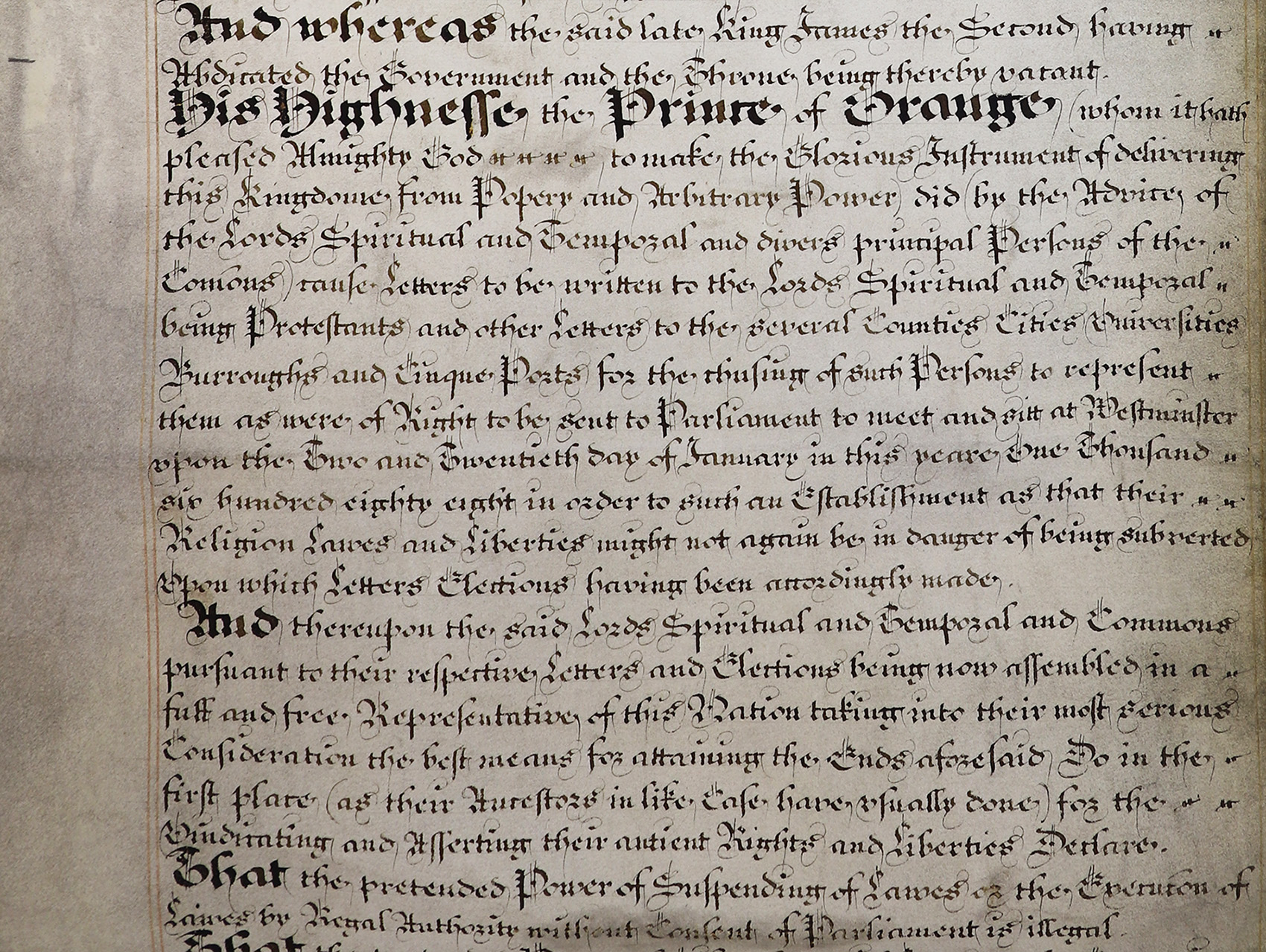
Extract 3b from the Enrolment of the Declaration of the 12 February of the Lords Spiritual and Temporal and Commons [the ‘Declaration of Rights’] Catalogue ref: C 212/18/1
This document is the Declaration of Rights, also known as the Bill of Rights, which was created by the English Parliament in February 1689. It established the rights of the English citizens and the responsibilities of the monarchy.
Document questions
- Is it accurate to say that James II ‘abdicated the government’ according to this extract of the ‘Declaration of Rights’?
- What reason is given to justify William of Orange’s invasion?
- Why is parliament due to sit in January 1688 [old style date]?
- What does the following statement from the Declaration mean: ‘the execution of laws by regal authority without consent of Parliament is illegal’
- Why was this considered an important right for parliament and people?
Document transcript
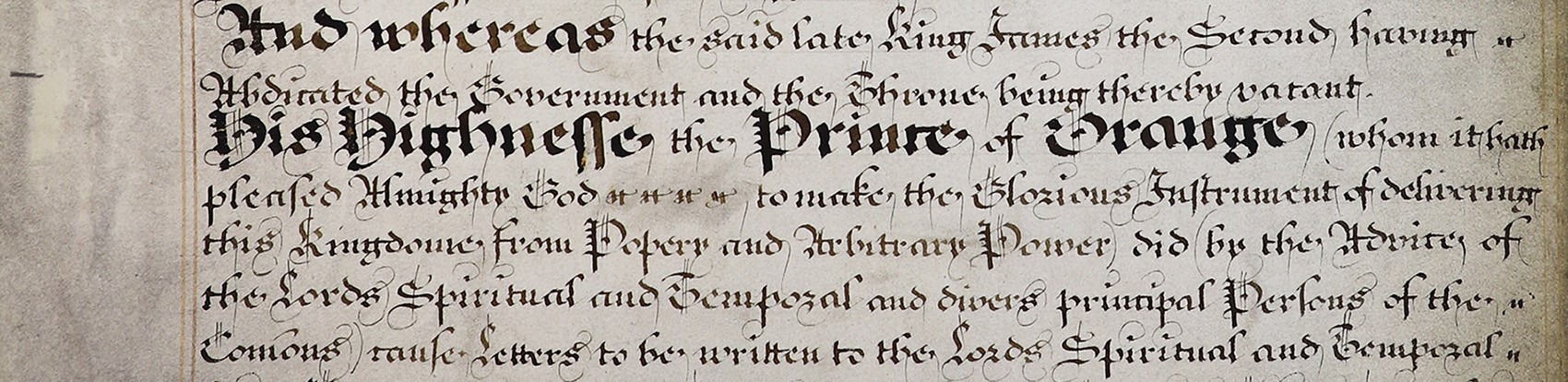
…
And whereas the said late King James the Second having abdicated the government and the throne being thereby vacant, his Highness the Prince of Orange (whom it hath pleased Almighty God to make the glorious instrument of delivering this kingdom from popery and arbitrary [unrestrained] power) did (by the advice of the Lords Spiritual and Temporal and divers principal persons of the Commons) cause letters to be written to the Lords Spiritual and Temporal being Protestants, and other letters to the several counties, cities, universities, boroughs and cinque ports, for the choosing of such persons to represent them as were of right to be sent to Parliament, to meet and sit at Westminster upon the two and twentieth day of January in this year one thousand six hundred eighty and eight [old style date], in order to such an establishment as that their religion, laws and liberties might not again be in danger of being subverted, upon which letters elections having been accordingly made.
And thereupon the said Lords Spiritual and Temporal and Commons, pursuant [following] to their respective letters and elections, being now assembled in a full and free representative of this nation, taking into their most serious consideration the best means for attaining the ends aforesaid, do in the first place (as their ancestors in like case have usually done) for the vindicating and asserting their ancient rights and liberties declare
That the pretended [false] power of suspending the laws or the execution of laws by regal authority without consent of Parliament is illegal.
…
Extract 3c
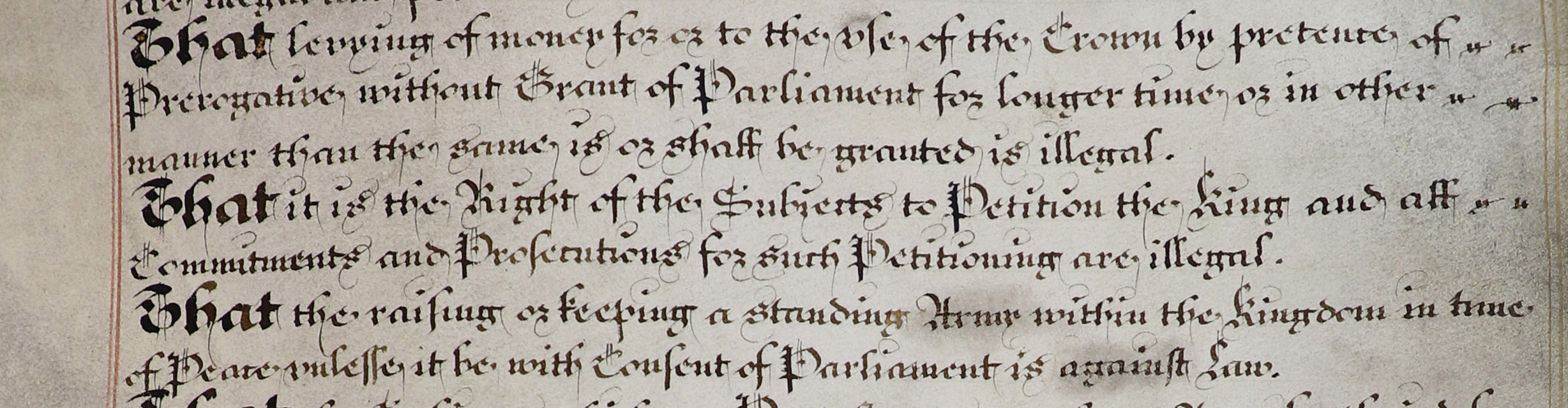
Extract 3c from the Enrolment of the Declaration of the 12 February of the Lords Spiritual and Temporal and Commons [the ‘Declaration of Rights’] Catalogue ref: C 212/18/1
This document is the Declaration of Rights, also known as the Bill of Rights, which was created by the English Parliament in February 1689. It established the rights of the English citizens and the responsibilities of the monarchy.
Document questions
- What issue does each right listed in the ‘Declaration’ here address?
- This is an extract from the ‘Declaration of Rights’. Find out what other rights were included in this ‘Declaration’.
Document transcript
…
That levying money [raising taxes] for or to the use of the Crown by pretence of prerogative [right], without grant of Parliament, for longer time, or in other manner than the same is or shall be granted, is illegal.
That it is the Right of the Subjects to Petition the King and ask Commitments and Pretension for such Petitioning are illegal.
That the raising or keeping a standing army within the kingdom in time of peace, unless it be with consent of Parliament, is against law.
…
Document 4
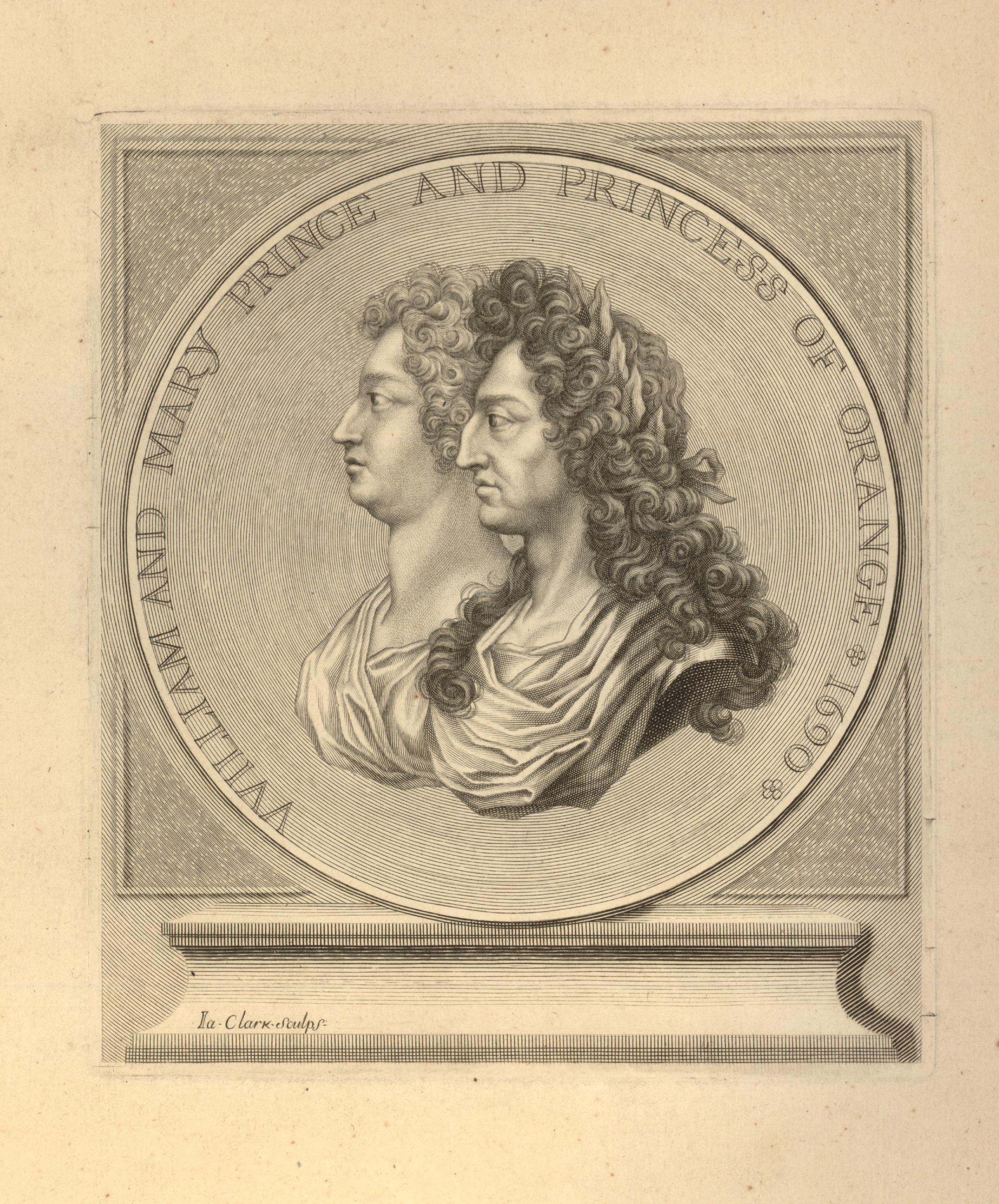
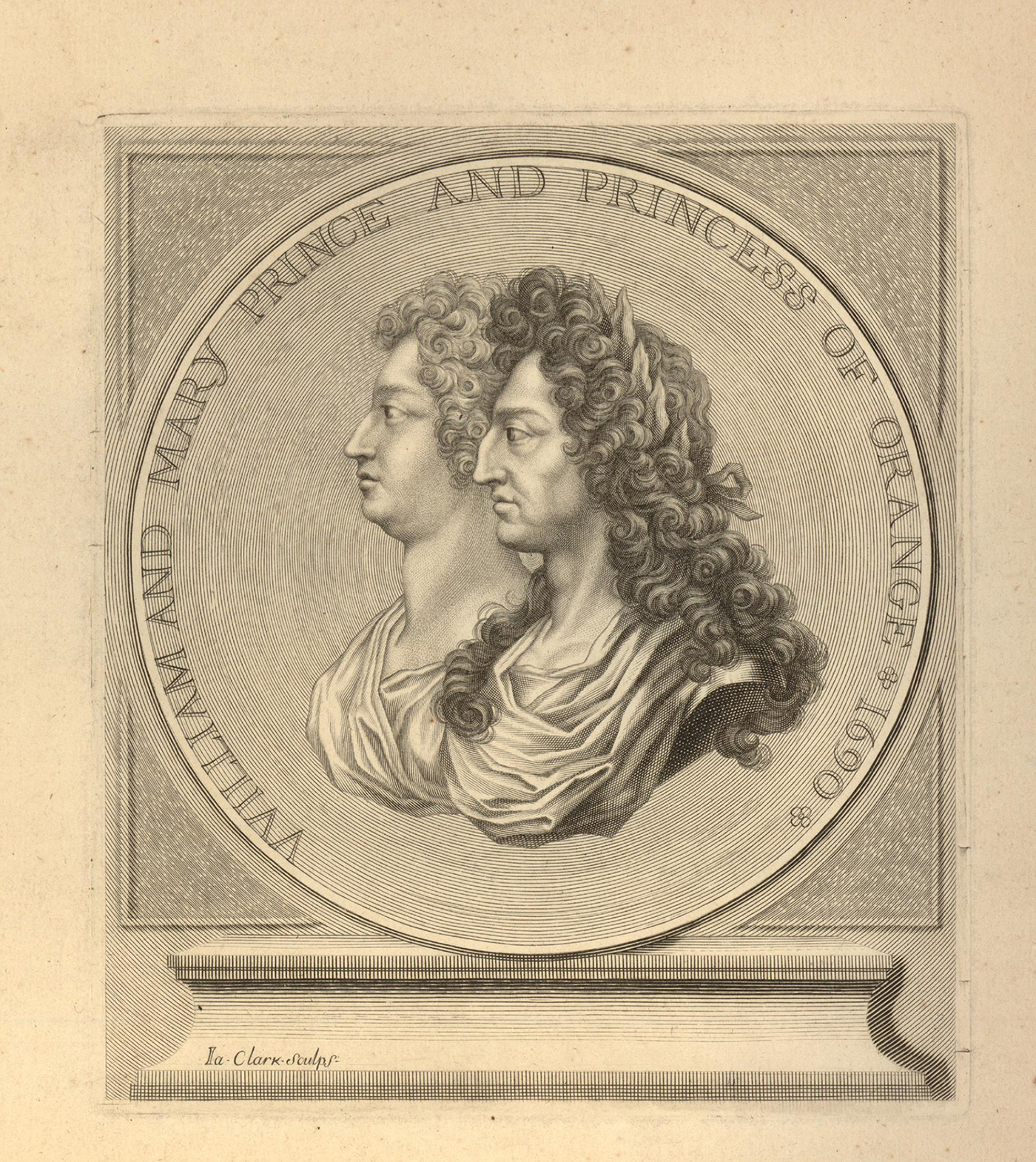
Engraving printed by James Clark showing William and Mary Prince and Princess of Orange 1690. A large medal on a pedestal with busts of William III and Mary II in Roman style. 1690. © The Trustees of the British Museum. Shared under a Creative Commons Attribution-NonCommercial-ShareAlike 4.0 International (CC BY-NC-SA 4.0) licence.
Document questions
- How does this engraving aim to reveal the power and permanence of William and Mary’s monarchy? [Clue: comment on the Roman style of the work.]
- How can this artwork be considered as propaganda for William of Orange’s invasion and joint monarchy?
- Why is the printed material shown as documents 1, 2 & 4 helpful for historians researching the causes of the Glorious Revolution? What can be understood from these forms propaganda?
Connections to Curriculum
Key stage 3
The Restoration, ‘Glorious Revolution’ and power of Parliament.
Key stage 5
These documents can be used to support any of the exam board specifications covering the Stuarts, specifically the reign of James II, Glorious Revolution, and the reign of William III and Mary II.
AQA GCE History ‘A’ Level
Stuart Britain and the Crisis of Monarchy, 1603-1702
Edexcel GCE History ‘A’ Level
Britain, 1625-1701: conflict, revolution, and settlement
OCR GCE History ‘A’ Level
The Making of Georgian Britain 1678-c.1760
Enquiry topic: The Glorious Revolution 1678-1689
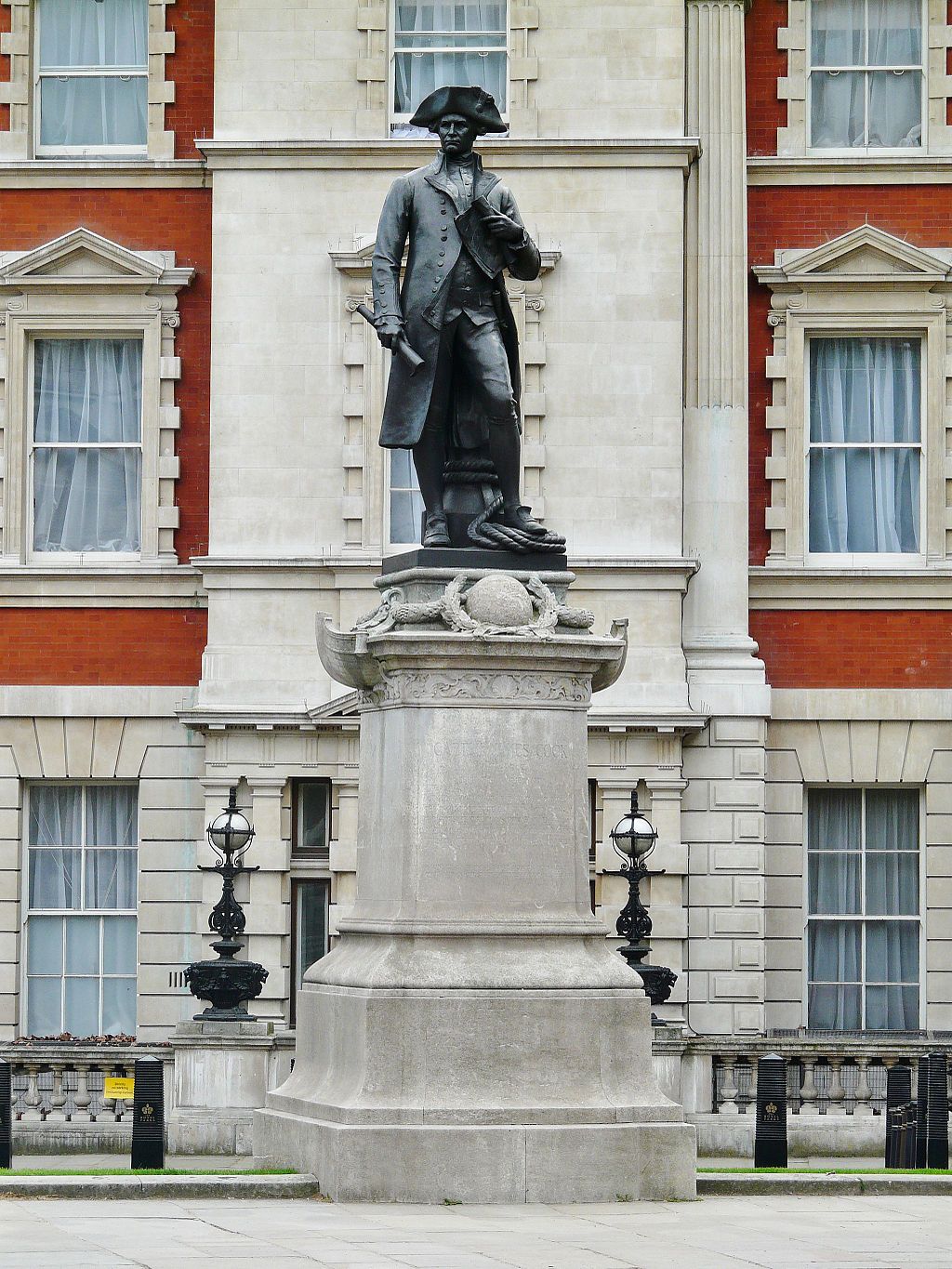
Statue of Captain James Cook, The Mall, 1914
This statue on The Mall, London, was created by Thomas Brock and was proposed by Joseph Carruthers, the former prime minister of New South Wales in Australia.
The inscription reads:
‘Captain James Cook, RN FRS, born 1728, died 1772.
Circumnavigator of the globe, explorer of the pacific ocean, he laid the foundations of the British Empire in Australia and New Zealand, chartered the shores of Newfoundland and traversed the ocean gates of Canada, both east and west.
Unveiled by H. R. H. Prince Arthur of Connaught on behalf of the British Empire League, 7th July 1914.’

Death of Captain Cook by John Cleverly the Younger, 1784
The original version of this painting was discovered in 2004. You can see it here. How does the original change the image of Captain Cook? Why do you think it was changed?

John Cleverly created his artworks based on his brother James’ sketches, as James Cleverly was a crew member on the voyage.

Extract from The Death of James Cook, 1789. The National Library of Australia.
This play was performed in Covent Garden just ten years after Cook’s death, and was an English version of a 1788 French pantomime by Jean-François Arnould-Mussot. It became very popular in London and toured throughout Britain.
The play focuses on a young Hawaiian couple, Pareea and Emai, and the Hawaiian villain Koah. Captain Cook intervenes against Koah on behalf of the couple and then protects King Kalaniʻōpuʻu from Koah and his warriors. Cook is killed by Koah and is mourned by everyone on the island.
You can read the script in its entirely on the National Library of Australia’s website.
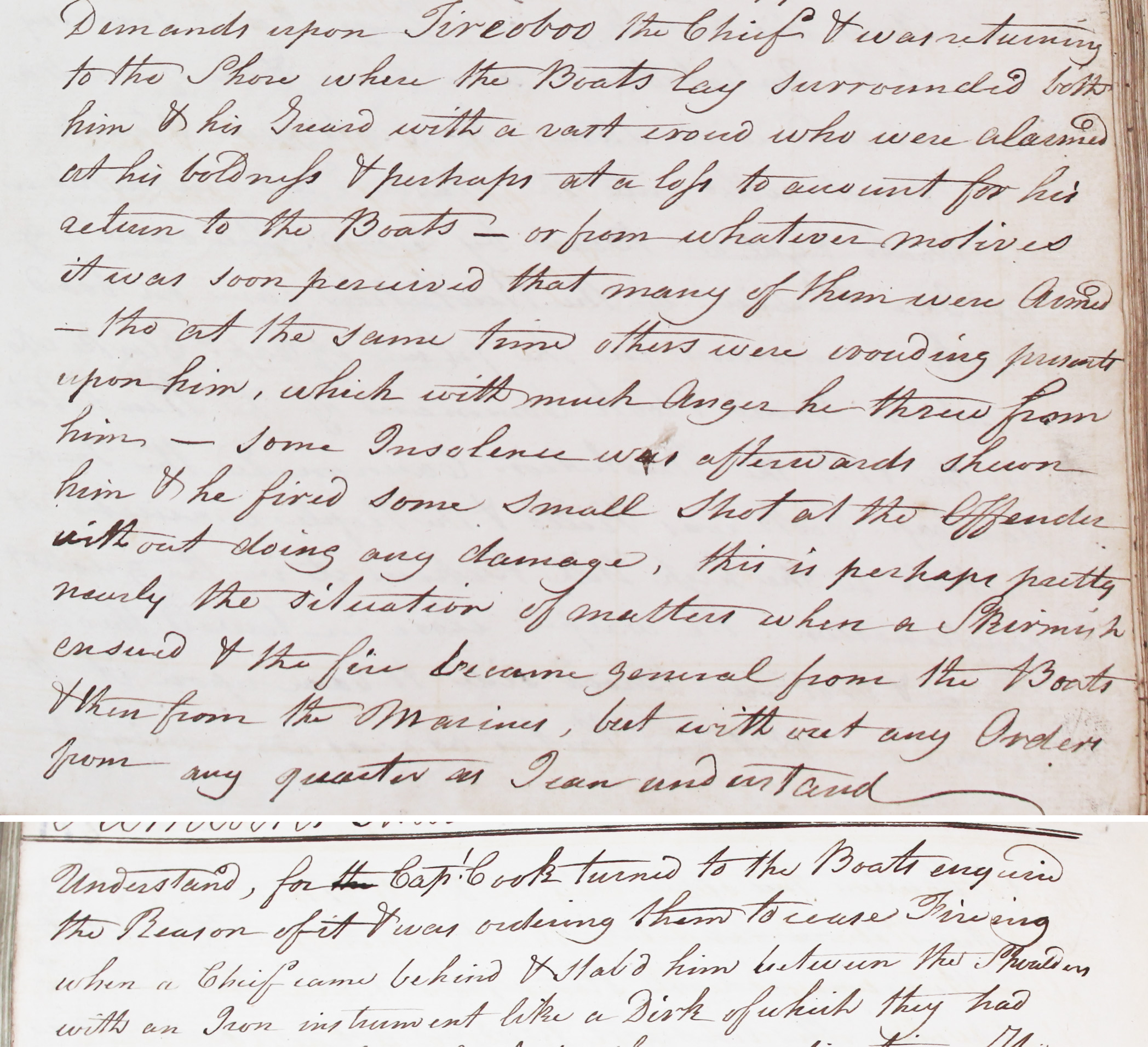
Log of John Rickman, Second Lieutenant. Catalogue ref: ADM 51/4529