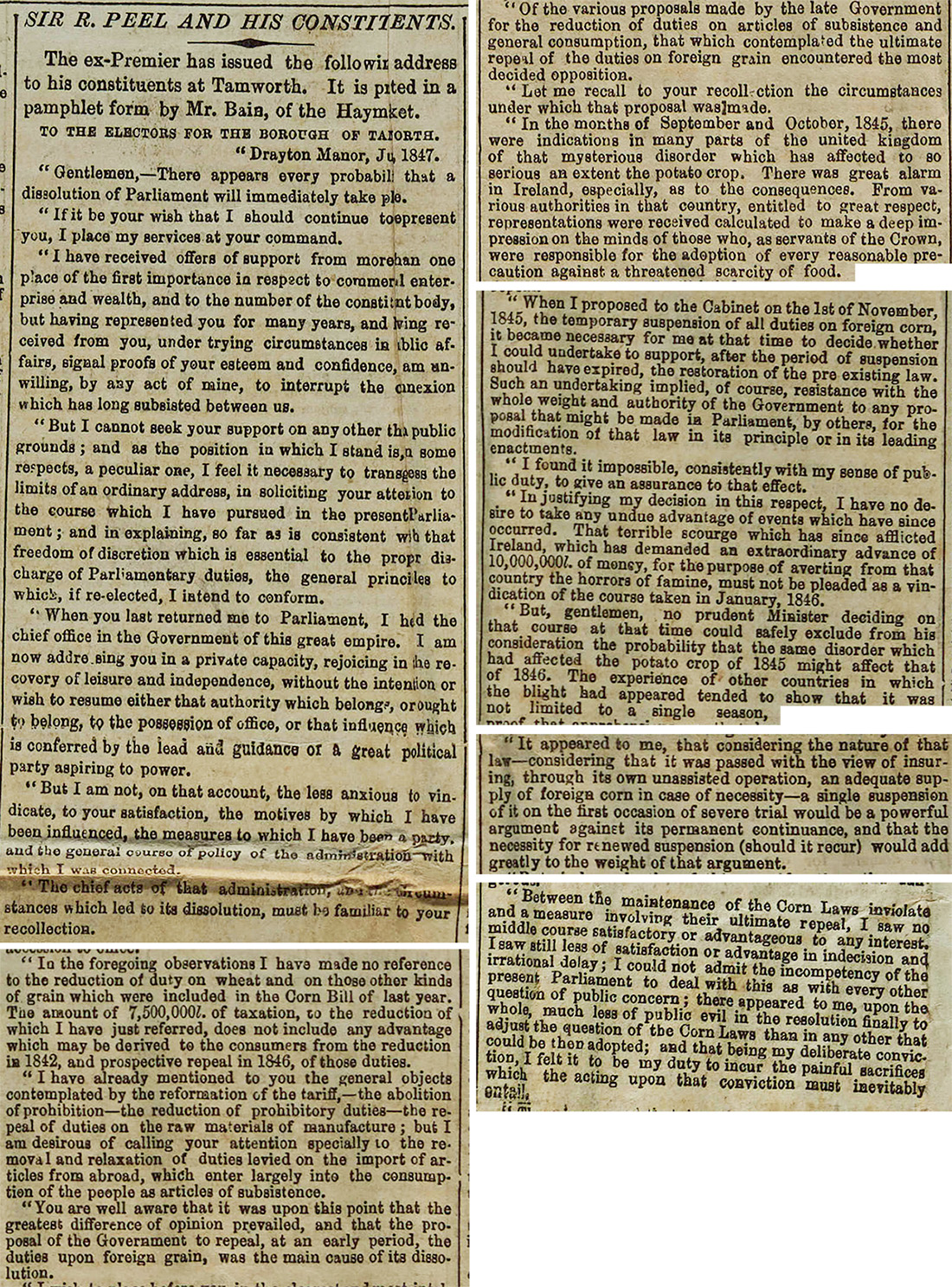
Extracts from the newspaper ‘The Times’ containing Sir Robert Peel’s letter to the Electors of Tamworth, July 1847. Catalogue ref: PRO 30/12/23/8.
[From the papers of Edward Law, 1st Earl of Ellenborough]
This newspaper extract relates to Robert Peel’s address to the electors of his constituency of Tamworth, Staffordshire, after his resignation as Prime Minister in 1846. He remained the MP for Tamworth until his death in 1850.
Transcript
SIR R. PEEL AND HIS CONSTITUENTS
The ex-Premier has issued the following address to his constituents at Tamworth. It is printed in a pamphlet form by Mr. Bain, of the Haymarket.
TO THE ELECTORS FOR THE BOROUGH OF TAMWORTH
Drayton Manor, July 1847
Gentlemen, – There appears every probability that a dissolution of Parliament will immediately take place.
If it be your wish that I should continue to represent you, I place my services at your command
I have received officers of support from more than one place of the first importance in respect to commercial enterprise and wealth, and to the number of constituent body, but having represented you for many years, and having received from you, under trying circumstances in public affairs, signal proofs of your esteem and confidence, I am unwilling, by any act of mine, to interrupt the connexion which has long subsisted between us.
But I cannot seek your support on any other than public grounds; and as the position in which I stand is, in some respects, a peculiar one, I feel it is necessary to transgress [ignore] the limits of an ordinary address, in soliciting [seeking] your attention to the course which I have pursued in the present Parliament; and in explaining, so far as it is consistent with that freedom of discretion which is essential to the proper discharge of Parliamentary duties, the general principles to which, if re-elected, I indeed to conform.
When you last returned me to Parliament, I held the chief office in the Government of this great empire. I am now addressing you in a private capacity, rejoicing in the recovery of leisure and independence, without the intention or wish to resume either that authority which belongs, or ought to belong, to the possession of office, or that influence which is conferred by the lead and guidance off a great political party aspiring to power.
But I am not, on that account, the less anxious to vindicate, to your satisfaction, the motives by which I have been influenced, the measures to which I have been a party, and the general course of policy of the administration with which I was connected.
The chief acts of that administration, and the circumstances which led to its dissolution, must be familiar to your recollection.
…
In the foregoing observations I have made no reference to the reduction of duty on wheat and on those other kinds of grain which were included in the Corn Bill of last year…. I am desirous of calling your attention specially to the removal and relaxation of duties levied on the import of articles from abroad, which enter largely into the consumption of the people as articles of substance.
“You are well aware that it was upon this point that the greatest difference of opinion prevailed, and that the proposal of the government to repeal, at an early period, the duties upon foreign grain, was the main cause of its dissolution.
….
Of the various proposals made by the late Government for the reduction of duties on articles of subsistence and general consumption that which contemplated the ultimate repeal of duties on foreign grain encountered the most decided opposition.
Let me recall to your recollection the circumstances upon which that proposal was made.
In the months of September and October 1845, there were indications in many parts of the United Kingdom of that mysterious disorder which has affected to so serious an extent the potato crop. There was great alarm in Ireland, especially as to the consequences. From various authorities in that country entitled to great respect, representations were received calculated to make a deep impression on the minds of those who, as servants of the Crown, were responsible for the adoption of every reasonable precaution against a threatened scarcity of food.
….
When I proposed to the Cabinet on the 1 of November 1845, the temporary suspension of all duties on foreign corn, it became necessary for me at that time to decide whether I could undertake to support, after the period of suspension should have expired, the restoration of the pre-existing law. Such an undertaking implied, of course, resistance with the whole weight and authority of the Government to any proposal that might be made in Parliament, by others, for the modification of that law in its principle or in its leading enactments.
“I found it impossible, consistently with my sense of public duty, to give an assurance to that effect.
“In justifying my decision to this respect, I have no desire to take any undue advantage of events which have since occurred. That terrible scourge which has since afflicted Ireland, which has demanded an extraordinary advance of 10,000,000.l [pounds] of money, for the purpose of averting from that country the horrors of famine, must not be pleaded as a vindication of the course taken in January 1846.
But, gentlemen, no prudent Minister deciding on that course at that time could safely exclude from his consideration the probably that the same disorder which had affected the potato crop of 1845 might affect that of 1846. The experience of other countries in which the blight had appeared tended to show that it was not limited to a single season
…
It appeared to me, that considering the nature of that law- considering that it was passed with the view of insuring, through its own unassisted operation, an adequate supply of foreign corn in case of necessity- a single suspension of it on the first occasion of severe trial would be a powerful argument against its permanent continuance, and that the necessity for its renewed suspension (should it recur) would add greatly to the weight of that argument
…
Between the maintenance of the Corn Laws inviolate and a measure involving their ultimate repeal, I saw no middle course satisfactory or advantageous to any interest. I saw still less of satisfaction or advantage in indecision and irrational delay; I could not admit the incompetency of the present Parliament to deal with this as with every other question of public concern; there appeared to me, upon the whole, much less of public evil in the resolution finally to adjust the question of the Corn Laws than in any other that could be then adopted; and that being my deliberate conviction, I felt it to be my duty to incur the painful sacrifices which acting upon that conviction must inevitably maintain.
…
- How does Peel characterise his relationship with his constituents?
- What can we infer about Peels’ motives for making this address to his constituents?
- According to this source, what is the key reason Peel provides for repealing the Corn Laws?
- How did Peel react to the events in Ireland and England?
- How does Peel use rhetoric (persuasive language) to explain himself as a dutiful public servant?