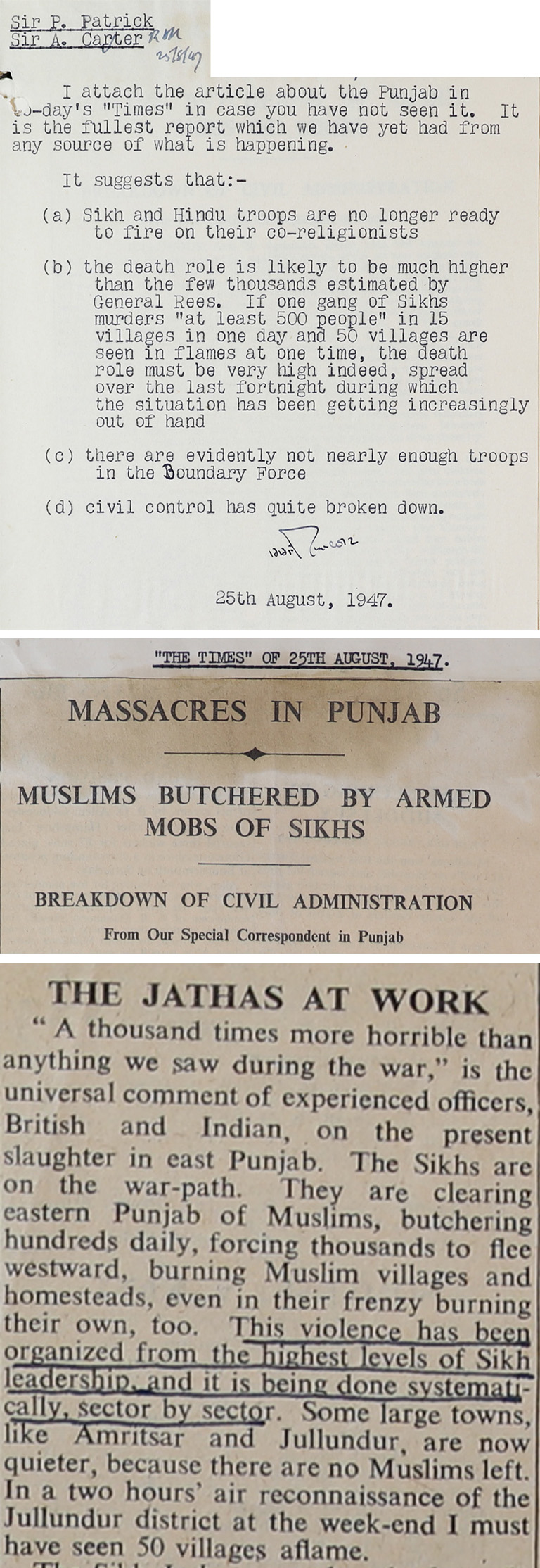
Cover note and extract from a newspaper article from The Times, 25th August, 1947. Catalogue ref: DO 142/416
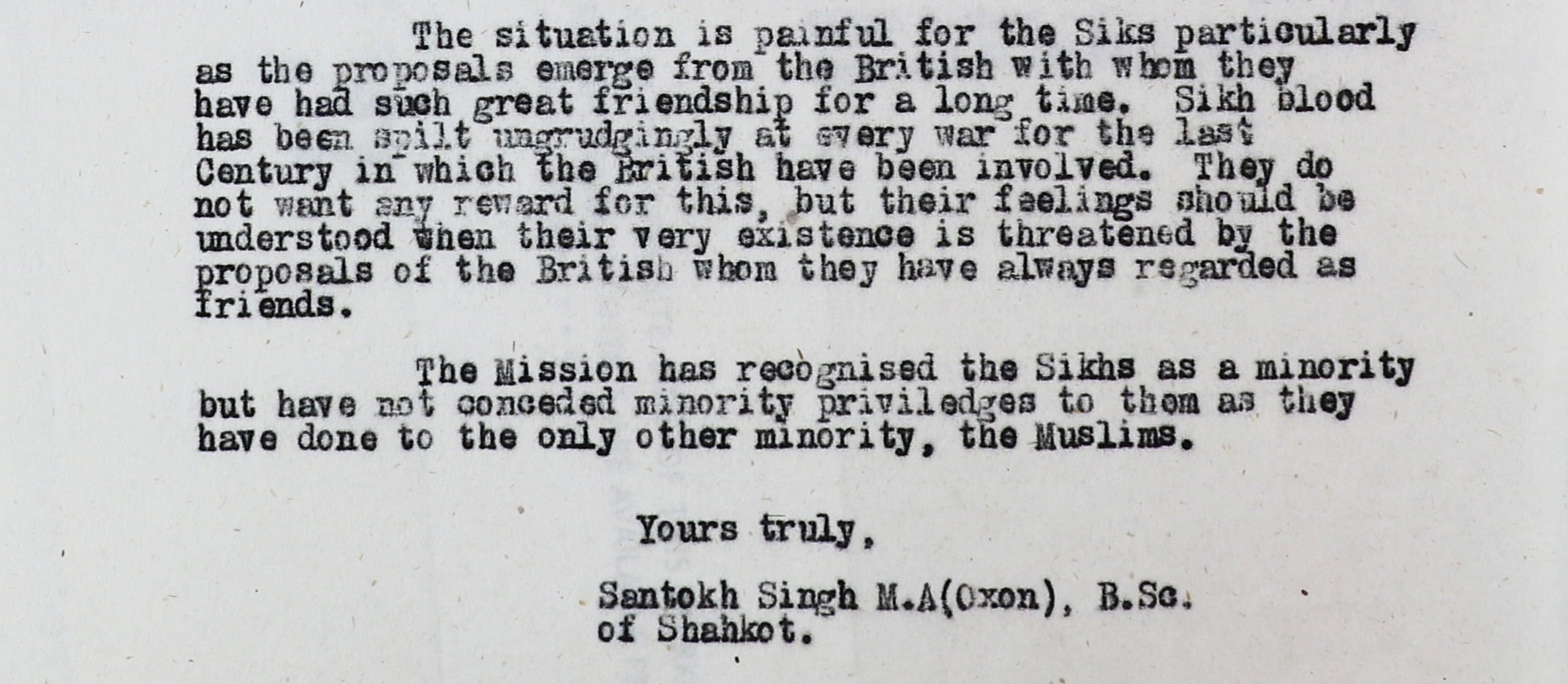
Letter from Santokh Singh, 1 June 1946. Catalogue ref: CAB 127/106
Context – Santokh Singh was a writer who wrote in Punjabi, with a Sikh father and a Hindu mother. He is writing to Lord Pethick Lawrence, a British politician involved in the negotiations leading to the partition of British India.
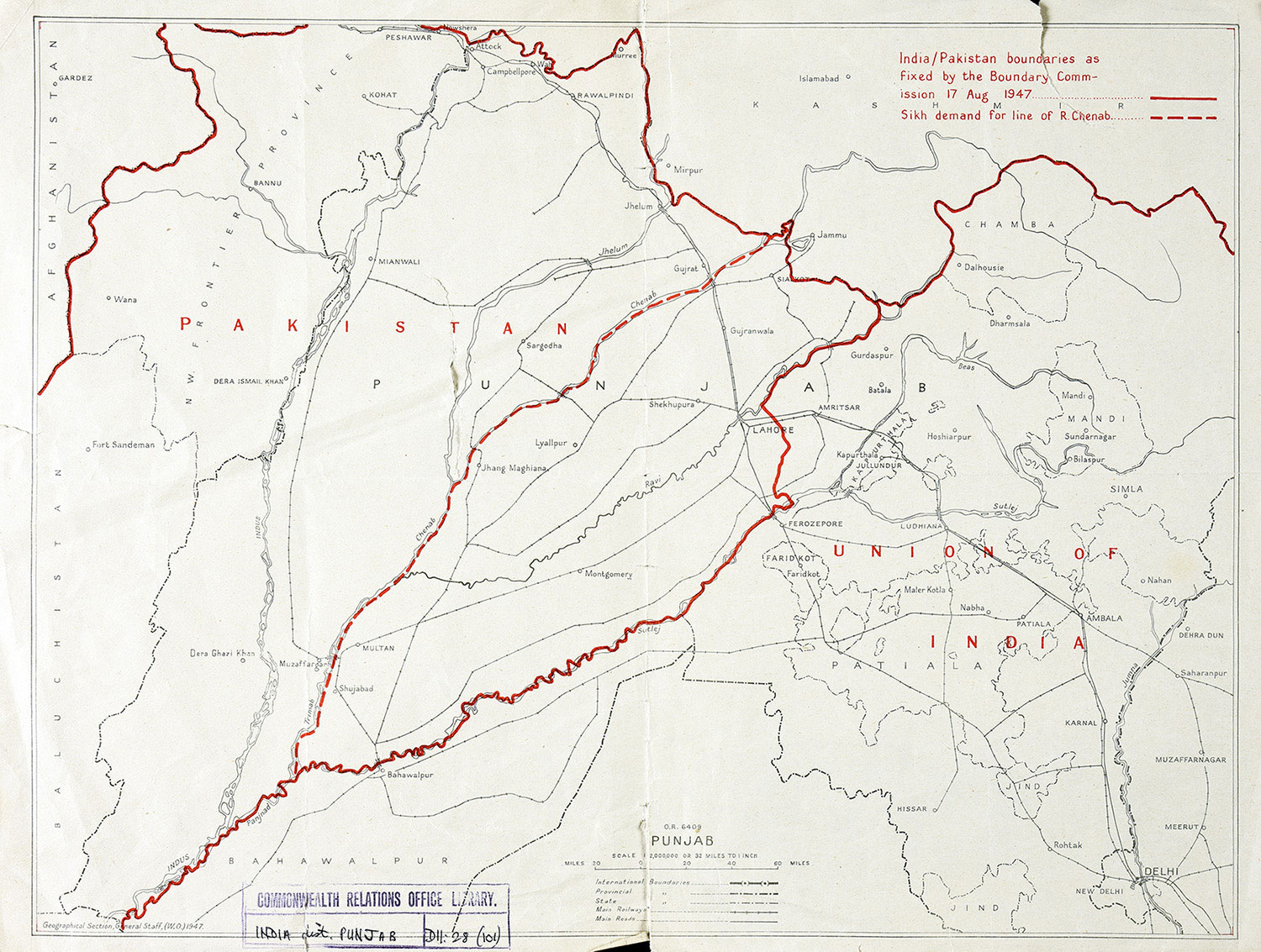
1947 map of the Punjab, India and Pakistan boundaries. Catalogue ref: CO1054/76
Context-
Lahore was a special place for the Sikhs. It was the location of many important Sikh religious and historical sites. In addition Guru Nanak, the founder of Sikhism, was born in Nankana Sahib, near Lahore. However this was a Muslim majority area and was made part of Pakistan. This didn’t take into account that non-Muslim people had strong connections to this area, they had businesses and had played a large role in developing the Punjab. Before the boundary line was drawn there were appeals from many in the Sikh community to give greater acknowledgement to Sikh history and heritage than they feared a focus on Muslim and non-Muslim populations would allow.
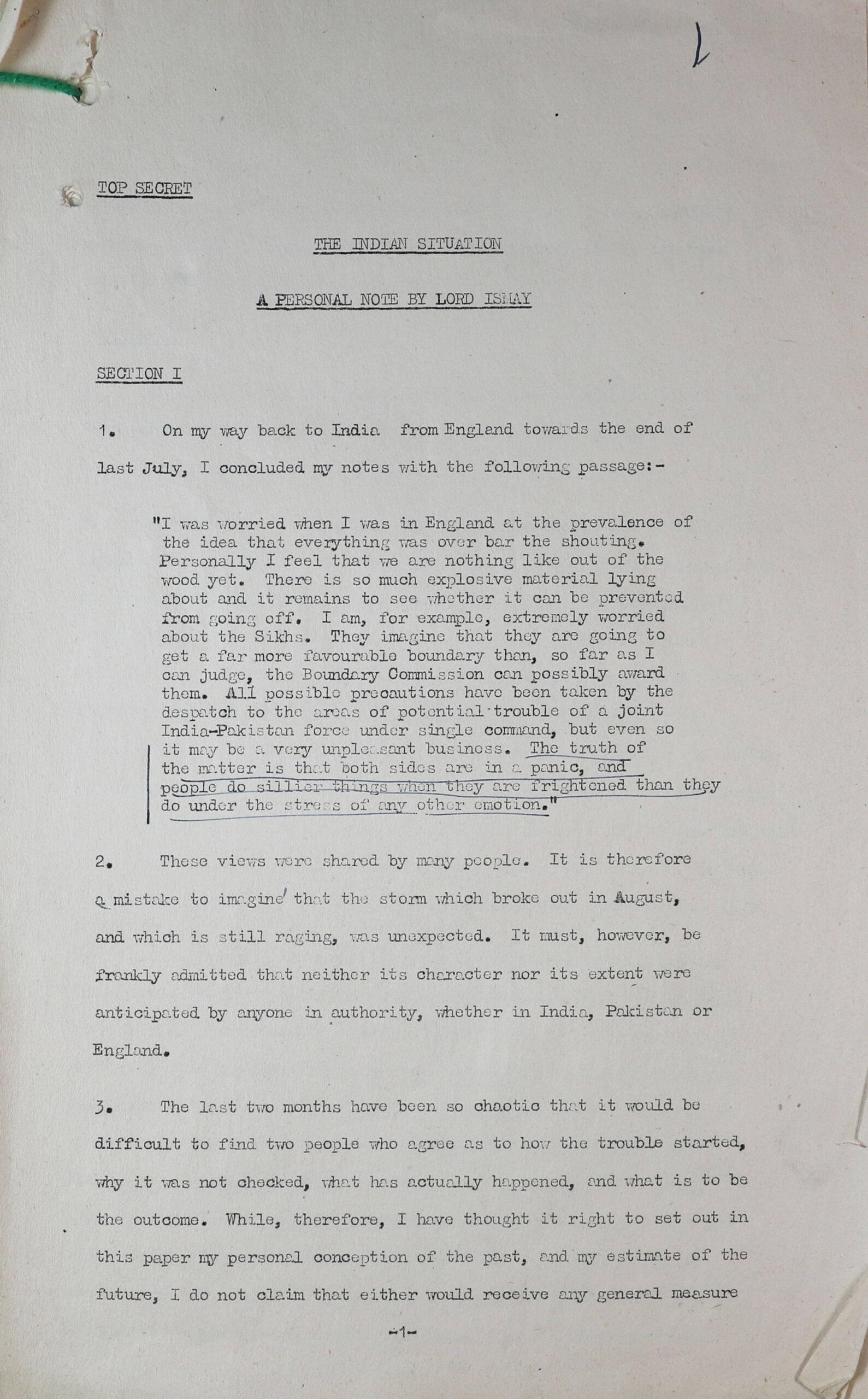
Catalogue ref: DO 121/69
Context – Lord Ismay was chief of Staff to Lord Mountbatten and therefore closely involved in negotiations.

Listen to the oral testimony from Iqbal’s aunt about partition.
Context – These are extracts from a conversation with Iqbal’s aunt whose family were displaced prior to the partition of British India. There are themed audio clips and a typed transcript.
- What type of document is this?
- What challenges did Iqbal’s aunt face when her family were displaced?
- Iqbal’s aunt shows a lot of empathy for Mr Ansari who was Muslim and recognition that he must have felt loss, like her family did.
- How does that challenge some of the simplistic ideas about ‘non- Muslim’ and ‘Muslim’ people in the Starter Source?
- How useful do you think oral testimony is as a source to learn about partition? Explain your answer.
1. Train journey
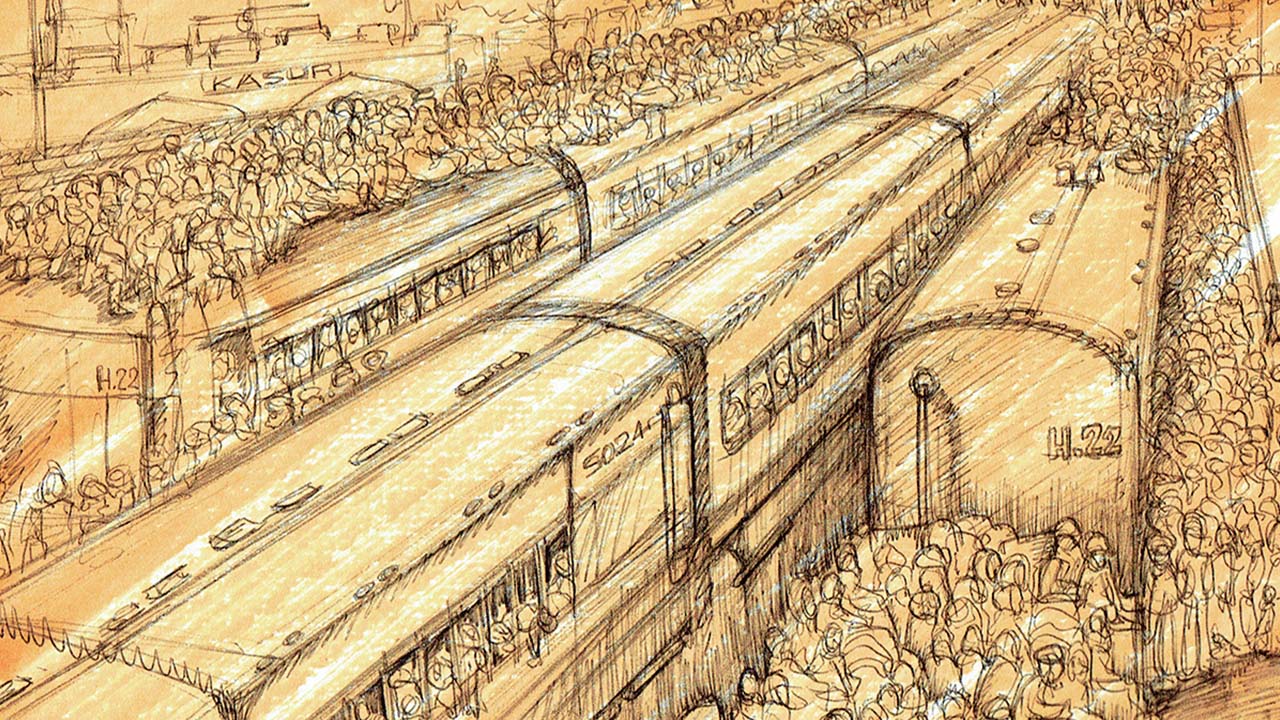
We were in a train, never seen before, but everyone was quiet, no one was saying anything, later on my mother told me were all wandering where are we going, what’s happening, that’s what she told us and I remember Lahore Station, the railway station, where there were people, people, people and my mother’s sister and her husband they came to see us at the station saying why are we going, are we mad, they still didn’t realise but then grandfather told us we must go, it is going to happen, that everybody will have to leave, those who are not of that religion of Pakistan going to leave. And then the train slowly moves, people are very happy, as children we were going to Ferozepur, Ferozepur, Ferozepur, it was going to be India. And my mother says that everybody was happy, and loud religious things were being said, thank God, we were saved and very sad and very unhappy that they had to leave their homes forever.
2. Learning Hindi
We had to learn a new language, which was Hindi. In Pakistan it was Urdu and English, and here it was going to be Hindi and English, so we had to go to a Hindi learning school to learn Hindi to go into school, to be admitted, and to learn that language. The teacher who was teaching us came from a very good local rich landlord family so that is a very beautiful memory, of learning the language from her. But we could not go to an English medium school because they were more expensive, and the Hindi medium was low fees and my parents could afford only that for the girls and the boys, brother, cousins, they went to the English medium. That trauma of Hindi medium stayed in me, that complex, lasted I think almost forever, but of course we managed with confidence but I remember wherever you went we grew up they would say you know so-and-so’s daughters. They are okay girls but you know they went to the Hindi medium schools, they are simpletons.
3. ‘Refugee girls’
I don’t remember the word refugee. It came only when we decided we are going to Dehradun because all the refugees are going towards Dehradun, towards Dehradun. Saharanpur, Rurki, Delhi. We were about to reach Dehradun, a beautiful place, it’s a valley between the two mountain ranges of the Himalayas. That is where I remember, ‘oh, they are refugees. They are the refugee girls. They are the refugee girls.’
4. My father and Mr Ansari
You see when the refugees were given houses which were left by the Muslims who went to Pakistan and the other way around. One very major trauma that in my mind is I must tell you, is my father, who suffered the maximum and he never, never laughed, never smiled easily because he could not get over it. 23 years after partition when he became ill, subconsciously or unconsciously he kept on saying, let’s go home, let’s go home. And my mother said, we are home. No, no, let’s go home. Because he was thinking home that is left behind.
We were given this place which belonged to Mr. Ansari, had a beautiful garden, seven types varieties of mangoes and lychees and all kinds of fruit. And he was a very nice man, who also had to leave the other way round, and then when I was thinking of my father saying, let’s go home, I wondered, Mr. Ansari must be missing his home, which became our home.
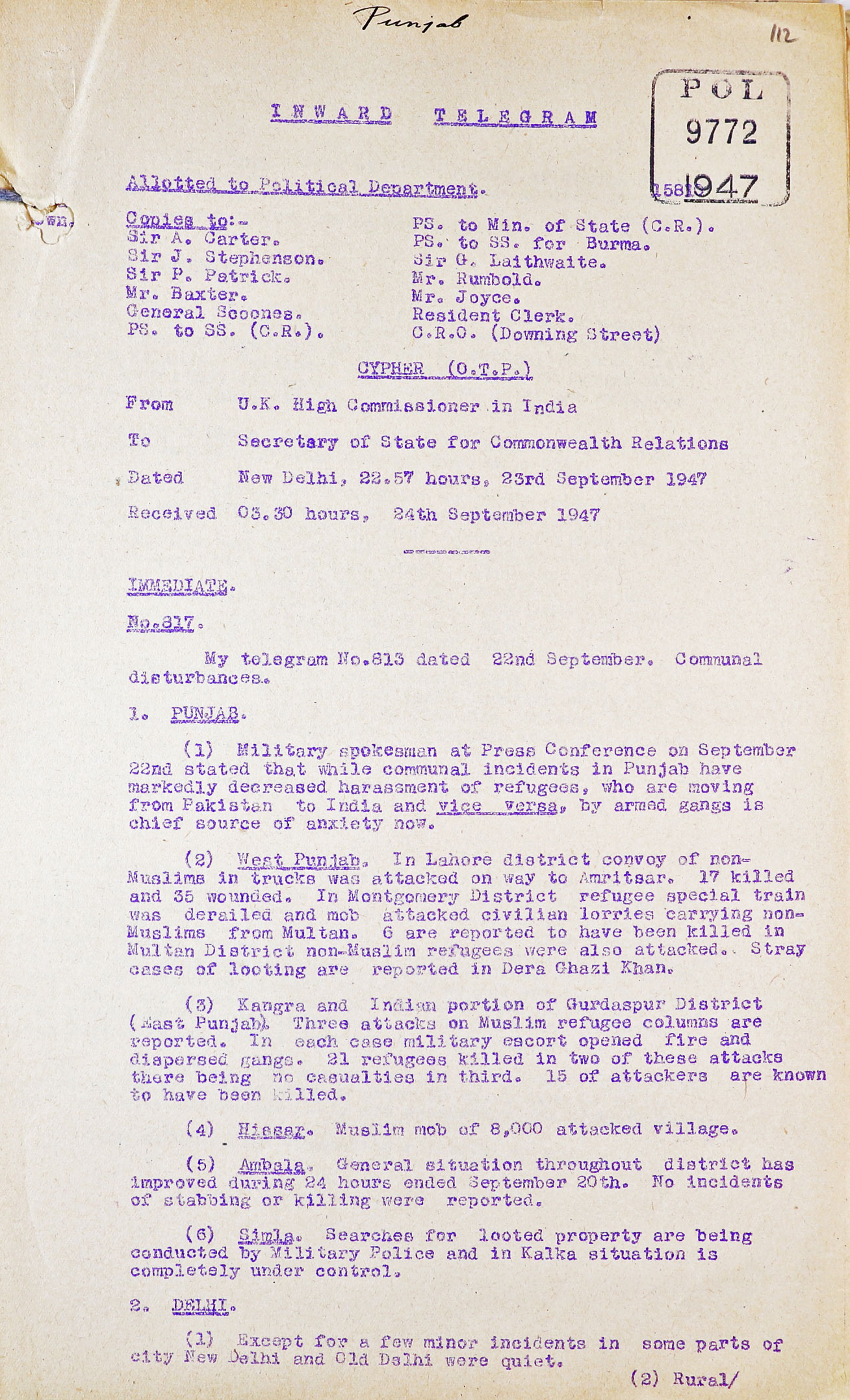
Telegram, September 1947. Catalogue ref: DO 142/416 .
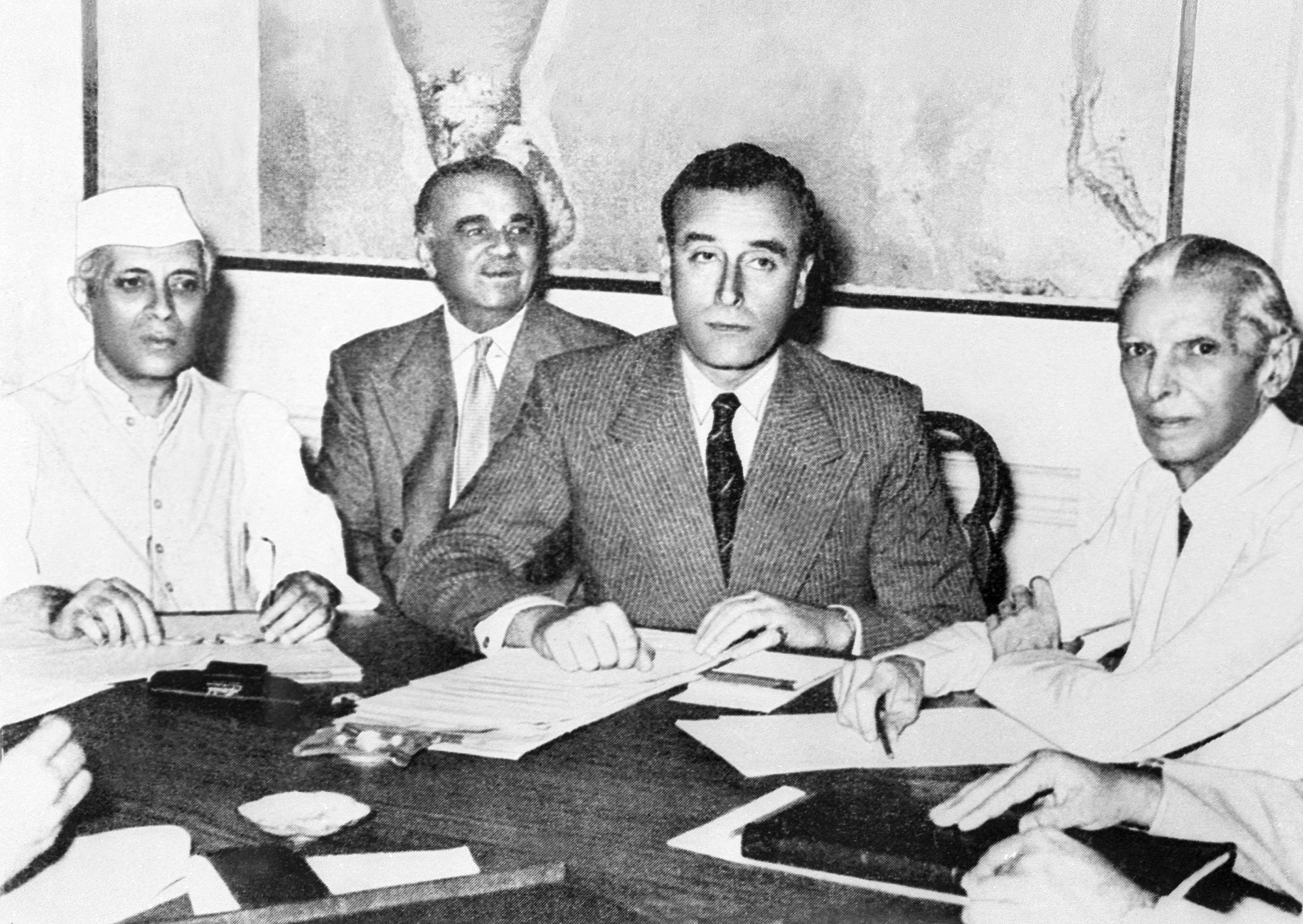
Photograph of: Jawaharlal Nehru – the first Prime Minister of independent India (left), Lord Ismay – Chief of Staff to Lord Mountbatten (centre left), Lord Mountbatten – British Viceroy of India (centre right), and Muhammed Ali Jinnah – first governor-general of Pakistan (right). Dinodia Photos / Alamy Stock Photo
In the below video, Iqbal Singh, Hannah Carter and Eleanor Newbigin introduce a document relating to the partition of British India. They explore what this document’s tone and content can tell us about British official’s attitudes to the violence that occurred after partition. Students also hear an oral testimony from Iqbal’s aunt whose family were displaced in 1946 due to growing tensions in British India. There is an accompanying resource pack you could use to explore this topic further.
The video and resource were launched at a plenary session at the SHP conference 2022.
What can The National Archives documents reveal about the partition of British India?Introduction to Partition
The partition of British India occurred in August 1947 when the British government withdrew from India after almost two hundred years of British rule.
People in British India had called for independence for decades. But, until the early 1940s, very few people–in Britain or India–would have thought that this independence would take the form of dividing up land.
A very important reason for British rule in India was military resources, particularly soldiers. In 1942, a point of uncertainty in the war for Britain, and growing Indian opposition to colonialism, the British government announced they would leave India after the war. There were many different political leaders and groups who disagreed about how to make everyone feel represented after Britain left. Muslims only made up a quarter of the population but these communities were not spread evenly. There were a few areas where Muslims were most of the population. There were calls from some Muslim leaders for these regions to have greater independence. Divisions grew.
By late 1946 British officials had given up on finding a solution in which many different groups could be represented within a single state. In February 1947 Lord Mountbatten was sent to oversee Britain’s withdrawal. On the 3rd June 1947 he stunned everyone by announcing with leaders Jawaharlal Nehru and Muhammad Ali Jinnah that Britain would give power to not one but two new governments – the government of India and the government of Pakistan, a year earlier than previously planned.
Officials from Britain and British India were given just 9 weeks to work out how British India would be divided. The final borders split the eastern and western areas of British India and ran through the provinces of Punjab and Bengal, important areas economically and politically with a roughly 50:50 split of Indian and Muslim populations.
Independence was declared on 14th and 15th August 1947 but the borders of these two new nations were announced 2 days later on the 17th of August. This meant that people celebrated independence without knowing for sure quite where the line between these two countries would be drawn.
People living in the regions affected by partition felt scared and uncertain about their future – not wanting to end up on the ‘wrong side’ of the border. In the months around August 1947 over 15 million people are thought to have migrated across the new borders. In Punjab in particular this huge human migration was accompanied by brutal violence- some of which we can see as a reflection of the fear and uncertainty of what was going on, of the future. However it is important to stress that much of the violence was not random but orchestrated by militias connected to various political parties who wanted to secure the best possible outcome after the British left India.
Communal disturbances
Our mystery document begins with the heading ‘communal disturbances’ which is a word we do not really recognise today. But it was a term that was widely used by officials in British-India to describe tensions between different religious groups. The use of the term ‘communal’ instead of just saying ‘religious’ showed that the British thought they were dealing with something specific to Indian society. It was thought that because of strong religious ideas Indian people were most likely to resolve things through violence. Religion was always assumed the cause, not more specific, local issues, which enabled officials to see the violence as something they were not responsible for, that it was caused by timeless differences between people.
Documents at The National Archives
The documents at The National Archives alongside those at the British Library India Office collection and records published in the Transfer of Power collection are some of the major collections of records in the UK about the period we are studying. While there is some duplication, the records at The National Archives are particularly strong for records of policy making at the highest level and for records of British armed forces stationed in India.
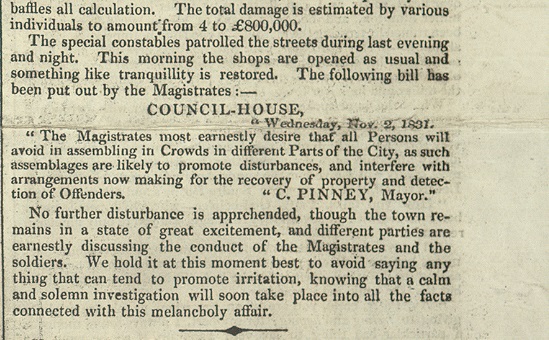
Extracts from ‘The Bristol Gazette’ on a riot in Bristol, 3 November 1831 Catalogue ref: HO 40/28.
According this newspaper, there were 8 inquests into why people died during the riot ‘of which two died by excessive drinking, four were burnt in the Square, and two were shot. A very great number must have lost their lives, of which we can obtain no account’.
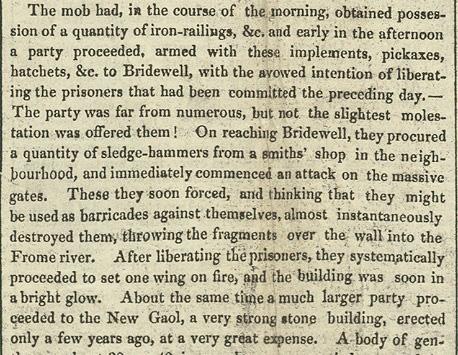
Extracts from ‘The Bristol Gazette’ on a riot in Bristol, 3 November 1831 Catalogue ref: HO 40/28.
According this newspaper, there were 8 inquests into why people died during the riot ‘of which two died by excessive drinking, four were burnt in the Square, and two were shot. A very great number must have lost their lives, of which we can obtain no account’.