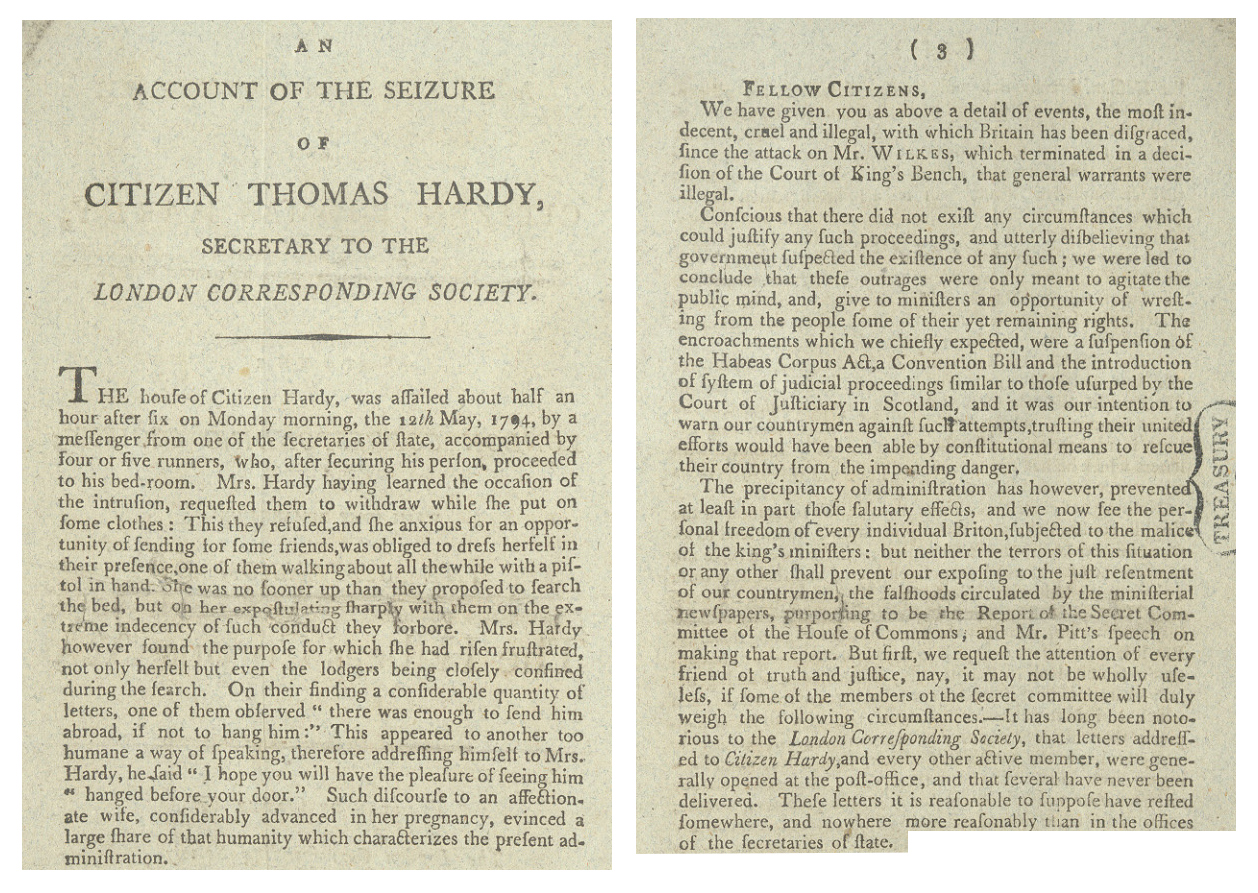
Extract from a printed account by the London Corresponding Society on the arrest of Thomas Hardy, 12 May 1794, Catalogue ref: TS 24/3/33
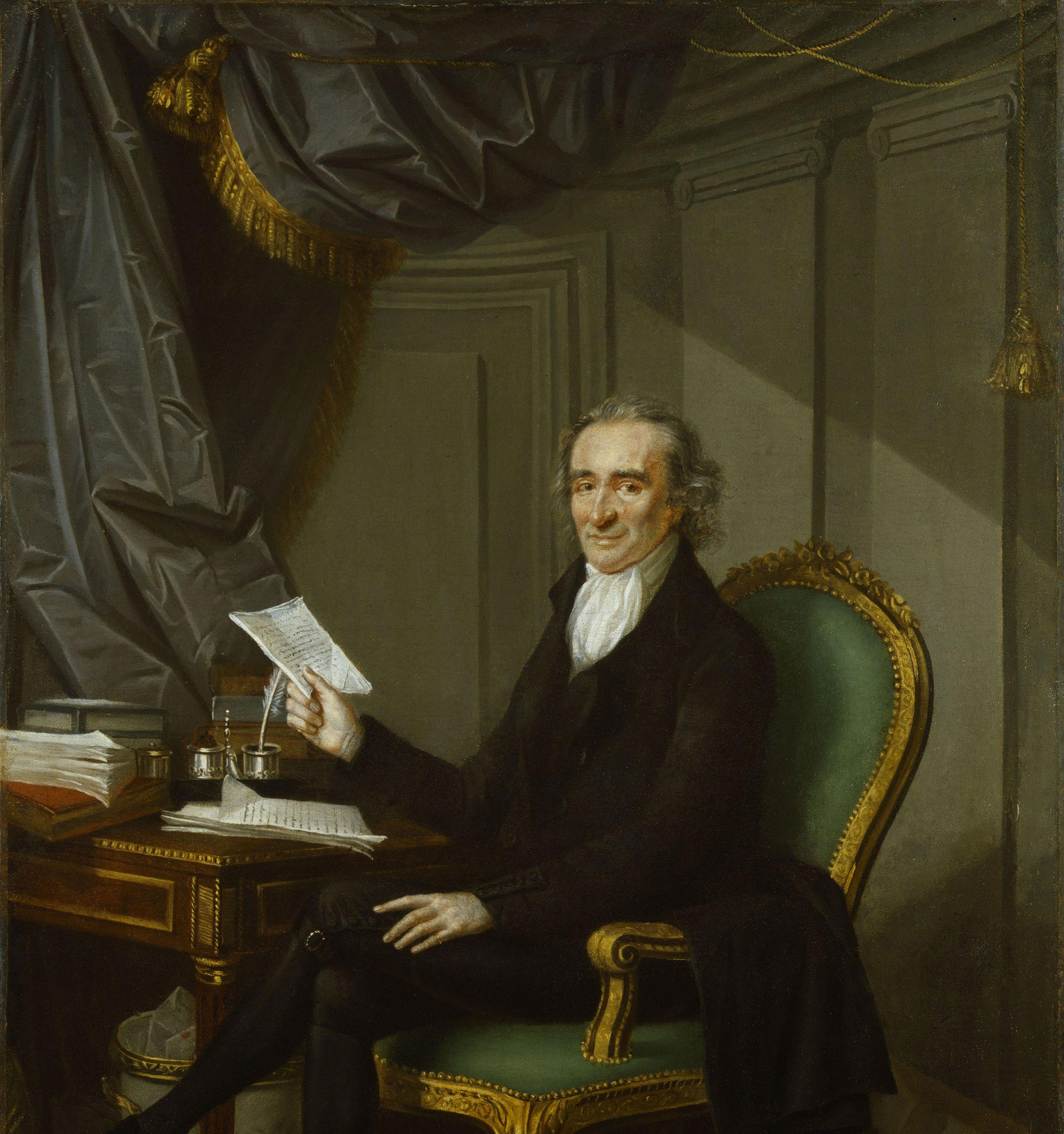
Very few people had the right to vote in the late eighteenth century. Politics and the running of the government was limited to a small number of wealthy people and certain people later called radicals, questioned if this was the best way of government.
The most important radical writer at this time was Thomas Paine (1737-1809). Paine was born in Thetford in Norfolk and later moved to America where he played an influential role in drafting the Declaration of Independence. He later travelled to France and became involved in the French Revolution, working with the leaders to produce the ‘Declaration of the Rights of Man’. Paine wrote a book called ‘The Rights of Man’ which said that everybody should have the right to be involved in government. His book sold half a million copies and was read by many more. It was frequently used as the discussion topic for political groups called corresponding societies.
Thomas Paine supported the development of corresponding societies, which grew up across the country in the 1790s in Derby, Dundee, Edinburgh, Glasgow London, Perth, Norwich, Nottingham and Sheffield. The societies aimed to gain public support for parliamentary reform including annual parliaments and universal suffrage.
Using the original documents in this lesson, find out how Thomas Paine and other radicals demanded change in how the country was to be governed. How did the government respond?
Political and social reform in 18th century BritainThe second half of the eighteenth century saw a blossoming of ideas concerning popular rights. In ‘The North Briton Radical’, a newspaper founded in 1762 by radical John Wilkes attacked on King George III and his Government. Wilkes was arrested on a general warrant: a document detailing the crime but not the name of the suspected criminal. Wilkes challenged the general warrant and eventually won his case. These events launched the cries of “Wilkes and Liberty!” and other popular slogans for free speech as a resistance to illegitimate power. Wilkes eventually fled to France but returned in 1768, becoming Member of Parliament for Middlesex. After a spell in prison and a series of expulsions and re-elections, Wilkes returned to popular campaigning arguing for the freedom for parliamentary debates to be reported and in favour of parliamentary reform.
This period was not marked by huge gains in rights but it re-introduced the idea of popular rights as an important aspiration. Parliament was pressurised to bring in a number of (unsuccessful) bills for reform. Pressure came from publications such as Major Cartwright’s Take Your Choice (1776), which argued for manhood suffrage, the secret ballot, annual elections and equal electoral districts.
Following the French Revolution, the idea that ‘political ‘rights’ meant the participation in the political process beyond the rights of the elite, became popular. The Rights of Man by Thomas Paine became the most famous expression of this idea and was very important for the corresponding societies. They began to meet at the same time that a revolution was taking place in France, during the late 1780s and the 1790s. The radicals, thought that citizenship came from universal ‘natural rights’. This meant that all men (though not necessarily all women) had a right to take part in politics, whatever their social class, political background or religious beliefs. They referred to each other as ‘citizens’. The government in Britain was worried that the corresponding societies might start a revolution. They became very concerned when the French revolutionaries executed their king. Many radicals were arrested and laws passed to ban corresponding societies and unions.
Thomas Hardy was a radical and the Secretary of the London Corresponding Society. It was the first radical group to be open to everyone. Their motto was that ‘our members be unlimited’. Hardy wanted to send a petition to Parliament in the hope that the political system would be reformed. Alarmed by the events in France and by the popularity of the London Corresponding Society, officials arrested Thomas Hardy in May 1794 for high treason. Shortly after Hardy’s arrest, supporters of the government attacked his home and the shock resulted in the death of his pregnant wife.
Along with the political clampdown against individual radicals, the Government faced the Royal Naval mutinies in 1797 and increased trade union activity. In quick succession the Government passed legislation against ‘unlawful oaths’ (naval mutineers had made such oaths to each other in 1797), corresponding societies and finally ‘combinations’ or trade unions.
Food prices rose and some common lands were enclosed in the second half of the eighteenth century. There were food riots from the 1750s to the 1770s and in the 1790s until 1801. Some historians have described those who took part in food riots as protecting their rights within a ‘moral economy’. These ideas also informed opposition to the continued reduction and removal of the common rights of the small farmer and landless workers. The loss of rights caused by enclosure resulted in various enclosure riots at places such as Charnwood Forest (1748-51), West Haddon (1765), Sheffield (1791), and Burton on Trent (1771-72). Such events also informed the democratic ideals of Thomas Paine and later movements such as the Chartists.
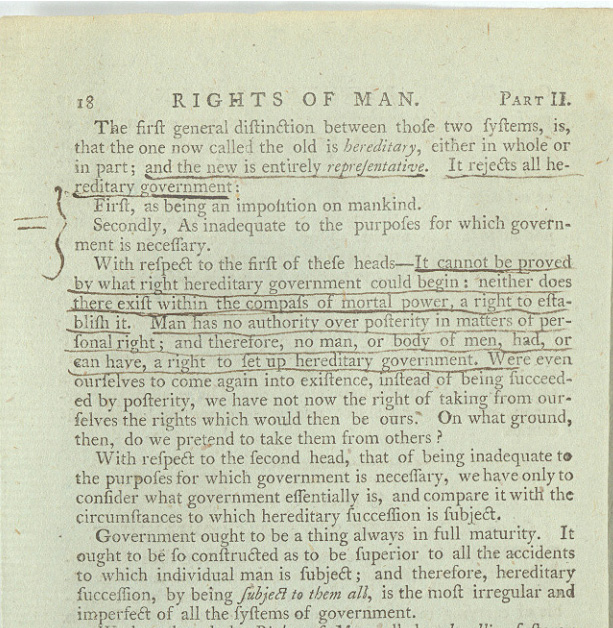
Extract from the second part of ‘The Rights of Man’ by Thomas Paine, 1792
Catalogue ref: TS 24/3/10, pp.18-19
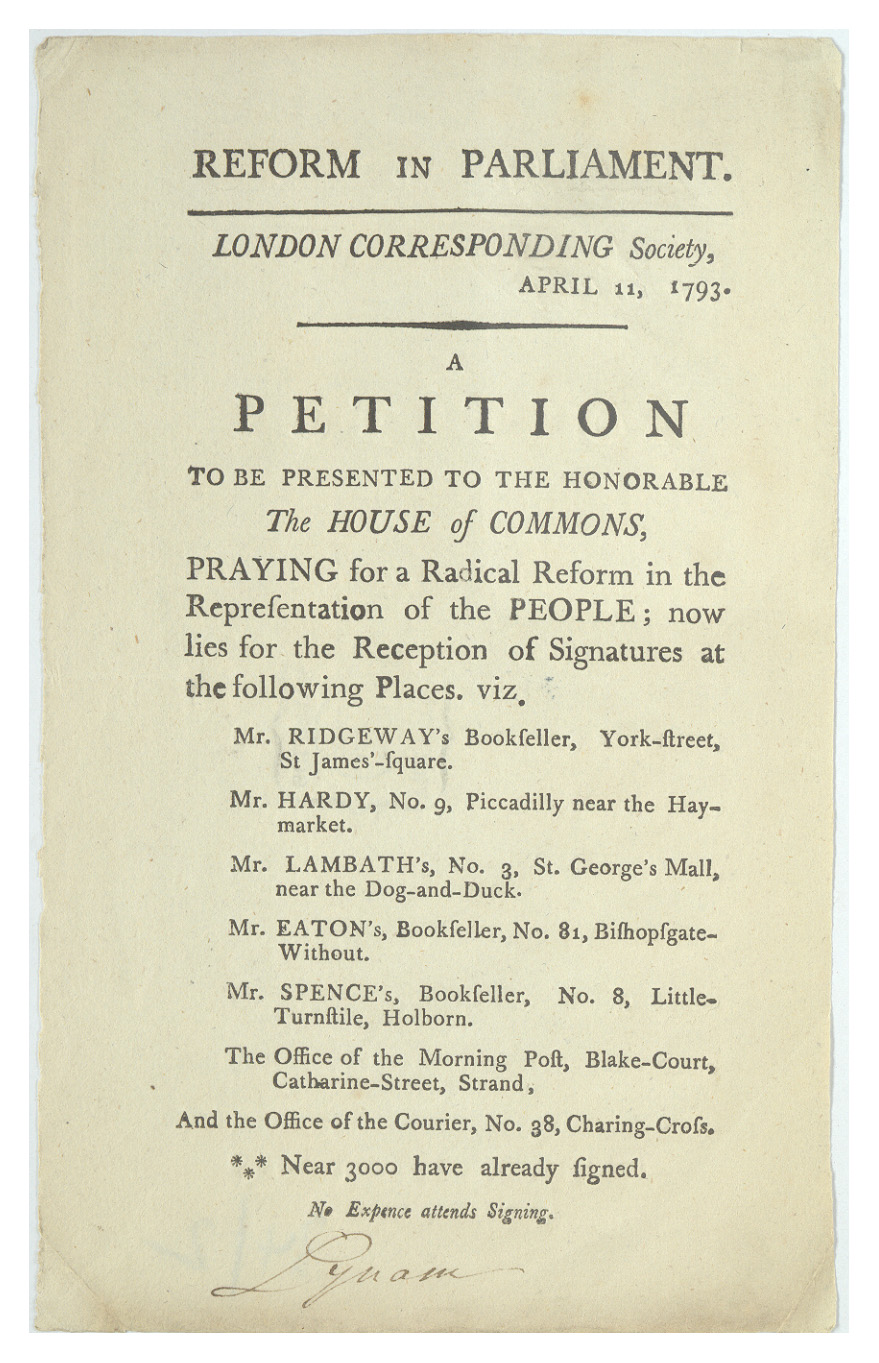
London Corresponding Society handbill, 1793 , Catalogue ref: TS 24/3/34
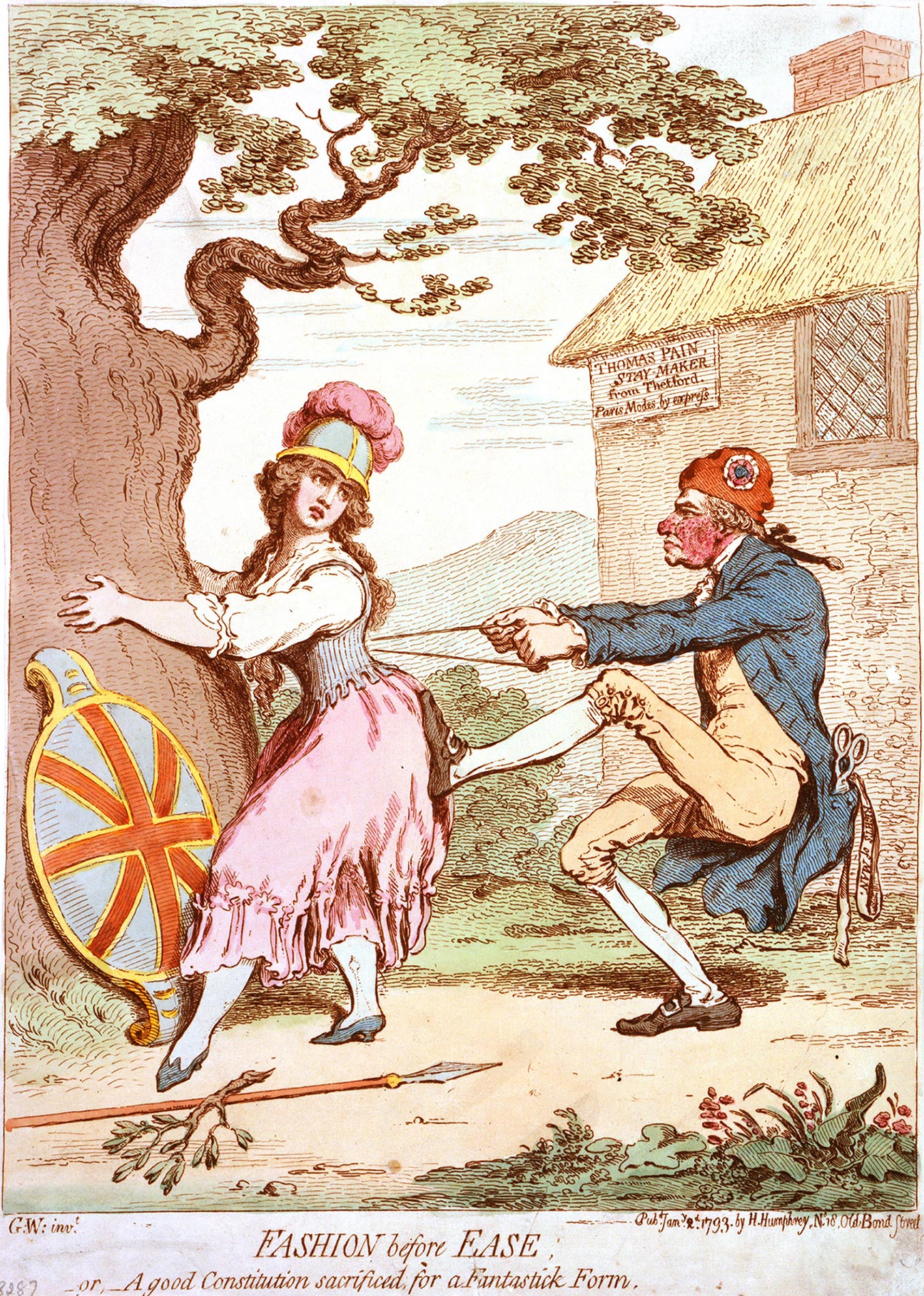
Political cartoon by James Gillray entitled: ‘Fashion before Ease;—or,—A good Constitution sacrificed for a Fantastick Form’, London, Published by H. Humphrey, 1793. © Library of Congress
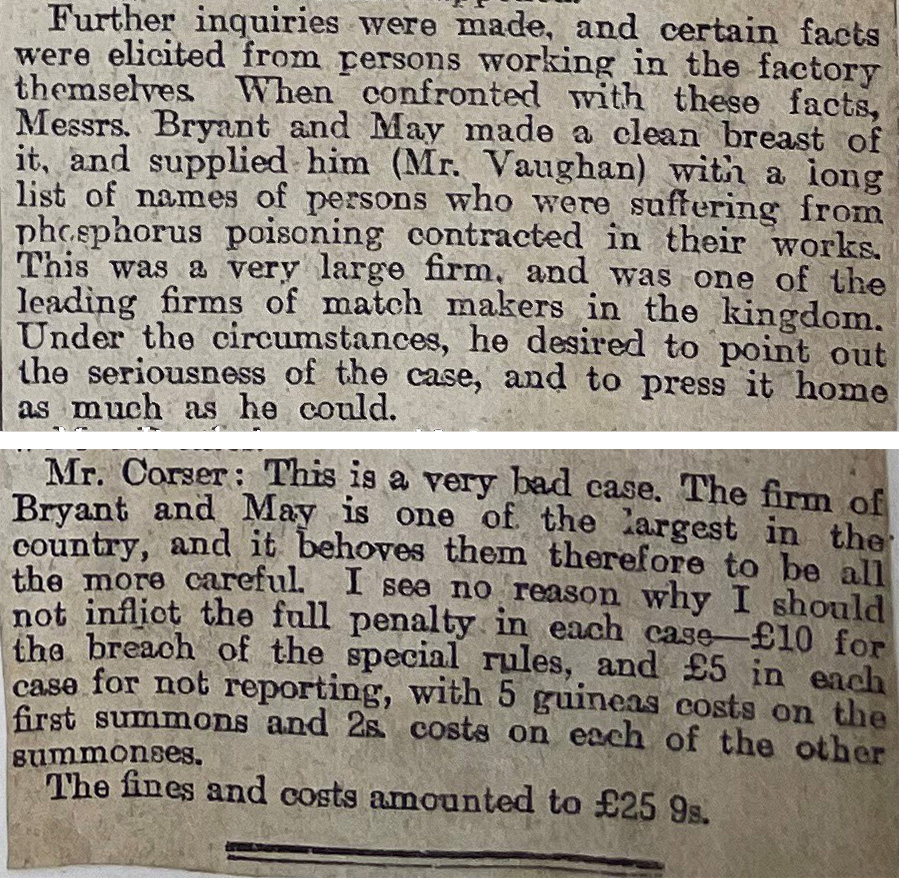
Extract from an article from a newspaper entitled ‘The Daily Chronicle’ describing a case of ‘phossy jaw’, 2 June 1898, Catalogue ref: HO 45/9849/B12393D.
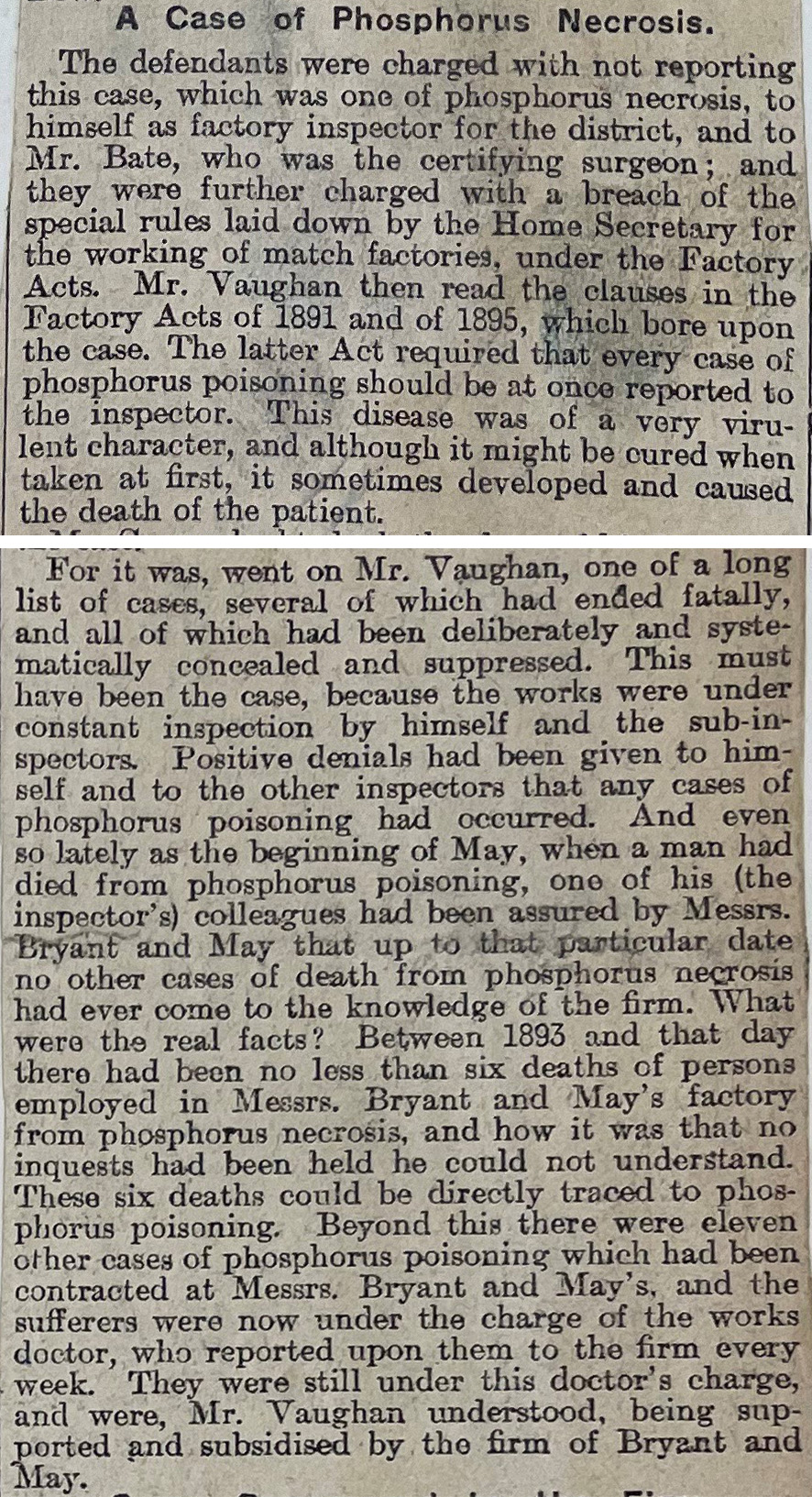
Extracts from an article from a newspaper entitled ‘The Daily Chronicle’ describing a case of ‘phossy jaw’, 2 June 1898, Catalogue ref: HO 45/9849/B12393D.
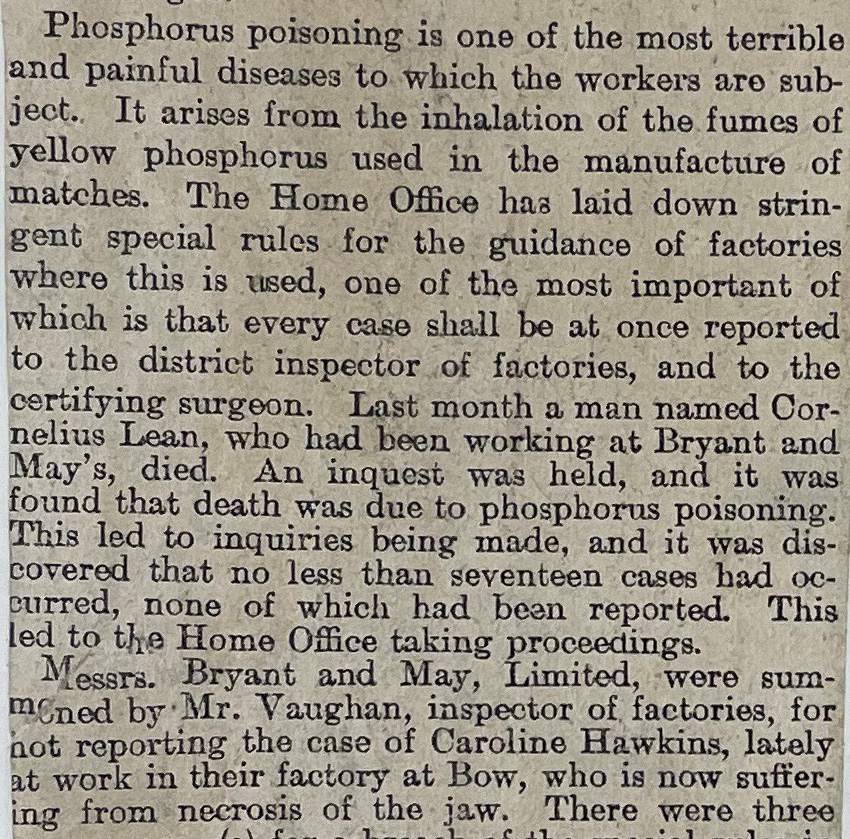
An article from a newspaper entitled ‘The Daily Chronicle’ describing a case of ‘phossy jaw’, 2 June 1898, Catalogue ref: HO 45/9849/B12393D.
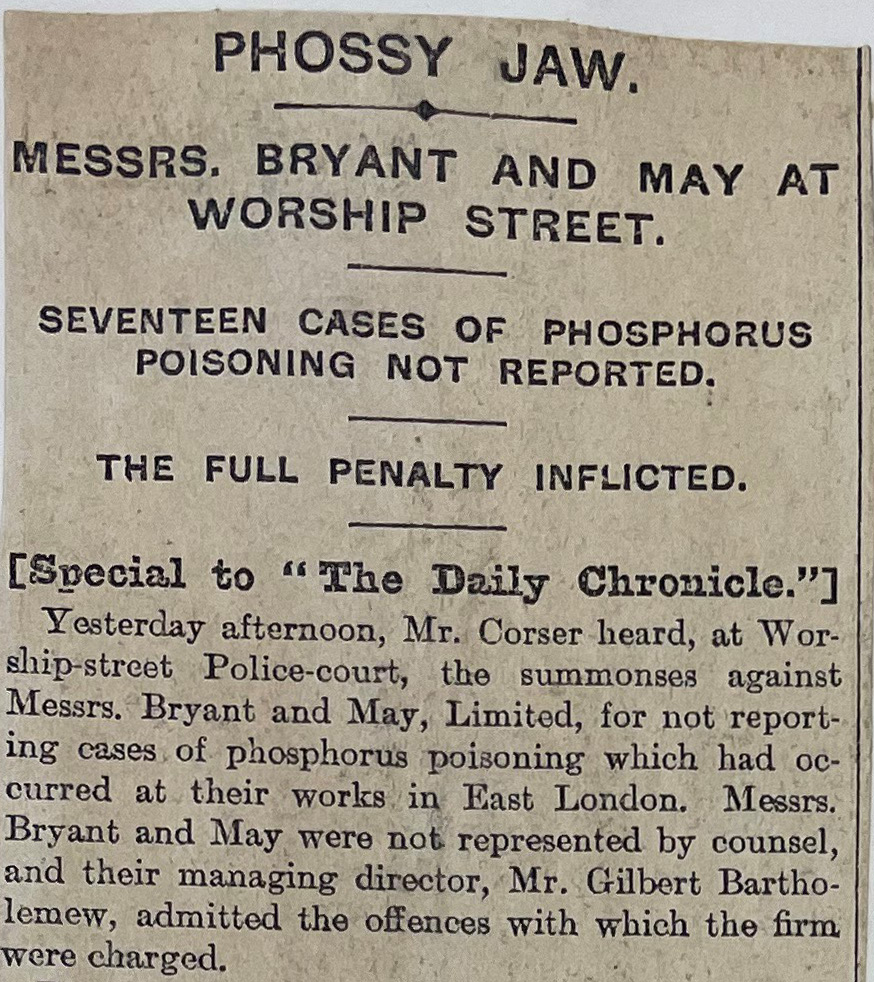
An article from a newspaper entitled ‘The Daily Chronicle’ describing a case of ‘phossy jaw’, 2 June 1898, Catalogue ref: HO 45/9849/B12393D.

Plans from the Home Office for an answer to a Parliamentary question from Liberal Member of Parliament, Edward Pickersgill about a case of phosphorous poisoning at the Bryant and May factory, 1898, Catalogue ref: HO 45/9849/B12393D