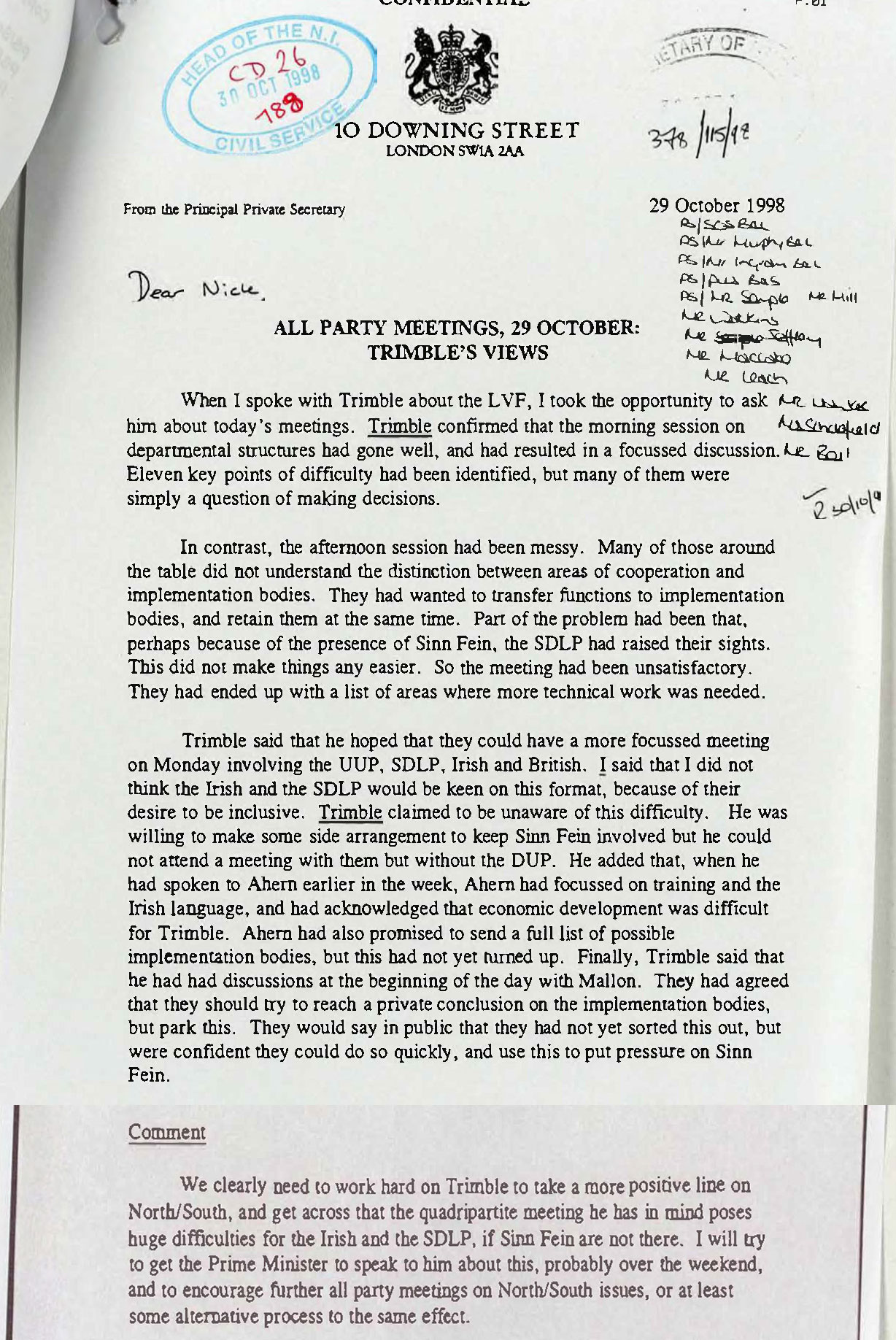
Extracts from a letter between the UK Prime Minister’s Office and the Northern Ireland Office. The letter was sent in October 1998.
Context notes
This letter was written in October 1998, by the Principal Private Secretary to the Prime Minister, a very senior figure in the UK civil service. He had been talking to David Trimble, leader of the Ulster Unionist Party, the largest Unionist Party in Northern Ireland at that time, about the Loyalist Volunteer Force (LVF), a Loyalist paramilitary organisation whose activities were causing concern. In the course of the conversation, they had talked about several other issues as well. The letter is reporting Trimble’s views to a colleague in the Northern Ireland Office.
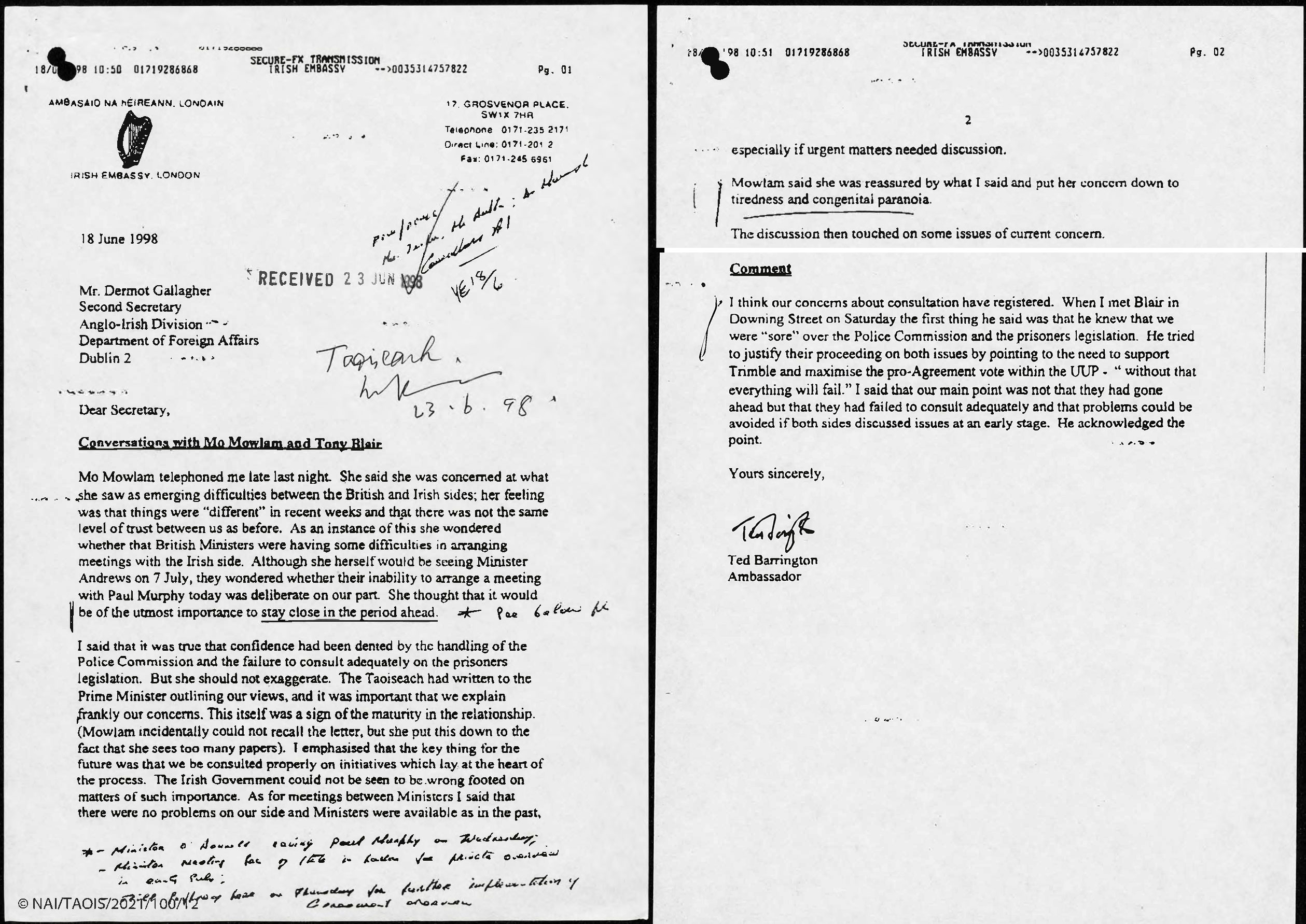
Extracts from a letter from the Irish Ambassador in London to Dermot Gallagher, a senior official in the Department of Foreign Affairs in Ireland June 1998
Context notes
The author of this letter was Ted Barrington, Ireland’s Ambassador to the UK. He was reporting back to his superiors in the Foreign Affairs Department of the Irish Government about a phone conversation with Mo Mowlam. Mowlam was the UK Government’s Secretary of State for Northern Ireland. Paul Murphy MP was a UK Government Minister, a senior UK official, who worked in Mo Mowlam’s department as Political Development Minister of State for Northern Ireland. A major part of Murphy’s job was liaising with officials from Ireland.
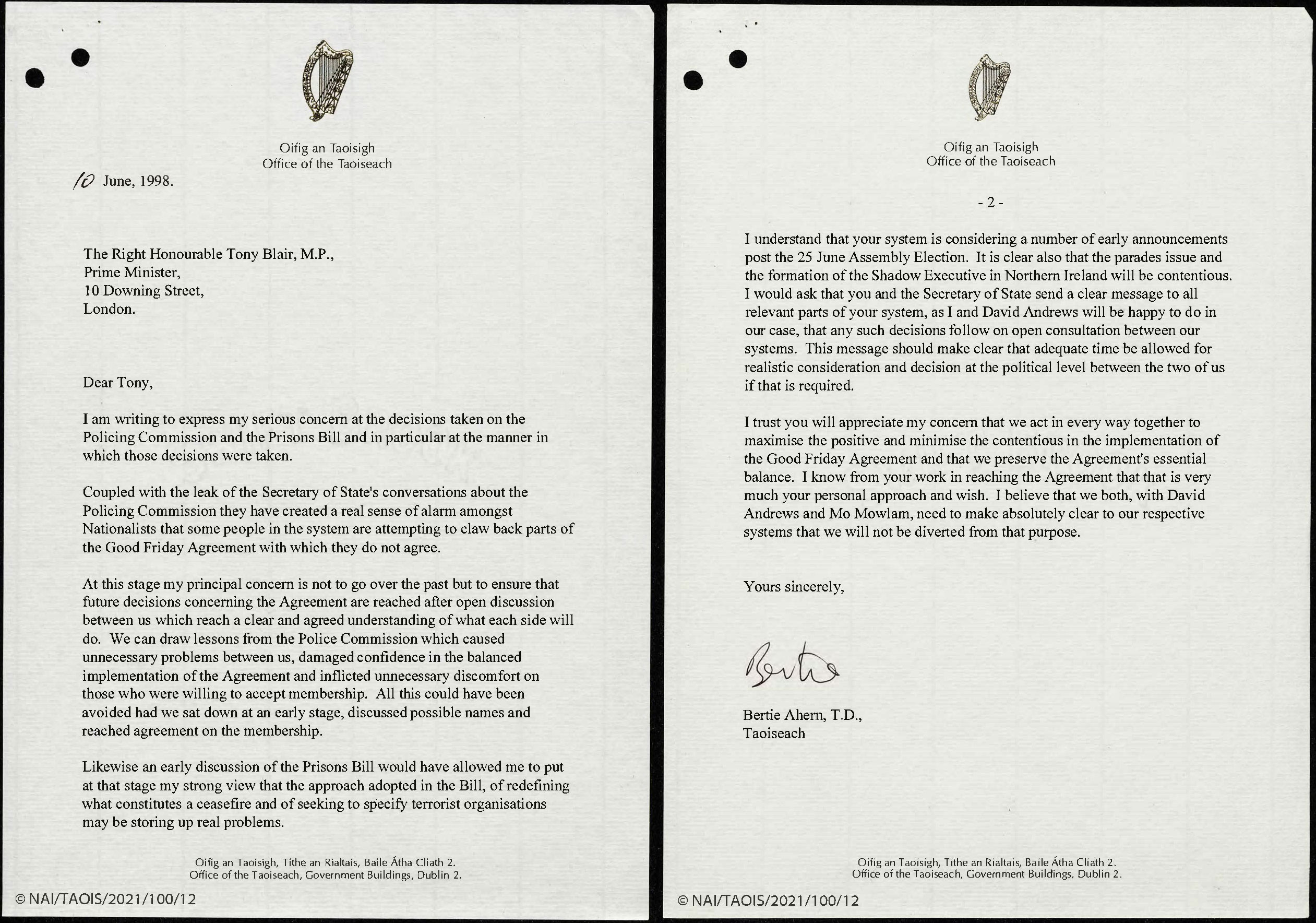
A letter from the Taoiseach Bertie Ahern to the UK Prime Minister Tony Blair, 10 June 1998
Context notes
One of many controversial issues in the history of Northern Ireland was the system of policing. Many in the Nationalist community felt that the existing police force, the Royal Ulster Constabulary (RUC) did not represent them properly. As part of the Agreement, the RUC was to be replaced by a new force called the Police Service of Northern Ireland. An Independent Commission on Policing for Northern Ireland was set up to study policing and make recommendations about how Northern Ireland was to be policed in the future. There was a great deal of heated debate about who should be appointed to be part of this Commission. The situation was not helped when a confidential document about the Commission was leaked to the press on 4 June 1998 and revealed how tense and angry the debate was over the Commission.
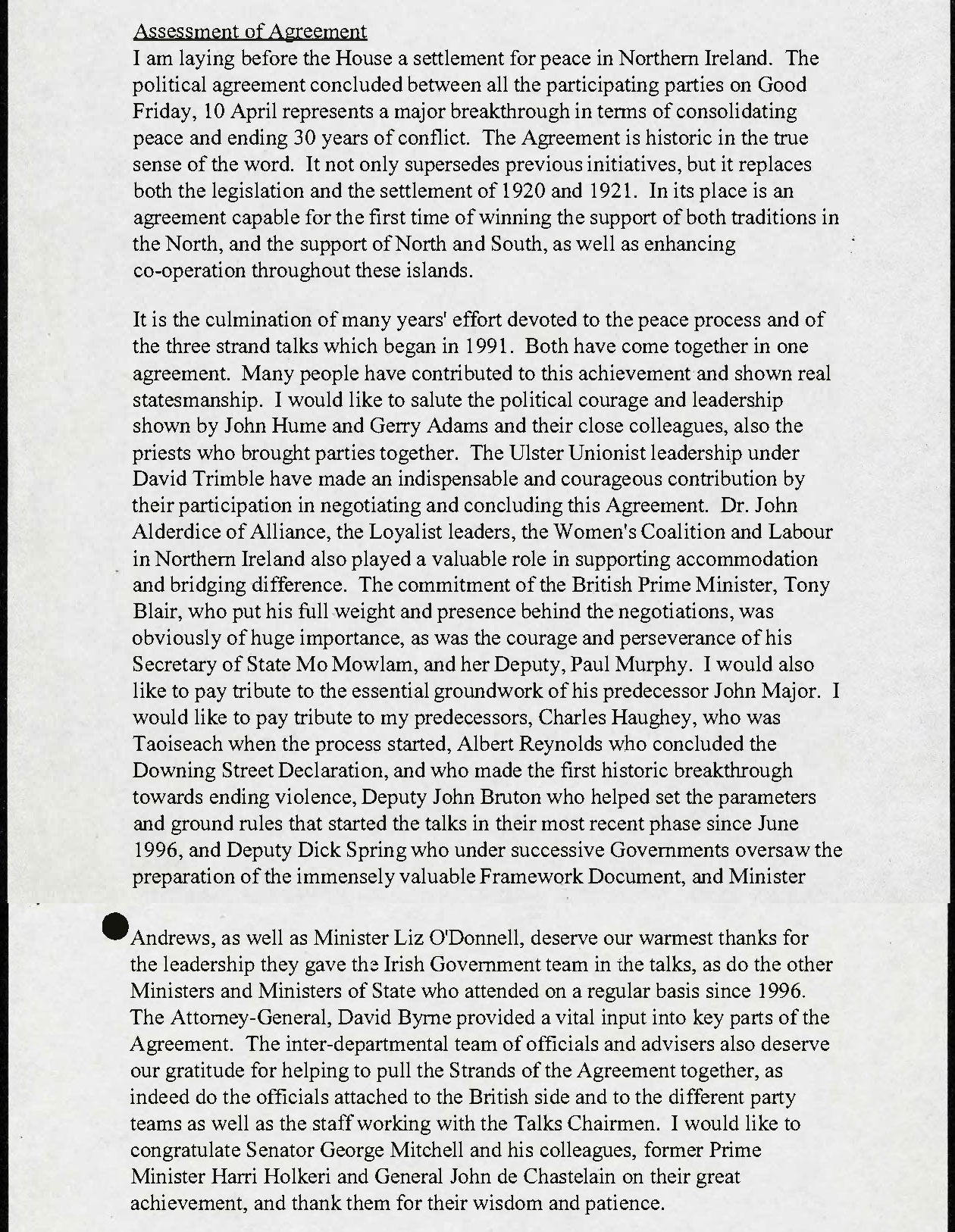
The text of a speech by the Taoiseach Mr. Bertie Ahern, TD on the Approval of the Multi-Party Agreement in Belfast on Good Friday, 10 April 1998. The speech was delivered on 22 April 1998.
Context notes
Bertie Ahern was the Irish Taoiseach, the Prime Minister of Ireland. In this speech he was setting out the Agreement to the Irish Seanad, the upper house of the Irish Dáil. The Agreement was the culmination of years of political initiatives, negotiations and many setbacks. It involved politicians from Northern Ireland, Britain, Ireland, the USA and the European Union.
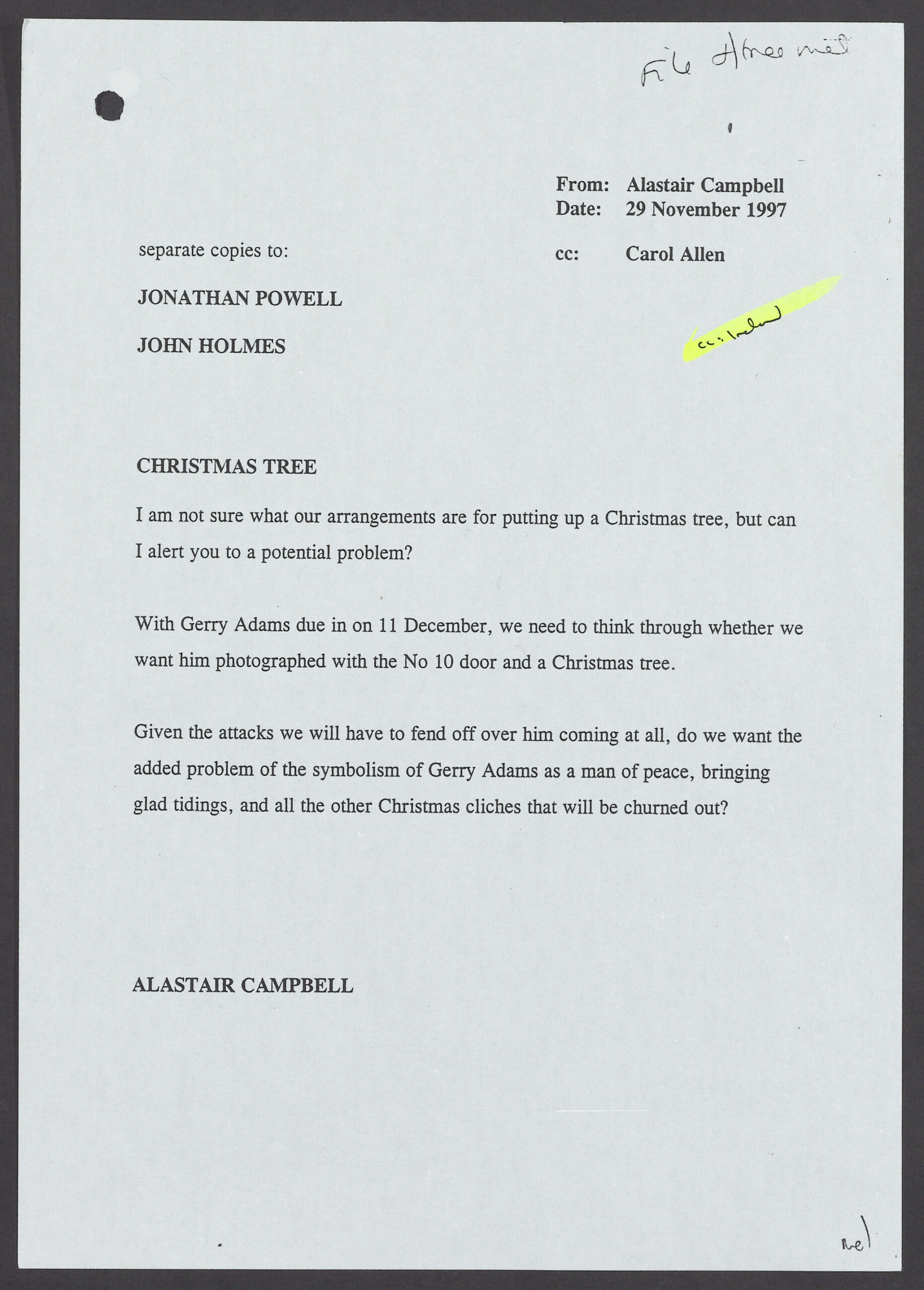
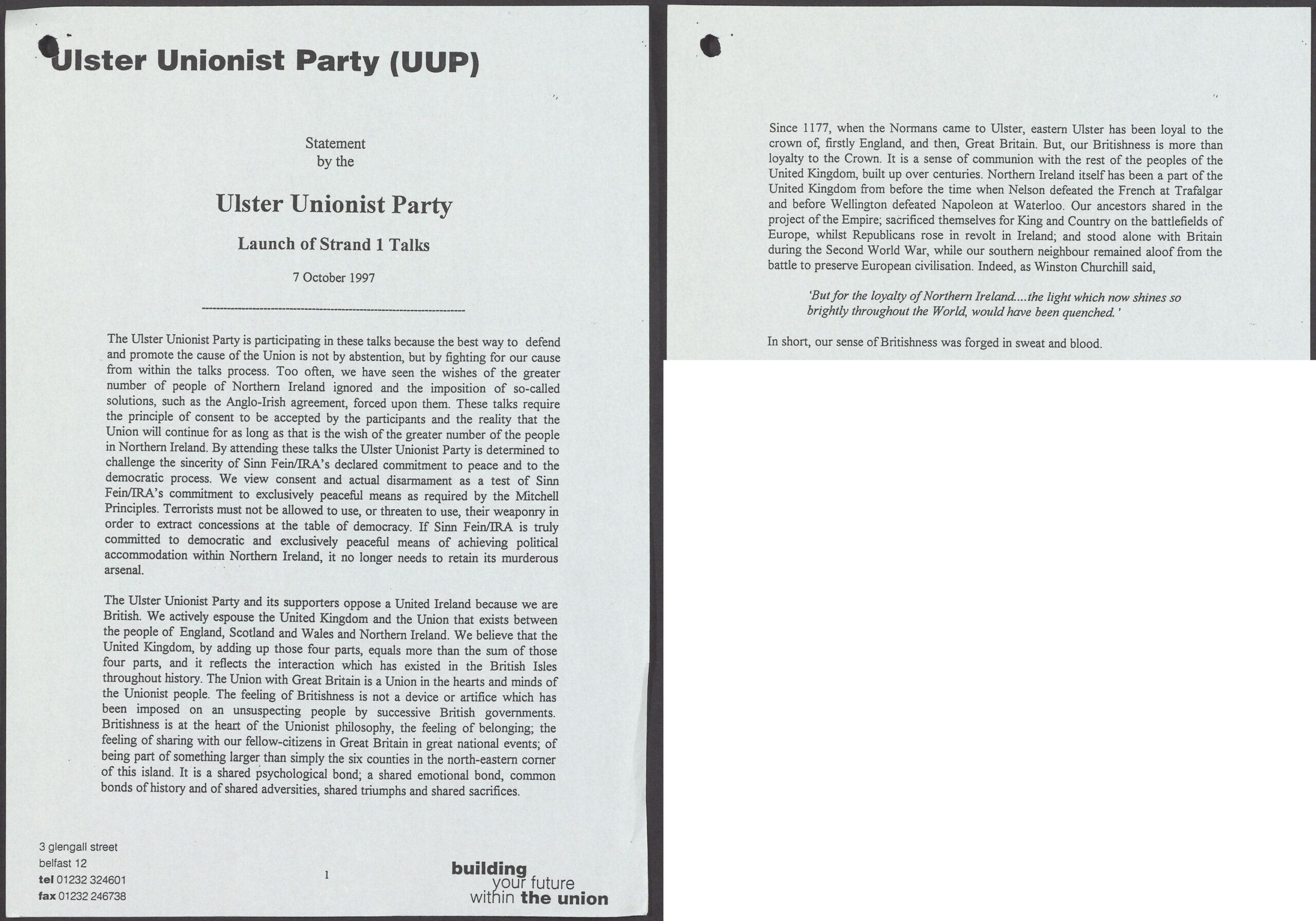
Extracts from an opening statement by Ulster Unionist Party (UUP), which was led by David Trimble, at the peace talks in Stormont, Belfast, on 7 October 1997. Catalogue reference: PREM 49/403

Extracts from a Northern Ireland Office (UK government department) record of a morning session during the peace talks on 12 June 1996 in Stormont, Belfast. The notes were recorded by a UK government official. Catalogue reference: CJ4/12228
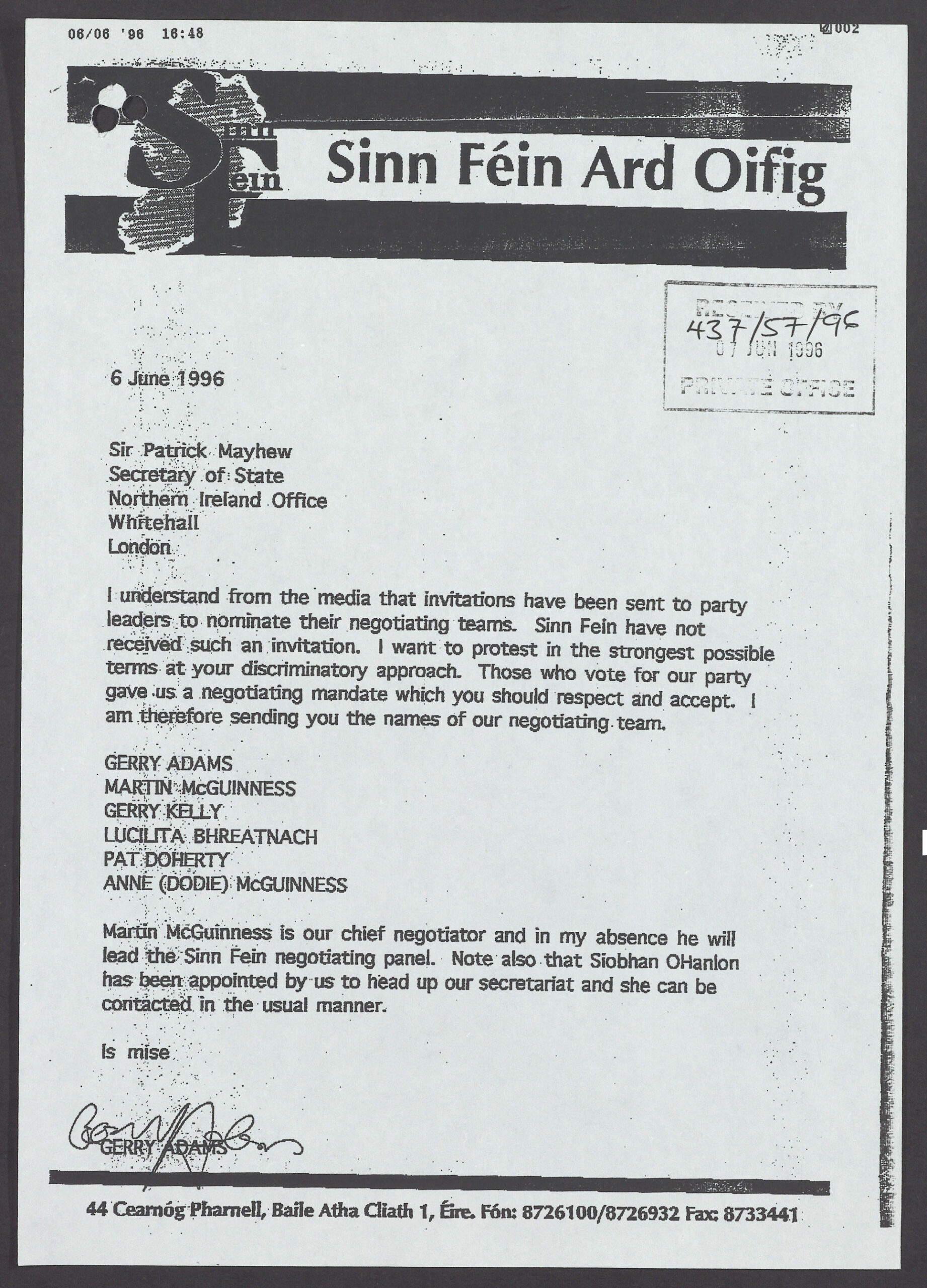
A letter from Gerry Adams, the leader of Sinn Féin, to Sir Patrick Mayhew, the Secretary of State for Northern Ireland (a UK government minister) Catalogue reference: CJ4/12383
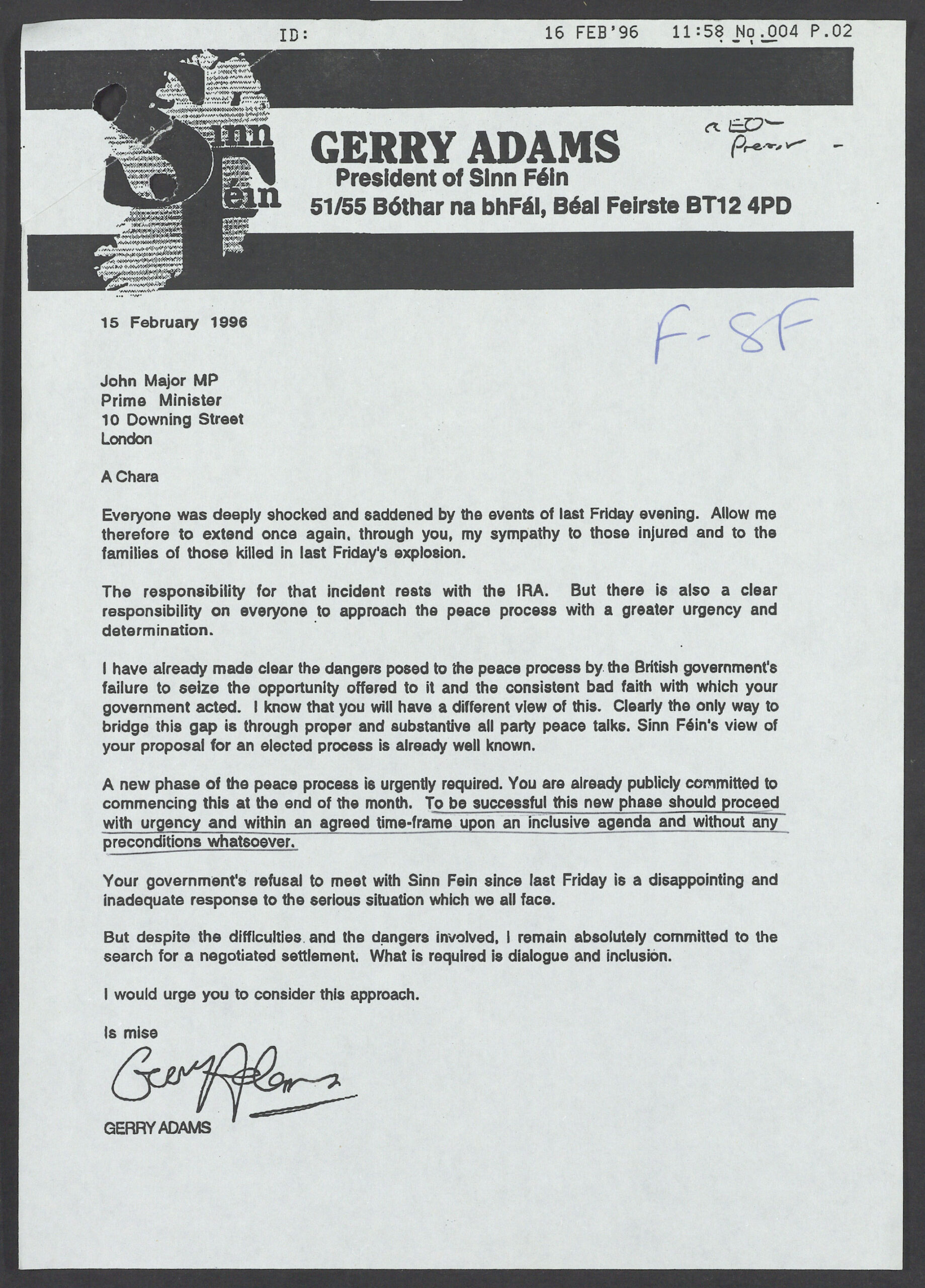
A letter from Gerry Adams, the leader of Sinn Féin, to John Major, the UK Prime Minister. Catalogue reference: CJ4/12375
Please note, the transcripts of the resources retain any typographical errors included in the original documents.
Historians substantiate their interpretations of the past by supporting their claims with evidence from primary sources. This is why two of the key assessment objectives at A Level are:
- Understanding and evaluating historical interpretations.
- Using and assessing a range of historical sources
Part 1: What role did the key figures in the peace process play? Is it possible to argue that there was one key figure or group?
This task provides A Level students with a collection of sources which will allow them to evaluate the role of key players and perhaps reach a judgement on how the work of these key players came together. Whilst very few historians would argue that only one individual or group was primarily responsible for bringing about the Belfast (Good Friday) Agreement, a range of experts were asked to highlight what they consider to be the most important factor. The first task for the students is to really understand the detail and the emphasis of these views before they test them against the sources.
Study each interpretation and summarise the key points made by the historian.
- What do they argue is the most important factor, individual or group?
- How did this contribute to the peace process and Belfast (Good Friday) Agreement?
- What challenges and obstacles had to be overcome?
- What evidence is given to support this interpretation?
- Does the historian’s biographical information help to explain their interpretation?
- From your own knowledge how convincing do you find this interpretation?
- What further evidence would you want to find in the documents to make the interpretation convincing?
- If you were to provide a one-word summary of this individual’s contribution, which of these would you choose, or can you think of a better word?
Obstructive / Unhelpful / Marginal / Constructive / Helpful / Pragmatic / Visionary / Essential
Part 2: Testing the views against the documents
This resource is NOT an exam practice paper. It is designed to explore how historians think about documents and make use of them. Students are introduced to the concept of a line of argument and to testing this against evidence from a range of documents. This will enable them to respond more effectively to the source and interpretation papers in their examinations.
All of the documents come from either:
- The National Archives of the United Kingdom
- The National Archives of Ireland
- The Public Record Office of Northern Ireland
For each document a number of discussion questions are posed which are designed to engage students in focused reading of the text. Students are then asked to consider whether the document could be used as evidence to support a particular view.
Carefully study the pack of 10 documents about the peace process.
- Decide whether each document could be used as evidence to support Views 1, 2, 3, 4 or 5.
- Remember that documents may support more than one view
- Decide whether they constitute strong, convincing evidence or whether more evidence is required to substantiate the interpretation and support the historian’s line of argument.
Download the resource pack below:
Key Stage Five Resources