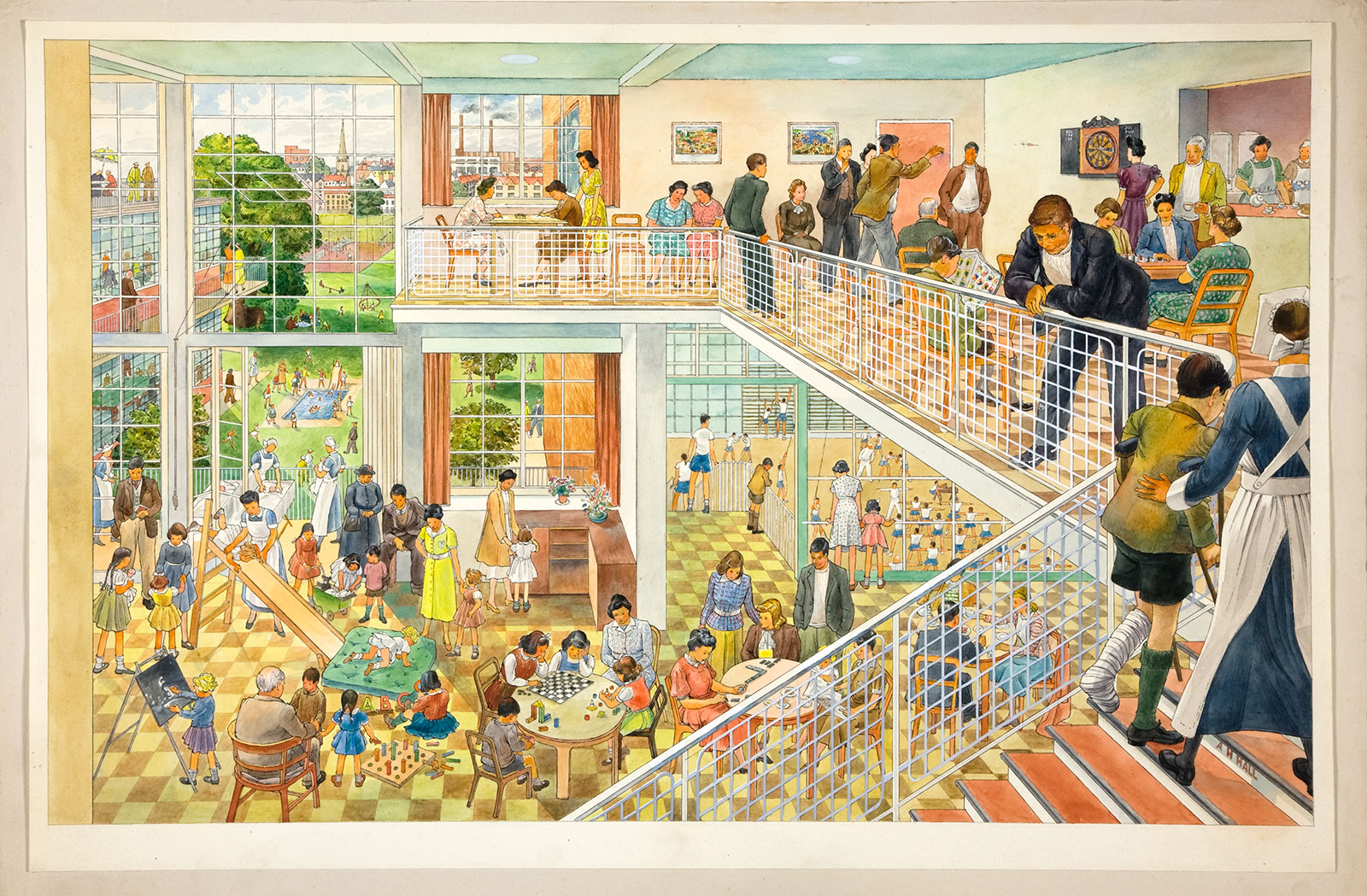
General War Pictures: The British Scene: Community centre 1939-1946, By A.H. Hall, (INF 3/1741)
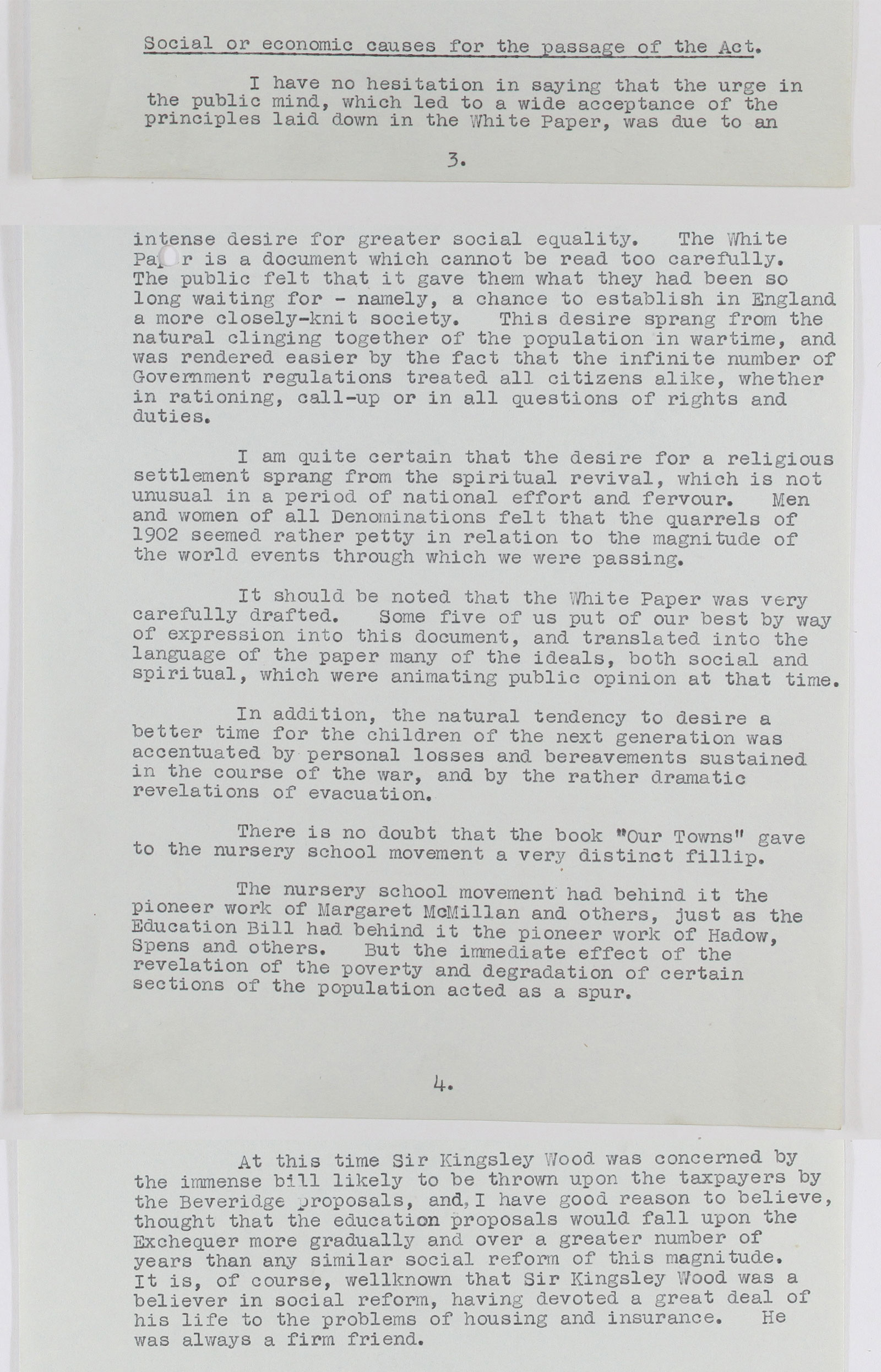
Extract from a note from RAB Butler to Dr. Sophia Weitzman who was writing an official history of state education, May 1945 (ED 136/692)
Social or economic causes for the passage of the Act [Butler Education Act, 1944]
I have no hesitation in saying that the urge in the public mind, which led to a wide acceptance of the principles laid down in the White Paper, was due to an intense desire for greater social equality. The White Paper is a document which cannot be read too carefully. The public felt that it gave them what they had been so long waiting for – namely, a chance to establish in England a more closely-knit society. This desire sprang from the natural clinging together of the population in wartime, and was rendered easier by the fact that the infinite number of Government regulations treated all citizens alike, whether in rationing, call-up or in all questions of rights and duties.
I am quite certain that the desire for a religious settlement sprang from the spiritual revival, which is not unusual in a period of national effort and fervour. Men and women of all Denominations felt that the quarrels of 1902 seemed rather petty in relation to the magnitude of the world events through which we were passing.
It should be noted that the White Paper was very carefully drafted. Some five of us put our best by way of expression into this document, and translated into the language of the paper many of the ideals, both social and spiritual, which were animating public opinion at that time.
In addition, the natural tendency to desire a better time for the children of the next generation was accentuated by personal losses and bereavements sustained in the course of the war, and by the rather dramatic revelations of evacuation.
There is no doubt that the book “Our Towns” gave to the nursery school movement a very distinct fillip.
The nursery movement had behind it the pioneer work of Margaret McMillan and others, just as the Education Bill had behind it the pioneer work of Hadow, Spens and others. But the immediate effect of the revelation of the poverty and degradation of certain sections of the population acted as a spur.
…
At this time Sir Kingsley Wood was concerned by the immense bill likely to be thrown upon the tax players by the Beveridge proposals, and, I have good reason to believe, thought that the education proposals would fall upon the Exchequer more gradually and over a greater number of years than any similar social reform of this magnitude. It is, of course, well known that Sir Kingsely Wood was a believer in social reform, having devoted a great deal of his life to the problems of housing and insurance. He was always a firm friend.
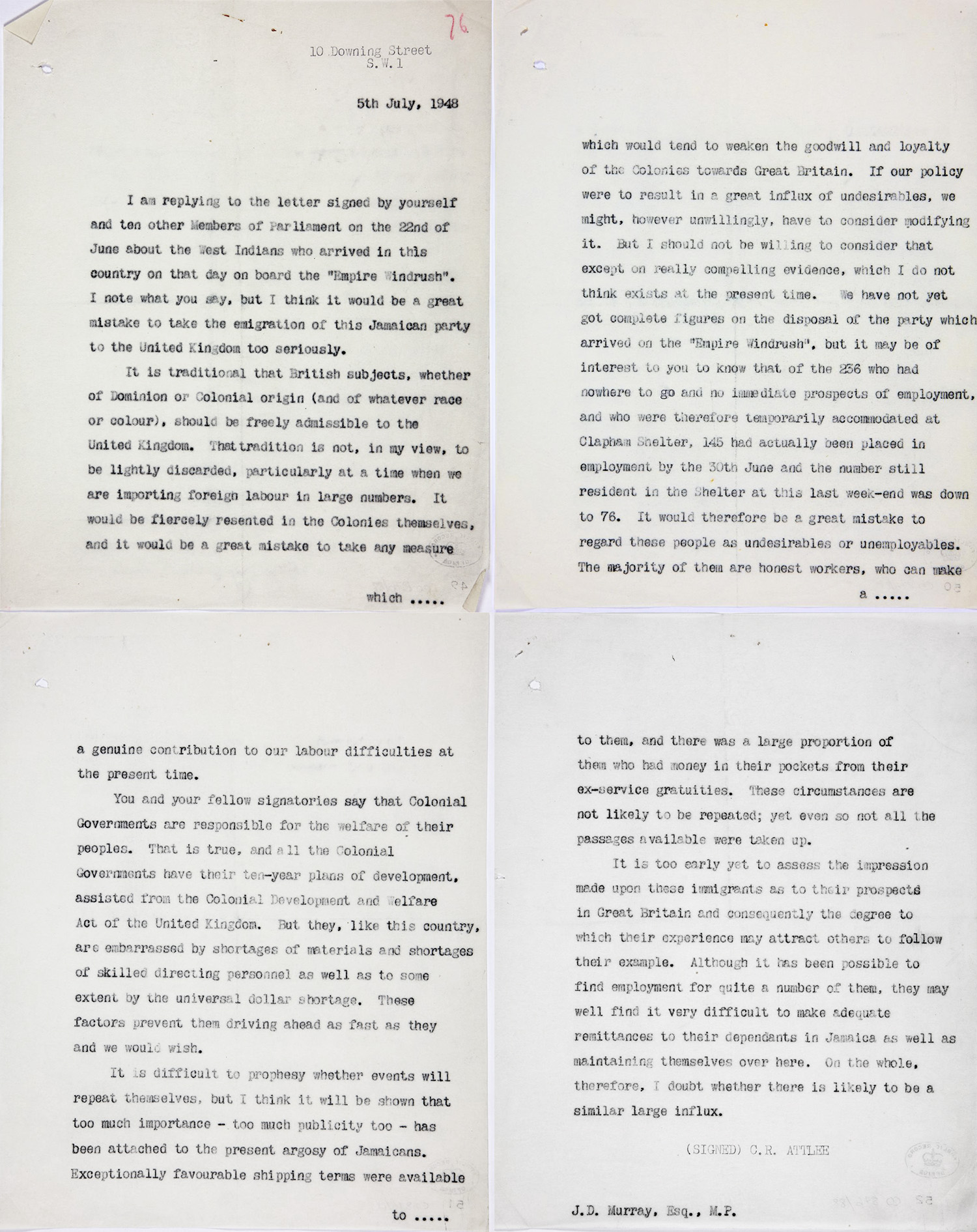
Letter from Prime Minister Attlee to an M.P. about immigration to the U.K, 5th July, 1948 (CO 876/88)
Another copy of this letter can be found at Catalogue Ref: HO 213/715
Transcript
10 Downing Street,
S.W.1
5th July, 1948
I am replying to the letter signed by yourself and ten other Members of Parliament on the 22nd of June about the West Indians who arrived in this country on that day on board the “Empire Windrush”. I note what you say, but I think it would be a great mistake to take the emigration of this Jamaican party to the United Kingdom too seriously.
It is traditional that British subjects, whether of Dominion or Colonial origin (and of whatever race or colour), should be freely admissible to the United Kingdom. That tradition is not, in my view, to be lightly discarded, particularly at this time when we are importing foreign labour in large numbers. It would be fiercely resented in the Colonies themselves, and it would be a great mistake to take any measure which would tend to weaken the goodwill and loyalty of the Colonies towards Great Britain. If our policy were to result in a great influx of undesirables, we might, however unwillingly, have to consider modifying it. But I should not be willing to consider that except on really compelling evidence, which I do not think exists at the present time. We have not yet got complete figures on the disposal of the party which arrived on the “Empire Windrush”, but it may be of interest to you to know that of the 236 who had nowhere to go and no immediate prospects of employment, and who were therefore temporarily accommodated at Clapham Shelter, 145 had actually been placed in employment by the 30th June and the number still resident in the Shelter at this last week-end was down to 76. It would therefore be a great mistake to regard these people as undesirable or unemployables. The majority of them are honest workers, who can make a genuine contribution to our labour difficulties at the present time.
You and your fellow signatories say that Colonial Governments are responsible for the welfare of their peoples. That is true, and all the Colonial Governments have their ten-year plans of development, assisted from the Colonial Development and Welfare Act of the United Kingdom. But they, like this country, are embarrassed by shortages of skilled directing personnel as well as to some extent the universal dollar shortage. These factors prevent them driving ahead as fast as they and we would wish.
It is difficult to prophesy whether events will repeat themselves, but I think it will be shown that too much importance- too much publicity too- has been attached to the present argosy of Jamaicans. Exceptionally favourable shipping terms were available to them, and there was a large proportion of them who had money in their pockets from ex-service gratuities. These circumstances are not likely to be repeated; yet even so not all the passages available were taken up.
It is too early yet to assess the impression made upon these immigrants as to their prospects in Great Britain and consequently the degree to which their experience may attract others to follow their example. Although it has been possible to find employment for quite a number of them, they may well find it very difficult to make adequate remittance to their dependants in Jamaica as well as maintaining themselves over here. On the whole, therefore, I doubt whether there is likely to be a similar large influx.
(SIGNED) C.R. ATTLEE
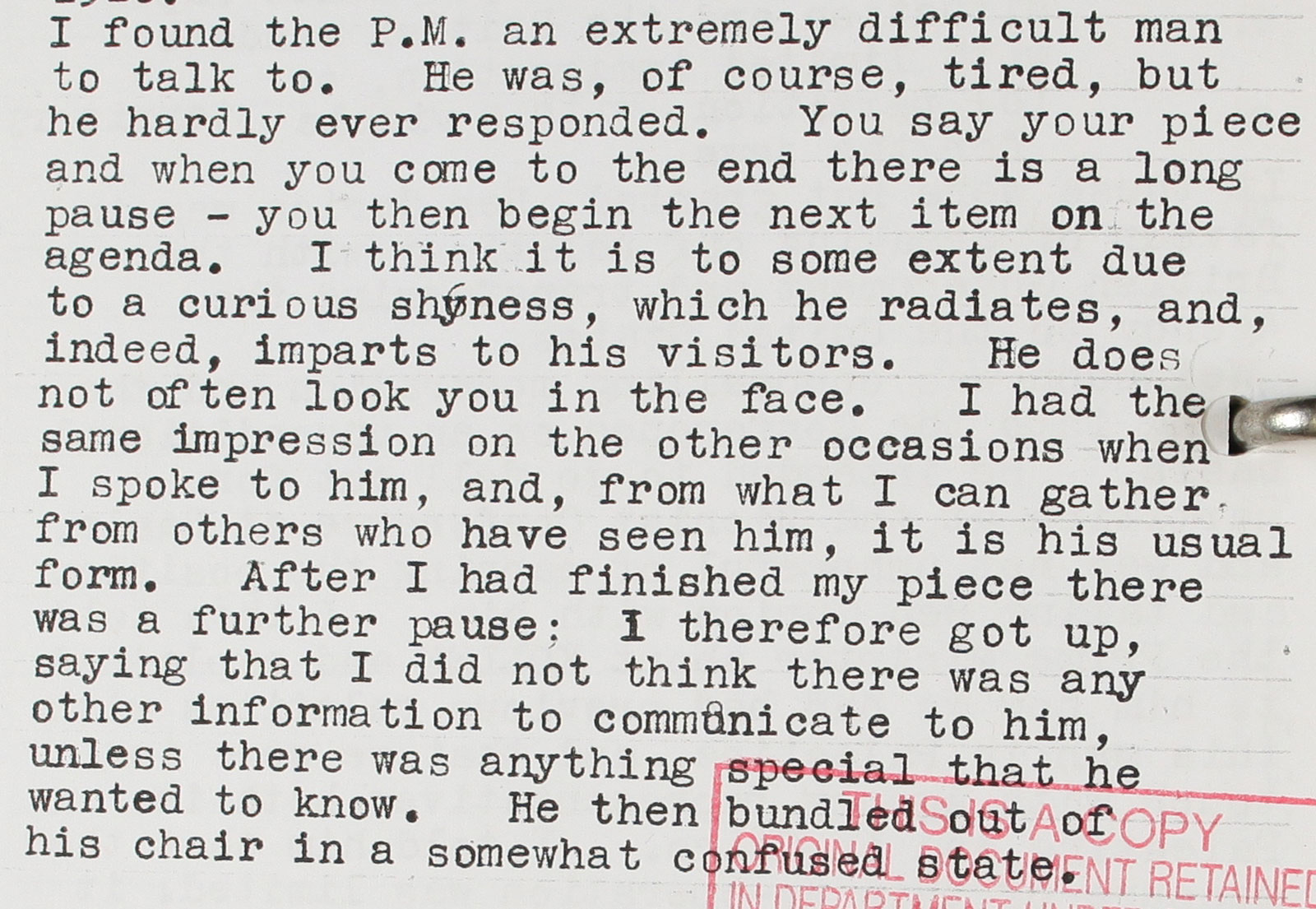
Extract from the diary of Guy Liddell, Deputy Director General of the Security Service, September 1946 to March 1947 (KV 4/468)
I found the P.M. an extremely difficult man to talk to. He was, of course, tired, but he hardly ever responded. You say your piece and when you come to the end there is a long pause- you then begin the next item on the agenda. I think it is to some extent due to a curious shyness, which he radiates, and indeed, imparts to his visitors. He does not often look you in the face. I had the same impression on the other occasions when I spoke to him, and from what I can gather from others who have seen him, it is his usual form. After I had finished my piece there was a further pause; I therefore got up, saying that I did not think there was any other information to communicate to him, unless there was anything special that he wanted to know. He bundled out of his chair in a somewhat confused state.
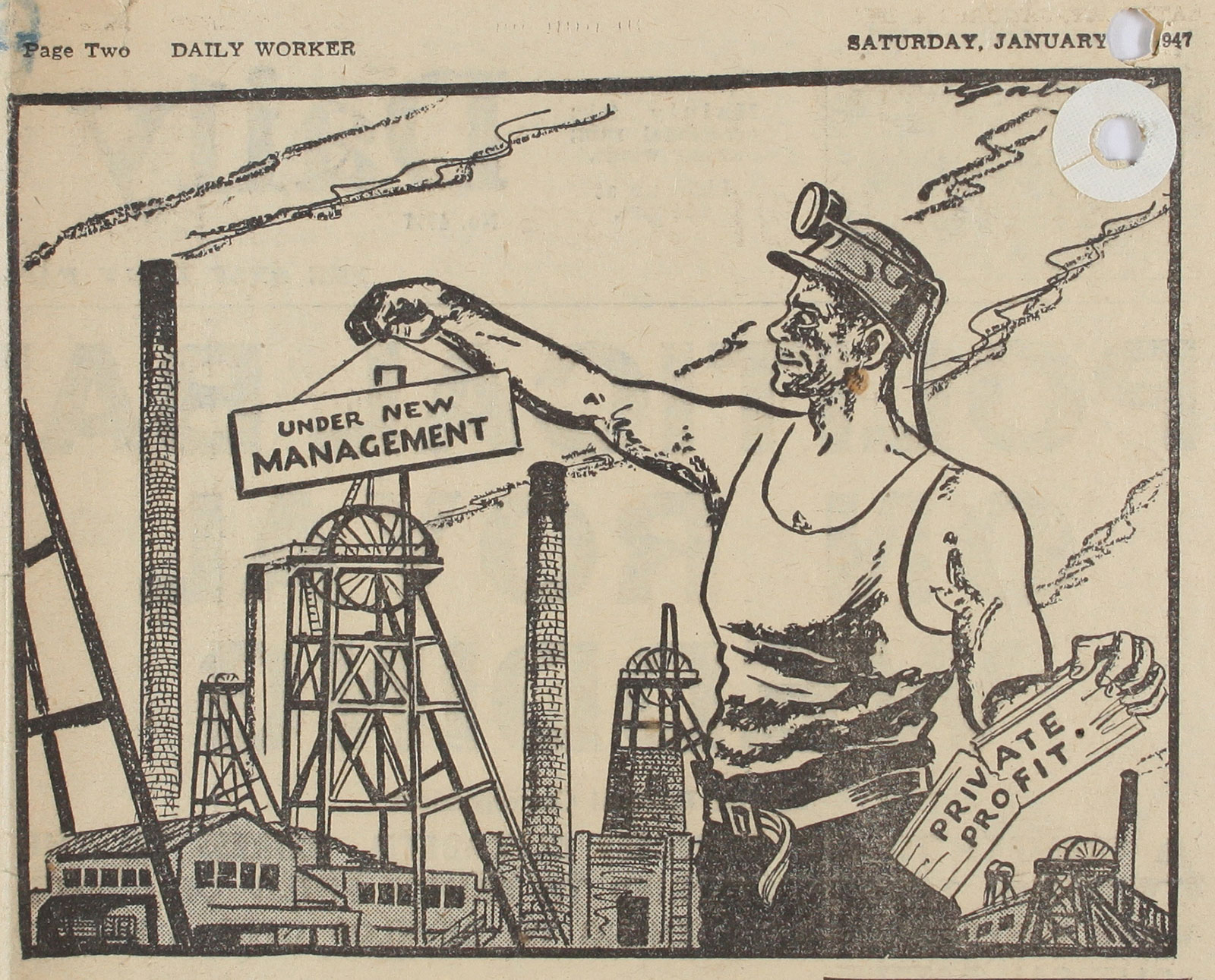
Cartoon on nationalisation of the coal mines from the Daily Worker, January 1947. By kind permission of the Morning Star. (CAB 21/2207)
Cartoon showing the coalmines under new management and a miner holding a torn paper with words “Private Profit”
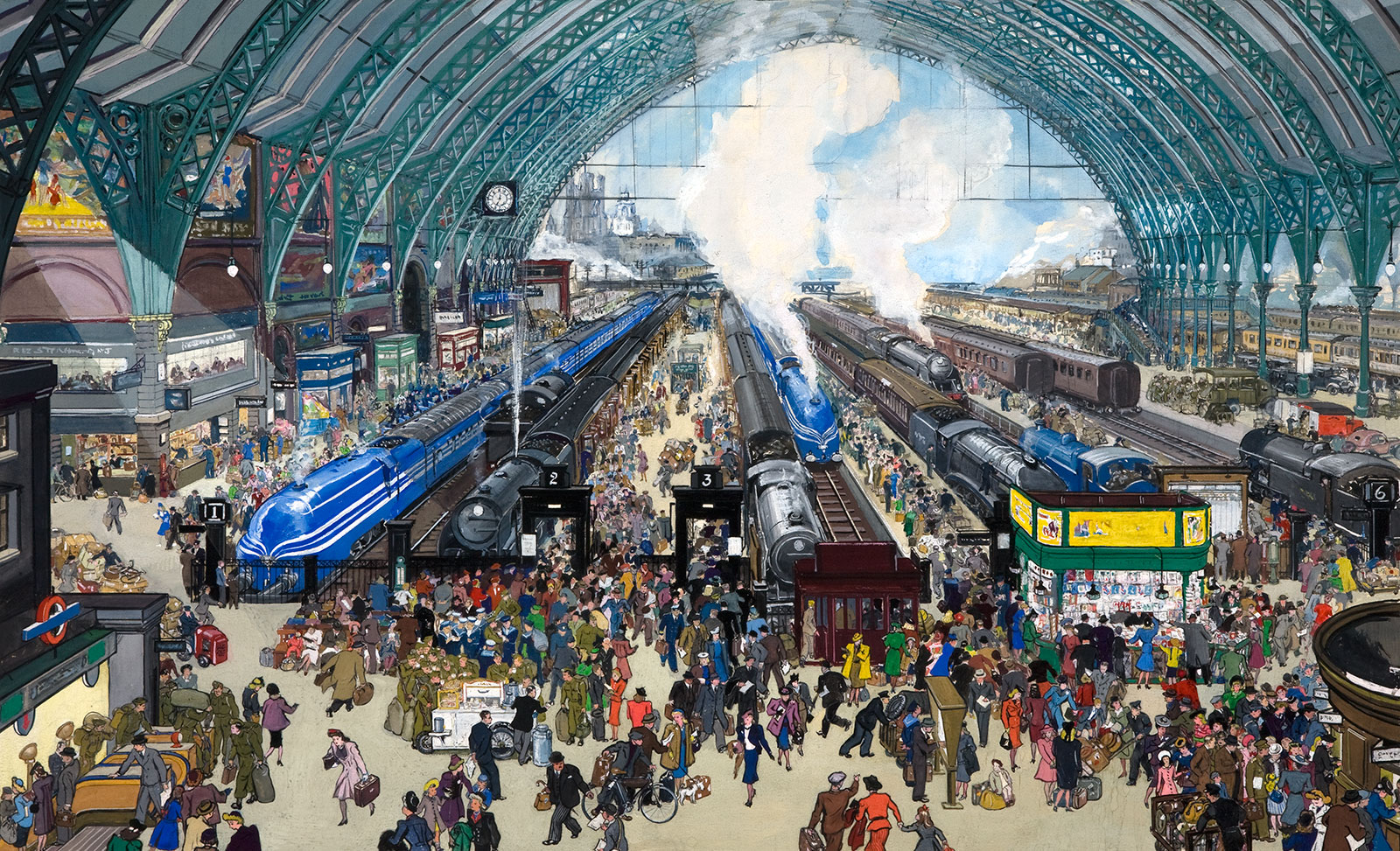
General War Pictures: The British Scene: London railway terminus, 1939-1946, by Grace Golden (INF 3/1740)
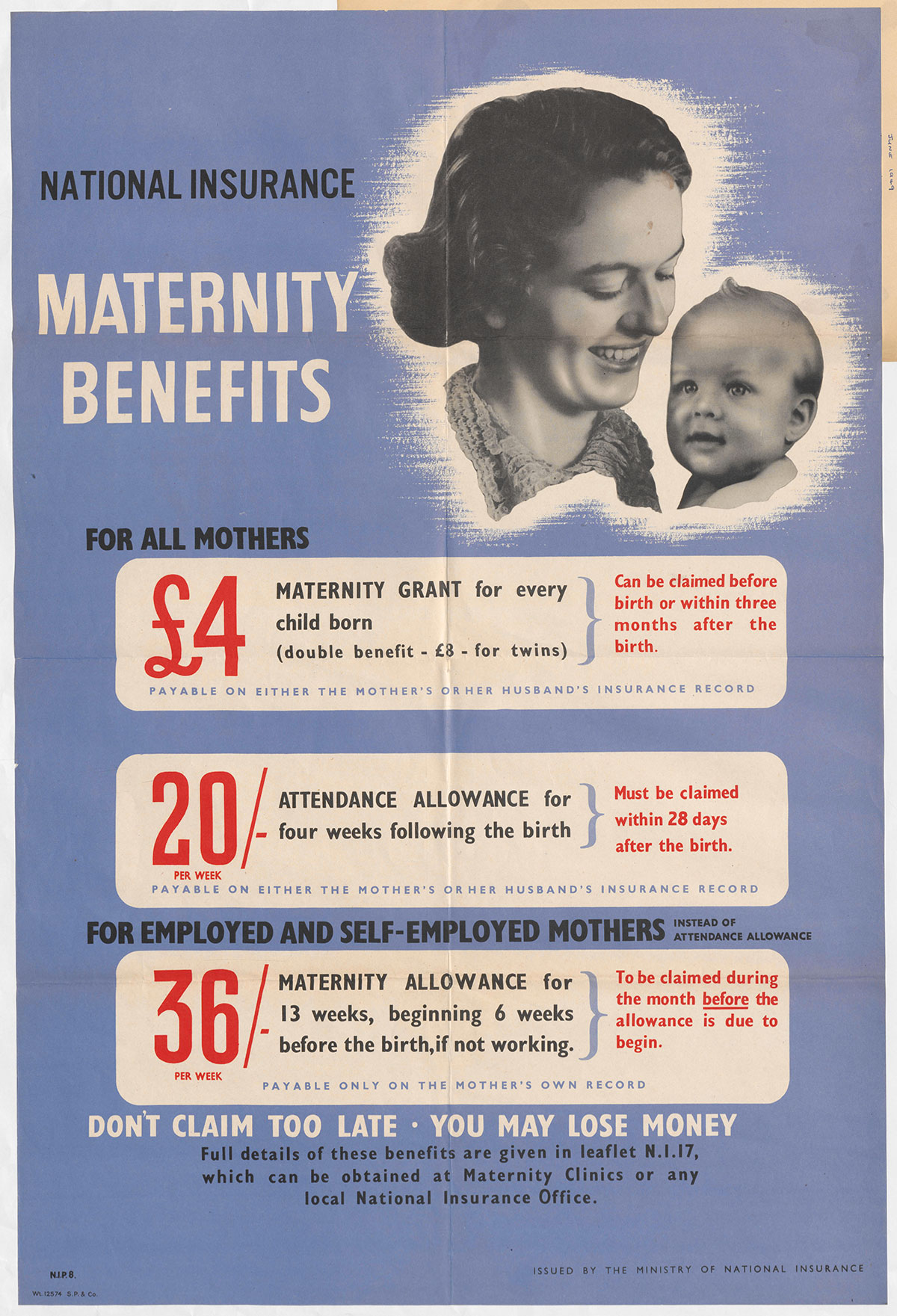 Planning for the future?
by Robert Crowcroft
The Attlee years were a remarkable time. The years between 1945 and 1951 saw nothing less than the birth of modern Britain. Most obviously, the universal welfare state that we now take for granted was created by the Labour government of Clement Attlee. Mass immigration began as new residents arrived from the West Indies, India and Pakistan. Ultimately this was to change the face of the country. Yet while the period is remembered as a golden age of renewal, it is frequently forgotten that Attlee’s Britain was in fact a drab and often unpleasant place to live.
The war shattered Britain’s finances, but had also instilled a longing for a better future. This found political expression in the outcome of the 1945 general election, where the Labour party won its first ever parliamentary majority in a landslide victory.
The most enduring legacy of the Attlee years is the welfare state. The Labour government implemented many of the ideas expounded in the Beveridge report, a 1942 official study recommending a welfare state to insure people from ‘the cradle to the grave’. It became a national phenomenon, a blueprint for the creation of the ‘New Jerusalem’: a prosperous yet egalitarian society.
Attlee’s welfare state reflected this ambition. All taxpayers contributed to social insurance, and everyone in the country was covered by it. Levels of benefits were standardised. The retirement pension was open to all and could now be claimed at the age of sixty-five rather than seventy. Under a scheme of family allowances, parents would receive a weekly payment upon the birth of their second child (and this would increase with any subsequent children).
But the most significant measure was the creation of the National Health Service in July 1948. In replacing the ramshackle and localised pre-war system of healthcare, and in committing the state to treat people free of charge no matter their condition, the NHS quickly became enshrined as a cornerstone of national life.
The government pursued radical policies elsewhere. Efforts were made to improve education for the mass of the people through the 1944 Education Act, and – in an attempt to avoid the high unemployment of the thirties – key sectors of the economy were nationalised. The most important were heavy industries like coal and steel, and infrastructure such as railways. The nationalisation programme stood alongside the welfare state as the major legacy of the Attlee Years, enduring for more than three decades.
But it was not all golden. Attlee’s Britain was hit by severe economic storms. A balance of payments crisis in 1947 retarded the economy and while the problems were largely a product of the war – as well as a notorious winter in 1947 – it is possible that a premature creation of the universal welfare state inhibited a return to prosperity.
Everyday life was drab and colourless. The Attlee years were blighted by inadequate and substandard housing. Living standards were a major issue: rationing was actually extended during the post-war era, and in 1946 bread was rationed for the first time. Housewives struggled to feed their families; prices rose; calorie intake for most people was below pre-war levels; and there were precious few consumer goods on the shelves. This grey existence quickly fractured the unity of wartime. Britain was a country deeply unsure of itself. As such while the era of Attlee exerts a significant hold over the national memory, it is equally important to emphasise that Britain at this time was not a particularly attractive place to live. Memory does play tricks, after all.
Robert Crowcroft is the author of “Attlee’s War: World War II and the Making of a Labour Leader”