Community Podcasting
Words by Sarah-Ann Cromwell, Project Manager, and Georgia Bould, Archivist
Project Summary
The Interesting Women project (2022) was one of ten action research projects selected by The Audience Agency to participate in their Digitally Democratising Archives programme. Each project was awarded a grant, training and mentoring, thanks to funding from the Department for Digital, Culture, Media and Sport (DCMS), and the National Lottery’s Digital Skills for Heritage initiative. This funding stream was designed to support the democratisation of archives and archiving through using digital technology, and to enable community access and involvement with archives and archiving.
We wanted to grow the representation of Bearwood women in the local archives, to increase Bearwood Community Hub’s knowledge and capability to contribute to the local archive, to increase awareness of digital archiving, and to learn both as individuals and as an organisation how to create a podcast.
With the support of Sandwell Archives, Sandwell Talking News for the Visually lmpaired, Bearwood Action for Refugees, and Mothership, we invited four women who are redefining Bearwood post-pandemic to share their story and, together, to create the first episode of the podcast Bearwood Interesting Women.
An amazing, two hundred and seventy-eight people accessed the podcast in the first seven days!
Each participant was to be encouraged to use her influence to educate and engage other women from our community to add episodes to the podcast and grow the new digital archive legacy for Bearwood and Sandwell after the project was completed.
A second part of the Interesting Women project, Digitise My Dialogue (2022) presents an online how-to digitise dialogue guide for preserving the legacy of an Interesting Woman, giving women the skills, tips, and hints to digitise their own voices to ensure the legacy of their lives is never lost.
The recording is available as a podcast. The full interviews are safely held at Sandwell Archives as Bearwood Community Hubs first ever archive.
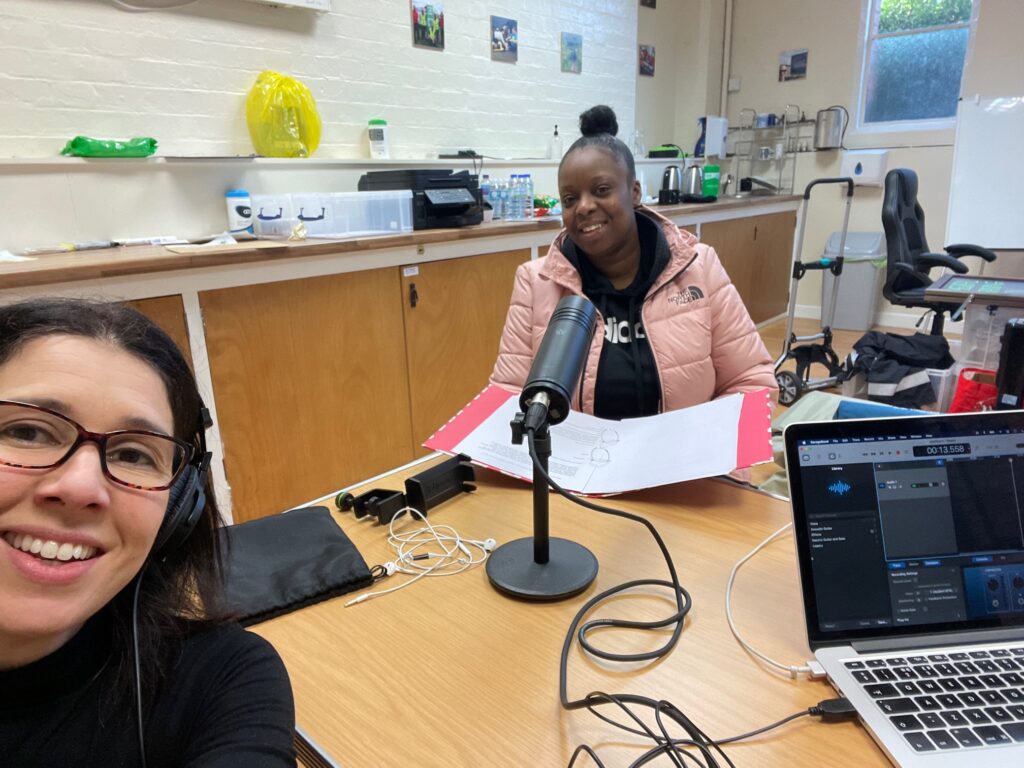
Sarah-Anne Cromwell and Naomi St Juste creating a podcast
Please describe any challenges or opportunities you faced and how you responded to those challenges and opportunities
Although I did build contingency time into my bid, no one – including funders or partners – flagged how much additional effort, particularly unpaid work, would be required to truly do this right. In the end, I spent over one hundred unpaid hours on this project. The unpaid time was spent on preparing materials for the final archive. Creating a community archive is a detailed, multi-stage process. It’s not simply recording an interview and sending it off. I did it because I believe in the importance of representing these women’s voices.
The way community organisations function means that many of us are volunteer-led, and even where freelancers are involved, we often work without core funding. In this case, like many community initiatives, once the project closes, the funding and capacity end. There was no additional funding available to support extended hours.
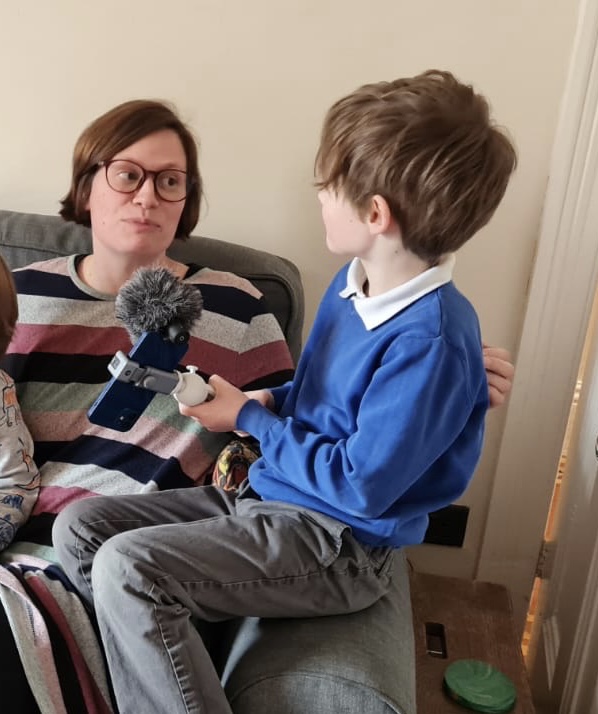
Ellie with a helper
What were the outcomes for service users or the parent body?
Outcomes for participants:
There were some common threads reported by participants when we asked what changes this project had brought about for them. All four women who shared their stories have reported significant positive impacts on their confidence, pride, and self-esteem.
Sharing their stories helped participants to reflect on their own lives: “The project gave me a chance to self-reflect and learn that I have achieved many positive things in my life that I hadn’t really took the time out to recognise before.”
Valuing themselves more: “It’s good to know that I can do something out of my comfort zone. I know it’s good for personal development and growth and I think that next time something similar comes along I would find it easier not to be concerned about what people might think of my interview.”
There seemed to be genuine excitement about getting their stories, views, experiences down for perpetuity: “Thank you for asking me to take part! It’s exciting to know that one day 100 years in the future people may find it interesting to hear what we were up to in Bearwood during the pandemic.”
Outcomes for the organisations:
We have received fantastic support and encouragement from the archivists, who have fed back that this has helped them think through the future of their digitisation journey, which is in its infancy.
We have created an open-to-all online resource on ‘how to digitise dialogue’ that can be shared widely amongst partners and any interested parties. We are excited about the potential of this legacy.
Funding continues to be a significant challenge. However, I’m proud that we’ve created a publicly accessible webpage where others can learn from our work – including how to archive personal stories through Sandwell Archives.
This project has been highly valuable to Bearwood Community Hub as an organisation. When we gain experience as an organisation, we feel more able to share our experience and, hopefully, enable further benefit to our community.
The project has signposted the way for Sandwell Archives to ensure that all voices are represented in the wider local historical archives. While we did not receive any deposits following the ‘Digitise Your Dialogue’ project, we believe it is in Sandwell Archives’ best interests to promote this work more and engage with potential visitors. In the future, we expect to work closely with community organisations to not only support their projects but engage new audiences through our own social media channels.
At Sandwell Archives, we will highlight the work of the Bearwood Interesting Women podcast as part of our service’s initiative to build a stronger digital policy and infrastructure.
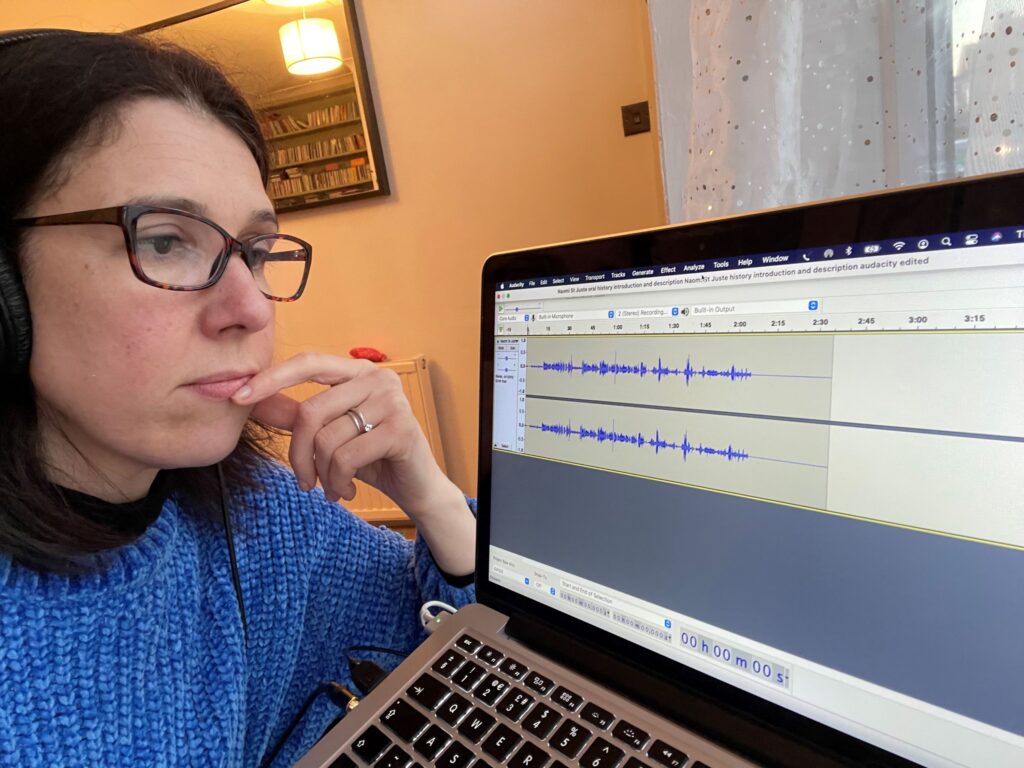
Sarah-Ann recording a podcast
Describe what you learned from the process:
This work is bigger than any one of us. It’s about community, legacy, and ensuring that we own our stories. If we don’t preserve our histories, someone else will write them for us. Archiving isn’t just a task – it’s a form of agency.
Bearwood Community Hub and the Project Manager have experienced significant upskilling and increases in awareness about how to archive, how to digitise, and how to budget for this kind of project.
(Sarah-Ann): “I’m dyslexic, and I leaned on Otter.ai to support transcription. But it struggled with Black Country dialects — something that points to a larger issue. We need artificial intelligence (AI) to reflect the true diversity of British voices, and it will only learn how to do this if we include a wider range of dialects and accents in our archives.”
If someone was thinking about taking on a similar project, what advice would give them?
The connections I’ve made have opened doors I never imagined – including this opportunity to share our story with The National Archives. If you’re doing this work, don’t go it alone. Connect with your local archiving networks.
If you’re aiming to collect archives from underrepresented communities, the most important thing to understand is this: You have to go to them. Setting up a café session and putting out a call for people to drop in during hours that suit your own schedule may work for some audiences, but it won’t reach those whose stories are often unheard.
Many under-represented women already gather in trusted community spaces – places where they feel safe, heard, and understood. These spaces are often held together by one trusted individual, someone who acts as a gatekeeper and protector. If you want to work with their community, you must go through them. That means taking time to build trust: Sitting down for tea, listening, answering questions, and proving that you will treat their stories – and their communities – with respect. If that trust is earned, they may choose to introduce you. This project was only possible because those relationships came first.
Partners and funders must take responsibility for being clear and transparent with first-time archivers about the true scope, labour, involved and the complexity of archiving. They must recognise that community-led work is often underfunded and volunteer-run. Projects should budget for paid time not only to deliver the archive itself (like doing interviews or transcriptions), but also for the invisible labour that goes into archiving community histories: things like relationship-building, consent conversations, admin, learning new systems, and responding to follow-ups.
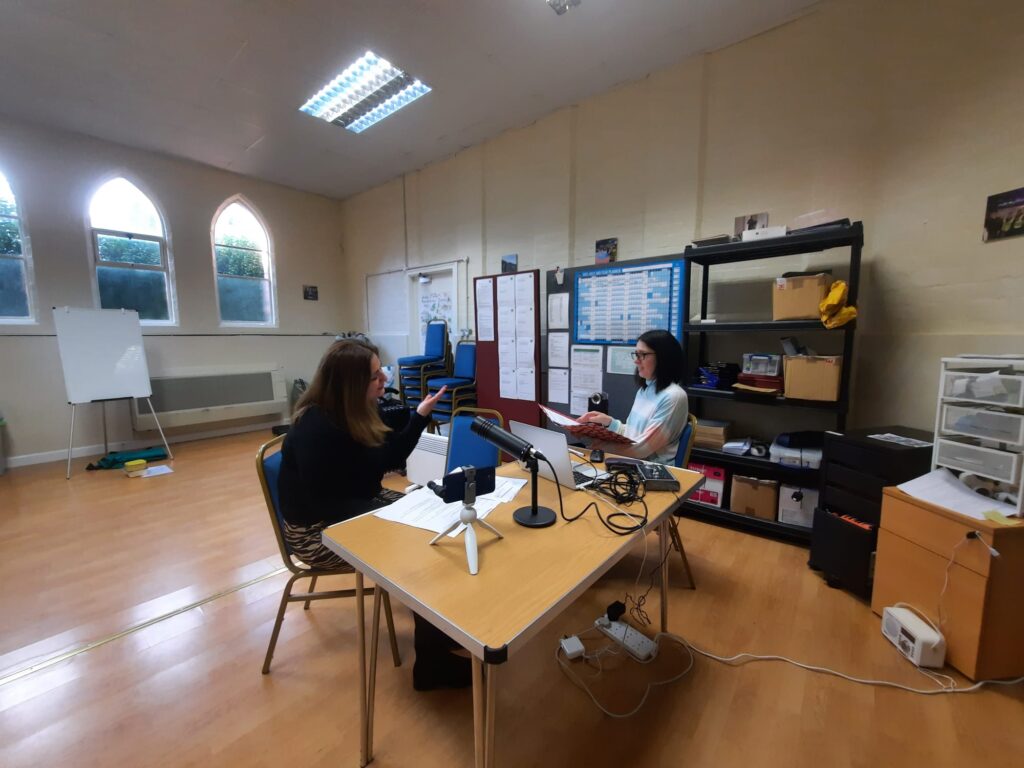
Sozan Hussain and Sarah-Ann Cromwell recording together
How will this work be developed in the future?
In the short-term:
We will publish the Interesting Women podcast on Sandwell Archives’ online catalogue. While the collection has been catalogued, it has not been made publicly searchable in the online catalogue yet.
In the medium term:
We hope to secure funding that will allow us to continue supporting Bearwood women in recording and digitising their stories. We would love to highlight the successes of Interesting Women for wider advocacy and interest to the archive sector.
Listen to the Interesting Women Podcast
Access Bearwood’s how-to guide to recording community voices