Assessment and award of Archive Service Accreditation

Find out more about the assessment process, and how Accreditation Panels operate.
Find out more about how to apply for accreditation, and what you need to be aware of before starting your application.
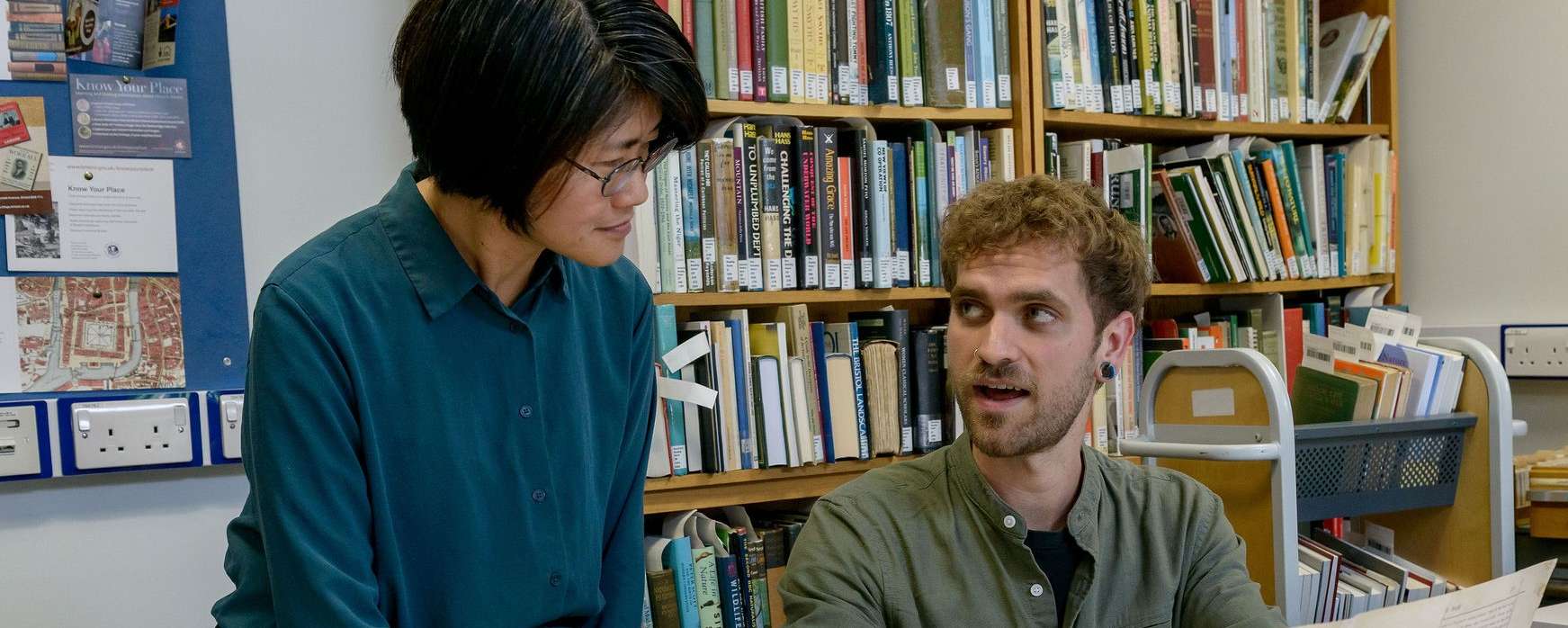
Examining collections at the University of Bristol Archive.
Richard Stonehouse
Archive services interested in applying for accreditation are advised to contact their home nation assessor body responsible for managing the application process before planning their application for advice:
Arrangements are made for national bodies to be assessed by representatives from other home nations.
Your assessor body can provide advice on making your application and can advise you on the assessment schedule.
Archive services in England should note that the assessment of an application at a specific Archive Service Accreditation Panel will only be guaranteed if agreed in advance. Applications for Archive Service Accreditation should be made at least three months before the date of an Archive Service Accreditation Panel to guarantee review at that panel.
Find out more about the assessment process, and how Accreditation Panels operate.
As archive services consider how to engage with Archive Service Accreditation, they should bear in mind that the programme is not looking for perfection. Accreditation is designed to offer a realistic development framework rather than be a gold standard. It can be achieved by the majority of eligible archive services.
However, accreditation supports professional service delivery by looking for:
Accredited Archive Service status is awarded by the UK Archive Service Accreditation Committee, based upon an assessment of the achievement of the archive service by the responsible assessor body. The Committee forms regular Panels to consider applications and make awards.
An archive service makes an application through its home nation assessor body. An assessor reviews the application. A percentage of applications are validated by an assessor visit, in some cases accompanied by a peer reviewer (an archive professional with relevant experience). On the basis of the application form, supporting document (and findings of the validation visit where appropriate) the assessor writes an assessment report and makes a recommendation on whether to award Archive Service Accreditation.
This assessment is then considered, along with the application itself, by a regular Archive Service Accreditation Panel, which makes the final award decision. The applicant is informed of the outcome in writing and provided with the full assessment report, which provides guidance on the reason for the decision and an short citation of the Panel’s view of the service.
The assessment report includes a number of future actions to guide further service development. These are ‘Required actions' (which need to be addressed to meet Archive Service Accreditation in future) and ‘Improvement’ actions (areas of future service development for the service to implement, but not mandatory for retaining Archive Service Accreditation).
An Accredited Archive Service will normally be reviewed after three years. At review stage the service completes a shorter review form, which checks the service’s development and is a moment for reporting significant change. It must then reapply in full after another three years. At both these stages, progress against actions set at the original Accreditation is updated.
Services that do not achieve Archive Service Accreditation can reapply when they are ready. To be successful, the service will need to show progress on critical ‘Required actions’ identified in the first assessment, as part of completing a full application.
Note: if a service makes an application and is given either full or provisional Accreditation with ‘Required actions’, these actions will have a timescale for their completion included as part of the assessment report.
There are then three possible outcomes:
If the service is fully accredited, these additional processes are required:
If the service is awarded provisional accreditation, these additional processes are required:
Process then returns to accreditation process point: 5. Accreditation Panel makes final decision on award
If the application for accreditation is not successful, these additional processes are required:
Process then returns to accreditation process point: 3. Service submits a completed application
There is no charge for either making an application or receiving Archive Service Accreditation. For most services the major ‘cost’ is the staff time required to gather data, undertake analysis, develop plans, policies and procedures.
This might seem daunting to smaller services. However, the application process is designed to be achievable by all services. Numerous small services have now achieved Accreditation. Taking a planned approach over a period of time will be the most effective way of using Accreditation to develop your service, and is usually the most realistic way of securing the necessary resource.
This is entirely dependent on the preparedness of your archive service. There is no specific timescale required by the programme.
Some services already have many of the plans, policies and procedures in place and it is just a question of reviewing and tightening up existing activity. In such a situation it might take six months to pull everything together whilst also running the service as normal.
For other services, Archive Service Accreditation provides an improvement framework for a complete review and overhaul of the service, which will take longer to implement.
The service’s personnel capacity will affect the timescale. Some services may make it a priority for one staff member to lead on with support from other staff. For other services, particularly smaller ones, it might fall to one person amidst many demands on their time. In the latter case, breaking down the application into small sections and dealing with each section as time allows may be the best solution.
Even when there is a lone professional whose task is clearly to lead the application, it is always helpful to ensure that other people connected with the archive service are aware of the application, can contribute in their areas of expertise, and perhaps provide a sounding board for any knotty issues. This helps to embed Archive Service Accreditation within the service, as well as providing practical support to the individual.
A number of factors may influence your decision on when to apply, in addition to preparing effectively for the application. You may wish to apply to receive your assessment feedback as part of a wider review. If your organisation also undertakes Museum Accreditation, you may opt to co-ordinate or dovetail the application timescales. As the application asks for statistics for the previous financial year, the timing of your financial year may have an impact.
The application process gives opportunities to discuss future changes to your archive service. However, it is not advisable to apply while still in the process of material change. For example, if you know a change of governance is coming but you do not yet know the nature and structure of the new governance it is advisable not to make an application until you can be sure.
Likewise, if you are working on a new building it would be advisable to make your application once you are in the new accommodation and you know how it performs for your archive service.
However, if you have longer term plans for major change, you are welcome to apply, to establish a current baseline for your service. If the material change is delivered within the six-year term of an award, you may be asked to complete reaccreditation at an earlier date.
If you are unsure about if the change will have an impact on when you should make your application, contact your assessor body for advice.
You should begin by checking your eligibility for the scheme. The next step is to assess the scale of your service.
Read our guidance to find out more about our six eligibility criteria.
Assess the scale of your service, using our guidance and scalability calculator.
Below is our full guidance document on applying for Archive Service Accreditation:
This guidance contains extensive advice on multiple factors of the Archive Service Accreditation application process. It includes guidance for the requirement as a whole, guidance for specific questions where suitable, advice on what information and supporting documentation is needed, and questions for you to consider when formulating responses, and more. It is divided into three sections: organisational health, collections, and access and engagement.
Below are reference-only versions of the application form and the review of accredited status form. All applications must be made via the online application form on the submit an Archive Service Accreditation application webpage.
This reference document contains all the questions that are found on the online application form, with space provided for responses. It is intended to be used as an aid to help draft your responses offline, to enable an easy application process via the online form.
This reference document contains all the questions that are found in the online application for review of accredited status, with space provided for responses. It is intended to be used as an aid to help draft your responses offline, to enable an easy application process via the online form.
If you are interested in making in an application, please contact your home nation assessor body. Some assessor bodies limit the number of applications they will accept in a year so you may need to reserve an application time in advance. Even if you are not planning to apply in the near future, you can begin the process of assessing how far the service needs to progress to become accredited, and your assessor body can offer support.
Undertake an initial assessment of your service against the requirements of the Standard, taking into account the scalability of your service. It is unlikely that you will meet all the requirements immediately and you should produce a development plan, which will enable you to meet the requirements of the Standard. Delivering this plan may take a number of months or longer, but this preparation is vital to enable you to make a successful application and to get the most out of working towards Archive Service Accreditation.
It is important to keep this proportionate and not to over-engineer a response. Where an archive service begins without the majority of policy and planning required by Accreditation, this can be an opportunity to establish a baseline, which can often be achieved through two or three primary documents. For example, an overarching archives management policy, a forward plan and a set of procedures for archives work can collectively address the majority of requirements.
Not all applications for accreditation are successful at their first attempt. Here are some key points for ensuring a good quality application:
An application may be unsuccessful simply because it has been made too early. Taking extra time can allow activities and procedures to bed in or for situations to settle down and become clearer. However, in some cases the service fundamentally does not meet some requirements of the standard and so will not be successful.
All services are strongly encouraged to contact their assessor body before they start an application to discuss whether there are significant issues that would definitely preclude a successful application and generally discuss their readiness for Archive Service Accreditation. Please note that assessor bodies are unable to review individual draft applications.
Archive Service Accreditation is suitable for archive services that are part of larger services such as a library, a museum, a special or unique and distinctive collection at a university. In such scenarios it should be clear how policy, planning and procedures are used to manage the archive collection even if this forms part of a bigger management unit.
Where archive collections are jointly managed with collections which have directly analogous needs, for example in a Special Collections operation which also holds rare books, it is recognised that there is little benefit in separating out archive elements from a holistic approach which meets the relevant professional standards for archives.
In this case, simply submit the unit-wide documentation except where there is a specific archive component. Even where this is not the case, it is recognised that it may be difficult to separate some aspects of the archive service from the wider institution (e.g. budgets, certain policy documents). If this is the case, please provide the details for the wider service and note in your application that it is not possible to separate out the archive element.
Your application should not only describe the current service but also look forward to its future development. Future change can be incorporated in a number of ways. Forward planning should articulate both changes that are expected to happen to the service and to drive change within the service.
Secondly, the application form provides opportunities to identify future changes across all aspects of the service. The service needs to identify material future changes, how these might affect the service and how the service is going to deal with the impact of any change. In describing future changes you should demonstrate that you have undertaken a thorough risk assessment and that your organisation is handling change with a controlled and managed approach.
‘Material future change’ is any change that will fundamentally affect how the service operates. For example, taking on a new person into an existing position will not be material but the loss of one or more paid posts would be for all but the largest services. Material changes can include areas such as loss of accommodation or planning for a new building, moving into a new type of governance, cuts in staffing numbers, changes in the service budget of more than 5%, or new partnerships for delivering services.
If you are unsure about whether a change is material and should be included in your application, contact your assessor body for advice.