free event
Register to attend Talking Records 2026
Register via Eventbrite to attend Talking Records: Spaces and places of care.
Talking Records is an annual themed symposium hosted by The National Archives, bringing together researchers and practitioners working with archival collections.
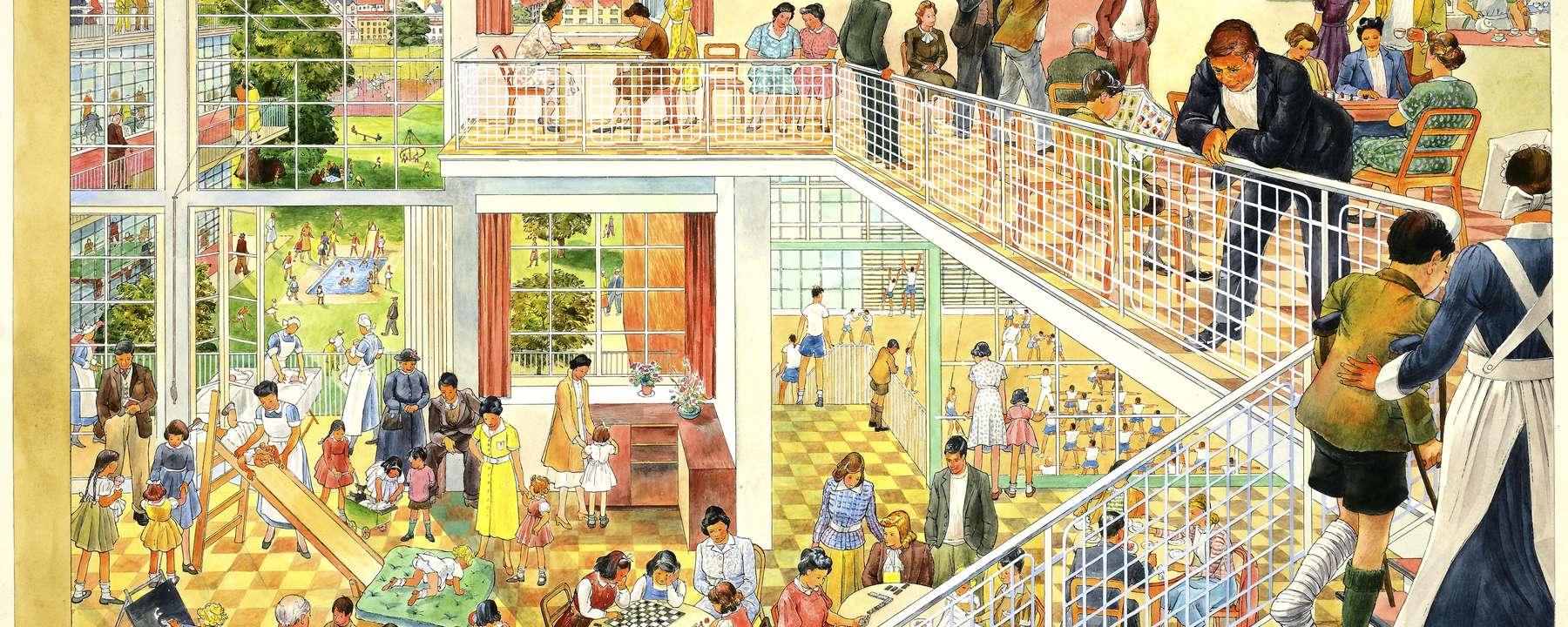
Community centre Artist's signature A H Hall. Catalogue reference: INF 3/1741
Monday 7 December 2026
In-person at The National Archives, Kew
free event
Register via Eventbrite to attend Talking Records: Spaces and places of care.
The 2026 symposium will explore histories of care and welfare and their intersections with histories of spaces and places. These histories leave complex traces in archival collections, entangled with histories of medicine, public health, poverty, government, social security and more.
Histories of welfare and care can be found across the collections at The National Archives. These range from records relating to welfare legislation to detailed documentation of particular institutions. These include the evolving responsibilities of the state for health and social care, the establishment of the National Health Service, and of documentation of institutions from medieval hospitals to Poor Law Unions.
The historic records of government offer rich insights into the diverse places and spaces associated with care and welfare. Plans, drawings, photographs, correspondence and many other documents testify to the ways in which space and place have shaped the provision of care and welfare in Britain and beyond. They also show how places and spaces have, in turn, been shaped by changing care and welfare practices, theories, and experiences.
Please note that Talking Records is an in-person only event. It is free to attend.
Registration
Welcome
Institutional spaces of care
Comfort break
Communities of care
Lunch
Document discussions
Itinerant care
Comfort break
Archives of care
Closing remarks
Please email us with any questions or information regarding accessibility requirements.
4–5 December 2025
Online and at The National Archives in Kew
Histories of pollution, contamination, and environmental damage can be found in a diverse range of records in the collections at The National Archives.
Across different times and places, from the very local to the global, the concept of pollution is intertwined with histories of land use and management, agricultural practices, urban space, natural disasters, health and safety, and public health and welfare. From the soil to water sources and the air, all aspects of the environment might be vulnerable to the effects of harmful substances, including pesticides, industrial waste, and radioactive material. Light and noise may also pollute, and both human and non-human creatures can be vulnerable when environments, habitats, and ecosystems are contaminated.
In records at The National Archives, pollution histories intersect with industrial histories (e.g. coal mining, industrial accidents, military activity) and urgent contemporary questions about energy sources and climate change. Pollution is an ever-evolving concept, and pre-modern records too can speak to us about changing scientific, social, and cultural understandings of contamination across the centuries – in histories of disease, for example.
This resource pack was produced for the Pollution in the Archive symposium, and includes the programme and further reading and resources related to the theme,
 Watch Watch the online event - Talking Records Symposium: Pollution in the Archive on YouTube
This video can also be viewed on YouTube with optional closed captions. Watch "Watch the online event - Talking Records Symposium: Pollution in the Archive" on YouTube.