Important information
This blog post quotes from and contains images of documents that use dehumanising and distressing descriptions of enslavement. References to death are also included.
Transatlantic slavery was thoroughly documented by Britain throughout the nearly 275 years of its operation. Today, many of these records are held by The National Archives. Our researchers are working to increase access and understanding of enslaved people’s histories through the PASSAGE project, which is funded by Lloyd’s Register Foundation. This project allows us to examine these records in greater detail than previously possible.
In this blog, the PASSAGE team reflect on some of the varied histories of enslavement that have surfaced through their research and cataloguing of documents so far. The records are testament to the resistance and survival of enslaved people. They also serve as reminders of the wide-ranging impact of transatlantic slavery and its ongoing legacies.
Enslaved Africans and skilled labour

Shipped by the Grace of God, in good Order and well-conditioned, by the Governor and Council at Cape Coast Castle in and upon the good Ship called the Chalmers whereof is Master, under God, for this present Voyage, Charles Anderson and now riding at Anchor in the Roads of Cape Coast and by God’s Grace bound for the West Indies to say, Two Men Slaves / one a Cooper & the other a Blacksmith being marked and numbered as in the Margin, and are to be delivered in the like good Order and well-conditioned, at the aforesaid Port of the West Indies (the Act of God, the King’s Enemies, Fire, and all and every other Dangers and Accidents of the Seas, Rivers, and Navigation, of whatever Nature and Kind soever, save Risk of Boats so far as Ships are liable thereto, excepted) unto Cap[tain] Anderson for sale account of the Committee or their Assigns, he or they paying Freight for the said slaves 2/7th of the amount sales with Primage and Average accustomed. In Witness whereof the Master or Purser of the said Ship hath affirmed to four Bills of Lading, all of this Tenor and Date; the One of which four Bills being accomplished, the other three to stand void. And so God fend the good Ship to her desired Port in Safety. Amen. Dated in Cape Coast Castle, 3 April 1806. [Signed] C Anderson. Printed by S. Couchman, Throgmorton Street. Sold be H. and S. Fourdrinier, Sherborne Lane, London.
Bill of Lading signed by Captain Charles Anderson, 3 April 1806. Catalogue reference: T 70/1583
-
- From our collection
- T 70/1583
- Title
- Detached Papers of the Company of Royal Adventurers of England Trading with Africa
- Date
- 1805–1806
Different types of enslavement and resistance were recorded in the Detached Papers of the Company of Merchants trading to Africa. These records largely relate to the business operations of 18th and 19th century West African coastal forts, centred on Cape Coast Castle (known as Ghana today). These forts were owned and maintained by the Company to support the sale of enslaved people by African traders to British ships’ captains.
A lot of the labour done in the forts was performed by enslaved people that the Company claimed as its property and which they referred to as ‘Company slaves’. These enslaved people's lives were often different from those trafficked across the Atlantic Ocean as they were guaranteed certain rights. These included a subsistence allowance in goods and the freedom to move around locally and have families. Many were also trained in skilled trades and would occasionally work together to collectively withdraw their labour as a negotiation tactic to secure their rights.
Despite these rights, the above bill of lading (a receipt for cargo shipped) shows a different reality to what enslaved people were promised. Listing two unnamed ‘men slaves’ as cargo, the document reveals that the status of the 'Company slave' could be uncertain. It provides evidence of the Company operating against its own charter by selling enslaved people off the coast. This appears to have been a punishment for the two men, as another document claimed they had engaged in ‘repeated theft’.
The only information we have on the men is that one was a cooper and the other a blacksmith. We do not know their names, ages or where in West Africa they were from. They were trafficked aboard a ship called the Chalmers and, from other records, we know that the ship and these two enslaved men were sent to Trinidad.
This record leaves us with more questions than answers about the two men. Were the men teenage apprentices or veteran tradesmen? Who, in terms of family and friends, were they forced to leave behind in Africa? And what would their skills as blacksmith and cooper mean for the lives they would lead after being sold in the Caribbean?
We are unlikely to find answers to these questions in our records as these men's names were not recorded. This makes it difficult to track their lives through the records, even if they are listed elsewhere.
Lives at sea

The return of William Walsh of the Town of Port of Spain, Mason of
List of families of slaves of the said William Walsh
Family of Walsh
Names: Lydia, Jenny
Surnames: Walsh, Walsh
Colour: Negro, Negro
Employment: Servant, none
Age 30, 6
Stature: 5 feet 1 3/4 inches, 3 feet
Country: Born at sea, Creole of Bermuda
Trinidad ‘Register of personal slaves’, 1813, showing entries for Lydia and Jenny Walsh. Catalogue reference: T 71/503, f. 195
-
- From our collection
- T 71/503
- Title
- Trinidad: 'Register of personal slaves'
- Date
- 1813
We can also find insights into the lives of enslaved people from 19th-century registers. Registers of enslaved people were created on behalf of the British Government and acted as bureaucratic tools of control. The practice of registration started in Trinidad in 1813 and continued across the Caribbean until 1834. The registers often differentiated enslaved people born in Africa, described as 'African’, from those born into slavery in the Caribbean, described as 'Creole'.
We have found 75 people in the digitised registers that defied the above categories. Instead, they are described as being ‘born at sea’. This included enslaved people born in the Middle Passage between West Africa and the Caribbean, as well as those born on ships trafficking people within the Caribbean.
The story of Lydia Walsh and her daughter Jenny includes both a passage from West Africa and a further journey within the Caribbean. According to registers for Trinidad, Lydia was born at sea around 1783–84, probably while her mother endured the Middle Passage. Lydia then gave birth to her own daughter, Jenny, in Bermuda around 1807–1808. By 1813, both Lydia and Jenny were in Trinidad’s capital, Port of Spain, where they were enslaved by William Walsh. This means at some point they faced another passage over 1,500 miles of ocean between Bermuda and Trinidad.

The triennial Return of Josephine Joachin by her mother Louise Joachin of the Quarter of South Naparima of Personal Slaves being her property
[...]
Jenny Walsh
Negro
Servant
14
4..3
Creole of Bermuda
No country marks
Acquired
Trinidad ‘Register of personal slaves’, 1822, showing entry for Jenny Walsh now in South Naparima without her mother. Catalogue reference: T 71/510, f. 2039
-
- From our collection
- T 71/510
- Title
- Trinidad: ‘Register of personal slaves’
- Date
- 1822
The passages and forced relocation experienced by enslaved people were not limited to those at sea. In 1822 Jenny was listed as ‘acquired’ by Josephine Joachin who was based in South Naparima, around 40 miles south of Port of Spain. There, 14-year-old Jenny was enslaved as a household servant without her mother.
The 75 enslaved people recorded as ‘born at sea’ probably represent a small fraction of those whose lives began onboard a ship. This is partly because government registers only began in 1813. Birth records relied on information being passed down to enslaved people from their parents, who they were often separated from at an early age. Even if enslaved people did know where they were born, this information would have to be given to the people providing information to the register. This was usually their enslaver or a person working for them.
The fact that there are any records of people ‘born at sea’ demonstrates the ways in which enslaved people carried their histories with them, reflecting another form of survival and resistance in the face of repeated displacement.
Fear and resistance
Image 1 of 3

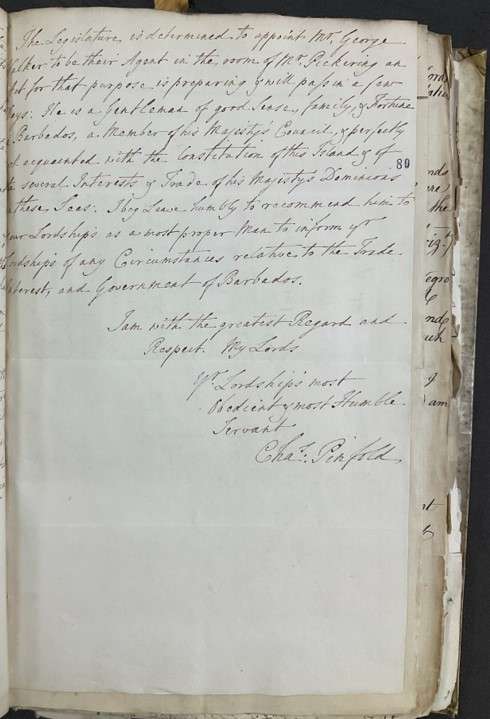
Letter from Charles Pinfold, Governor of Barbados, to the Honourable Lords Commissioners for Trade and Plantations, 28 May 1763. Catalogue reference: CO 28/32 ff. 79-80
Image 2 of 3

Image 3 of 3
-
- From our collection
- CO 28/32
- Title
- Correspondence from Barbados
- Date
- 1760–1767
The Colonial Office records reflect the harrowing and complex system of transatlantic slavery from the perspectives of governmental bodies. These records show the way in which enslaved people were discussed and controlled. They also provide insights into the political affairs of each colony and how members of government used enslaved people for their own personal gain.
One example of this comes from 1763, when the Governor of Barbados, Charles Pinfold, wrote to the Lords Commissioners for Trade and Plantations. He raised his concerns about a fellow member of the Council of Barbados, John Adams, and his use of the enslaved people he owned.
Pinfold described John Adams as having armed enslaved people on his father’s estate. He claimed that Adams did this to fight against a Provost Marshal and other officers who arrived on his estate, to ‘execute rights of the Courts of Justice’. Although very little information is provided on the reasoning of the presence for the Provost Marshals, the actions of Adams reflect the complexities within structures of government.
John Adams was eventually banned from taking any forms of governmental office on the island. This was not due to his defiance against the Provost Marshalls, but his use of arming enslaved people to do so. In his letter, Pinfold implied that these actions threatened the stability of slave society and put enslavers at risk of revolt. John Adams’ case demonstrates that some council members would not only exploit enslaved people for financial profit but would also use them to defend their personal and political grievances.
Despite the social position of the enslaved, their continuous acts of resistance, such as Tacky’s Revolt in Jamaica that took place just a few years before this incident, still instilled fear into the government that wanted to control them.
Records of remembrance

Cape Coast Castle, Febry 25th 1754
These are to certify to the committee of the Company of Merchants trading to Africa or whom else it may concern that this day died Quodjebah, labouress, a negro woman, slave belonging to the company at this place aged 24 years.
Tho[ma]s Westgate, Surgeon
John Clifton, Surveyor
No of Tally 164.
Death certificate of Quodjebah, one of the women enslaved at Cape Coast Castle. Catalogue reference: T 70/1522/122
-
- From our collection
- T 70/1522/122
- Title
- Certificates of death and property loss
- Date
- 1754
Within the Company of Merchants records, we have uncovered a small number of death certificates noting the passing of enslaved people in West African fortifications. They are bundled with death certificates of soldiers and certificates relating to goods that had arrived in a damaged condition, which could suggest that the certificates related to insurance claims. These scraps of paper stand as rare memorials to the stolen lives of enslaved Africans, despite telling us little about how they died. Similar to the other certificates, one reads
These are to certify to the committee of the Company of Merchants trading to Africa or whom else it may concern that this day died Quodjebah, labouress, a negro woman, slave belonging to the company at this place aged 24 years.
Quodjebah’s death certificate, dated 25 February 1754, Catalogue reference: T 70/1522/122
On the International Day for the Remembrance of the Slave Trade and its Abolition, documents such as this invite us to reflect on both memory and loss. Britain enslaved more than 3 million Africans between the late-16th and mid-19th centuries. Despite this overwhelming number, most people who experienced enslavement are missing from the historical record as named individuals. Their lives, beliefs, families, hopes, and suffering were rarely considered worthy of documentation beyond their value to enslavers and trading companies. Against this silence, we know of 24-year-old Quodjebah, who was held at Cape Coast Castle, and can only speculate on what brought her life to an end so prematurely. Other details about her life are absent from our records.
On this day of remembrance, we honour all the lives represented in our records, like Quodjebah, Lydia and Jenny. At the same time, our thoughts are with the millions of names that were never recorded, have not survived, or remain undiscovered. Their absence from the archive is itself a testament to the profound human loss created by the transatlantic slave trade.
The PASSAGE Project
A project exploring histories of enslavement through the lens of British slave ships (1760-1807).