A growing body of research
On display at The National Archives throughout September is a 19th century Chinese military map. This is part of our Stories Unboxed display, which spotlights a different document from our collection every month.

A complete view of the 19th century hand-coloured map of a coastal region of China, 1850s. Detailed annotations describe villages, roads and local features, while the distinctive pink labels appear to record strategic military observations and intelligence. Catalogue reference: FO 931/1916
-
- From our collection
- FO 931/1916
- Title
- 19th century Chinese military map of a coastal region
- Date
- Around 1850–1860
At first glance, the map appears to be a detailed geographical record of a coastal region in China. It shows settlements, waterways, mountains and military observations from across the province's landscape. Yet closer examination reveals much more than the information written on its surface.
The map offers a fascinating introduction to the world of heritage science. Its pigments, colour choices and paper structure provide evidence of artistic traditions, trade networks and technological exchanges that connected East and Southeast Asia with the wider world. It also highlights how scientific analysis can help us make informed decisions about the preservation and display of archival records.
The map is just one of many East and Southeast Asian records investigated by our Heritage Science team in recent years. Working alongside colleagues from Conservation for Imaging, the Prize Papers Project, and Conservation Treatment, we have examined a range of objects. Some examples include:
- The 1842 Treaty of Nanking
- Chinese government documents printed on distinctive red papers
- Chinese silks recovered from captured ships
- Containers once used to transport liquid opium samples
Image 1 of 4

Bilingual pages from the Treaty of Nanking, 1842, signed between Great Britain and China, which ended the First Opium War. The pages show Chinese text alongside an English translation of the imperial reply following the treaty negotiations. The yellow coloured paper was produced by dyeing it with turmeric. Catalogue reference: FO 93/23/1B
Image 2 of 4

Chinese administrative papers. Distinctive red papers dyed with safflower were used in official Chinese administrative communications. These were discovered and conserved as part of a recent digitisation project. Catalogue reference: FO 682.
Image 3 of 4

Textile samples found within the wallet of Dutch merchant Jan Bekker Teerlink, dating to 1803, part of National Archives’ Prize Papers collection. The samples were made for the Chinese export market and are rare survivals, with some retaining their original handwritten labels. Catalogue reference: EXT 11/140
Image 4 of 4

Two empty opium tin boxes. Such tins were used for the packaging and distribution of prepared opium. Catalogue reference: FO 228
Although these records differ greatly in appearance and purpose, they share one characteristic. Each contains material evidence that can help us better understand how it was made, used and preserved. Looking beyond the written content allows us to ask different questions and uncover stories that are often invisible in a digital image or transcription.
Why materiality matters
Archives are often consulted for the information they contain, but records are also physical objects. The fibres, pigments, dyes and substrates (base material) they are made from can reveal important information about the societies that produced them.
In the case of East and Southeast Asian collections, material analysis can help us better understand regional production traditions and technological practices. The pigments used on maps, the dyes used to colour official documents, and the fibres selected for paper and textiles reflect the choices of their maker. These choices were likely influenced by local resources, cultural preferences and specialist knowledge.
The Chinese military map currently on display provides a good example of local production traditions. While Western cartographic (the making and drawing of maps) traditions typically depict rivers in blue and mountains in green or brown, this map uses green waterways and blue mountains. Such differences remind us that colours do not simply describe landscapes; they reflect cultural systems of representation and meaning.

Chinese cartographic traditions depict rivers in green and mountains in blue, colouring conventions that differ from many Western maps. Catalogue reference: FO 931/1916
The materials themselves also tell stories of exchange and connection. East and Southeast Asian records often contain evidence of local materials being used alongside imported technologies and pigments. Through scientific examination of the materials in these records, archives can become a source for studying trade routes, technological transfer and the movement of knowledge across continents.
Analysing a 19th century Chinese military map
Before being put on display, the military map underwent a range of scientific analyses designed to better understand its materials and support its long-term preservation.
A variety of non-invasive techniques can be used to investigate archival materials without sampling or damaging the object. These techniques include:
- X-Ray Fluorescence (XRF) to help identify many inorganic elements present in pigments and colourants
- Multispectral imaging to visualise features that are invisible under normal lighting
- Reflectance spectroscopy and vibrational spectroscopies, such as Raman spectroscopy, which can provide further information about inorganic and organic materials
Scientific instruments and facilities

Find our about the scientific instruments we have in our labs and our analytical specialisms.
When used together, these approaches can provide a remarkably detailed understanding of an object's material composition.
Analysis of the Chinese military map revealed a sophisticated palette of pigments. The results of XRF mapping identified copper (Cu)-rich green pigments used to depict waterways, consistent with the mineral pigment malachite. Widely used across China for centuries, malachite was a traditional green pigment valued for its colour and durability.
Areas of the map associated with red features (roads) were found to contain mercury (Hg). This indicates the presence of vermilion or cinnabar; a bright red mercury-based pigment widely used across East Asia during the 19th century. Lead (Pb) was also detected in several areas of the map. This may be associated with lead white or other lead-bearing materials. This was used either as pigments or mixed with other colours to modify their appearance.
In contrast, the blue mountains were found to contain Prussian blue, a synthetic iron (Fe)-based pigment first developed in Europe in the early 18th century. Little more than a century after its invention, Prussian blue had spread around the world and found its way into a Chinese military map.

X-ray fluorescence imaging elemental distribution maps of a Chinese military map. The maps show the spatial distribution of copper (Cu), iron (Fe), lead (Pb), and mercury (Hg), allowing the identification of pigments and drawing materials used to record different types of information.
The presence of these pigments together highlights how material analysis can reveal connections that are not immediately clear from the map itself.
As seen above, traditional materials such as malachite and cinnabar were used alongside imported pigments such as Prussian blue. This demonstrates how local artistic and cartographic practices incorporated new materials while maintaining established practices. The map is therefore both a product of Chinese cartographic traditions and a testament to global networks of trade and exchange.
Multispectral imaging provided further insights while studying this map. When illuminated with ultraviolet light, the pink labels, which appear to contain military observations, display the characteristic orange fluorescence associated with safflower dye. This is a pink to red dye obtained from the petals of the Carthamus tinctorius plant. The use of safflower was further confirmed using fibre optic reflectance spectroscopy.
Similar fluorescence responses have been observed in several Chinese government red and pink documents held at The National Archives. This provides further evidence of traditional East Asian colourants being used across different types of records.
Seen together, these scientific results reveal records that are not purely local or global in their material make-up. Instead, they are products of a connected world in which materials, technologies and ideas crossed borders and were adapted to local needs.

Visible light (top) and ultraviolet fluorescence (bottom) images of a Chinese military map. Comparison of the two imaging modes reveals differences in the fluorescence of the paper, pigments, and inscriptions, highlighting material differences across the document.
Materiality and preventive conservation
Understanding the materials present in archival collections is not only valuable for historical research. It is also essential for long-term preservation.
Different pigments and dyes respond very differently to environmental conditions. Some mineral pigments remain relatively stable over centuries, while many organic dyes can be extremely vulnerable to light exposure.
For example, Safflower is well known among conservators for its poor lightfastness, meaning colours can fade rapidly when exposed to light. Due to this, the identification of safflower in several Chinese government documents held at The National Archives immediately raised questions about display and access.
To investigate this vulnerability further, we used microfadeometry, a technique that exposes an extremely small area of an object to a controlled light source while monitoring colour change. The results confirmed that the red colourant is highly light-sensitive.
Similar observations were seen in experimental studies of dyed silks. Light-ageing experiments comparing safflower, indigo and turmeric demonstrated substantial fading in safflower-coloured samples. This reinforced the need for careful environmental management when displaying objects containing this dye.

The results of an experiment to demonstrate the fading behaviour of safflower-dyed silk after exposure to natural sunlight. The upper half of the silk was exposed to unfiltered, direct sunlight for 14 days in August, while the lower half was covered. The pronounced loss of colour in the exposed area illustrates the extreme light sensitivity of safflower.
This information directly informed our conservation decision-making for this month’s Stories Unboxed display. Understanding which materials are particularly vulnerable helps us determine exhibition durations, lighting conditions and storage requirements. For the map currently on display, the identification of light-sensitive safflower colourants played an important role in the exhibition planning process.
In the display, the map is only displayed for a limited period and benefits from carefully controlled lighting, UV-filtering glazing, routine light monitoring and the use of shutters outside opening hours. These measures help reduce light exposure, ensuring that access today does not compromise the preservation of the map for future generations.
New perspectives on East and Southeast Asian collections
The study of East and Southeast Asian records at The National Archives demonstrates how heritage science can enrich archival research.
Whether investigating the pigment palette of a military map, identifying safflower in government documents, or exploring objects linked to the opium trade, the same principle applies: materials matter.
These records are more than carriers of information. They are evidence of cultural traditions, technological knowledge, commercial networks and historical interactions that connected East and Southeast Asia with the wider world. By looking beyond the text, we gain a deeper understanding not only of the records themselves, but also of the people, materials and ideas that shaped them. In doing so, we are better equipped to preserve these remarkable collections for the future.
Display
Stories Unboxed
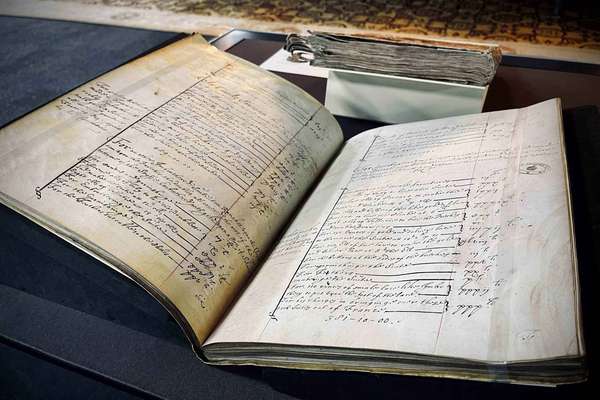
Find out how to view this 19th century Chinese military map at The National Archives this September.