nationalcollection.org.uk
Deep Discoveries
Find out more on the Towards a National Collection website
Browse a selection of research projects we’ve completed in the past few years.
Arts and Humanities Research Council (AHRC)
2013–2015
Incorporated Council of Law Reporting; LexisNexis; Office of the Parliamentary Counsel; Office for Official Publications of the European Communities; Thomson Reuters.
This project aimed to create new legislation data research infrastructure, support downloadable data and online tools. It will also investigate the idea of a pattern language for mapping the statute book of UK legislation.
Researchers typically lack the raw data, tools and methods to undertake research across the whole statute book. This project provided data, tools and trusted methods to enable big data research across legislation.
Arts and Humanities Research Council (AHRC) under Towards a National Collection
2020–2021
University of Surrey and Victoria and Albert Museum
Deep Discoveries was a project exploring the application of computer vision (CV) and explainable artificial intelligence (XAI) methods. We will investigate if these methods can enhance the ability of general audiences and specialist researchers to discover visual collections in new and/or more effective ways.
The team developed and user-tested a CV-based search platform that allowed users to visually articulate their search task. It also allowed users to understand how the CV algorithm found similarity between their input image and the returned image results. Finally, it carried out a ‘visual dialogue’ with the AI to refine their search further.
nationalcollection.org.uk
Find out more on the Towards a National Collection website
Technology Strategy Board (now Innovate UK), plus additional funding from the industry partner.
2013–2015
This project aimed to develop specialised software for risk-based assessment of environmental conditions in storage of cultural heritage collections.
The project created graphical representations that correlate environmental monitoring data and indicators of preservation. This helped to develop reporting tools that can inform management decisions for improving preservation environments and meeting sustainability targets.
The National Archives is now using the software developed through the project, called Ensight, for its annual environmental assessment. We are also leading in the development of new specifications for managing environmental conditions in cultural collections.
Jisc
2011–2013
Coventry University and BT Heritage
This project aimed to digitise BT’s physical archive, making almost half a million photographs, documents and correspondence available online.
Images and documents detail how Britain laid the foundations for global communications, including the first telephone exchange in 1879 and the Queen making the first automatic long-distance telephone call in the 1950s.
The team produced case studies which show how digitised archival material can be used to explore new avenues both in teaching and research in a wide range of subjects, from design to linguistic and cultural studies.
digitalarchives.bt.com
Find out more on the BT website
Innovate UK
2024–2026
Tabled Technologies Limited, Keele University, Northumbria University and Swansea University
The National Archives Legal datasets are the primary source of legislation and case law in the UK jurisdiction, available free of charge for computational analysis. However, the datasets had not been annotated or enhanced to optimise them for machine learning. This is an increasing problem in the era of pre-trained public LLMs that often fail to provide accurate legal interpretation to uniformed users.
The project addressed Sir Geoffrey Vos, Master of the Rolls and President of the Civil Courts’ statements:
'If GPT-4 (and its subsequent iterations) is going to realise its full potential for lawyers… it is going to have to be trained to understand the principles upon which lawyers, courts and judges operate… the present version of ChatGPT does not have a sufficiently reliable moral compass.'
The project comprised of:
Arts and Humanities Research Council (AHRC)
2016–2017
School of Advanced Study, University of London; King’s College London; University of Cambridge; University of Sussex; University of Waterloo; British Library
This project aimed to bring together a network that would deliver an understanding of the potential of born-digital big data for humanities research.
How are humanities researchers engaging with this source, which includes the live and archived web, aggregated tweets and emails? What kinds of questions would this data allow us to ask and answer? What insights can scholars in the humanities learn from the computer and social sciences, and from the archives and libraries who are concerned with securing all of this information?
An exchange of knowledge and experience took place through a series of workshops across the network, and was distilled into a white paper.
The National Lottery Heritage Fund and the Engineering and Physical Sciences Research Council (EPSPRC) Impact Acceleration Account.
2019–2020
The University of Warwick, Dorset History Centre, Gloucestershire Archives, Transport for London Archives, University of Brighton Design Archives, University of Leeds Brotherton Library, and the Digital Preservation Coalition
This project proposed a collaborative approach to managing digital preservation risk, bringing established statistical risk management methods into the digital heritage sphere. Project participants created a structured evidence base, pooling collective experience to map and explain an interconnected network of risk events, actions and impact on heritage.
Find out more about the project
Arts and Humanities Research Council (AHRC)
2019–2022
The University of York, with the support of the Chapter of York Minster.
This project investigated the political role of the Archbishops of York, 1304-1405. The principal aim was to make the key records of spiritual and temporal governance more digitally accessible and searchable for free. The project website now features high-quality digital images of the registers of the archbishops held at the Borthwick Institute for Archives, the University of York. These are held alongside searchable, indexed summaries of all entries from each 14th century register and from the many records of government that relate to ecclesiastical affairs held at The National Archives. The website also contains background information to archiepiscopal registration and the mechanics of government, project blog and features that have emerged from the research.
york.ac.uk
Find out more on the University of York website.
Arts and Humanities Research Council.
2021–2025.
UK Research and Innovation (UKRI)
Towards a National Collection (TaNC) was a major five-year £18.9 million investment in the UK’s world-renowned museums, archives, libraries and galleries. Funding was provided through UK Research and Innovation’s Strategic Priorities Fund and delivered by the Arts and Humanities Research Council (AHRC).
The programme took the first steps towards creating a unified virtual ‘national collection’ by dissolving barriers between different collections.
Archived page
Find out more about the TaNC projects carried out at The National Archives.
Arts and Humanities Research Council (AHRC) and The National Archives
2014–2017 (including 15 months of external funding)
Institute for Historical Research, University of Brighton, University of Leiden.
The research phase of the project developed new probabilistic models and tools that allow researchers to trace and connect individuals, with confidence, across historical ‘big data’.
In the implementation phase we exploited this research to create a new navigation feature in our catalogue, Discovery. This provides researchers with suggested links between records that may relate to the same people, with associated confidence measures.
Government of Ireland
2023–2025
Trinity College Dublin, The National Archives Ireland, Public Record Office of Northern Ireland, Irish Manuscripts Commission and Trinity College Dublin Library
The Virtual Record Treasury of Ireland is an all-island and international collaboration aiming to re-imagine and reconstruct through digital technologies the Public Record Office of Ireland. This housed seven centuries of Ireland’s archival heritage and was destroyed on June 30th, 1922, in the opening engagement of Ireland’s Civil War.
The Treasury is an open-access resource, freely and permanently available online to all those interested in Ireland’s deep history at home and abroad. It brings together images, transcripts, translations and other data from surviving originals, official and antiquarian transcripts and other replacement records for those lost in the blaze. The National Archives supports the Medieval Exchequer ‘Gold Seam’. This is a digital edition of over 150 years of financial records deposited for audit at Westminster. We also support INSPIRE, which provides digital access and enhanced metadata to the papers of the secretaries of state in the late seventeenth and early eighteenth centuries. Together with the partners across Ireland and around the world, the project is democratizing access to invaluable records and illuminating seven centuries of Irish history.
virtualtreasury.ie
Find out more on the project website.
Focus on
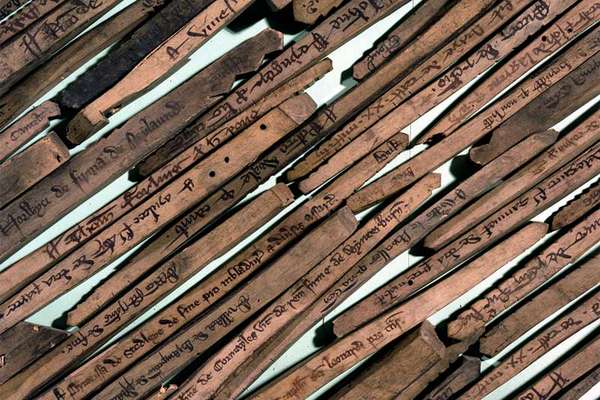
In 1325, officials found suspicious mistakes in the account of the former treasurer of Ireland and hauled him through the courts. What did they uncover?