How to look for records of... Records of veterans of nuclear testing (the contents of the Merlin database)
How can I view the records covered in this guide?
How many are online?
- All
Contents
- 1. Why use this guide?
- 2. Where to go for further support, if you have been affected by the content of these records
- 3. What was the Merlin database?
- 4. What are these records and how can they be searched?
- 5. Supporting sensitivity and transparency
- 6. How to access records held at The National Archives
- 7. Other records relating to nuclear testing and the Atomic Weapons Establishment held at The National Archives
- 8. Records in other archives and organisations
1. Why use this guide?
This guide provides information on records transferred to The National Archives (TNA) from the contents of the Merlin Database.
The transfer of the Merlin Database records from the Atomic Weapons Establishment (AWE) to The National Archives started in September 2025 and the Ministry of Defence (MOD) and AWE anticipate that it will take them a year to transfer the records to The National Archives. This guide will be updated as records are transferred to The National Archives and are made available via our online catalogue, Discovery.
This guide sets out the context for historical records which formed part of the Merlin Database that was compiled by AWE between 2006 – 2008 at the request of the MOD. It also provides details about other material that relates to nuclear testing and that is held by The National Archives and other organisations.
2. Where to go for further support, if you have been affected by the content of these records
Records from the Merlin Database include content that some people may find distressing. If you have been affected by these records, you can find useful advice on looking after your mental health and wellbeing on the NHS Every Mind Matters website and from the mental health charity Mind.
3. What was the Merlin database?
Between 1952 and 1967, around 22,000 Armed Forces personnel, as well as scientists and civilians, took part in the UK’s nuclear testing programme in Australia and the Pacific to develop the UK nuclear deterrent.
In 2005 approximately 1,000 armed forces veterans of these British atmospheric nuclear tests launched legal proceedings against the MOD, seeking compensation for injuries.
The Merlin Database was created and compiled between 2006 and 2008, by AWE at the request of the MOD, to enable its Veteran’s Policy Unit (subsequently the Armed Forces Compensation Team), the Deputy Chief of Defence Staff, Personnel and Training, and the Treasury Solicitor (subsequently the Government Legal Department), to quickly identify relevant factual documentary evidence/records about the nuclear testing programme relevant to the litigation.
The litigants seeking compensation set out 12 areas in which the MOD (and its predecessors) were alleged to have been negligent. The database was designed to compile relevant records on those 12 areas.
The 12 areas covered the following subjects:
- Research/information prior to and during the testing period (pre-1950s until 1960s), in respect of effects of participation in testing.
- Research/information prior to and during the testing period, in respect of exposure to ionising radiation.
- Knowledge of the MOD during the 1950s-1960s in respect of the effects of participation including effects of ionising radiation.
- Consideration given by the MOD to the risks of participation, including risk assessments.
- Provision of protective equipment against risks, including details of nature and availability.
- Guidelines on the use of protective equipment, and whether such equipment was mandatory.
- Guidelines relating to safe distances, during or in the aftermath of detonation.
- Details of distances that individuals were positioned during or after detonations, if differing from above.
- Warnings given to participants prior to participation as to potential health risks.
- Guidance given to participants before and after participation as to damage likely to result, and guidance to minimise or alleviate that damage.
- Monitoring of health, safety and well-being of participants during and after tests and programmes.
- Medical Studies conducted by MOD or any other organisation pre-1950s to date, which prove or disprove a link between exposure to ionising radiation or participation in nuclear tests and experimental programmes, and any of the conditions listed in Section 4 of the Claimants’ solicitors’ letter dated 15 November 2005.
Within the database there was also a category number 13 created to account for any other relevant material that the AWE staff found when reviewing material relevant to the litigation.
4. What are these records and how can they be searched?
The database, known as the Merlin Database, consisted almost entirely of scanned and indexed PDFs of individual papers from AWE registered files, and other documents in the possession of AWE, which relate to the 12 topic areas of litigation. The National Archives are treating these scans as “born digital” records and separate to the paper records from which they were copied. They are being transferred in tranches from AWE to The National Archives. They will be made available to search and download from Discovery.
The database also included scans of individual correspondence folders. These contain copies of correspondence held by AWE, between Nuclear Test Veterans and/or their family members, various government departments, and AWE itself. These were primarily where the Veteran had requested further information relating to their participation at the tests.
In many cases the papers scanned were from material that the UK Government had shared publicly with The Royal Commission into British Nuclear Tests in Australia (the McClelland Commission) held in 1984-1985, or were papers generated by that Commission. Much of this material has previously been declared as a public record under the Public Records Act and transferred to The National Archives by AWE, MOD or other Government Departments. There are also records from AWE corporate, nuclear science, and analytical science departments.
Key information (metadata) from the Merlin Database has been included and incorporated into the Merlin collection on Discovery. The metadata from the Merlin Database is in its original format and has not been updated or corrected (save for formatting). It is known that the metadata is in some cases incomplete or inconsistent – this is preserved so as not to alter the collection as a record.
- Author is included where that information existed within the Merlin Database.
- Keywords indicate topics (and often sub-topics) within the document. For example: “Sites – Maralinga”. This enables you to search for an entire topic, or a specific element.
- The “Treasury Solicitor Questions” Keyword refers to the 13 subject areas outlined in Section 3, above. “Veterans01” to “Veterans13” reference the individual subject area.
- The Merlin Record Number is a sequential numerical Unique Identification Number (UIN) that was used within the database. Its only purpose is to identify a specific record.
Document dates are included where that information existed within the Merlin Database. Due to data formatting limitations, where the document has only a partial date, or a date range, the metadata has been transformed to reflect the last possible date. For example, where a document is dated ‘1955’, or ‘1952-1955’, the metadata will display ‘1955 Dec 31’.
The file names are not always indicative of the content of the scanned document. In many cases, PDFs were named using only sequential file numbers. More detailed information of the contents can be found in the ‘Description’ field of the catalogue entry.
Consistent, reliable metadata for the names of individuals is not available in the database. Outside of the name appearing in the filename itself, or in the ‘author’ field, there is no reliable way to search for names.
The National Archives have included in this guide an example of how an individual catalogue entry will look on Discovery.
Example catalogue entry for ES 38
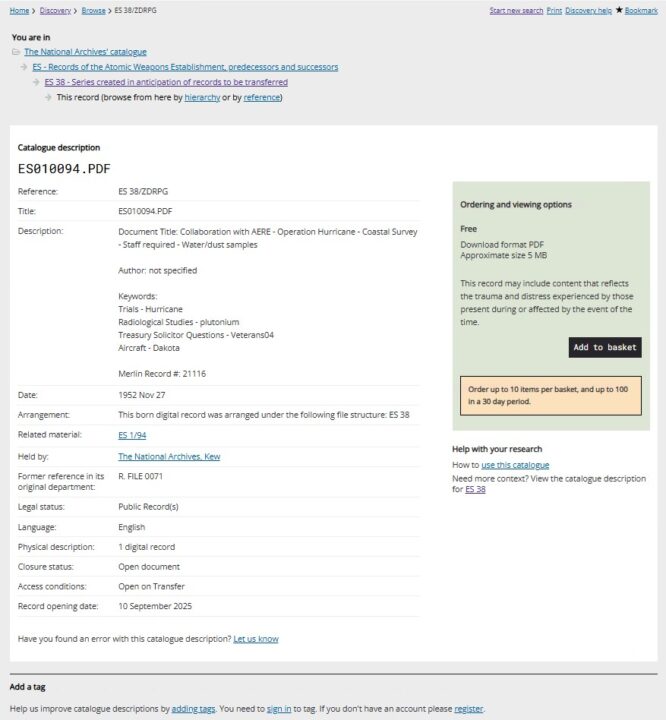
Researchers should note that some of the catalogue descriptions contain inaccuracies originating from the source system, such as poorly indexed document titles (for example, ‘qwertyuiop’). This data has been transferred ‘as is’ without correction to preserve the integrity of the original record.
5. Supporting sensitivity and transparency
As part of preparing the Merlin Database records for transfer to The National Archives, the MOD and AWE have undertaken a review of the contents to ensure that any redactions are in line with information rights legislation and, where applicable, national security requirements. All records transferred in the first tranche, are OPEN on transfer to The National Archives and are accessible via The National Archives catalogue Discovery.
A member of the public will be able to submit an FOI request to The National Archives by submitting a request directly from the catalogue entry on Discovery or by following the instructions on this form. When The National Archives receives an FOI request, we will consult with MOD/AWE under section 66 of the FOIA.
The National Archives also operates a Takedown and Reclosure Policy. Should a member of the public (or a government department) consider that material available on open access should be closed they should submit a request following this process.
6. How to access records held at The National Archives
The records from the Merlin Database can be accessed using The National Archives’ online catalogue. The records are held in digital format, and the first tranche of records are available online.
Born-digital records (such as the Merlin Database records) can be downloaded free of charge. Members of the public can download 10 digital documents at a time. This is limited to 100 records in a 30-day period where you sign into a TNA account. If you do not sign into a TNA account, there is no limit on the volume of records you can download, although they will still need to be processed in batches of 10 at a time. If you are in our reading rooms, you can view and download digital documents on our computers for free, or email copies to your own devices.
The National Archives’ online catalogue will indicate the format of the record. If you need further help using our catalogue, please consult Discovery help.
This guide will be updated as records are transferred by AWE and published by The National Archives.
The Merlin Database records are catalogued within the ES 38 series.
Search or browse descriptions in our catalogue.
7. Other records relating to nuclear testing and the Atomic Weapons Establishment held at The National Archives
Records of AWE can be found in the ES department series and include records relating to a variety of aspects of its work, including policy, reports, and nuclear testing.
Records of the UK Atomic Energy Authority can be found in the AB department series.
Photocopies of evidence given to the Australian Royal Commission into United Kingdom Nuclear Weapons Testing in Australia can be found in DEFE 16 and FCO 1.
8. Records in other archives and organisations
The National Archives of Australia holds records relating to nuclear testing including records of the Royal Commission into British Nuclear Tests in Australia during the 1950s and 1960s. There is also a “guide to records of nuclear tests at Maralinga“.
Included in this guide are recent government announcements relating to the contents of the Merlin Database and Nuclear Test Veterans. Written Ministerial Statements:
https://questions-statements.parliament.uk/written-statements/detail/2025-06-30/hcws748
https://questions-statements.parliament.uk/written-statements/detail/2024-05-21/hcws486
Included in the written Ministerial statement of 21st May 2024 the following list was published: https://www.gov.uk/government/collections/atomic-weapons-establishment-awe-records-relating-to-nuclear-test-veterans
A directory of UK archive services can be found on The National Archives website: https://discovery.nationalarchives.gov.uk/find-an-archive.