
Important information
This article features records relating to themes of homophobia, policing, and surveillance.
Joy and risk
In December 1927, Bobby Britt, a working-class dancer, welcomed friends to his home with Constance Carre. Over these winter months, they hosted joyful gatherings in their flat in the heart of London’s Fitzrovia. The gramophone would play; dancing, singing and laughter filled the space.
We know about these parties due to extensive undercover surveillance and the records preserved at The National Archives. This article draws primarily on the Central Criminal Court depositions in CRIM 1/387.
-
- From our collection
- CRIM 1/387
- Title
- Central Criminal Court deposition
- Date
- February 1927
I owe a huge debt of gratitude to historian Matt Houlbrook, whose brilliant book Queer London first brought these records – and many others documenting queer culture of the era – to light.
Why were these individuals under observation? Because at these gatherings, men formed relationships with other men, at a time when sex acts between men were criminalised and widely condemned by society. The 1920s saw a surprising but thriving underground queer culture that existed in the shadows of criminalisation. 25 Fitzroy Square was part of this.

Plan of the basement at 25 Fitzroy Square, London, 1927. Catalogue ref: CRIM 1/387.
Working-class queer friends
Bobby and Constance invited friends, and friends of friends, to their parties and to watch Bobby’s salacious dances. One of the dances was a depiction of Salome from the controversial Oscar Wilde play – an unwise thing to be associated with in the aftermath of Wilde's trials and conviction for gross indecency. For the dance Bobby wore a gilded, transparent skirt. The attendees tended to be working-class men, with professions including clerks and dancers.
The interior was striking in its bohemian and ‘oriental’ style. Other spaces in this era were similarly fashioned, such as the queer-friendly Caravan Club on Endell Street. Red walls adorned the bedroom, with a red light outside the front door.
Surveillance and the raid
Unknown to Bobby and his friends, their sanctuary was under surveillance. For weeks, police officers observed them through gaps in curtains and from the basement roof, noting every gesture they deemed suspicious.
Guests knew they were vulnerable, planning to enter the property in pairs and keeping the curtains drawn. Despite this, individuals were seen kissing and cuddling. At one point, two men were observed naked together. Bobby was even followed from the stage door of his job in the West End hit Lady Be Good to public urinals, with police remarking on his powdered face and painted eyebrows.
The fragile safety of their basement gatherings was raided by police on 16 January 1927 – a rare instance of a private flat being targeted rather than a commercial venue such as a club or bar.
On the night of the raid attendees were questioned by police. One individual explained:
Bobby is my friend. I often come here to a party. We all dance together. It is just a party [by] the boys.
A visitor to Bobby's Fitzroy Square flat, quoted in a police report.
Working-class men were often at greater risk because of their more public uses of space and fewer resources to be discreet.
Through the lens
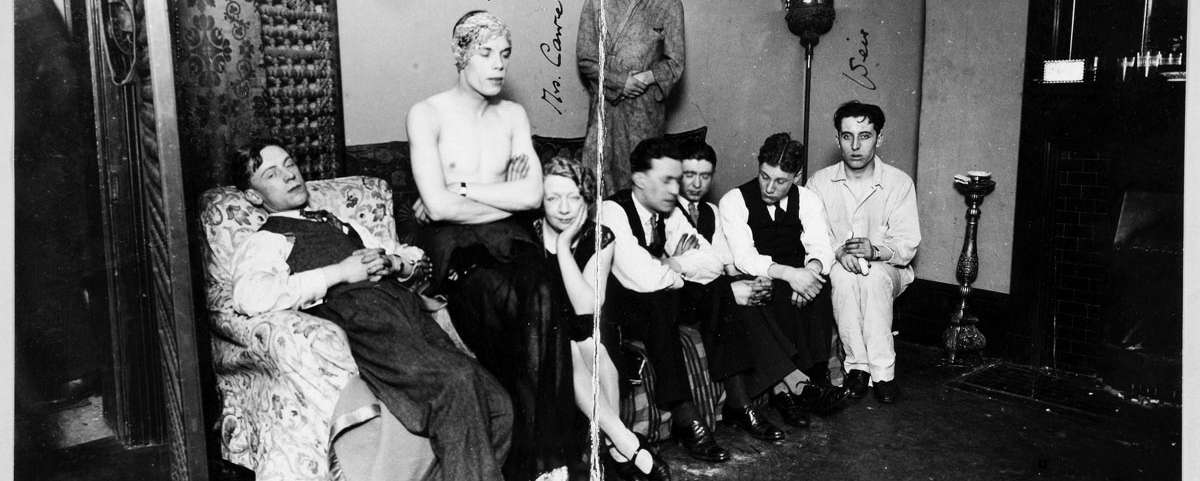
Photographs taken as police evidence offer an uncomfortable yet striking insight into the people and space. A photograph of the bedroom shows the bed looking recently used, with the sheets ruffled, and a pair of shoes by the bedside. The photographs also show Bobby and his friends, some disobediently looking away from the camera, others appearing indifferent. The photographs were annotated by police.

Photograph of a small bedroom area in the flat, 25 Fitzroy Square, 1927. Catalogue ref: CRIM 1/387.
These records survive because of state oppression. They raise uncomfortable but important questions about the ethics behind this rare and powerful material. We have chosen to show the photographs of these individuals to represent their defiance and agency, and the reality of the state homophobia people historically faced.
Their clothes would have also seemed transgressive – Constance wearing a flapper-style dress, with her hair in a bob; Bert in a dressing gown, with a modern-looking swimsuit underneath; Harold wearing a pyjama-style linen suit. Meanwhile Bobby was in his skirt, naked torso, ‘lady’s shoes’ and a patterned headband.

Photograph of individuals present during a raid of Fitzroy Square, used as evidence, 1927. Catalogue ref: CRIM 1/387.
Police paid particular attention to anything perceived as sexual or gender non-conforming, such as Bobby’s outfit. On one occasion, five men approaching the door were overheard saying:
Hello girls, come on in – we are having a right royal time.
A visitor to Bobby's Fitzroy Square flat, quoted in a police report.
In court, a commentator remarked that these men ‘behaved as though they were women’, noting theatrical costumes, feminine voices, and powdered faces. At the time, femininity – including the use of make-up – was heavily associated with homosexuality. Houlbrook notes the ‘complex ways male identities were defined’ in this time, with much more fluid constructions of gender.
Ultimately, this was all useful in building a case against the individuals who partied at Fitzroy Square.
The letters
Nine letters and a Christmas card written to Bobby and Bert (Bobby’s nephew and fellow dancer) were seized during the raid. These letters reveal not just love, but enduring queer networks and chosen family, with intimate reflections never meant for the police, only for each other.

Original handwritten letters seized during the raid on 25 Fitzroy Square in 1927. Catalogue ref: CRIM 1/387.
One powerful set of letters came from 'Macnamara', writing to Bobby while travelling extensively, mentioning San Francisco, New Orleans and California. At one point he described his dear Bobby as ‘the campest thing between London and San Francisco’. In one letter from 1923, Macnamara writes:
There is nothing finer in this whole universe than sincere friendship and I do trust that ours may prove so as long as we live.
Macnamara in their letter to Bobby
Written on New Year's Day from San Francisco, it talks about confetti-filled streets. The letters are filled with wonderful, affectionate nicknames and queer humour - such as ‘Lady of the Camellias’, ‘My dearest camping Bessie’, and ‘old auntie Aggy’. Macnamara talks about his relationship with another man during this time, using the language of ‘marriage’ and ‘honeymoon’.

1091 Bush St
San Francisco California
New Year’s Day
4pm
My dear Bob
I have today taken stock of all my friends and I hold you foremost amongst the few dear friends which I hold there is nothing finer in the whole […]
Handwritten letter from Macnamara in San Francisco to Bobby in London, 1923. Catalogue ref: CRIM 1/387.
The seized letters addressed to Bert are predominantly love letters, but they show the complexities of love between men, including love that had to be hidden and unrequited love. One letter from 'Eric' is written in several stages at different points in the day and is an intense, heartfelt expression of someone in love but not being loved back:
You say that you could never love me, – but that you offer me friendship, which you say is far greater than love. I cannot agree with you about this my dear . . . I must confess that I don’t see how I can keep love out of my side of the friendship. It is a simple true fact that I love you baby dear.
Eric to Bert, 1927.
Other letters referenced the queer scene in London, their social lives and the frustration of not being able to talk publicly about their feelings. A letter between Eric and ‘Peter’ declares: ‘I wanted to shout to the whole of the office that I was in love with you’.
The versions of the letters held in The National Archives are both handwritten and typed. The police underlined names, male and female pronouns and phrases that demonstrated romantic love.
On trial
The court case took place at the high profile Central Criminal Court, on 8 February 1927. The individuals present were accused of:
tippling, whoring, using obscene language, indecently exposing their private naked parts and behaving in a lewd obscene and disorderly and riotous manner.
Central Criminal Court report
All pleaded not guilty. Much of the court debate centred on whether a private flat could be considered a ‘disorderly house’. This was a term applied to places considered a public nuisance or morally corrupting.
The court was presented with extensive evidence from the detailed observations, as well as a selection of unique objects – including items of clothing, photographs, floor plans and letters. Only a select number of these items survive.

Black transparent skirt
Red sash
Pair lady’s shoes
Material
Bathing costume
A pair of slippers
Suit of pyjamas
Set of photographs
Plan
6 Letters address to Bruce
4 Letters address to Lummes
List of exhibits used as evidence in the Fitzroy Square case. Catalogue ref: CRIM 1/387.
Although preserved in our collections, it seems ultimately that the letters were not used as evidence in court. Newspaper reports show Sir Henry Curtis Bennett, K.C. believed they ‘ought never to have been admitted as evidence, as they could not be properly connected with the offence with which appellants were charged’ and would lead to a natural prejudice against those brought to court.
Some of the letters also pre-dated the raid by several years and related to people not present. Despite this Sir Henry did concede that the letters were clearly of an ‘obscene character’.
Bobby was charged with keeping a disorderly house, and received the most serious sentence of 15 months hard labour. Others, including Bert, received shorter sentences.
After 1927
Records show that not long after their prison sentences, in 1929, both Bobby and Bert travelled to New York. We can imagine that they may have been visiting Macnamara and his husband.
Further records suggest that Bobby lived to the age of 100. He had been born in 1900 and would have lived through many changes in the law. For a significant period of Bobby’s life, the 1967 Sexual Offences Act would have been in force, decriminalising homosexual acts in private. He remained a professional dancer.
These records are wonderful to read, revealing vibrant possibilities of love and friendship between men in the 1920s – and the heartbreak and joy within them. Yet there is a sadness in their survival: these records exist only because parts of their lives were unjustly policed.
The presence of these letters in court files shows the danger of writing about queer desire in the 1920s. Today, they offer a rare, personal insight into queer lives in the early 20th century.
Further reading
- ‘Kisses and kind thoughts’: Queer networks and letters between men
- Corrupting public morals? Fitzroy Square and queer desire
- Matt Houlbrook, Queer London: Perils and Pleasures of the Sexual Metropolis, 1918-1957 (2006)
- Janes, Dominic, The scene of the crime: police photographs, visual culture and sexuality. Legal Information Management (2015)
- The Tale of Bobby Britt and ‘Prudes on the Prowl’ at the Empire Theatre, Rob Baker January 16, 2018
Past exhibition
Love Letters

This free exhibition showcased 500 years of devotion, longing, sacrifice and passion, covering royalty and parliamentarians, literary icons and unknown scribes.