Operation Overlord
The D-Day landings, officially known as Operation Overlord, remain one of the most significant military operations in history. On 6 June 1944, Allied forces from several nations landed on the beaches of northern France. Here they opened a new front against Nazi Germany, which helped to bring about the end of the Second World War in Europe.
While the scale of the operation was unprecedented, its success depended on more than military planning and manpower. Crucially, it relied on the accurate interpretation of weather conditions by a team of meteorologists led by Group Captain James Stagg. Their forecasts played a vital role in determining when the invasion could take place. Records at The National Archives, including reports and the weather forecasts they produced, detail their crucial work.
Stagg and his career
Born and educated in Scotland, Stagg earned his degrees from the University of Edinburgh before beginning his professional career as a science teacher. At the age of 24, he joined the British Meteorological Office (now the Met Office) as an assistant.
During his time at the Meteorological Office, which was operated by the Air Ministry, the government department responsible for the Royal Air Force, he also served as a Senior Technical Officer. In 1932, he participated in a Royal Society polar expedition of Arctic Canada. Before the outbreak of the Second World War, he was appointed Superintendent of Kew Observatory – then the central observatory for the Meteorological Office.
At the start of the Second World War, Stagg served as a civilian member of the meteorological service. In April 1944, he was granted an Emergency Commission as a Group Captain in the Royal Air Force Volunteer Reserve. He was subsequently appointed Chief Meteorological Officer at the Supreme Headquarters Allied Expeditionary Force (SHAEF) – the military command responsible for planning and executing the Allied invasion of northwest Europe. Here, Stagg led the team responsible for providing weather forecasts to senior Allied commanders including General Dwight D. Eisenhower who was the Supreme Allied Commander of SHAEF.

Group Captain James Stagg, from the Imperial War Museum collection.
Gathering the data
Weather forecasting was considered a matter of national security during the Second World War, so much so that public weather forecasts were suspended for the duration of the conflict. This did not mean, however, that meteorological observations stopped. Accurate weather data remained essential for military planning, particularly in the lead-up to Operation Overlord. In an age before satellite technology, gathering this information was a challenging and complex task.
In early 1944, a joint British-American Meteorological Section was established specifically to provide weather forecasts for D-Day. The team collected data from several sources. During the week before the planned invasion on 5 June, eight British and American weather ships were stationed at designated locations across the Atlantic to monitor and report atmospheric conditions. In addition, the Royal Air Force carried out a series of meteorological reconnaissance flights, although the information obtained from these missions was sometimes considered unreliable.
Together with weather reports from the west coast of Ireland, these observations provided a broad picture of conditions across the North Atlantic. The data was then analysed by Stagg and his team who interpreted the forecasts. They then supplied senior SHAEF commanders with the information they needed to determine whether weather conditions were suitable for launching the invasion.

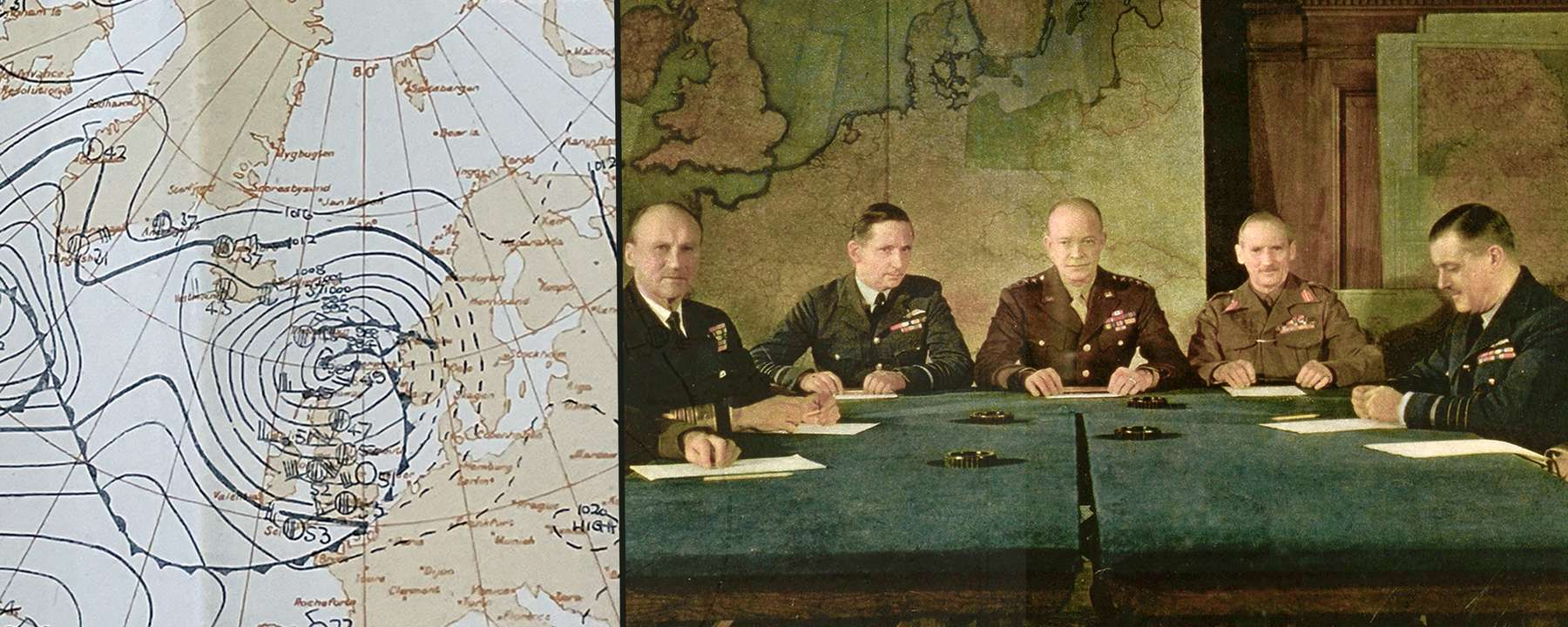
Chart of Weather in the Northern Hemisphere
Morning of Monday 5th June 1944.
GENERAL INFERENCE: A depression centred near the Shetlands is drifting northeast and beginning to ease up. There will be strong to gale force west to northwest winds in Shetland at first, moderating steadily. It will be mainly cloudy throughout the British Isles with showers in Scotland, N. England and N. Ireland and scattered showers further south at first; later showers are expected to die out in England, Ireland and S. Scotland. It will be rather cool in the South, cool in the North.
FURTHER OUTLOOK: Rain spreading into W. Ireland, and W. Scotland later tomorrow afternoon moving east.
Gale warning in operation in districts 13A, 13B. Time of issue 0800 4.6.44 and in districts 11,15, and 16 at 13.55 4.6.44.
Weather forecast for the Northern Hemisphere on the morning of Monday 5 June 1944, the planned date for D-Day. Catalogue reference: AIR 37/1124A
Deciding when to launch
At the end of the war, a report was written examining the meteorological factors that influenced the choice of date for the Allied invasion. It concluded that the ideal conditions for the operation would have included light or calm winds and clear visibility unaffected by fog, mist, or haze. The report acknowledged, however, that such conditions were rarely achievable. As it noted:
in English weather, even English summer weather, it was clearly impracticable to set up an ideal set of conditions and defer the assault until this set of conditions was obtained.
Catalogue reference: CAB 106/976
In addition to military and political considerations, planners also had to account for the timing of high and low tides, as well as levels of natural illumination influenced by twilight and the phase and position of the moon. Consequently, the Allies agreed upon a set of minimum acceptable meteorological conditions under which the invasion could proceed.
These criteria ultimately formed the basis for the decision to launch Operation Overlord on 6 June 1944. Even with agreed thresholds in place, however, the task of producing and interpreting weather forecasts was far from straightforward. The decision depended entirely on predictions of rapidly changing conditions, placing enormous pressure on those responsible for advising the Allied command. The intensity of these discussions is reflected in documents preserved at The National Archives.

The conference room was ANCXF Mess Room in Southwick House, a large room with a table at one end and easy chairs at the other; walls on three sides lined with bookcases, most of which were empty except for a certain number of books from the Navigation School at PORTSMOUTH which had been using the house for some time since their own headquarters was blitzed. The conference table was not used; the meetings were informal, those present using the easy chairs and the weather exposition being given at the very start.
The weather situation was dealt with on each occasion by the Senior Meteorologist – Group Captain STAGG – who was accompanied by Commander PLEMING R.N. and Colonel YATES, U.S. Army Air Corps. Prior to this series the previous meetings to consider the weather had been held at SHAEF and on Monday, 29th May, 1944 Group Captain STAGG had given an optimistic long-range forecast with a considerable degree of confidence. However, on the Saturday night he had a different tale to tell. The long period of settled conditions was breaking up and the outlook for D-Day and the succeeding days was now most unpromising; in fact, the type of weather to be expected was such that made forecasting for more than 24 hours a very hazardous undertaking.
D-Day weather report. Catalogue reference: AIR 37/1124A
Stormy weather
With the invasion initially scheduled for 5 June, a series of meetings began on the evening of Saturday 3 June to determine whether the operation should proceed as planned or be postponed. Forecasting conditions had been relatively uncomplicated up to that point, but by the weekend the weather had deteriorated significantly. Stagg later recalled that the changing conditions made reliable prediction much more difficult.
As forecasts continued to be updated throughout the weekend, it became increasingly clear that the invasion could not go ahead on 5 June, as planned. Senior commanders met repeatedly to review the latest meteorological assessments and consider their implications.
During a crucial meeting on the night of 4 June, Stagg and his team advised that a brief improvement in conditions was likely on 6 June. On the basis of this forecast, General Dwight D. Eisenhower made the decision to proceed, reportedly remarking: 'Well boys, there it is, I don't see how we can possibly do anything else.'

2100, Sunday, 4th June. Supreme Commander’s meeting.
Since the statement made before the meeting on Saturday evening, there have been some rapid and unexpected developments in the weather situation over the Atlantic. A front from one of the deep depressions in the northwest Atlantic has moved much farther south than was expected and is now traversing the Channel areas. It is almost over Portsmouth now and will clear the eastern Channel at least on the English side overnight. When that front has passed there will be an interval of fair conditions which, from the evidence we now have, should last until at least dawn on Tuesday.
Wind speeds by Monday evening should decrease to Force 3-4 on the French Channel coasts and cloud will become mainly less than 5/10, with base 2-3000 ft.
After that interval, lasting till Tuesday morning, cloud will probably increase to 8/10-10/10 from the west during Tuesday afternoon and will continue so overnight Tuesday.
From a time on Wednesday which cannot be defined from present information, mainly cloudy conditions will continue; but there should be some intervals of broken cloud. In this period from Wednesday to Friday, there will probably be intervals of 10/10ths cloud with base at 1000 feet; these overcast intervals of low cloud may be expected to last 4-6 hours at a time.
Report on the meteorological implications in the selection of the day for D-Day. Catalogue reference: CAB 106/976
Stagg later recorded the events in his diary. He recalled Eisenhower telling him:
Well, Stagg, I promise you now that if this forecast of yours comes off, I'll give each of you a bottle of whiskey.
General Dwight D. Eisenhower, Catalogue reference: CAB 106/976
D-Day
In his entry for 6 June, Stagg wrote that he rose at 5am and reported to his post, where Admiral Creasy, Chief of Staff to Admiral Sir Bertram Ramsay, Commander of the Allied Naval Expeditionary Force, greeted him with the words: 'You must feel a tremendous load off your shoulders, Stagg. Anyway, you can feel proud of your forecast.'
Soon afterwards, the invasion began. The forecasts had been made, the decision had been taken, and the success of the operation would now depend on events unfolding across the English Channel.
In the early hours of 6 June 1944, more than 150,000 Allied troops landed by sea and air onto five beaches in Normandy, France. While the weather conditions were not perfect, it was better than the previous day – Stagg's judgement had proved correct. The Allied troops were able to make good progress, despite heavy casualties. By the end of the day, they had taken all the beaches they had set out to hold.
Eisenhower, who went on to become the 34th president of the United States, would later commend James Stagg's team, writing:
I wish you to express my appreciation to the members of your section and the meteorological personnel of subordinate and associated agencies whose combined goodwill and co-operation contributed so much to the final results.
General Dwight D. Eisenhower, Catalogue reference: AIR 73/8

SECRET
SUPREME HEADQUARTERS
ALLIED EXPEDITIONARY FORCE
Office of the Supreme Commander
28 June 1944
SUBJECT: Commendation
TO: Group Captain J.M. Stagg, OBE,
Chief, Meteorological Section,
G-3 Division,
SHAEF.
- I desire to commend you for the skilful operation of the meteorological services in support of the ‘OVERLORD’ assault on the Continent of EUROPE. I wish you to express my appreciation to the members of your section and the meteorological personnel of subordinate and associated agencies whose combined goodwill and co-operation contributed so much to the final results.
- Through the months preceding D day your tireless efforts, good judgement, skill and sound leadership resulted in the development of a procedure capable of utilizing the talents and facilities of both nations and all services in a unified manner.
- I have been particularly impressed with the sound approach made by you to the difficult task of coordinating all agencies. I have noted with assurance your deep sense of responsibility and integrity in presenting all facts precisely as they were conceived to be. Your straight-forward attitude in presenting the weather situations and forecasts, frequently under the most difficult conditions, permitted me to reach decisions with confidence that I was acting on the best information and advice obtainable.
- This service on your part, and on the part of those associated with you, merits very special commendation as an outstanding contribution to the success of the whole operation.
(Signed) Dwight D. Eisenhower
DWIGHT D. EISENHOWER
General, U.S. Army
Letter from Dwight Eisenhower to James Stagg. Catalogue reference: AIR 73/8
After the war Stagg returned to the Met Office. In 1971 he published Forecast for Overlord, in which he gave his account of D-Day. He died on 23 June 1975 at the age of 74.
Records featured in this article
-
- From our collection
- AIR 73/8
- Title
- James Martin Stagg MCB OBE: Chief Scientific Officer Meteorological Office
- Date
- 1923–1977
-
- From our collection
- CAB 106/976
- Title
- Report on the meteorological implications in the selection of D-Day
- Date
- 1944
-
- From our collection
- AIR 37/1124A
- Title
- Operation Overlord: D-Day weather
- Date
- 1944–1948