In pictures
The life and court trials of Oscar Wilde
Oscar Wilde was a celebrated 19th century author and playwright. He is remembered today for his wit as well as his relationships with men, which led to his imprisonment. The National Archives’ records allow us to follow milestones throughout his life.
Important information
This material references historical legal offences targeting gay men, state homophobia, and language reflecting the homophobic attitudes of the period. It also mentions relationships with boys outside the age of consent.
Photograph of a pencil drawing of a young Oscar Wilde

- Date
- 12 September 1907
- Catalogue reference
- COPY 1/513/131
Born in Dublin, Oscar Wilde was an excellent student from an early age. He later studied at Trinity College in Dublin followed by Magdalen College at Oxford University. This drawing shows him as a student. It was registered posthumously for copyright purposes.
In the following years, Oscar married Constance Lloyd and had two sons. His life then changed again after meeting Robbie Ross in Oxford. From around this time, he started exploring relationships with men. This was just after the introduction of the 1885 Labouchère Amendment, which broadened offences between men during a period of rising moral panic.
Despite these obstacles, Oscar achieved major success in the 1890s, including the publication of his controversial novel The Picture of Dorian Gray in 1890. In 1891, Oscar met Lord Alfred Douglas, a 21-year-old Oxford undergraduate known as Bosie.
Annotated calling card of the Marquis of Queensberry left for Oscar Wilde

- Date
- March 1895
- Catalogue reference
- CRIM 1/41/6
Bosie’s father was the Marquis of Queensberry, John Sholto Douglas. He strongly disliked his son’s relationship and began a campaign of harassment against Oscar.
The Marquis of Queensberry left a calling card on 18 February 1895 at the Albemarle Club when Oscar was present. The exact words on the card are debated but it is believed to say: ‘For Oscar Wilde posing somdomite [sodomite]’.
This accused Oscar of engaging in sodomy (having sexual relationships with men), which was criminalised at the time. Feeling he had no other choice, Oscar made the fateful decision to privately prosecute Queensberry for libel (spreading misinformation about him). Bosie said he and his family would pay for the case.
This small calling card is one of the most famous exhibits in legal history, it ultimately triggered the chain of events leading to Oscar’s downfall.
Indictment of Oscar Wilde, Central Criminal Court

- Date
- 20 May 1895
- Catalogue reference
- CRIM 4/1120
The libel case centred on whether Queensbury's claim of Oscar’s ‘sodomy’ was accurate. Queensbury’s team of investigators found evidence of Oscar’s sexual relationships. Additionally, during the trial, Oscar accidentally undermined his own case. He stated that he could not have kissed a man because he was ‘very ugly’. To the prosecution, this implied that he would kiss a more attractive man.
Oscar lost the libel case in March 1895, and a warrant for his arrest was immediately issued, with 25 charges including sodomy and gross indecency. The following trial focused on Oscar’s relationships with boys and young men. Oscar elegantly defended himself, referencing a phrase that Bosie used in his poetry, ‘The love that dare not speak its name’.
A split jury led to a retrial but the evidence against Oscar was overwhelming. Due to this he was given the maximum sentence of two years hard labour.
Letter requesting the pardon of Oscar Wilde, from Lord Alfred Douglas to Queen Victoria

- Date
- 25 June 1895
- Catalogue reference
- HO 45/24514
Oscar was sent to Pentonville Prison while Bosie went to France to avoid the press. While there, Bosie petitioned Queen Victoria for Oscar’s release: ‘if he be guilty has already been punished more, a thousand times more cruelly than he deserves’. Here Bosie is referring to Oscar’s bankruptcy, familial isolation and professional ruin resulting from the trial.
Bosie condemned the laws of the time, describing Oscar as ‘unjustly convicted by the force of prejudice’. Charles Gill, Senior Treasury Counsel, considered also charging Bosie for their ‘immoral relations’. Bosie’s youth, Oscar’s influence, and insufficient evidence led to the decision not to prosecute, with Bosie described as ‘one of Wilde's victims’. Bosie’s class and status likely played a role in this decision.
The pardon letter was sent to the Home Office with a note stating, ‘her Majesty has not seen’ it.
Oscar Wilde’s prison petition about his wife and children

- Date
- October 1895
- Catalogue reference
- PCOM 8/433
Oscar’s trial shattered his family life; his wife and children moved abroad under new names. Constance was one of the people first to visit Oscar in prison as she wanted to discuss a potential divorce. Despite this, the meeting went well, and reconciliation seemed possible.
Oscar and Bosie had lived extravagantly, and after the trial Oscar was forced to pay court costs. This, combined with the downfall of his writing career, led to bankruptcy. As a result, financial worries weighed on his marriage until the end.
Oscar was also concerned for his children. In this handwritten petition, he asked for an agreement on their ‘guardianship, education, and future’.
During a visit to Oscar, Constance broke the news of his mother’s death, which greatly upset him. This was the last time Oscar saw his wife.
List of books requested by Oscar Wilde at Reading Gaol

- Date
- 15 October 1896
- Catalogue reference
- PCOM 8/433
Oscar struggled with his mental and physical health in prison, being described as in a ‘very morbid state of mind’. Based on medical recommendations he was moved to a county gaol (jail) in Reading.
Oscar’s wellbeing seemed tied to his access to reading and writing. Prison petitions by Oscar stated that he had re-read everything available already. He wrote that he was ‘deprived of everything that could soothe, distract or heal a wounded and shaken mind’. A year after his initial imprisonment, the gaol agreed to provide Oscar with paper, ink and more books.
Oscar’s handwritten list shows which books were approved as non-controversial by the prison, including Christopher Marlow’s collected works. Eventually, his friends were allowed to purchase approved texts for Oscar on the condition that they would then become part of the prison’s library.
Request to send Lord Alfred Douglas his manuscript of De Profundis

- Date
- 2 April 1897
- Catalogue reference
- PCOM 8/434
With his new writing materials, Oscar wrote De Profundis from his prison cell in 1897. This was essentially a 50,000-word love letter to Bosie and demonstrated the tormented nature of their relationship.
When Major James Nelson was made governor at Reading Gaol, Oscar benefited from friendlier interactions and special permission to access his prison writing. Although a remark in his file states, ‘one wonders if he was ever capable of feeling shame or any other genuine emotion. This question is no doubt the outcome of De Profundis.’
Oscar unwisely requested to send the manuscript to Bosie from prison, but it was not allowed. Instead, it was eventually handed to Oscar on his release. He gave the text to Ross, his literary executor (who would control Oscar’s writings after his death).
Oscar later sent Nelson signed versions of his works, in recognition of his kindness.
Arrangements for Oscar Wilde’s prison release

- Date
- 30 April 1897
- Catalogue reference
- PCOM 8/434
In one petition, Oscar asked for an earlier release date as he feared press attention and public attacks. This was after his humiliating prison transfer at Clapham Junction where he was seen in jail dress and handcuffs. There were also concerns that Queensberry might try to intervene.
Oscar’s close friend More Adey, art critic and aesthete, was frequently in touch with him. He requested to visit Oscar with Ross and artist Charles Ricketts to arrange plans for after his release. These friends asked for police protection for Oscar and raised some funds to support his relocation.
Oscar’s request was rejected; instead, he was released quietly at 06:15 on 19 May 1897, having served his full sentence. Adey was present.
After a brief reunion with friends, Oscar left on the night boat to France, never to return to England. He spent the rest of his life in self-imposed exile.
Death certificate of Oscar Wilde

- Date
- 30 November 1900
- Catalogue reference
- RG 35/35
Oscar and Bosie had a brief, ill-fated reunion in Rouen in August 1897. This prompted Constance to end his financial allowance and contact with her. Constance and Oscar had a deed of separation but never divorced and Oscar reluctantly ended his guardianship of his children. Constance later died in 1898.
From this time, Oscar travelled around Europe, with support from friends, predominately living in Paris. He also urged authorities to show more compassion towards prisoners, as expressed in his poem, the Ballad of Reading Gaol and newspaper letters.
Oscar died on 30 November 1900 at the Hotel d’Alsace in Paris, aged 46. His cause of death was cerebral meningitis, which was likely a consequence of a prison fall.
His death certificate was transferred from France and is now held in our collection.
Request to pardon Oscar Wilde on the centenary of his conviction

- Date
- 20 May 1994
- Catalogue reference
- HO 291/2752
Nearly a century after Oscar’s imprisonment, activist group Outrage! urged the government to pardon him. Co‑founder Peter Tatchell argued, ‘The time has now come to put right the grave injustice of Wilde’s trial and sentence,’ which he framed as a rejection of the period’s homophobia.
Home Office officials debated the issue, but concluded a pardon was impossible since Oscar remained legally guilty, despite the offence he was charged with legally no longer existing. Campaigners expressed their bitter disappointment.
Oscar was eventually pardoned in 2017 under the Police and Crime Act, known as the ‘Turing Law’ (named after Alan Turing). This cleared people of historical homosexual acts that were no longer considered a crime.
The fight to pardon Oscar shows his continued importance to activists and their determination to expose the lasting harms of criminalised same‑sex desire.
Featured article
Focus on
Policing sex in public toilets in 1930s London
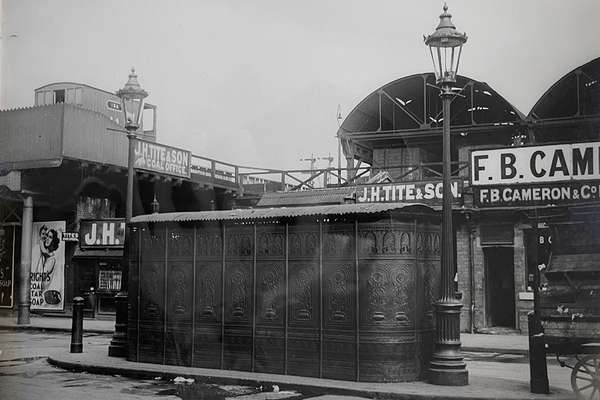
Records from the 1930s describe attempts to police sexual activities between men in public toilets – and officers’ thoughts on when to enforce the rules.