In pictures
The causes of the American Revolution
Following over a decade of growing dissent, on 4 July 1776, Britain’s American colonies declared independence and formed a new nation: the United States of America. Our records chart this rising tension, as Britain's colonies inched towards rebellion and separation.
Important information
This story highlights documents that relate to colonial histories of exploitation perpetrated during the transatlantic slave trade, and against Indigenous people of North America. One record, 'The Dunmore Proclamation', includes archaic and racist language.
The Stamp Act

- Date
- 22 March 1765
- Catalogue reference
- YHL/PO/PU/1/1765/5G3n11
Facing debt from the Seven Years War (1756–1763), the British government reasoned that its expensive and expanding North American colonies should contribute more to their upkeep.
In the nearly 200 years since British colonists had first settled in North America, they had enjoyed considerable autonomy. Although subjects of the British crown, they were not represented by MPs in Westminster. Instead, colonists were represented at a local level by colonial councils, presided over by governors – and paid their taxes locally in return.
The Stamp Act threatened to change this. It levied taxes, via mandatory stamps on various kinds of everyday paperwork, ranging from legal documents to newspapers. Unlike other colonial taxes, these duties were to be paid directly to the government in Britain. This 'taxation without representation' caused an uproar in the Thirteen Colonies within North America.
Grant of land near the Mohawk River to Sir William Johnson

- Date
- June 1765
- Catalogue reference
- MPQQ 1/29
Indigenous people and European colonists coexisted uneasily in colonial North America. As Britain’s Thirteen Colonies established themselves firmly on America’s Atlantic coastline, colonists sought new lands further west – and began trying to displace Indigenous nations in pursuit of those opportunities.
This record represents the sale of land on the Mohawk River, in upstate New York, from members of the Mohawk nation to the British colonial official William Johnson. Johnson was a key British liaison with Indigenous nations in the region, who also used his position as Superintendent of Indian Affairs to secure land and resources for himself.
After 1763, King George III ordered that colonists must not settle lands further west than the Appalachian Mountains. This attempt to limit colonists’ westward expansion became a major grievance towards the growing rebellion in British America.
Reported value of tea destroyed during the Boston Tea Party

- Date
- 16 February 1774
- Catalogue reference
- CO 5/247
In 1768, another unpopular set of Acts (the Townshend Acts) were issued, placing tariffs on various imports. After widespread unrest they were repealed in 1770, with one exception: the tariff on tea.
The Tea Act (1773) allowed the East India Company to sell tea directly into British America without paying tariffs. However, buyers in America would still need to pay the tariff imposed by the Townshend Acts.
Angry British-American colonists responded by preventing Company ships from unloading tea in American ports. On 16 December 1773, a group of dissatisfied Boston townspeople disguised in mock Mohawk outfits rushed aboard three ships in Boston and broke open the chests of tea, throwing it overboard.
The Company’s records, as reported here, valued the destroyed tea at £9,659 6s 4d – over £1.2M today. Such costly destruction represented a significant escalation in the American crisis.
Report of casualties from skirmishes at Lexington and Concord

- Date
- 19 April 1775
- Catalogue reference
- CO 5/769
To assert control, the British Government passed the 'Intolerable Acts' restricting the colonies' ability to trade and self-govern.
In late 1774, delegates from 12 British-American colonies met in the First Continental Congress. They rejected the legislation and underlined the colonies’ autonomy. Rebellious colonists began organising into armed militia groups.
On 19 April 1775, British general Thomas Gage ordered units in Boston to capture rebel military supplies at the nearby town of Concord. En route, at Lexington, they were confronted by local militia.
The British fought their way through to Concord, but were forced to retreat to Boston, harried all the way by a growing force of rebels. By the morning of 20 April, Boston was besieged. The American Revolutionary War had begun.
This British casualty report shows 62 killed and 157 wounded. Rebel casualties were estimated at 93.
The Dunmore Proclamation

- Date
- 7 November 1775
- Catalogue reference
- CO 5/1353
Colonial America’s economy was driven by enslaved labour, particularly in the southern colonies. Plantation owners enslaved hundreds of thousands of African people, in harsh conditions, to produce commodities like tobacco.
In 1775, an opportunity to reclaim their freedom came. In November colonists in Virginia rose up against their governor Lord Dunmore. He retreated to safety, but was urgently short on armed forces. In desperation he issued this proclamation offering freedom to any person enslaved by a rebel who might escape and fight for the British. Virginia's population was about 475,000, of which some 180,000 were enslaved.
Thousands of enslaved people seized the opportunity offered by the proclamation. For these Black Loyalists, life, liberty, and the pursuit of happiness, as proclaimed by American revolutionaries, was more than just rhetoric – it was a very real fight for freedom.
Common Sense by Thomas Paine

- Date
- 10 January 1776
- Catalogue reference
- TS 24/3/5
Even after the outbreak of armed conflict on the continent, many in British America still imagined a future within the British Empire, and dismissed ideas of independence as a dangerous pipedream. However, this pamphlet would change all that.
Thomas Paine’s Common Sense was published anonymously in January 1776. Promising 'simple facts, plain arguments, and common sense', it took the Thirteen Colonies by storm. Soon, thousands of British-Americans were considering Paine’s arguments against hereditary monarchy. Ordinary people were inspired by this vision for a new form of government: one that would separate America from Britain and create new, united states. 'Nothing can settle our affairs so expeditiously', Paine argued, 'as an open and determined declaration for independence'.
Original ‘Dunlap’ printing of the United States Declaration of Independence

- Date
- 4 July 1776
- Catalogue reference
- EXT 9/1
'We hold these Truths to be self-evident, that all Men are created equal'. By printing these words, the United States of America declared their independence.
This was the result of over a decade of dispute. British-Americans argued their fundamental rights and liberties were being undermined, that they were being unfairly taxed, and that British rule over the colonies was tyrannical. Britain believed its colonies were part of a global economic empire, and should be subordinate to the will of Parliament and the crown. Neither backed down, and by 1775 the American colonies were in open, armed rebellion.
On 4 July 1776, the Continental Congress issued this Declaration of Independence, blaming the King for colonial mismanagement and proclaimed, in the face of such 'Tyranny', they had no choice but to 'throw off' British rule by force and become a new nation: the United States of America.
Featured article
The story of
Ann Nevil: 'The most Notorious Malafactor Imaginable'
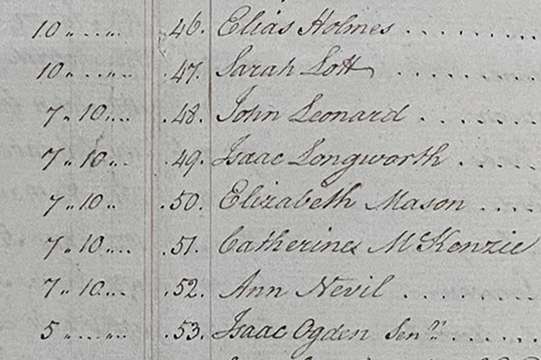
Ann Nevil's story is one of many extraordinary people whose lives were changed forever during the American Revolution.