







Teaching resource
What caused the 1832 Great Reform Act?
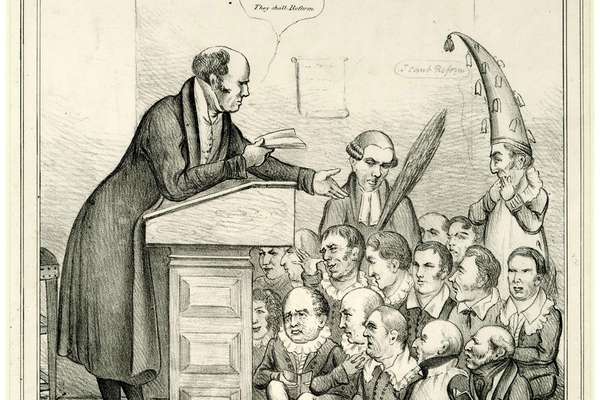
This lesson uses documents from 1830–31 to reveal how and why people demanded change to the voting system.
Teaching resource
Chartism was a working-class movement to gain political rights and influence that emerged in 1836 in London. It expanded rapidly across the country and was most active between 1838 and 1848. Use the original documents in this lesson to find out more about Chartism.

A Chartist meeting at Blackfriars Bridge from the Illustrated London News, 15 April 1848. Catalogue reference: ZPER 34/12 f.242
How and why did Chartists campaign for political rights in 19th-century Britain?

ADDRESS OF THE PEOPLE’S CHARTER UNION
FELLOW COUNTRYMEN,
The Object of our Union is the attainment of the People’s Charter–the recognition by the legislature of our right of political equality, with such provisions as seem necessary for the fair and efficient exercise of that right for the public good. That is to say: –our Union seeks the enactment of UNIVERSAL SUFFRAGE–the admission to the franchise of every man of twenty-one years of age, of sound mind and un-convicted of crime; EQUAL REPRESENTATION – the division of the United Kingdom into equal electoral districts; THE ABOLITION OF THE PROPERTY QUALIFICATION now required of Members of Parliament, and of all qualifications except the choice of the Electors; VOTE BY BALLOT – to prevent bribery and intimidation; ANNUAL PARLIAMENTS – to insure the responsibility of the members to their constituents; AND THE PAYMENT OF MEMBERS – rendered necessary by the abolition of the present property qualification. These are the points of the Charter which we desire to have established as the law of the land: for which purpose we claim the aid and co-operation of all those who agree with our opinions; for which purpose we entreat the attentive consideration of those who differ from us.
Few persons, we believe, deny our right to Suffrage-that inalienable right of every human being, the right of self-sovereignty, of an independent nature, an individuality which cannot be merged in or confused with individuality of another. The objections generally resolve themselves into questions of expediency.
We are told that–“The mass of the people are not fit for the franchise.” We answer – the exercise of the franchise will be their best education. – “There must be some test of intelligence.” Where will you have it? Reading and writing, what is called education, will not be sufficiently clear. They are not knowledge, but only the tools of knowledge. – “The difficulty of election.” A sufficient number of polling places will obviate that.–“The swamping of the intelligent by the unintelligent.” Then, as now, we believe, intelligence will know how to win its way. It will scarcely be intelligence else. – We entreat all classes of society to consider well these things, to judge if there be among their objections, either to the expediency of the immediate enactment of Universal Suffrage, or to the other provisions of the Charter, any of sufficient force to outweigh the broad justice of our claim. For ourselves we believe that, the heavens will not fall because justice is done; but that, justice must produce good results.
But we claim the Suffrage not merely as a right, but as a means of duty. We believe that, it is not good for a nation that any of its members should be without the political education which teaches a man to care for the interests and honour of his country. We believe that, only by the free and concurrent action of all its members is it possible for a nation to develop all its best capabilities, to reach its highest destination.
We disclaim all desire of injuring others, all sympathy with acts of outrage or disorder. We desire by peaceable and legal means, and by them alone, to alter and amend the institutions of the country: by establishing its legislative system upon the only true basis–the ascertained will of the majority, at once the guarantee of present order, and the promise of peaceful growth and happiness for the future.
We call upon all classes to aid us in this work. It is no class-work: but the business and duty of all. It is incumbent on both, the elector and the non-elector, the rich and the poor, the capitalist and the labourer, to consider seriously what measures may be most available to maintain public order and content, on the broad basis of universal justice-universal honesty, which is ever the best policy.
For the Council of the People’s Charter Union:
Thomas Cooper, President.
William Addiscott, Secretary.
17th April, 1848
Extracts from the handbook of the People’s Charter Union, 17 April 1848. Catalogue reference: HO 45/2410A

ADDRESS OF THE PEOPLE’S CHARTER UNION
FELLOW COUNTRYMEN,
The Object of our Union is the attainment of the People’s Charter–the recognition by the legislature of our right of political equality, with such provisions as seem necessary for the fair and efficient exercise of that right for the public good. That is to say: –our Union seeks the enactment of UNIVERSAL SUFFRAGE–the admission to the franchise of every man of twenty-one years of age, of sound mind and un-convicted of crime; EQUAL REPRESENTATION – the division of the United Kingdom into equal electoral districts; THE ABOLITION OF THE PROPERTY QUALIFICATION now required of Members of Parliament, and of all qualifications except the choice of the Electors; VOTE BY BALLOT – to prevent bribery and intimidation; ANNUAL PARLIAMENTS – to insure the responsibility of the members to their constituents; AND THE PAYMENT OF MEMBERS – rendered necessary by the abolition of the present property qualification. These are the points of the Charter which we desire to have established as the law of the land: for which purpose we claim the aid and co-operation of all those who agree with our opinions; for which purpose we entreat the attentive consideration of those who differ from us.
Few persons, we believe, deny our right to Suffrage-that inalienable right of every human being, the right of self-sovereignty, of an independent nature, an individuality which cannot be merged in or confused with individuality of another. The objections generally resolve themselves into questions of expediency.
We are told that–“The mass of the people are not fit for the franchise.” We answer – the exercise of the franchise will be their best education. – “There must be some test of intelligence.” Where will you have it? Reading and writing, what is called education, will not be sufficiently clear. They are not knowledge, but only the tools of knowledge. – “The difficulty of election.” A sufficient number of polling places will obviate that.–“The swamping of the intelligent by the unintelligent.” Then, as now, we believe, intelligence will know how to win its way. It will scarcely be intelligence else. – We entreat all classes of society to consider well these things, to judge if there be among their objections, either to the expediency of the immediate enactment of Universal Suffrage, or to the other provisions of the Charter, any of sufficient force to outweigh the broad justice of our claim. For ourselves we believe that, the heavens will not fall because justice is done; but that, justice must produce good results.
But we claim the Suffrage not merely as a right, but as a means of duty. We believe that, it is not good for a nation that any of its members should be without the political education which teaches a man to care for the interests and honour of his country. We believe that, only by the free and concurrent action of all its members is it possible for a nation to develop all its best capabilities, to reach its highest destination.
We disclaim all desire of injuring others, all sympathy with acts of outrage or disorder. We desire by peaceable and legal means, and by them alone, to alter and amend the institutions of the country: by establishing its legislative system upon the only true basis–the ascertained will of the majority, at once the guarantee of present order, and the promise of peaceful growth and happiness for the future.
We call upon all classes to aid us in this work. It is no class-work: but the business and duty of all. It is incumbent on both, the elector and the non-elector, the rich and the poor, the capitalist and the labourer, to consider seriously what measures may be most available to maintain public order and content, on the broad basis of universal justice-universal honesty, which is ever the best policy.
For the Council of the People’s Charter Union:
Thomas Cooper, President.
William Addiscott, Secretary.
17th April, 1848

‘Attack on the workhouse at Stockport’ from the Illustrated London News, 20 August 1842. Catalogue reference: ZPER 34/1 f.236

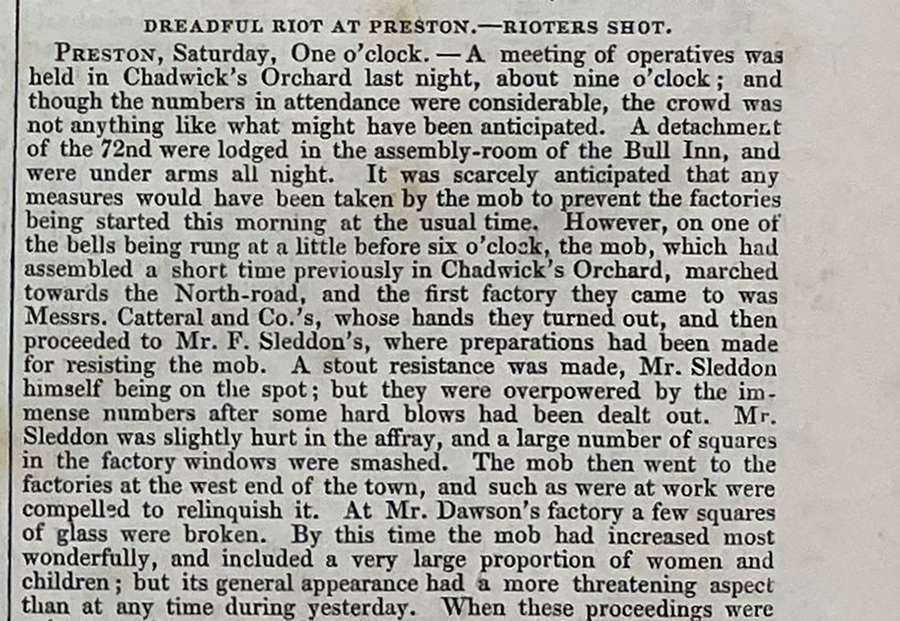
Dreadful Riot at Preston–Rioters shot
Preston, Saturday, one o’clock.—A meeting of operatives [workers] was held in Chadwick’s Orchard last night, about nine o’clock; and though the numbers in attendance were considerable, the crowd was anything like what might have been anticipated. A detachment of the 72nd were lodged in the assembly-room of the Bull Inn, and were under arms all night. It was scarcely anticipated that any measures would have been taken by the mob to prevent the factories being started this morning at the usual time. However, on one of the bells being rung at a little before six o’ clock, the mob, which had assembled at a short time previously in Chadwick’s Orchard, marched towards the North-Road, and the first factory they came to was Messrs, Catteral and Co.’s whose hands they turned out, and then proceeded to Mr. F. Sleddon’s where preparations had been made for resisting the mob. A stout resistance was made, Mr. Sleddon himself being on the spot; but they were overpowered by the immense numbers after some hard blows had been dealt out. Mr. Sleddon was slightly hurt in the affray, and a large number of squares in the factory windows were smashed. The mob then went to the factories at the west end of the town, and such as were at work were compelled to relinquish [give up] it. At Mr. Dawson’s factory a few squares of glass were broken. By this time the mob had increased most wonderfully, and included a very large proportion of women and children; but its general appearance had a more threatening aspect than at any time during yesterday.
Article on a riot in Preston from the ‘Illustrated London News’, 20 August 1842. Catalogue reference: ZPER 34/1

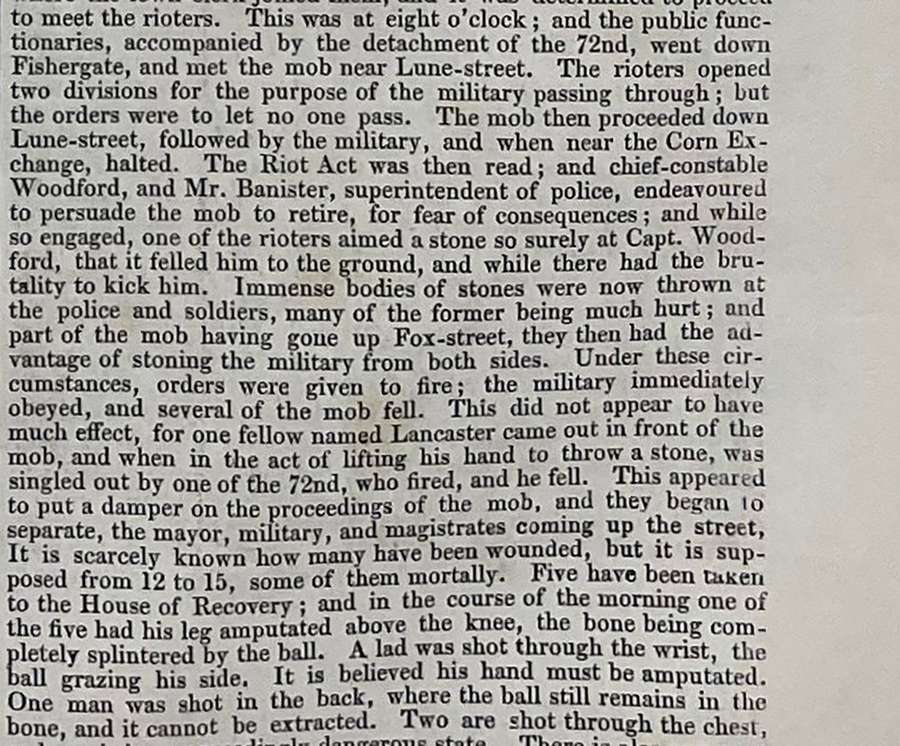
…
This was at eight o’clock; and the public functionaries [town officials], accompanied by the detachment of the 72nd [Regiment], went down Fishergate, and met the mob near Lune-lane. The rioters opened two divisions [parted] for the purpose of the military passing through; but the orders were to let no one pass. The mob the proceeded down Lune-street, followed by the military, and when near the Corn Exchange, halted. The Riot Act was then read; and chief-constable Woodford, and Mr. Banister, superintendent of police, endeavoured to persuade the mob to retire, for fear of consequences; and while so engaged, one of the rioters aimed a stone so surely at Capt. Woodford, that it felled him to the ground, and while there had the brutality to kick him. Immense bodies of stones were now thrown at the police and soldiers, many of the former being hurt; and part of the mob having gone up Fox-street, they then had the advantage of stoning the military from both sides. Under these circumstances, orders were given to fire; the military immediately obeyed, and several of the mob fell. This did not appear to have much effect, for one fellow named Lancaster came out in front of the mob, and when in the act of lifting his hand to throw a stone, was singled out by one of the 72nd, who fired, and he fell. This appeared to put a damper on the mob, and they began to separated, the mayor, military, and magistrates coming up the street. It is scarcely know how many have been wounded, but it is supposed from12 to 15, some of them mortally [killed]. Fire have been taken to the House of Recovery; and in the course of the morning one of the five had his leg amputated above the knee, the bone being completely splintered by the ball [metal shot]. A lad was shot through the wrist, the ball grazing his side. It is believed his hand must be amputated. One man was shot in the back, where the ball still remains in the bone, and cannot be extracted. Two are shot through the chest.

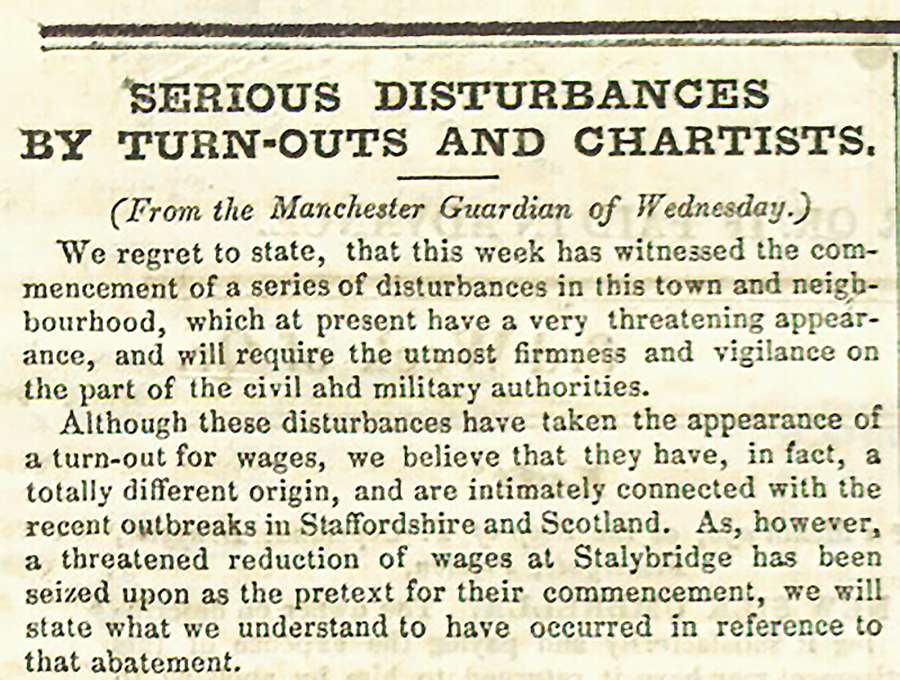
SERIOUS DISTURBANCES BY TURN-OUTS AND CHARTISTS
(From the Manchester Guardian of Wednesday.)
We regret to state, that this week has witnessed the commencement [beginning] of a series of disturbances in this town and neighbourhood, which at present have a very threatening appearance, and will require the utmost firmness and vigilance on the part of the civil and military authorities.
Although these disturbances have taken the appearance of a turn-out for wages, we believe that they have, in fact, a totally different origin, and are intimately connected with the recent outbreaks in Staffordshire and Scotland. As, however, a threatened reduction of wages at Stalybridge has been seized upon as the pretext [excuse] for their commencement, we will state what we understand to have occurred in reference to that abatement …
Extracts from an article about trouble in Manchester and its surroundings in ‘The Preston Chronicle and Lancashire Advertiser’, 13 August, 1842. Catalogue reference: HO 45/249A

On Sunday a very large meeting was held on Mottram Moor, where eight or ten thousand people are said to have been present, and at which, we believe, the extensive outrages committed on Monday and Tuesday were discussed and agreed upon; and their objects were stated to be the attainment of “the people’s charter,” and of “a fair day’s wage for a fair day’s work.”
On Monday morning the plans previously laid began to be rapidly developed. Messrs. Bayley’s spinners and weavers did not go to work; and, having been joined by reinforcements from Ashton and the neighbourhood, consisting, not only of spinners and weavers, but of colliers, [person who digs/ transports coal] labourers, and workpeople of all descriptions, they went in succession to all the mills in Stalybridge, and insisted on the steam engines being stopped, and the hands sent out of the mills. As is usual on such occasions, the mob were headed by a number of big lads, who made a great noise. These were followed by a few men and women, mixed indiscriminately together; and to these succeeded the main body. Not gaining access to the mills of Messrs. John and Jeremiah Lees so soon as they expected, the mob set to work, and ripped the planks out of the large doors. They also broke the lodge and mill windows. They got into the mill yard, and abused several of the hands; who, it appears, had been attempting to affect their escape by another door. Messrs. Cheetham’s hands, it appears, had not gone to their work at all, no doubt knowing what was to happen, and not choosing to have the trouble of being turned out. The ringleaders of the mob having insisted on the people from the various mills joining them, they soon formed a numerous body. …

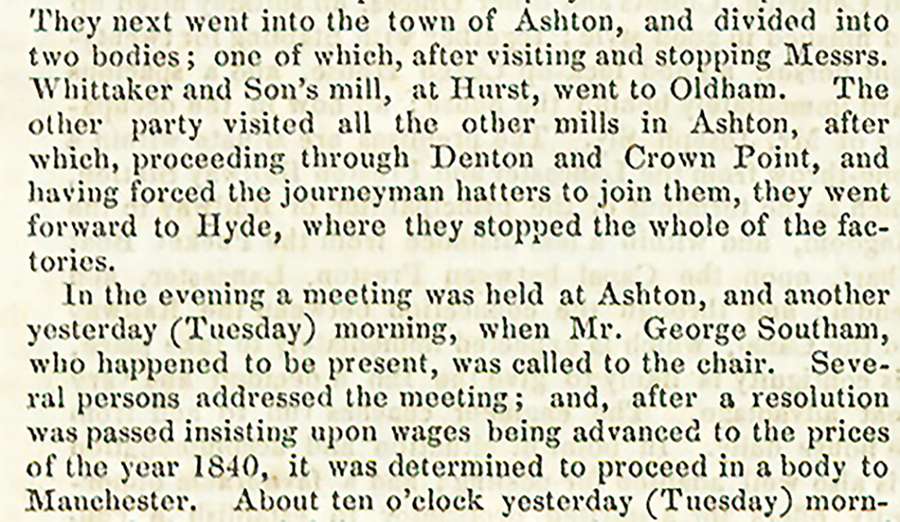
They next went into the town of Ashton, and divided into two bodies; one of which, after visiting and stopping Messrs. Whittaker and Son’s mill, at Hurst, went to Oldham. The other party visited all the other mills in Ashton, after which, proceeding through Denton and Crown Point, and having forced the journeyman [trained worker in a trade] hatters to join them, they went forward to Hyde, where they stopped the whole of the factories.
In the evening a meeting was held at Ashton, and another yesterday (Tuesday) morning, when Mr. George Southam, who happened to be present, was called to the chair. Several persons addressed the meeting; and, after a resolution was passed insisting upon wages being advanced to the prices of the year 1840, it was determined to proceed in a body to Manchester. …

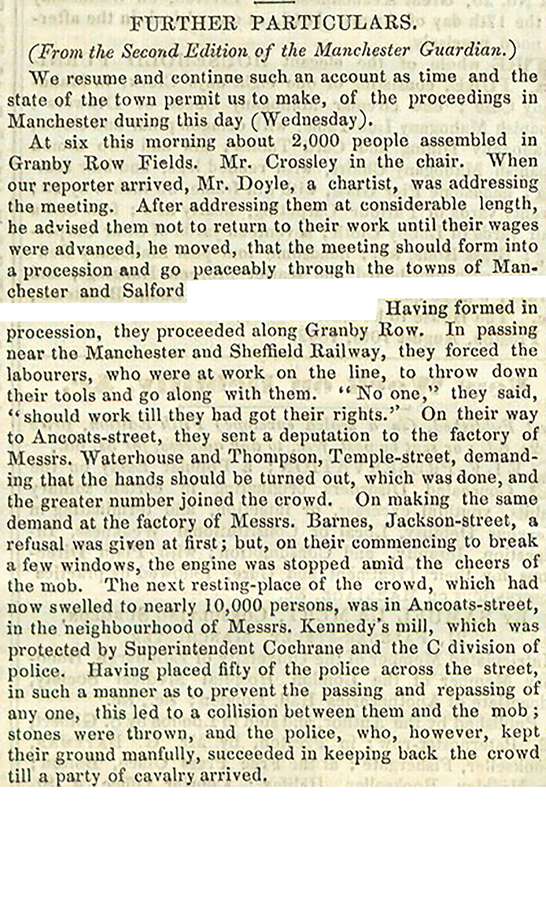
Further Particulars
(From the Second edition of the Manchester Guardian)
We resume and continue such an account as time and the state of the town permit us to make, of the proceedings in Manchester during this day (Wednesday).
At six this morning about 2,000 people assembled in Granby Row Fields. Mr. Crossley in the chair. When our reporter arrived, Mr. Doyle, a chartist, was addressing the meeting. After addressing them at considerable length, he advised them not to return to their work until their wages were advanced, he moved, that the meeting should form into a procession and go peaceably through the towns of Manchester and Salford
…
Having formed in procession, they proceeded along Granby Row. In passing near the Manchester and Sheffield Railway, they forced the labourers, who were at work on the line, to throw down their tools and go along with them. “No one,” they said, “should work till they had got their rights.” On their way to Ancoats-street, they sent a deputation to the factory of Messrs. Waterhouse and Thompson, Temple-street, demanding that the hands should be turned out, which was done, and the greater number joined the crowd. On making the same demand at the factory of Messrs. Barnes, Jackson-street, a refusal was given at first; but, on their commencing to break a few windows, the engine was stopped amid the cheers of the mob. The next resting-place of the crowd, which had now swelled to nearly 10,000 persons, was in Ancoats-street, in the neighbourhood of Messrs. Kennedy’s mill, which was protected by Superintendent Cochrane and the C division of police. Having placed fifty of the police across the street, in such a manner as to prevent the passing and repassing of any one, this led to a collision between them and the mob; stones were thrown, and the police, who, however, kept their ground manfully, succeeded in keeping back the crowd till a party of cavalry arrived.
…
This shows a Chartist meeting held on Kennington Common, London. There was a platform for speakers to stand and address the crowd. A daguerreotype was an image created by a photographic process popular in 1840s and 1850s.

‘The meeting on Kennington Common-from a Daguerreotype’, the Illustrated London News, 15 April 1848. Catalogue reference: ZPER 34/12
This lesson uses sources from The National Archives to explore the Chartist movement. Before starting, it would be useful to ensure that students are familiar with key political terms:
The first source that students examine is an extract from the handbook of the People’s Charter Union to find out about the aims of the movement. The second source is a cartoon from the Illustrated London News which shows the ‘Attack on the workhouse at Stockport’ in 1842. The source prompts students to consider the link between dissatisfaction with the New Poor Law and support for Chartism.
Next, students look at two extracts from an article in the Illustrated London News about a riot in Preston in 1842. Here, they look at the response of the authorities to events and determine if these events were linked to the Chartist movement.
The fourth source concerns extracts from an article in The Preston Chronicle and Lancashire Advertiser about riots in Manchester and its surroundings. What is the link between the Chartist Charter and the demand for higher wages? These sources could also provide the opportunity to discuss the role of the press and how these events are reported.
The final source is an illustration showing a Chartist meeting on Kennington Common from the Illustrated London News in 1848. Students consider what it reveals about the supporters of the movement and the advantages and disadvantages of using visual evidence. Students can also use the image shown at the top of the lesson page as evidence to further explore the nature of this Chartist meeting.
You may want to split the lesson for students working individually or use the sources in paired/group work. Students should be encouraged to think about the limitations of looking at this evidence to evaluate any understanding of the Chartist movement.
AQA GCSE History: Britain: Power and the people: c1170 to the present day
AQA GCE History: The Age of Reform: Britain 1832–1885
Edexcel GCE History: Protest, agitation and parliamentary reform in Britain, c1780–1928
OCR GCE History: From Pitt to Peel: Britain 1783–1853
The Great Reform Act of 1832 delivered voting rights to the property-owning middle classes in Britain. However, many working men were disappointed that they could not vote.
Chartism was a working-class movement which emerged in 1836 in London. It expanded rapidly across the country and was most active between 1838 and 1848. The aim of the Chartists was to gain political rights and influence for the working classes. Their demands were widely publicized through their meetings and pamphlets. The movement got its name from the People’s Charter which listed its six main aims:
The Chartists presented three petitions to Parliament to make their six point charter law in 1839, 1842 and 1848. Each petition was rejected. The final Chartist petition of 1848, it was claimed, had six million signatures.
The Chartists planned to deliver it to Parliament after a peaceful mass rally on Kennington Common in London. According to the Illustrated London News on 15 April 1848, ‘One hundred and fifty thousand special constables, watchful for the preservation of order, have grasped their useless truncheons and have paraded the streets without meeting a foe’. 15,000 Chartists were said to have turned up. The demonstration was considered a failure and the rejection of this last petition marked the real decline of Chartism.
The petition itself was ridiculed and said to contain 1,975,496 names and many forgeries, including the signatures of Queen Victoria and Mr Punch. Chartist conventions continued until the 1850s but without mass support.
Opponents of the movement feared that Chartists were not just interested in changing the way Parliament was elected but really wanted a revolution. They also thought that the Chartists, who said they disapproved of violent protest, were in fact stirring up a wave of riots around the country.
On 4 November 1839, 5,000 men marched into Newport in Monmouthshire, and attempted to take control of the town. Led by three well-known Chartists: John Frost, William Jones and Zephaniah Williams, they gathered outside the Westgate Hotel, where the local authorities were temporarily holding a number of potential troublemakers. Troops protecting the hotel opened fire, killing at least 22 people, and brought the uprising to an abrupt end.
Support for Chartism peaked at times of economic depression and hunger, in 1839, 1842 and 1848. In 1842, for example there was rioting in Stockport, due to unemployment and near-starvation, the new union workhouse was attacked. Also, in Manchester workers protested against wage cuts, wanting ‘a fair day’s pay for a fair day’s labour’. The Plug Plots were a series of strikes in Lancashire, Yorkshire, the Midlands and parts of Scotland that took place in the summer of 1842. Workers removed the plugs from the boilers to bring factory machinery to a halt. Wage cuts were the main issue, but support for Chartism was also strong at this time. In 1848 as trade was still depressed and interest in political reform peaked again with news of revolution in France and a third Chartist petition was planned.
Chartism is often described as a working-class movement, but it had some middle-class supporters who were hoped it would promote education reform and teetotalism. It was not necessarily a revolt against industrialisation either. Many chartist supporters worked in the domestic industry as handloom weavers, stocking makers, shoemakers or carpenters, however, the latter two trades were not impacted by industrialisation at that point.
Although the Chartist movement ended without achieving its aims, the fear of civil unrest remained. Later in the century, many Chartist ideas were included in the Reform Acts of 1867 and 1884. At the time, the six-point charter proved too radical for a Parliament representing the middle and upper classes to make into law.
Possibly the movement could have made more progress had its leadership been more united. There were also regional differences in Chartist support, for example in Wales, Chartism was often associated with Nonconformist chapels but in Leeds some Chartists worked to enter local government. Despite its failure, it was a significant movement because it gave the working classes a sense of class consciousness and valuable political experience in campaigning, organising publicity and holding meetings.
Teaching resource
This lesson uses documents from 1830–31 to reveal how and why people demanded change to the voting system.
Education session
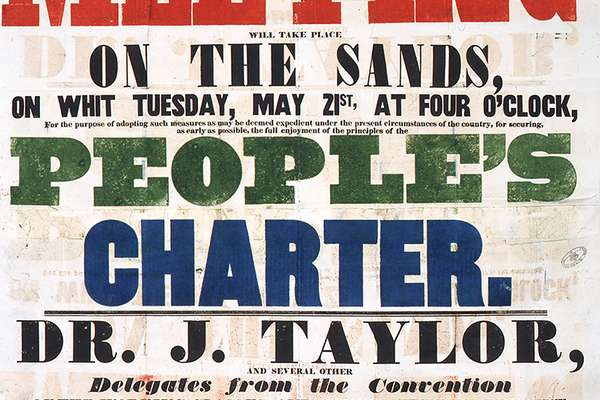
This session for key stage 5 asks the question: who were the Chartists?
Education session
This session explores the methods employed by the Chartists in the North East of England.