


youtube.com
What was the Great Reform Act 1832?
Watch this short video created by the Parliamentary Archives and Royal Holloway, University of London.
Teaching resource
This lesson uses original documents from 1830–31 to reveal the causes of the Great Reform Act of 1832. Find out how and why people demanded change to the voting system.

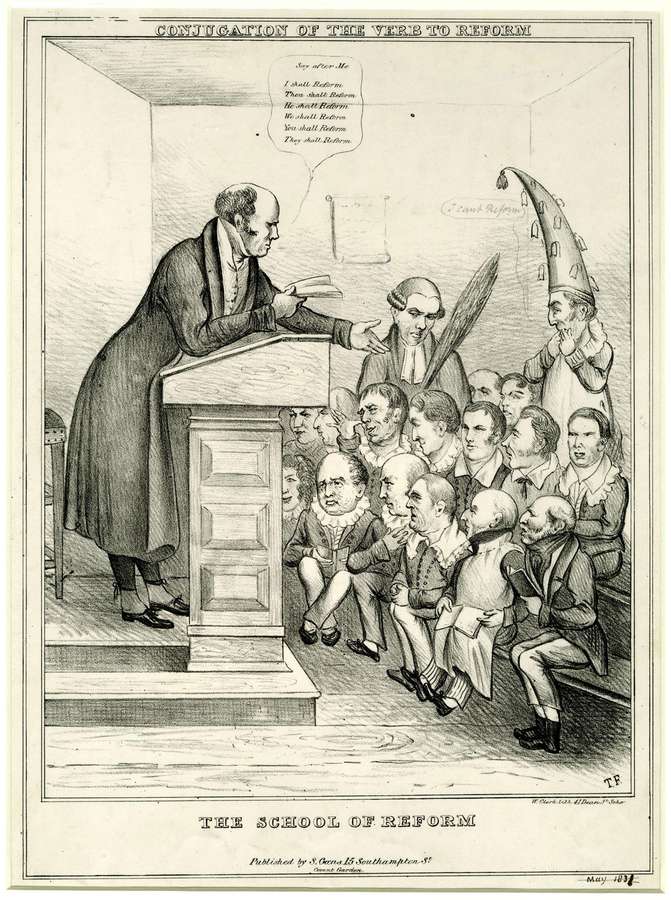
Lithograph entitled ‘Conjugation of the verb to Reform: The School of Reform’, May 1831.
How and why did people campaign for political rights in 19th century Britain?
This source shows the Prime Minister, Earl Grey, addressing his cabinet.

Conjugation of the Verb to Reform
[in a speech bubble above Prime Minister Grey's head]
'I shall Reform
Thou shall Reform
He shall Reform
We shall Reform
You shall Reform
They shall Reform'
The School of Reform
W. Clerk. lith 41 Dean St Soho
Published by S. Gans 15 Southampton St
Covent Garden
May 1838
Lithograph titled ‘Conjugation of the verb to Reform: The School of Reform’, printed in May 1831.
The people of South Shields and the surrounding neighbourhood held a meeting in their town hall on 31 December 1830. The purpose of the meeting was to discuss petitioning Parliament about reform. The town wanted to be able to elect their own MPs. The meeting was called by the magistrates and chaired by a local Justice of the Peace. They debated the wording of a petition and made it available in the town hall and in shops so that all classes of people could sign it. This is the petition that was adopted.
Because the property in the area was mostly leasehold, the people writing the petition did not have a vote. In the petition, they say that they don’t mean to push any particular ideas on to Parliament as to how the shortcomings of the voting system can best be fixed. They trust in the wisdom and justice of Parliament to provide the vote to people with enough intelligence to make a wise choice and enough property to choose how to vote independently.

The Humble Petition of the undersigned Merchants, Manufacturers, Ship owners and other Inhabitants of the Town of South Shields, and its neighbourhood,
Sheweth, [shows]
That the present State of the Representation, excluding from direct Influence, in the Election of Members of Parliament, very many of His Majesty's subjects, who sustain a great charge of direct Taxation, has thereby departed from the Principle of the Constitution, and has become in an especial degree, inadequate to the wants of the Country, in respect of the trading Community, inhibiting large Towns.
That the “Town of South Shields”, extending through the contiguous [neighbouring] Townships of South Shields and Westoe, contained in 1821, a Population of 16,500 Persons, exclusive of Seamen. That the Number, as your Petitioners believe, has of late years, greatly increased, and is chiefly engaged either in Manufactures, for which the Situation of the Town, and the Resources of its Neighbourhood, afford built [have] great Facilities, or in extensive Concerns of Shipping, there being 13 Graving Docks [these are dry docks where ships could be built and repaired], and 58,000 Tons of Shipping, owned by the Inhabitants of South Shields.
That your Petitioners humbly state their Persuasion, that the Trade and Shipping Interests of the Town, might have been more effectually [better] promoted, if your Petitioners, had been able to convey to the Legislature, the Facts and Arguments, collected by their own Experience, through the constitutional [Parliament], Organ of Representatives of their own Choice [M.P.s elected by them], and that, under every Event, the Decision of the Legislature [Parliament] , would be acted upon, with readier Alacrity [speed], if your Petitioners could feel satisfied, that such Decision had proceeded upon that full Consideration of their Interests, which it would be the Office and Duty of their local Representatives to procure [get].
That the County of Durham, wherein your Petitioners reside, returns from within the entire Body of the County, fewer Members [M.Ps], in the Ratio of its Population, than any other English County, namely 4 only, 2 for the County, and 2 for the City of Durham. That there is no Community between your Petitioners and the Electors of the City of Durham, in respect of Trade or local Interests, and that the Property in this Town and Neighbourhood, being, with an inconsiderable Exception, Leasehold under the Dean and Chapter of Durham, your Petitioners do not enjoy any influential Voice in the Return of the Members for the County; and it is the Belief of your Petitioners, that owning to these Circumstances, they labour [they suffer a greater lack of the right to vote.] under a more serious Destitution of the elective Franchise, than the Inhabitants of any other Town in Great Britain, of equal Trade and Magnitude [size].
That it is not the Intent of your Petitioners, to obtrude on your Honourable House, any Recommendation, as to particular Schemes, by which the Defects of the Representation may best be remedied; that they confide in the Wisdom and Justice of your Honourable House, so to regulate the elective Franchise, as to impart it more extensively to those of their Fellow Subjects, who possess enough of Intelligence, to form a judicious Choice, and enough of Property (the Fruit of Industry and Skill) to maintain that Choice with Independence. And your Petitioners most earnestly entreat [request] your Honourable House, to take such early Measures of Parliamentary Reform, as may redress [set right] these Grievances of your Petitioners, which they have humbly set forth, and promote the Concord [peaceful relations] , and Stability of the Empire.
And your Petitioner shall ever pray &c.
A petition from South Shields in County Durham, 31 August 1830. Catalogue reference: HO 44/24

THE
Friends of Liberty
Will dine at Mr. Kenmir’s,
Geo. III Inn, Gateshead, on
Tuesday, Aug. 24th, 1830,
IN
COMMEMORATION
OF THE RECENT
GLORIUS TRIUMPH OVER
TYRANNY IN FRANCE.
Dinner on the Table at 3 o’ Clock in the Afternoon.
Tickets to be had at Mr Kenmir’s Bar, and W. Stephenson’s
Shop, No 3, Bridge End, Gateshead – Price 5s. 6d. [5 Shillings and 6 pence]
Advertisement for a dinner in Gateshead in August 1830 to celebrate the July 1830 revolution in France. Catalogue reference: HO 44/21
According to this newspaper, there were 8 inquests into why people died during rioting in Bristol, ‘of which two died by excessive drinking, four were burnt in the Square, and two were shot. A very great number must have lost their lives, of which we can obtain no account’.

SIR CHAS. [Charles] WETHERELL’s ENTRY INTO BRISTOL. Awful and Calamitous Riots [disastrous riots] DESTRUCTION BY FIRE OF THE NEW GAOL- BRIDEWELL-GLOUCESTER COUNTY PRISON, (Lawford’s Gate) –THE BISHOP’s PALACE–THE TOLL HOUSES AND GATES THE MANSION-HOUSE–THE CUSTOM-HOUSE–THE EXCISE-OFFICE–AND UPWARDS OF FORTY HOUSES IN QUEEN-SQUARE, PRINCE’S-STREET, &c.
For several weeks there had been a feeling very general amongst many classes in this city – and a feeling shared equally by some of the most respectable individuals in the town – that the continued and perverse [stubborn] opposition of Sir Charles Wetherell to the Reform Bill, and the very gross and intemperate language [offensive language] in which he suffered himself to indulge, designating even the very highest official characters in the country as a set of “blundering, ignorant, unprincipled, and factious demagogues [leaders who appeal to emotion and prejudice],” would lead to a very strong manifestation [display] of feeling towards him on his entry as Recorder [job as senior judge] into this city. Nothing like violence was, however, we are quite sure, ever contemplated – and nothing like violence, we are equally sure, was evinced [shown] throughout the whole of the late deplorable scenes; – by any person who cares a straw about political principles. The injury that has been done, and the ruin that is now written in burning characters on one of the fairest portions of our city, were caused by the lowest creatures, who finding that the course of events indulged them in undisturbed control, gave loose to their passions; and becoming stimulated by plunder, maddened by liquor and rendered secure [made safe] by non-interposition [lack of anyone intervening], resembled rather demons than human beings.
Extracts from The Bristol Gazette on a riot in Bristol, 3 November 1831. Catalogue reference: HO 40/28

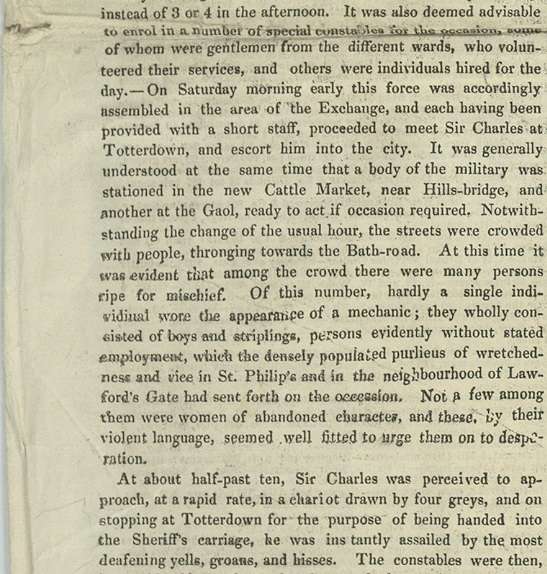
It was also deemed advisable to enrol in a number of special constables for the occasion, some of whom were gentlemen from the different wards [parts of the town], who volunteered their services, and others were individuals hired for the day. – On Saturday morning early this force was accordingly assembled in the area of the Exchange, and each having been provided with a short staff [long stick], proceeded to meet Sir Charles at Totterdown, and escort him into the city. It was generally understood at the same time that a body of the military was stationed in the new Cattle Market, near Hills-bridge, and another at the Gaol, ready to act if occasion required. Notwithstanding the change of the usual hour, the streets were crowded with people, thronging towards the Bath-road. At this time it was evident that among the crowd there were many persons ripe for mischief. Of this number, hardly a single individual wore the appearance of a mechanic [skilled worker using tools] ; they wholly consisted of boys and striplings [adolescents], persons evidently without stated employment, which the densely populated purlieus [area near] of wretchedness and vice in St. Philip’s and in the neighbourhood of Lawford’s Gate had sent forth on the occasion. Not a few among them were women of abandoned [not respectable] character, and these, by their violent language, seemed well fitted to urge them on to desperation.
At about half-past ten, Sir Charles was perceived to approach, at a rapid rate, in a chariot drawn by four greys, and on stopping at Totterdown for the purpose of being handed into the Sheriff’s carriage, he was instantly assailed [attacked] by the most deafening yells, groans, and hisses.
Further extract from The Bristol Gazette. Catalogue reference: HO 40/28

We firmly believe, from our own observation and from the concurrent [agreeing] testimony of numerous persons of all political principles present, that if it had not been for the very indiscreet zeal [energy] of some of the volunteer constables, no further disturbance would have taken place. True it is that some stones – we are sure they did not exceed half-a-dozen – had been thrown, and some very trifling injury had taken place. The constables, however, aided by some very young gentlemen, who loudly made a boast of their principles, charged into the crowd, and made themselves particularly busy in apprehending various individuals, whom they dragged into the Mansion-House, using their staves without mercy. The mob, who at this time were quite unarmed, raised a cry of “To the Back,” where piles of faggots [bundles of sticks] for firewood are usually kept, and in a short time about fifty, principally boys, returned with sticks. A kind of rescue was attempted, which ended in the rout of the mob [defeat of the crowd], and the constables proceeded back in triumph.
Further extract from The Bristol Gazette. Catalogue reference: HO 40/28

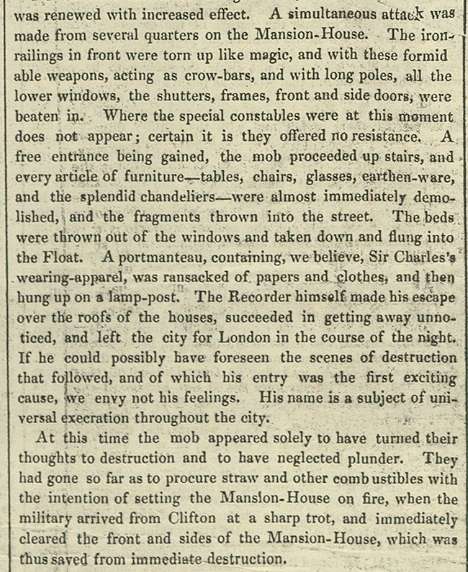
A simultaneous attack was made from several quarters on the Mansion-House. The iron-railings in front were torn up like magic, and with these formidable weapons, acting as crow-bars, and with long poles, all the lower windows, the shutters, frames, front and side doors, were beaten in. Where the special constables were at this moment does not appear; certain it is they offered no resistance. A free entrance being gained, the mob proceeded up stairs, and every article of furniture – tables, chairs, glasses, earthen-ware, and the splendid chandeliers – were almost immediately demolished, and the fragments thrown into the street. The beds were thrown out of the windows and taken down and flung into the Float. A portmanteau [large bag], containing, we believe, Sir Charles’s wearing-apparel, was ransacked of papers and clothes, and then hung up on a lamp-post. The Recorder himself made his escape over the roofs of the houses, succeeded in getting away unnoticed, and left the city for London in the course of the night. If he had possibly foreseen the scenes of destruction that followed, and of which his entry was the first exciting cause, we envy not his feeling. His name is a subject of universal execration [to be detested] throughout the city.
At this time the mob appeared solely to have turned their thoughts to destruction and to have neglected plunder. They had gone so far as to procure straw and other combustibles [things that could burn] with the intention of setting the Mansion-House on fire, when the military arrived from Clifton at a sharp trot, and immediately cleared the front and sides of the Mansion-House, which was thus saved from immediate destruction.
Further extract from The Bristol Gazette. Catalogue reference: HO 40/28

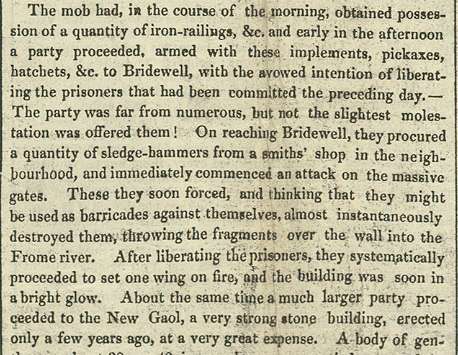
The mob had, in the course of the morning, obtained possession of a quantity of iron-railings, &c. and early in the afternoon a party proceeded, armed with these implements, pickaxes, hatchets, &c. to Bridewell, with the avowed [determined] intention of liberating the prisoners that had been committed the preceding day. – The party was far from numerous, but not the slightest molestation [harm] was offered them! On reaching Bridewell, they procured a quantity of sledge-hammers from a smith’s shop in the neighbourhood, and immediately commenced an attack on the massive gates. These they soon force, and thinking that they might be used as barricades against themselves, almost instantaneously destroyed them, throwing the fragments over the wall into the Frome River.
After liberating the prisoners, they systematically proceeded to set one wing on fire, and the building was soon in a bright glow. About the same time a much larger party proceeded to the New Gaol, a very strong stone building, erected only a few years ago, at a very great expense.
Further extract from The Bristol Gazette. Catalogue reference: HO 40/28

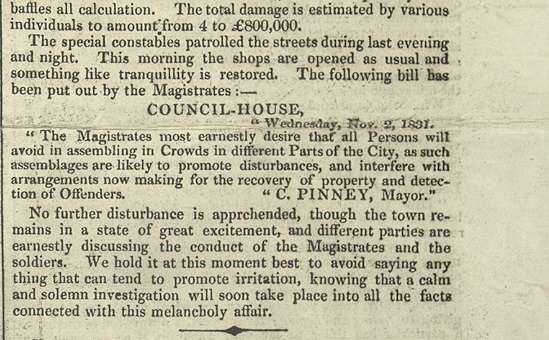
… The total damage is estimated by various individuals to amount from 4 [£400,000] to £800,000. The special constables patrolled the streets during the last evening and night. This morning the shops are opened as usual and something like tranquillity is restored. The following bill has been put out by the Magistrates.
COUNCIL-HOUSE
Wednesday, Nov. 2 1831
“The Magistrates most earnestly desire that all Persons will avoid assembling in Crowds in different Parts of the City, as such assemblages [gatherings] are likely to promote disturbances, and interfere with arrangements now making for the recovery of property and detection of Offenders. “C. PINNEY, Mayor.”
No further disturbance is apprehended [expected], though the town remains in a state of great excitement, and different parties are earnestly discussing the conduct of the Magistrates and the soldiers. We hold it at this moment best to avoid saying anything that can tend to promote irritation, knowing that a calm and solemn investigation will soon take place into all the facts connected with this melancholy [sad] affair.
Further extract from The Bristol Gazette. Catalogue reference: HO 40/28
This lesson uses sources from The National Archives to explore some of the context to the passage of the Great Reform Act of 1832. Before starting, it would be useful to ensure that students are familiar with key political terms: suffrage; ballot; representation; franchise; legislature; for example.
You could use Source 1, a lithograph entitled: ‘Conjugation of the verb to Reform: ‘The School of Reform’, printed in May 1831, as a starter activity. Define the term ‘Conjugation’ as the change that takes place in a verb to express person e.g. you, I, we, they. Nine of the thirteen members of Grey’s cabinet were members of the House of Lords when he was made Prime Minister in November 1830, determined to produce a reform bill that aimed to give more people a voice and representation in Parliament. Shown from right to left, the boys represent the Dukes of Cumberland and Gloucester, and Lord Eldon and Ellenborough (partly hidden by Grey’s desk), with Lord Londonderry on his left. In the second row are seven boys including Lord Wetherell, sitting next to Sir Robert Peel and thumbing his nose. On the right are Aberdeen and Newcastle. The Duke of Wellington (a strong Tory) weeps with the fingers of both hands in his mouth and his cap resembles a fool’s cap.
Source 2 is a petition from South Shields in County Durham, 31 August 1830. The townspeople chose to petition Parliament to demand the right to elect their own MPs. They also give their reasons why they want to be part of the political process. The source demonstrates the demand for political reform in the country especially in growing industrial towns. It is also worth discussing with students the tone of the petition, which is highly respectful. This source is quite challenging in comparison to the others; teachers may wish to break it down into sections for discussion. Words are defined in square brackets and phrases explained at the end of the transcript to support.
Source 3 is an advertisement for a dinner in Gateshead in August 1830 to celebrate the July 1830 revolution in France. This was part of wave of revolutions which swept across Europe. The July revolution in France was the second in France, since 1789. It marked the overthrow of Bourbon King Charles X who was replaced by Louise Philippe, Duke of Orleans as King. Louise Philippe was later forced to abdicate in the Revolution of 1848. It is important to explore with students why the government might have been concerned and gathered information about this meeting. How does it help to explain the growing demand for political reform in the 19th century?
Finally, Source 4 is a series of extracts from an article in the ‘The Bristol Gazette’ on a riot in Bristol, 3 November 1831. According to the newspaper, there were 8 inquests into why people died during the riot ‘of which two died by excessive drinking, four were burnt in the Square, and two were shot. A very great number must have lost their lives, of which we can obtain no account’. Here students can look at the response of the authorities to events and determine if these events were linked to the demand for political reform and changes to voting system. Why was Sir Charles Wetherell so disliked? What other factors caused discontent? The source could also provide the opportunity to discuss the role of the press and how these events were reported.
You may want to split the lesson for students working individually, or use the document sources in paired/group work. Students should be encouraged to think about the limitations of looking at this evidence to evaluate any understanding of the demand for reform to electoral system.
All sources are transcribed and have difficult language defined in square brackets.
AQA GCSE History: Britain: Power and the people: c1170 to the present day
The 1832 Reform Act became law in response to years of criticism of the electoral system from those outside and inside Parliament. It was known as the Great Reform Act, which basically gave the vote to middle class men, leaving working men and women disappointed.
Elections in Britain were neither fair nor representative. To vote, a person had to own property or pay certain taxes to qualify, which excluded most working-class people. There were also constituencies with several voters that elected two MPs to Parliament, such as Old Sarum in Salisbury. In these ‘rotten boroughs’, with few voters and no secret ballot, it was easy for those standing for election to buy votes. Industrial towns like Manchester or Birmingham, which had grown during the previous 80 years, had no Members of Parliament to represent them.
In 1831, the House of Commons passed a Reform Bill, but the House of Lords, dominated by the Tory party, defeated it. This was followed by riots and serious disturbances in London, Birmingham, Derby, Nottingham, Leicester, Yeovil, Sherborne, Exeter and Bristol.
The riots in Bristol were some of the worst seen in England in the 19th century. They began when Sir Charles Wetherall, who was opposed to the Reform Bill, came to open the Assize Court in his role as Recorder, or senior judge. Assize courts were held in the main county towns and presided over by visiting judges from the higher courts based in London. Public buildings and houses were set on fire; there was more than £300,000 of damage and 12 people died. Of 102 people arrested and tried, 31 were sentenced to death. Lieutenant-Colonel Brereton, the commander of the army in Bristol, was court-martialled.
There was a fear in government that unless there was some reform there might be a revolution instead. They looked to the July 1830 revolution in France, which overthrew King Charles X and replaced him with the more moderate King Louis-Philippe, who agreed to a constitutional monarchy. In Britain, King William IV lost popularity for standing in the way of reform.
The king agreed to create some new Whig peers to get the bill through parliament. When the House of Lords heard this, they agreed to pass the Reform Act. As result, 57 ‘rotten and pocket boroughs’ were removed and the new towns like Birmingham, Bradford, Leeds, and Sheffield, for example, were given the right to elect MPs, although constituencies were still of uneven size.
However, only men in the boroughs who owned property worth at least £10 could vote. In the counties only adult men owning property worth £2 a year and adult males renting land worth more than £50 a year could vote. Most working-class men were excluded from the vote owing to these property qualifications – which varied across the country depending upon house prices and only men who could afford to pay to stand for election could be MPs. All women were excluded. In effect most middle-class men gained the vote and some skilled craftsmen. This reform did not go far enough to silence all protest.
youtube.com
Watch this short video created by the Parliamentary Archives and Royal Holloway, University of London.
museums.bristol.gov.uk
Discover more sources from Bristol Museum on the Reform Riots in the city.