




















Teaching resource
Indian independence, part one
This set of documents allows key stage 4 and 5 students to explore the subject of Indian independence and partition in 1947. Part one covers the years to 1947.
Teaching resource
This collection of documents allows key stage 4 and 5 students to develop their own lines of historical enquiry on the subject of Indian independence and the partition of India. It covers the events of 1947.

Map titled 'India & Pakistan showing diagrammatically the position of the states'. Catalogue reference: CAB 21/2038
The background information of this resource and some of the sources contain references to physical and sexual violence.
What led to the partition of India in 1947?
You can discover more related documents in our Indian independence, part one collection.

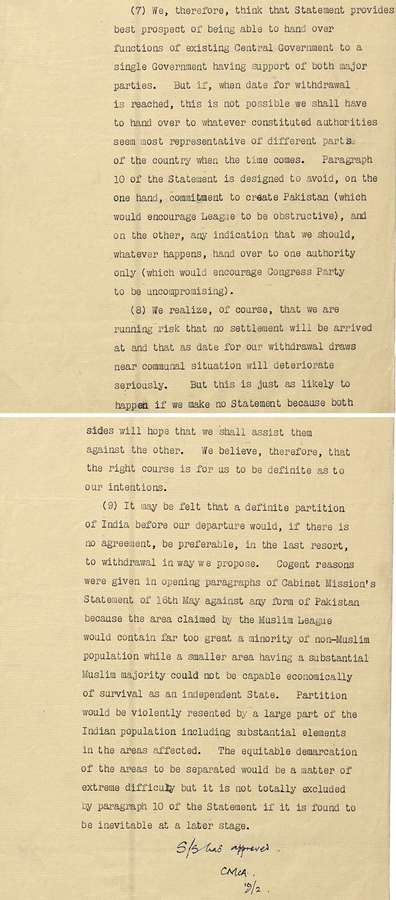
(7) We, therefore, think that Statement provides best prospect of being able to hand over functions of existing Central Government to a single Government having support of both major parties. But if, when date for withdrawal is reached, this is not possible we shall to hand over to whatever constituted authorities seem most representative of different of the country when the time comes. Paragraph 10 of the Statement is designed to avoid, on the one hand, commitment to create Pakistan (which will encourage League to be obstructive), and on the other, any indication that we should, whatever happens, hand over to one authority only (which would encourage Congress Party to be uncompromising).
(8) We realize, of course, that we are running risk that no settlement will be arrived at and that no settlement will be arrived at and that as date for our withdrawal draws near communal situation will deteriorate seriously. But this is just as likely to happen if we make no Statement because both sides will hope that we shall assist them against the other. We believe, therefore, that the right course is for us to be definite as to our intentions.
(9) It may be felt that a definite partition of India before our departure would, if there is no agreement, be preferable, in the last resort, to withdrawal in any way we propose. Cogent reasons were given in opening paragraphs of Cabinet’s Mission Statement of 16th May against any form of Pakistan because the area claimed by the Muslim League would contain far too great a minority of non-Muslim population while a smaller area having a substantial Muslim majority could not be capable economically of survival as an independent state. Partition would be violently resented by a large part of the Indian population including substantial elements in the area affected. The equitable demarcation of the areas to be separated would be a matter of extreme difficulty but it is not totally excluded by paragraph 10 of the statement if it is found inevitable at a later stage.
Secretary of State’s comments on India policy for the British Ambassador in Washington, 19 February 1947. Catalogue reference: FO 371/63529
Listen
We, therefore, think that Statement provides best prospect of being able to hand over functions of existing Central Government to a single Government having support of both major parties. But if, when date for withdrawal is reached, this is not possible we shall to hand over to whatever constituted authorities seem most representative of different of the country when the time comes. Paragraph 10 of the Statement is designed to avoid, on the one hand, commitment to create Pakistan (which will encourage League to be obstructive), and on the other, any indication that we should, whatever happens, hand over to one authority only (which would encourage Congress Party to be uncompromising).
We realize, of course, that we are running risk that no settlement will be arrived at and that no settlement will be arrived at and that as date for our withdrawal draws near communal situation will deteriorate seriously. But this is just as likely to happen if we make no Statement because both sides will hope that we shall assist them against the other. We believe, therefore, that the right course is for us to be definite as to our intentions.
It may be felt that a definite partition of India before our departure would, if there is no agreement, be preferable, in the last resort, to withdrawal in any way we propose. Cogent reasons were given in opening paragraphs of Cabinet’s Mission Statement of 16th May against any form of Pakistan because the area claimed by the Muslim League would contain far too great a minority of non-Muslim population while a smaller area having a substantial Muslim majority could not be capable economically of survival as an independent state. Partition would be violently resented by a large part of the Indian population including substantial elements in the area affected. The equitable demarcation of the areas to be separated would be a matter of extreme difficulty but it is not totally excluded by paragraph 10 of the statement if it is found inevitable at a later stage.

TOP SECRET
[INDIAN POLICY]
[FINAL DRAFT STATEMENT]
…
10. After months of hard work by the Cabinet Mission a great measure of agreement was obtained as to the method by which the constitution should be worked out. This was embodied in their statements of May last. His Majesty’s Government there agreed to recommend to Parliament a constitution there worked out, in accordance with the proposals made therein, by a fully representative Constituent Assembly.
…
12. In regard to the Indian States, as was explicitly stated by the Cabinet Mission, His Majesty’s Government do not intend to hand over their powers and obligations under paramountcy to any Government of British India. It is not intended to bring paramountcy , as a system, to a conclusion earlier than the date of the final transfer of power, but it is contemplated that for the intervening period the relations of the Crown with individual states may be adjusted by agreement.
Draft statement of Britain’s India policy prepared by the Secretary of State for India for the British Ambassador in Washington, 20 February 1947. Catalogue reference: FO 371/63529
Listen
TOP SECRET
[INDIAN POLICY]
[FINAL DRAFT STATEMENT]
It has long been the policy of successive British Governments to work towards the realisation of self government in India. In pursuance of this policy an increasing measure of responsibility has been devolved on Indians and today the civil administration and the Indian Armed Forces rely to a very large extent on Indian civilians and officers. In the constitutional field the Acts of 1919 and 1935 passed by the British Parliament each represented a substantial transfer of political power. In 1940 the Coalition Government recognised the principle that Indians should themselves frame a new constitution for a fully autonomous India, and in the offer of 1942 they invited them to set up a Constituent Assembly for this purpose as soon as the war was over.
His Majesty’s Government believe this policy to have been the right and in accordance with sound democratic principles. Since they came into office, they have done their utmost to carry it forward to its fulfilment. The declaration of the Prime Minister of 15th March last which met with general approval in Parliament and the country, made it clear that it was for the Indian people themselves to chose their future status and constitution and that in the opinion of Her Majesty’s Government the time had come for responsibility for government of India to pass into Indian hands.
The Cabinet Mission which was sent to India last year spent over three months in consultation with Indian leaders in order to help them agree upon a method for determining the future constitution of India, so that the transfer of power might be smoothly and rapidly effected. It was only when it seemed clear that without some initiative from the Cabinet Mission agreement was unlikely to be reached that they put forward proposals themselves.
These proposals, made public in May last, envisaged that the future constitution of India should be settled by Constituent Assembly composed, in the manner suggested therein, of representatives of all communities and interests in British India and of the Indian States.
Since the return of the Mission an Interim Government has been set up at the centre composed of the political leaders of the major communities exercising wide powers within the existing constitution. In all the Provinces Indian Governments responsible to Legislatures are in office.
It is with great regret that His Majesty’s Government find there are still differences among Indian parties which are preventing the Constituent Assembly from functioning as it was intended that it should. It is the essence of the plan that the Assembly should be fully representative.
His Majesty’s Government desire to hand over their responsibility to authorities established by a constitution approved by all parties in India in accordance with the Cabinet Mission’s plan, but unfortunately there is at present no clear prospect that such a constitution and such authorities will emerge. The present state of uncertainty is fraught with danger and cannot be indefinitely prolonged. His Majesty’s Government wish to make it clear that it is their definite intention to effect the transference of power into responsible India hands by a date no later than June 1948.
…
After months of hard work by the Cabinet Mission a great measure of agreement was obtained as to the method by which the constitution should be worked out. This was embodied in their statements of May last. His Majesty’s Government there agreed to recommend to Parliament a constitution there worked out, in accordance with the proposals made therein, by a fully representative Constituent Assembly. But if it should appear that such a constitution will not have been worked out by a fully representative Assembly before the time mentioned in paragraph 7, His Majesty’s Government will have to consider to whom the powers of the Central Government in British India should be handed over, on the due date, whether as a whole to some form of central government for British India or in some areas to the existing Provincial governments, or in such other way as may seem most reasonable and in the best interests of the Indian people.
…
In regard to the Indian States, as was explicitly stated by the Cabinet Mission, His Majesty’s Government do not intend to hand over their powers and obligations under paramountcy to any Government of British India. It is not intended to bring paramountcy , as a system, to a conclusion earlier than the date of the final transfer of power, but it is contemplated that for the intervening period the relations of the Crown with individual states may be adjusted by agreement.

U.S. PRESS LAUDS DECISION ON INDIA.
WASHINGTON –The British decision to withdraw completely from India by June, 1948, has been lauded generally in the U.S. press as an epoch-making pronouncement placing the responsibility for the solution of India’s internal problems unequivocally in the hands of the Indian leaders.
Widespread comment emphasised the necessity for agreement between the two major factions in India end expressed hope that the British decision would prod the Indian leaders to an agreement among themselves.
The NEW YORK HERALD TRIBUNE said:
“Attlee’s announcement that the British were determined to withdraw from India whether or not a new constitution could be agreed upon by the Indians, is a truly momentous event. It marks a breach with the older world that is more striking than anything that has occurred since World War One revolutionised Europe. A new nation, whose potentialities can only be guessed at, is rising in Asia–in a plastic Asia that may yet, in sure hands, be shaped into a mould for the future of the world.
“The British might easily have lingered on in India, playing off Hindu against Moslem, prince against peasant, presiding over a tense and costly stalemate in the interests of imperial prestige. By refusing this role—despite the temptations which it must have offered to a government under great pressure from within and without the country–Attlee and his colleagues have been statesmanlike. And the British people discarding the trappings of imperialism–which would have seemed shabby in the cold , cruel light of this post-war dawn–have taken on a new dignity and a new moral strength, which multiplies the respect they have won by courage in the war and patience under the privations of peace.”
The CINCINNATI ENQUIRER said:
“The Attlee commitment does not promise a united India, as originally contemplated. It clearly leaves the way open to three Indian states–a predominately Hindu India, a separate state embracing the heavily Moslem areas, and a scattered agglomeration of native states ruled by princes. And that is what a self-governing India will be, in June of next year, unless meantime the several factions can reach agreement on the constitution of a single Indian confederation with a central government in common…
“Attlee and his colleagues can very properly take the position that a union of division in India is not their affair. They have tried hard to get the Indian factions to join in drafting a single constitution. Agreement has proved impossible. It is logically the responsibility of the Indians to find the basis for unity within their own number.”
THE NEW YORK TIMES said:
“Every passing day should now crowd the opposing Indian leaders closer to some compromise. It may be that the Moslems themselves can modify (Moslem leader) Jinnah’s recalcitrant attitude. There are signs that some of them are trying to do so. A position which is still politically expedient now may become untenable a year from now. Nehru may be shrewd enough to increase his inducements for Moslem collaboration. It is certain India cannot build her independence on a deadlock. Independence with no ability to control it and no power to maintain it promises only catastrophe.”
Round up of American press reaction to Britain’s decision to leave India, 28 February 1947. Catalogue reference: FO 371/63529
Listen
U.S. PRESS LAUDS DECISION ON INDIA.
WASHINGTON –The British decision to withdraw completely from India by June, 1948, has been lauded generally in the U.S. press as an epoch-making pronouncement placing the responsibility for the solution of India’s internal problems unequivocally in the hands of the Indian leaders.
Widespread comment emphasised the necessity for agreement between the two major factions in India end expressed hope that the British decision would prod the Indian leaders to an agreement among themselves.
The NEW YORK HERALD TRIBUNE said:
“Attlee’s announcement that the British were determined to withdraw from India whether or not a new constitution could be agreed upon by the Indians, is a truly momentous event. It marks a breach with the older world that is more striking than anything that has occurred since World War One revolutionised Europe. A new nation, whose potentialities can only be guessed at, is rising in Asia–in a plastic Asia that may yet, in sure hands, be shaped into a mould for the future of the world.
“The British might easily have lingered on in India, playing off Hindu against Moslem, prince against peasant, presiding over a tense and costly stalemate in the interests of imperial prestige. By refusing this role—despite the temptations which it must have offered to a government under great pressure from within and without the country–Attlee and his colleagues have been statesmanlike. And the British people discarding the trappings of imperialism–which would have seemed shabby in the cold , cruel light of this post-war dawn–have taken on a new dignity and a new moral strength, which multiplies the respect they have won by courage in the war and patience under the privations of peace.”
The CINCINNATI ENQUIRER said:
“The Attlee commitment does not promise a united India, as originally contemplated. It clearly leaves the way open to three Indian states–a predominately Hindu India, a separate state embracing the heavily Moslem areas, and a scattered agglomeration of native states ruled by princes. And that is what a self-governing India will be, in June of next year, unless meantime the several factions can reach agreement on the constitution of a single Indian confederation with a central government in common…
“Attlee and his colleagues can very properly take the position that a union of division in India is not their affair. They have tried hard to get the Indian factions to join in drafting a single constitution. Agreement has proved impossible. It is logically the responsibility of the Indians to find the basis for unity within their own number.”
THE NEW YORK TIMES said:
“Every passing day should now crowd the opposing Indian leaders closer to some compromise. It may be that the Moslems themselves can modify (Moslem leader) Jinnah’s recalcitrant attitude. There are signs that some of them are trying to do so. A position which is still politically expedient now may become untenable a year from now. Nehru may be shrewd enough to increase his inducements for Moslem collaboration. It is certain India cannot build her independence on a deadlock. Independence with no ability to control it and no power to maintain it promises only catastrophe.”

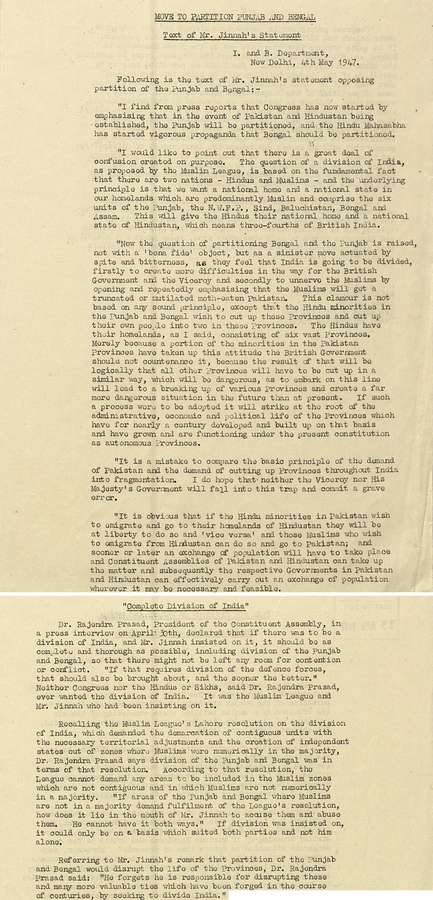
MOVE TO PARTITION PUNJAB AND BENGAL
Text of Mr. Jinnah’s Statement
I and B. Department,
New Delhi, 4th May, 1947
Following is the text of Mr. Jinnah’s statement opposing partition of the Punjab and Bengal:-
”I find from press reports that Congress has now started by emphasising that in the event of Pakistan and Hindustan being established, the Punjab will be partitioned, and the Hindu Mahasabha has started vigorous propaganda that Bengal should be partitioned.
”I should like to point out that there is a great deal of confusion created on purpose. The question of a division of India, as proposed by the Muslim League, is based on the fundamental fact that there are two nations- Hindus and Muslims- and the underlying principle is that we want a national home and a national state in our homelands which are predominately Muslim and compromise the six units of the Punjab, the N.W.F.P., Sind, Baluchistan, Bengal and Assam. This will give the Hindus their national home and a national state of Hindustan, which means three-fourths of British India.
”Now the question of partitioning Bengal and the Punjab is raised, not with a ‘bona fide’ object, as a sinister move actuated by spite and bitterness, as they feel that India is going to be divided, firstly to create more difficulties in the way for the British Government and the Viceroy and secondly to unnerve the Muslims by opening and repeatedly emphasising that the Muslims will get a truncated or mutilated moth-eaten Pakistan. This clamour is not based on any sound principle, except that the Hindu minorities in the Punjab and Bengal wish to cut up these provinces and cut up their own people into two in these Provinces. The Hindus have their homelands, as I have said, consisting of six vast Provinces. Merely because a proportion of the minorities in the Pakistan Provinces have taken up this attitude with the British Government should not countenance it, because the result of that will be logically that all other Provinces will have to be cut up in similar way, which will be dangerous, as to embark on this line will lead to a breaking up of various Provinces and create a far more dangerous situation in the future than at present. If such a process were to be adopted it will strike at the root of the administrative, economic and political life of the Provinces which have for nearly a century developed and built up on that basis and have grown as functioning under present constitution as autonomous provinces.
It is obvious that if the Hindu minorities in Pakistan wish to emigrate and go to their homelands of Hindustan they will be at liberty to do so and ‘vice versa’ and those Muslims who wish to emigrate from Hindustan can do so and go to Pakistan; and sooner or later an exchange of population will have to take place and Constituent Assemblies of Pakistan and Hindustan can take up the matter and subsequently the respective Governments in Pakistan and Hindustan can effectively carry out an exchange of population wherever it may be necessary and feasible.
…
“Complete Division of India”
Dr. Rajendra Prasad, President of the Constitituent Assembly, in press interview on April 30th, declared that if there was to be a division of India, and Mr. Jinnah insisted on it, it should be as complete and thorough as possible, including the division of the Punjab and Bengal, so that there might not be left any room for contention or conflict. “If that requires division of defence forces, that should also be brought about, and the sooner the better”. Neither Congress nor the Hindus or Sikhs, said Dr, Rajendra Prasad, ever wanted the division of India. It was the Muslim League and Mr. Jinnah who had been insisting on it.
... “If areas of the Punjab and Bengal where Muslims are not in a majority demand fulfilment of the League’s resolution, how does it lie in the mouth of Mr. Jinnah to accuse them and abuse them. He cannot have it both ways.” If division was insisted on, it could only be on a basis which suited both parties and not him alone.
Referring to Mr. Jinnah’s remark that partition of the Punjab and Bengal would disrupt the life of the Provinces, Dr Rajendra Prasad said: “He forgets he is responsible for disrupting these and many more valuable ties which have been forged in the course of centuries, by seeking to divide India.”
Speech by Muhammad Jinnah on the partition of Bengal and the Punjab, 4 May 1947. Catalogue reference: FO 371/63533
Listen
” I find from press reports that Congress has now started by emphasising that in the event of Pakistan and Hindustan being established, the Punjab will be partitioned, and the Hindu Mahasabha has started vigorous propaganda that Bengal should be partitioned.
” I should like to point out that there is a great deal of confusion created on purpose. The question of a division of India, as proposed by the Muslim League, is based on the fundamental fact that there are two nations- Hindus and Muslims- and the underlying principle is that we want a national home and a national state in our homelands which are predominately Muslim and compromise the six units of the Punjab, the N.W.F.P., Sind, Baluchistan, Bengal and Assam. This will give the Hindus their national home and a national state of Hindustan, which means three-fourths of British India.
” Now the question of partitioning Bengal and the Punjab is raised, not with a ‘bona fide’ object, as a sinister move actuated by spite and bitterness, as they feel that India is going to be divided, firstly to create more difficulties in the way for the British Government and the Viceroy and secondly to unnerve the Muslims by opening and repeatedly emphasising that the Muslims will get a truncated or mutilated moth-eaten Pakistan. This clamour is not based on any sound principle, except that the Hindu minorities in the Punjab and Bengal wish to cut up these provinces and cut up their own people into two in these Provinces. The Hindus have their homelands, as I have said, consisting of six vast Provinces. Merely because a proportion of the minorities in the Pakistan Provinces have taken up this attitude with the British Government should not countenance it, because the result of that will be logically that all other Provinces will have to be cut up in similar way, which will be dangerous, as to embark on this line will lead to a breaking up of various Provinces and create a far more dangerous situation in the future than at present. If such a process were to be adopted it will strike at the root of the administrative, economic and political life of the Provinces which have for nearly a century developed and built up on that basis and have grown as functioning under present constitution as autonomous provinces.
It is obvious that if the Hindu minorities in Pakistan wish to emigrate and go to their homelands of Hindustan they will be at liberty to do so and ‘vice versa’ and those Muslims who wish to emigrate from Hindustan can do so and go to Pakistan; and sooner or later an exchange of population will have to take place and Constituent Assemblies of Pakistan and Hindustan can take up the matter and subsequently the respective Governments in Pakistan and Hindustan can effectively carry out an exchange of population wherever it may be necessary and feasible.
…
“Complete Division of India”
Dr. Rajendra Prasad, President of the Constitituent Assembly, in press interview on April 30th, declared that if there was to be a division of India, and Mr. Jinnah insisted on it, it should be as complete and thorough as possible, including the division of the Punjab and Bengal, so that there might not be left any room for contention or conflict. “If that requires division of defence forces, that should also be brought about, and the sooner the better”. Neither Congress nor the Hindus or Sikhs, said Dr, Rajendra Prasad, ever wanted the division of India. It was the Muslim League and Mr. Jinnah who had been insisting on it.
Recalling the Muslim League’s Lahore resolution on the division of India, which demanded the demarcation of contiguous units with the necessary territorial adjustments and the creation of independent states out of zones where Muslims were numerically in the majority, Dr. Rajendra Prasad says the division of the Punjab and Bengal was in terms of that resolution. According to that resolution, the League cannot demand any areas to be included into Muslim zones which are not contiguous and in which Muslims are not numerically in a majority. “If areas of the Punjab and Bengal where Muslims are not in a majority demand fulfilment of the League’s resolution, how does it lie in the mouth of Mr. Jinnah to accuse them and abuse them. He cannot have it both ways.” If division was insisted on, it could only be on a basis which suited both parties and not him alone.
Referring to Mr. Jinnah’s remark that partition of the Punjab and Bengal would disrupt the life of the Provinces, Dr Rajendra Prasad said: “He forgets he is responsible for disrupting these and many more valuable ties which have been forged in the course of centuries, by seeking to divide India.”

Secret
21 May 1947
House of Commons
London S.W.1
My dear Prime Minister,
I have now had the opportunity of consulting my colleagues upon the terms of a possible settlement in India which you and the Viceroy put before us last night. As a result I am in a position to assure you that if those terms are made good, so that there is an effective acceptance of Dominion status for the several parts of a divided India, the Conservative Party will agree to facilitate the passage this session of the legislation necessary to confer Dominion status upon such several parts of India.
Believe me,
Yours sincerely,
Winston Churchill
Handwritten letter from Conservative leader Winston Churchill to Prime Minister Clement Attlee agreeing to support Indian independence. Catalogue reference: PREM 8/565
Listen
21st of May 1947
House of Commons
London S.W.1
Secret
My dear Prime Minister,
I have now had the opportunity of consulting my colleagues upon the terms of a possible settlement in India which you and the Viceroy put before us last night. As a result I am in a position to assure you that if those terms are made good, so that there is an effective acceptance of Dominion status for the several parts of a divided India, the Conservative Party will agree to facilitate the passage this session of the legislation necessary to confer Dominion status upon such several parts of India.
Believe me,
Yours sincerely,
Winston Churchill

Transcript
BROADCAST BY VICEROY
EVENTS LEADING TO DECISION
The following is the text of the broadcast which Lord Mountbatten, the Viceroy, made yesterday to the Indian people on the transfer of power to Indian hands:-
A statement will be read to you tonight giving the final decision of his Majesty’s Government as to the method by which power will be transferred from British to Indian hands. But before this happens I want to give a personal message to the people of India, as well as a short account of the discussions which I have held with the leaders of the political parties, and which have led up to the advice I tendered to His Majesty’s Government during my recent visit to London.
Since my arrival in India at the end of March I have spent almost every day in consultation with as many of the leaders and representatives of as many communities and interests as possible. I wish to say how grateful I am for all the information and helpful advice that they have given me. Nothing I have seen or heard in the past few weeks has shaken my firm opinion that with a reasonable measure of good will between the communities a unified India would be by far the best solution of the problem.
...
ORIGINAL PLAN
My first course, in all my discussions, was therefore to urge the political leaders to accept unreservedly the Cabinet mission plan of May 16, 1946. In my opinion that plan provides the best arrangement that can be devised to meet the interests of all the communities of India. To my great regret it has been impossible to obtain agreement either on the Cabinet mission plan or on any other plan that would preserve the unity of India. But there can be no question of coercing any large areas in which one community has a majority to live against their will under a Government in which another community has a majority—and the only alternative to coercion is partition.
...
POSITION OF SIKHS
We have given careful consideration to the position of the Sikhs. This valiant community forms about an eighth of the population of the Punjab, but they are so distributed that any partition of this province would inevitably divide them. All of us who have the good of the Sikh community at heart are very sorry to think that the partition of the Punjab which they themselves desire, cannot avoid splitting them to a greater or lesser extent. The exact degree of the split will be left to the boundary commission on which they will, of course, be represented.
...
The solution to this dilemma, which I put forward, is that his Majesty’s Government should transfer power now to one or two governments of British India each having Dominion status as soon as the necessary arrangements can be made. This I hope will be within the next few months. I am glad to announce that his Majesty’s Government have accepted this proposal and are already having legislation prepared for introduction in Parliament this session.
...
Whichever way the decision of the Indian people may go, I feel sure any British officials or officers who may be asked to remain for a while will do everything in their power to help implement that decision. His Majesty as well as his Government have asked me to convey to all of you in India their sincere good wishes for your future and the assurance of their continued good will.
I have faith in the future of India and am proud to be with you all at this momentous time. May your decisions be wisely guided and may they be carried out in the peaceful and friendly spirit of the Gandhi-Jinnah appeal.
MR. ATTLEE’S MESSAGE
A recording of the Viceroy’s message to the Indian people was broadcast in this country last night. It was introduced by the Prime Minister who said that the twofold purpose of the plan now put forward was to make possible the maximum degree of harmony and cooperation between the Indian political parties in order that the partition of India, if decided upon, might involve as little loss and suffering as possible, and secondly to enable the British Government to hand over its responsibilities in an orderly and constitutional manner at the earliest opportunity.
“I would make an earnest appeal to everyone to give calm and dispassionate consideration to these proposals,” Mr. Attlee went on. “It is, of course, easy to criticize them, but weeks of devoted work by the Viceroy have failed to find any alternative that is practicable. They have emerged from the hard facts of the situation in India”.
The Times reports on Lord Mountbatten’s radio broadcast on partition, 4 June 1947. Catalogue reference: CAB 21/2038
Times Media Limited News Licensing
Listen
BROADCAST BY VICEROY
EVENTS LEADING TO DECISION
The following is the text of the broadcast which Lord Mountbatten, the Viceroy, made yesterday to the Indian people on the transfer of power to Indian hands:-
A statement will be read to you tonight giving the final decision of his Majesty’s Government as to the method by which power will be transferred from British to Indian hands. But before this happens I want to give a personal message to the people of India, as well as a short account of the discussions which I have held with the leaders of the political parties, and which have led up to the advice I tendered to His Majesty’s Government during my recent visit to London.
Since my arrival in India at the end of March I have spent almost every day in consultation with as many of the leaders and representatives of as many communities and interests as possible. I wish to say how grateful I am for all the information and helpful advice that they have given me. Nothing I have seen or heard in the past few weeks has shaken my firm opinion that with a reasonable measure of good will between the communities a unified India would be far the best solution of the problem.
For more than a hundred years, 400,000,000 of you have lived together, and this country has been administered as a single entity. This has resulted in unified communications, defence, postal services and currency; an absence of tariffs and Customs Barriers; and the basis for an integrated political economy. My great hope was that communual differences would not destroy this.
ORIGINAL PLAN
My first course, in all my discussions, was therefore to urge the political leaders to accept unreservedly the Cabinet mission plan of May 16, 1946. In my opinion that plan provides the best arrangement that can be devised to meet the interests of all the communities of India. To my great regret it has been impossible to obtain agreement either on the Cabinet mission plan or on any other plan that would preserve the unity of India. But there can be no question of coercing any large areas in which one community has a majority to live against their will under a Government in which another community has a majority—and the only alternative to coercion is partition.
But when the Muslim League demanded the partition of India, Congress used the same arguments for demanding in that event the partition of certain provinces. To my mind this argument is unassailable. In fact neither side proved willing to leave a substantial area in which their community have a majority under the government of the other. I am, of course, just as much opposed to the partition of provinces as I am to the partition of India herself, and for the same basic reasons. For just as I feel there is an Indian consciousness which should transcend communal differences, so I feel there is a Punjabi and Bengali consciousness which has evoked a loyalty to their province. And so I felt it was essential that the people of India themselves should decide this question of partition.
The procedure for enabling them to decide for themselves whether they want the British to hand over power to one or two governments is set out in the statement which will be read to you. But there are one or two points on which 1 should like to add a note of explanation.
It was necessary, in order to ascertain the will of the people of the Punjab. Bengal, and part of Assam, to lay down boundaries between the Muslim majority areas and the remaining areas, but I want to make it clear that the ultimate boundaries will be settled by a boundary commission and will almost certainly not be identical with those which have been provisionally adopted.
…
POSITION OF SIKHS
We have given careful consideration to the position of the Sikhs. This valiant community forms about an eighth of the population of the Punjab, but they are so distributed that any partition of this province would inevitably divide them. All of us who have the good of the Sikh community at heart are very sorry to think that the partition of the Punjab which they themselves desire, cannot avoid splitting them to a greater or lesser extent. The exact degree of the split will be left to the boundary commission on which they will, of course, be represented.
The whole plan may not be perfect: but like all plans its success will depend on the spirit of good will with which it is carried out. I have always-felt that once it was decided in what way to transfer power, the transfer should take place at the earliest possible moment, but the dilemma was that if we waited until a constitutional set-up for all India was agreed, we should have to wait a long time, particularly if partition were decided on, whereas if we handed over power before the Constituent Assemblies had finished their work we should leave the country without a constitution.
The solution to this dilemma, which I put forward, is that his Majesty’s Government should transfer power now to one or two governments of British India each having Dominion status as soon as the necessary arrangements can be made. This I hope will be within the next few months. I am glad to announce that his Majesty’s Government have accepted this proposal and are already having legislation prepared for introduction in Parliament this session. As a result of these decisions the special function of the India Office will no longer have to be carried out, and some other machinery will be set up to conduct future relations between his Majesty’s Government and India.
I wish to emphasize that this legislation will not impose any restriction on the power of India as a whole or of the two new States if there is partition, to decide in the future their relationship to each other and to other member states of the British Commonwealth.
Thus the way is now open to an arrangement by which power can be transferred many months earlier than the most optimistic of us thought possible, and at the same time leave it to the people of British India to decide for themselves on their future, which is the declared policy of his Majesty’s Government.
INDIAN STATES
I have made no mention of the Indian States, since the new decisions of his Majesty’s Government are concerned with the transfer of power in British India.
If the transfer of power is to be effected in a peaceful and orderly manner, every single one of us must bend all his efforts to the task. This is no time for bickering, much less for the continuation in any shape or form of the disorders and lawlessness of the past few months. Do not forget what a narrow margin of food we are all working on. We cannot afford any toleration of violence. All of us are agreed on that.
Whichever way the decision of the Indian people may go, I feel sure any British officials or officers who may be asked to remain for a while will do everything in their power to help implement that decision. His Majesty as well as his Government have asked me to convey to all of you in India their sincere good wishes for your future and the assurance of their continued good will.
I have faith in the future of India and am proud to be with you all at this momentous time. May your decisions be wisely guided and may they be carried out in the peaceful and friendly spirit of the Gandhi-Jinnah appeal.
MR. ATTLEE’S MESSAGE
A recording of the Viceroy’s message to the Indian people was broadcast in this country last night. It was introduced by the Prime Minister who said that the twofold purpose of the plan now put forward was to make possible the maximum degree of harmony and cooperation between the Indian political parties in order that the partition of India, if decided upon, might involve as little loss and suffering as possible, and secondly to enable the British Government to hand over its responsibilities in an orderly and constitutional manner at the earliest opportunity.
“I would make an earnest appeal to everyone to give calm and dispassionate consideration to these proposals,” Mr. Attlee went on. “It is, of course, easy to criticize them, but weeks of devoted work by the Viceroy have failed to find any alternative that is practicable. They have emerged from the hard facts of the situation in India”.

[Left:]
Liberator
Spokesman of the Sikh People
New Delhi. Sunday September, 21, 1947
ALL THAT GLITTERS IS GOLD HERE
…
[Right:]
LET PATIALA LEAD THE PANTH TO GLORY
Sir,
The heinous and suicidal decision of the Punjab Boundary Commission has been implemented. To say the least, it is highly disappointing from the Sikh’s point of views- A clever British I lawyer has deprived us of our innumerable holy shrines, including our Mecca and Jerusalem, Sri Nankana Sahib, and more than 70 per cent, of our holdings just with one stroke of his pen. Can any Sikh tolerate this intolerable position? Most certainly not. The clarion call of our lost prestige and fatally wounded pride beckons all of us to stake our all now and here in the struggle either to win it or to meet a martyr’s death.
Hark, there is another voice. It is not so soul-inspiring as the first, but it is saner and seems more promising. We do not want war to lose it and thus be deprived of whatever is left with us. We want a war to win it and get our due share. Winning of war requires large, efficient and well-equipped army and vast resources. Our opponents no more consist of partially trained and poorly equipped fanatic mobs. They have now been reinforced by strong, well-trained and highly equipped army, whereas, our strength and our army are in the hands of those who dare not risk anything for us at this moment. Thus to fight our enemies now is to invite our own disaster.
It is no cowardice if we utilise this time in strengthening our hold at one point and then wait for a chance, which will not be in the distant future, to pounce upon those who dare stand between our due share and us.
Let us unanimously choose the Maharajadhiraj of Patiala the head of our community and I then put our demand before the Indian Union that the whole of the Punjabi speaking area of the East Punjab be joined with the territory of Patiala State. The Maharaja of Patiala should be preferred to other Sikh rulers for the simple reason that nearly a million of our stout bretheren are residing in that State. Our compact and constitutional union with them at this juncture will create a new sense of self confidence and security among our ranks and files who have been greatly unnerved by the recent sad happenings in the Punjab. We should solemnly assure the congress and our Hindu bretheren that the new State thus formed will remain within the Indian Union and guard its western frontiers stoutly and faithfully and that it will follow democratic principles.
The creation of a bigger Sikh State is a matter of urgent necessity, otherwise we will not be able either to stop the present haphazard mass migration of our men from the West Punjab, which is economically so disasterous to us or to rehabilitate to our national advantage those who have already come to this side. Only States with their vast resources and prestige, and not private bodies, however well organised these may be, can hope to tackle these mighty problems successfully.
May God grant us sufficient courage, determination, unity and above all constructive statesmanship to enable us to realise our dream of Khalistan.
Khalistan Zinda Bad. Jubbulpore.
AMAR SINGH.
The Liberator, a Sikh newspaper published in India (New Delhi), 21 September 1947. Catalogue reference: WO 208/3811
Listen
Liberator, Spokesmen of the Sikh People, Sunday September 21st, 1947:
ALL THAT GLITTERS IS GOLD HERE
…
LET PATIALA LEAD THE PANTH TO GLORY
Sir,
The heinous and suicidal decision of the Punjab Boundary Commission has been implemented. To say the least, it is highly disappointing from the Sikh’s point of views- A clever British I lawyer has deprived us of our innumerable holy shrines, including our Mecca and Jerusalem, Sri Nankana Sahib, and more than 70 per cent, of our holdings just with one stroke of his pen. Can any Sikh tolerate this intolerable position? Most certainly not. The clarion call of our lost prestige and fatally wounded pride beckons all of us to stake our all now and here in the struggle either to win it or to meet a martyr’s death.
Hark, there is another voice. It is not so soul-inspiring as the first, but it is saner and seems more promising. We do not want war to lose it and thus be deprived of whatever is left with us. We want a war to win it and get our due share. Winning of war requires large, efficient and well-equipped army and vast resources. Our opponents no more consist of partially trained and poorly equipped fanatic mobs. They have now been reinforced by strong, well-trained and highly equipped army, whereas, our strength and our army are in the hands of those who dare not risk anything for us at this moment. Thus to fight our enemies now is to invite our own disaster.
It is no cowardice if we utilise this time in strengthening our hold at one point and then wait for a chance, which will not be in the distant future, to pounce upon those who dare stand between our due share and us.
Let us unanimously choose the Maharajadhiraj of Patiala the head of our community and I then put our demand before the Indian Union that the whole of the Punjabi speaking area of the East Punjab be joined with the territory of Patiala State. The Maharaja of Patiala should be preferred to other Sikh rulers for the simple reason that nearly a million of our stout bretheren are residing in that State. Our compact and constitutional union with them at this juncture will create a new sense of self confidence and security among our ranks and files who have been greatly unnerved by the recent sad happenings in the Punjab. We should solemnly assure the congress and our Hindu bretheren that the new State thus formed will remain within the Indian Union and guard its western frontiers stoutly and faithfully and that it will follow democratic principles.
The creation of a bigger Sikh State is a matter of urgent necessity, otherwise we will not be able either to stop the present haphazard mass migration of our men from the West Punjab, which is economically so disasterous to us or to rehabilitate to our national advantage those who have already come to this side. Only States with their vast resources and prestige, and not private bodies, however well organised these may be, can hope to tackle these mighty problems successfully.
May God grant us sufficient courage, determination, unity and above all constructive statesmanship to enable us to realise our dream of Khalistan.
Khalistan Zinda Bad. Jubbulpore.
AMAR SINGH.

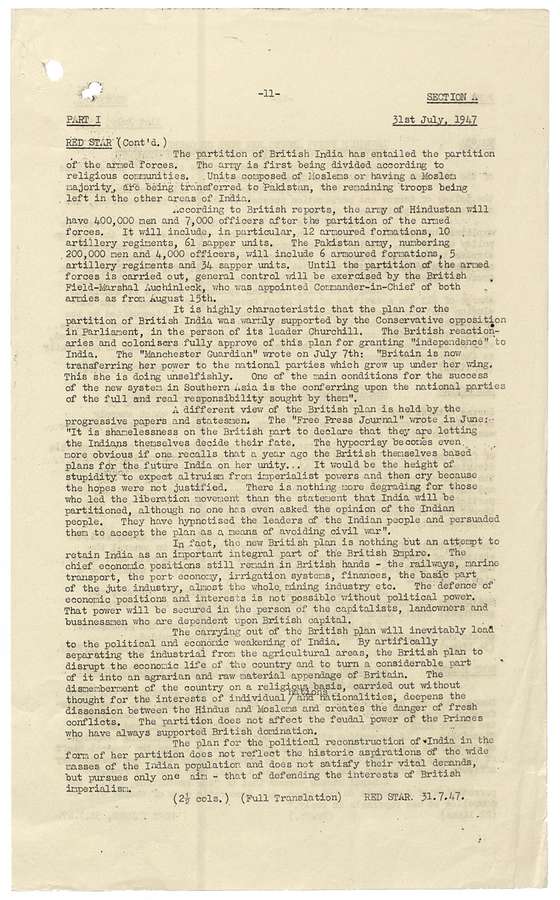
31st July 1947
RED STAR
The partition of British India has entailed the partition of the armed forces. The army is first being divided according to religious communities. Units composed of Muslims or having a Moslem majority, are being transferred to Pakistan, the remaining troops being left in the other areas of India.
According to British reports, the army of Hindustan will have 400,000 men and 7,000 officers after the partition of the armed forces. It will include, in particular, 12 armoured formations, 10 artillery regiments, 61 sapper units. The Pakistan army, numbering 200,000 men and 4,000 officers, will include 6 armoured formations, 5 artillery regiments and 34 sapper units. Until the partition of the armed forces is carried out, general control will be exercised by the British Field-Marshal Auchinleck, who was appointed Commander-in-Chief of both armies as from August 15th.
It is highly characteristic that the plan for the partition of British India was warmly supported by the Conservative opposition in Parliament, in the person of its leader Churchill. The British reactionaries and colonisers fully approve of this plan for granting “independence” to India, The “Manchester Guardian” wrote on July 7th: “Britain is now transferring her power to the national parties which grew up under her wing. This she is doing unselfishly. One of the main conditions for the success of the new system in Southern Asia is the conferring upon the national parties of the full and real responsibility sought by them”.
A different view of the British plan is held by the progressive papers and statesmen. The “Free Press Journal” wrote in June: “It is shamelessness on the British part to declare that they are letting the Indians themselves decide their fate. The hypocrisy becomes even more obvious if one recalls that a year ago the British themselves based plans for the future India on her unity… It would be the height of stupidity to expect altruism from imperialist powers and then cry because the hopes were not justified. There is nothing more degrading for those who led the liberation movement than the statement that India will be partitioned, although no one has even asked the opinion of the Indian people. They have hypnotised the leaders of the Indian people and persuaded them to accept the plan as o, means of avoiding civil war”.
In fact, the new British plan is nothing but an attempt to retain India as an important integral part of the British Empire, The chief economic positions still remain in British hands – the railways, marine transport, the port economy, irrigation systems, finances, the basic part of the jute, industry, almost the whole, mining industry etc. The defence of economic positions and interests is not possible without political power. That power will be secured in the person of the capitalists, landowners and businessmen who are dependent upon British capital.
The carrying out of the British plan will inevitably lead to the political and economic weakening of India. By artifically separating the industrial from the agricultural areas, the British plan to disrupt the economic life of the country and to turn a considerable part of it into an agrarian and raw material appendage of Britain. The dismemberment of the country on a religious basis, carried out without thought for the interests of individual nations and Nationalities, deepens the dissension between the Hindus and Moslems and creates the danger of fresh conflicts, The partition, does not affect the feudal power of the Princes who have always supported British domination.
The plan for the political reconstruction of India in the form of her partition does not reflect the historic aspirations of the wide masses of the Indian population and does not satisfy their vital demands, but pursues only one aim – that of defending the interests of British imperialism.
Translation of article from Red Star newspaper published in the Soviet Union, 31 July 1947. Catalogue reference: FO 371/63567
Listen
31st July 1947
RED STAR
The partition of British India has entailed the partition of the armed forces. The army is first being divided according to religious communities. Units composed of Muslims or having a Moslem majority, are being transferred to Pakistan, the remaining troops being left in the other areas of India.
According to British reports, the army of Hindustan will have 400,000 men and 7,000 officers after the partition of the armed forces. It will include, in particular, 12 armoured formations, 10 artillery regiments, 61 sapper units. The Pakistan army, numbering 200,000 men and 4,000 officers, will include 6 armoured formations, 5 artillery regiments and 34 sapper units. Until the partition of the armed forces is carried out, general control will be exercised by the British Field-Marshal Auchinleck, who was appointed Commander-in-Chief of both armies as from August 15th.
It is highly characteristic that the plan for the partition of British India was warmly supported by the Conservative opposition in Parliament, in the person of its leader Churchill. The British reactionaries and colonisers fully approve of this plan for granting “independence” to India, The “Manchester Guardian” wrote on July 7th: “Britain is now transferring her power to the national parties which grew up under her wing. This she is doing unselfishly. One of the main conditions for the success of the new system in Southern Asia is the conferring upon the national parties of the full and real responsibility sought by them”.
A different view of the British plan is held by the progressive papers and statesmen. The “Free Press Journal” wrote in June: “It is shamelessness on the British part to declare that they are letting the Indians themselves decide their fate. The hypocrisy becomes even more obvious if one recalls that a year ago the British themselves based plans for the future India on her unity… It would be the height of stupidity to expect altruism from imperialist powers and then cry because the hopes were not justified. There is nothing more degrading for those who led the liberation movement than the statement that India will be partitioned, although no one has even asked the opinion of the Indian people. They have hypnotised the leaders of the Indian people and persuaded them to accept the plan as o, means of avoiding civil war”.
In fact, the new British plan is nothing but an attempt to retain India as an important integral part of the British Empire, The chief economic positions still remain in British hands – the railways, marine transport, the port economy, irrigation systems, finances, the basic part of the jute, industry, almost the whole, mining industry etc. The defence of economic positions and interests is not possible without political power. That power will be secured in the person of the capitalists, landowners and businessmen who are dependent upon British capital.
The carrying out of the British plan will inevitably lead to the political and economic weakening of India. By artifically separating the industrial from the agricultural areas, the British plan to disrupt the economic life of the country and to turn a considerable part of it into an agrarian and raw material appendage of Britain. The dismemberment of the country on a religious basis, carried out without thought for the interests of individual nations and Nationalities, deepens the dissension between the Hindus and Moslems and creates the danger of fresh conflicts, The partition, does not affect the feudal power of the Princes who have always supported British domination.
The plan for the political reconstruction of India in the form of her partition does not reflect the historic aspirations of the wide masses of the Indian population and does not satisfy their vital demands, but pursues only one aim – that of defending the interests of British imperialism.

OUTWARD TELEGRAM
From the High Commissioner for the United Kingdom
To Commonwealth Relations Officer
15th September 1.30 p.m.
Priority Immediate Secret
My telegram No. 749 dated 13th September.
COMMUNAL DISTURBANCES
A) There was continued tension in rural areas of East Punjab but movement of refugees has continued satisfactorily.
B) In Ambala District situation was reported to have deteriorated greatly and in Rohtak district heavy killing was reported at one place (please treat this para. as confidential)
C) Mob of 25,000 people attacked village about 30 miles North of Delhi but was beaten off by military force.
D) Disturbed conditions continue in Jullundur, Hoshiarpur and Kapurthala.
E) Sikhs attacked Muslim refugee column near Amritsar and inflicted about 60 casualties on raiders (please treat name of communities concerned and number of casualties as confidential).
F) Sikhs attacked a refugee train between Jullundur and Kapurthala and inflicted about 70 casualties. Raiders also suffered heavy casualties.
First page of a report on the developing partition situation by the British High Commissioner in India, 15 September 1947. Catalogue reference: DO 133/59

…
Further extracts from a report on the developing partition situation by the British High Commissioner in India, 15 September 1947. Catalogue reference: DO 133/59

…
REACTION OF PARTIES TO AWARDS
First reactions came from ministers of Pakistan Government. Nishtar Ghazanfar Ali Khan and Chundrigar condemned it violently. Nishtar called it a parting kick by the British while Chundrigar said that decision might persuade Pakistan not to remain in the Commonwealth. Singha, leader of Christian Community in Pakistan, said it was a one sided award and most unfair to Pakistan. Reactions of Hindus and Sikhs in east Punjab to award is that the Non-Muslims did not have a fair deal and that it is a great betrayal of both sides. It is also reported that responsible circles in Delhi (presumably Hindu), consider that award relating to Chittagong Hill Tracts is untenable because Radcliffe exceeded his terms of reference in making proposals regarding them.
Extract from an earlier telegram report on the developing partition situation by the British High Commissioner in India, 19 August 1947. Catalogue reference: DO 133/59
Listen
OUTWARD TELEGRAM
From the High Commissioner for the United Kingdom
To Commonwealth Relations Officer
15th September 1.30 p.m.
Priority Immediate Secret
My telegram No. 749 dated 13th September.
COMMUNAL DISTURBANCES
PUNJAB Following is main information received during last two days regarding situation.
A) There was continued tension in rural areas of East Punjab but movement of refugees has continued satisfactorily.
B) In Ambala District situation was reported to have deteriorated greatly and in Rohtak district heavy killing was reported at one place (please treat this para. as confidential)
C) Mob of 25,000 people attacked village about 30 miles North of Delhi but was beaten off by military force.
D) Disturbed conditions continue in Jullundur, Hoshiarpur and Kapurthala.
E) Sikhs attacked Muslim refugee column near Amritsar and inflicted about 60 casualties on raiders (please treat name of communities concerned and number of casualties as confidential).
F) Sikhs attacked a refugee train between Jullundur and Kapurthala and inflicted about 70 casualties. Raiders also suffered heavy casualties.
…
CASUALTIES. Nehru at Press Conference on 12th (September) said that the official and non-official sources estimated number of deaths in Delhi disturbances roughly at 1,000. Official verified figures of casualties in disturbances in West and East Punjab were 15,000 killed but he felt these figures were very low and might be doubled or trebled.
REFUGEES.
A) Official figures on view in Government House Map room show that between 17th August and 7th September 325,000 Muslim refugees and 838, 000 non-Muslims had crossed over principal frontier posts between Pakistan and India. Nehru at Press Conference said that by September 12th one and a quarter million persons have come from West Punjab to East Punjab and similar number from East to West. Probably another half a million are waiting to be moved.
B) Delhi refugee figures obtained from Map room show that on 12th September there were 162,000 non-Muslim refugees of which only 12,000 were in refugee camps, the remainder staying with friends or relatives. On same date there were 90,000 Muslim refugees in about six camps and 14,000 more had been cleared from Delhi during the preceding two days. Nehru said nearly quarter of Delhi population now consisted of refugees.
EXCHANGE OF POPULATIONS. In his prayer speech on 13th (September) Gandhi said that transfer of population would mean nothing but greater misery and wished that India and Pakistan would unitedly make up their minds against transfer of population. In contrast Nehru said that they had not been thinking of exchange of population but it was forced upon them and they had to carry out their duty.
SIKHS. Nehru in press conference said that he found in reports, especially in foreign reports, statements made that blame, if not all a great part of it, lay with Sikhs. That was not fair to Sikhs, who had undoubtedly misbehaved themselves as others had misbehaved but to cast blame on Sikhs was completely wrong.
…
Extract from earlier telegram report dated 19th August 1947, (DO 133/59)
REACTION OF PARTIES TO AWARDS
First reactions came from ministers of Pakistan Government. Nishtar Ghazanfar Ali Khan and Chundrigar condemned it violently. Nishtar called it a parting kick by the British while Chundrigar said that decision might persuade Pakistan not to remain in the Commonwealth. Singha, leader of Christian Community in Pakistan, said it was a one sided award and most unfair to Pakistan. Reactions of Hindus and Sikhs in east Punjab to award is that the Non-Muslims did not have a fair deal and that it is a great betrayal of both sides. It is also reported that responsible circles in Delhi (presumably Hindu), consider that award relating to Chittagong Hill Tracts is untenable because Radcliffe exceeded his terms of reference in making proposals regarding them.

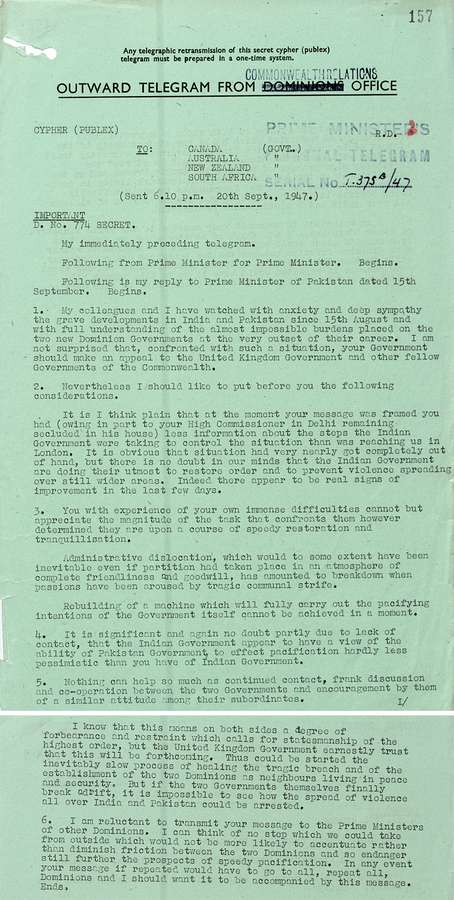
OUTWARD TELEGRAM FROM COMMONWEALTH RELATIONS OFFICE
TO: CANADA, AUSTRALIA, NEW ZEALAND, SOUTH AFRICA
(Sent 6. 10 p.m. 20th Sept., 1947)
IMPORTANT
D. No, 774 SECRET.
My immediately preceding telegram.
Following from Prime Minister for Prime Minister. Begins
Following is my reply to Prime Minister of Pakistan dated 15th September Begins.
Rebuilding of a machine which will fully carry out the pacifying intentions of the Government itself cannot be achieved in a moment.
4. It is significant and again no doubt partly due to lack of contact, that the Indian Government appear to have a view of the ability of Pakistan Government to effect pacification hardly less pessimistic than you have of Indian Government.
5. Nothing can help so much as continued contact, frank discussion and co-operation between the two Governments and encouragement by them of a similar attitude among their subordinates.
…
I know that this means on both sides a degree of forbearance and restraint which calls for statesmanship of the highest order, but the United Kingdom Government earnestly trust that this will be forthcoming. Thus could be started the inevitably slow process of healing the tragic breach and of the establishment of the two Dominions as neighbours living in peace and security. But if the two Governments themselves finally break adrift, it is impossible to see how the spread of violence all over India and Pakistan could be arrested.
6. I am reluctant to transmit your message to the Prime Ministers of other Dominions I can think of no step which we could take from outside which would not be more likely to accentuate rather than diminish friction between the two Dominions and so endanger still further the prospects of speedy pacification. In any event your message if repeated would have to go to all, repeat all, Dominions and I should want it to be accompanied by this message.
Ends.
Telegram informing Commonwealth leaders of Attlee’s response to requests from Jinnah for assistance in handling partition violence. Catalogue reference: PREM 8/584
Listen
OUTWARD TELEGRAM FROM COMMONWEALTH RELATIONS OFFICE
TO: CANADA, AUSTRALIA, NEW ZEALAND, SOUTH AFRICA
(Sent 6. 10 p.m. 20th Sept., 1947)
IMPORTANT
D. No, 774 SECRET.
My immediately preceding telegram.
Following from Prime Minister for Prime Minister. Begins
Following is my reply to Prime Minister of Pakistan dated 15th September Begins.
My colleagues and I have watched with anxiety and deep sympathy the grave developments in India and Pakistan since 15th August and with full understanding of the almost impossible burdens placed on the two new Dominion Governments at the very outset of their career. I am not surprised that, confronted with such a situation, your Government should make an appeal to the United Kingdom Government and other fellow Governments of the Commonwealth.
Nevertheless I should like to put before you the following considerations. It is I think plain that at the moment your message was framed you had (owing in part to your High Commissioner in Delhi remaining secluded in his house) less information about the steps the Indian Government were taking to control the situation than was reaching us in London. It is obvious that situation had very nearly got completely out of hand, but there is no doubt in our minds that the Indian Government are doing their utmost to restore order and to prevent violence spreading over still wider areas. Indeed there appear to be real signs of improvement in the last few days.
You with experience of your own immense difficulties cannot but appreciate the magnitude of the task that confronts them however determined they are upon a course of speedy restoration and tranquillisation.
Administrative dislocation, which would to some extent have been inevitable even if partition had taken place in an atmosphere of complete friendliness and goodwill, has amounted to breakdown when passions have been aroused by tragic communal strife.
Rebuilding of a machine which will fully carry out the pacifying intentions of the Government itself cannot be achieved in a moment.
It is significant and again no doubt partly due to lack of contact, that the Indian Government appear to have a view of the ability of Pakistan Government to effect pacification hardly less pessimistic than you have of Indian Government.
Nothing can help so much as continued contact, frank discussion and co-operation between the two Governments and encouragement by them of a similar attitude among their subordinates.
…
I know that this means on both sides a degree of forbearance and restraint which calls for statesmanship of the highest order, but the United Kingdom Government earnestly trust that this will be forthcoming. Thus could be started the inevitably slow process of healing the tragic breach and of the establishment of the two Dominions as neighbours living in peace and security. But if the two Governments themselves finally break adrift, it is impossible to see how the spread of violence all over India and Pakistan could be arrested.
I am reluctant to transmit your message to the Prime Ministers of other Dominions I can think of no step which we could take from outside which would not be more likely to accentuate rather than diminish friction between the two Dominions and so endanger still further the prospects of speedy pacification. In any event your message if repeated would have to go to all, repeat all, Dominions and I should want it to be accompanied by this message.
Ends.

19. We are, no doubt, still far too much embroiled in the storm of events to be able to view them in perspective or to give a full explanation of why they burst upon us with a force that has seemed almost overwhelming. I have suggested above that on the transfer of power to Indian hands, there was a sudden release of elemental feelings, and of emotions on which the effects of education, or semi-education, and the stimulus exerted for years past by revolutionary leaders cannot yet be gauged. The division of the Old India, which provided the basis for the transfer of power, although agreed to by the Hindu, Muslim and Sikh political leaders, was a grievous disappointment to all three parties. As between the two major communities, it ran counter, on the Hindu side, not only to the fundamental tenets of the Congress Party (let alone the Mahasabha and other political parties and organisations) that India must remain one, but also to a similar feeling in the inmost hearts of large masses of the population including, I should say, not a few Muslims, especially amongst those whose homes and interests are in what is now the Dominion of India. There have always been, and still are, Muslims, including leaders, in the Congress Party; so far as I know, there are no Hindus in the Muslim League. Compensations for Congress, at least, were that the Plan of June 3rd afforded means of getting rid of British rule at the earliest possible date and the hope of creating a strong central Government for what is now the Dominion of India. Mr. Jinnah and the Muslim League, on the other only obtained a “truncated, moth-eaten Pakistan” which, however, if far different from the Pakistan of their dreams, they preferred to no Pakistan at all. The ever-deteriorating relations between the leaders of the Congress and the ...
First page from UK High Commissioner Terence Shone writing to the Secretary of State for Commonwealth Relations, 14 October 1947. Catalogue reference: DO 142/259

... Muslim League had made it clear that collaboration between them in any Central Government was impracticable; and when the only power which had been able to keep them together (if latterly with ever increasing difficulty) set a date for withdrawal, the two main parties were forced to accept the best arrangement they could get. Neither was satisfied; one at least – the Congress – did not, I feel sure, regard the arrangement as lasting.
20. Painful as it is to say it, I believe it to be true that the two new Dominions were born of antipathy – to use no stronger word – and pressure of circumstances, rather than of desire to forgot the past and face the future in a spirit of mutual co-operation. In the circumstances, as “The Round Table’s” leader writer suggests, it would have been a miracle if they had settled down in peace and amity. From the point of view of the Muslims, the partition of the Punjab cut in twain the very heart of Pakistan. The position there was further complicated by the presence of the third party (the Sikhs) who, though relatively small in numbers, had shown signs of being determined to resist the partition of their community by any means in their power.
They had for long been animated by hatred for the Muslims; and it may be questionable whether their leader in the last Viceroy’s Cabinet, Sardar Baldev Singh, was truly representative of his people. Alternatively, he and/or other Sikh leaders may have accepted partition because there was nothing else for it at the time but rebellion (which they had reason to know would then be ruthlessly put down) but with the ulterior design that if opportunity offered, the Sikhs would somehow or other be brought together again. It is one of the main complaints of the Pakistan Government against the Government of India, in their appeal to H.M. Government and the Dominions, that adequate measures have not been taken to curb and control the Sikhs. There can be no doubt that Sikhs have played a prominent part in the slaughter of Muslims, perhaps even more in the Sikh States than in the East Punjab; and the Sikh refugees who have been moving into that province from, the West Punjab in their tens of thousands, have been moving in convoys, with their animals, vehicles and household effects, in quasi-military order, to settle down on the lands from which the ...
Further extracts from the UK High Commissioner Terence Shone writing to the Secretary of State for Commonwealth Relations, 14 October 1947. Catalogue reference: DO 142/259

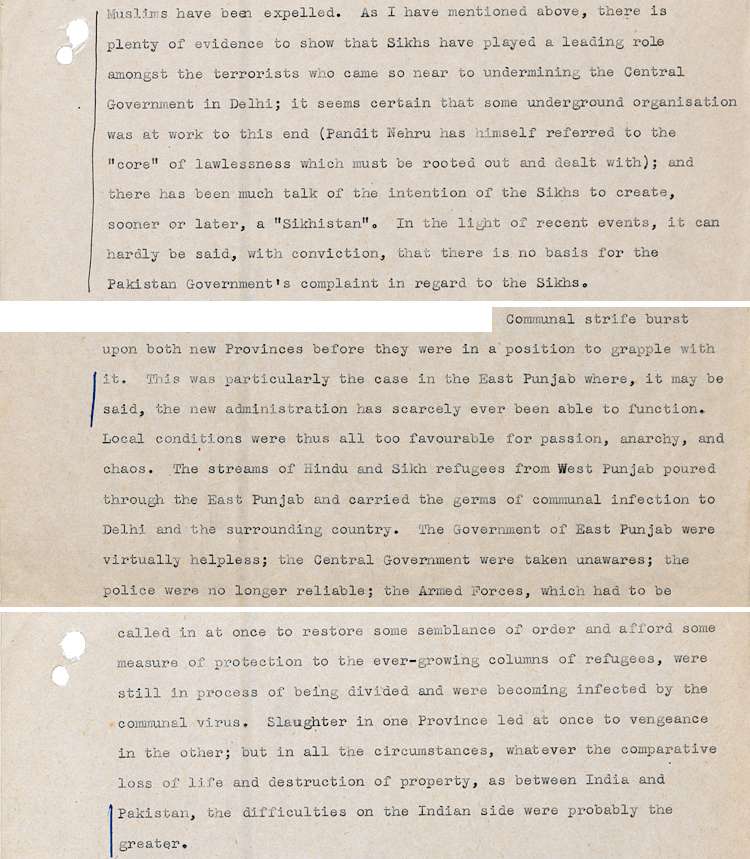
... Muslims have been expelled. As I have mentioned above, there is plenty of evidence to show that Sikhs have played a leading role amongst the terrorists who came so near to undermining the Central Government in Delhi; it seems certain that some underground organisation was at work to this end (Pandit Nehru has himself referred to the “core” of lawlessness which must be rooted out and dealt with); and there has been much talk of the intention of the Sikhs to create, sooner or later, a “Sikhistan”. In the light of recent events, it can hardly be said, with conviction, that there is no basis for the Pakistan Government’s complaint in regard to the Sikhs.
…
Communal strife burst upon both new Provinces before they were in a position to grapple with it. This was particularly the case in the East Punjab where, it may be said, the new administration has scarcely ever been able to function. Local conditions were thus all too favourable for passion, anarchy, and chaos. The streams of Hindu and Sikh refugees from West Punjab poured through the East Punjab and carried the germs or communal infection to Delhi and the surrounding country. The Government of East Punjab were virtually helpless; the Central Government were taken unawares; the police were no longer reliable; the Armed Forces, which had to be called in at once to restore some semblance of order and afford some measure of protection to the ever-growing columns of refugees, were still in process of being divided and were becoming infected by the communal virus. Slaughter in one Province led at once to vengeance in the other; but in all the circumstances, whatever the comparative loss of life and destruction of property, as between India and Pakistan, the difficulties on the Indian side were probably the greater.
Further extracts from the UK High Commissioner Terence Shone writing to the Secretary of State for Commonwealth Relations, 14 October 1947. Catalogue reference: DO 142/259
Listen
We are, no doubt, still far too much embroiled in the storm of events to be able to view them in perspective or to give a full explanation of why they burst upon us with a force that has seemed almost overwhelming. I have suggested above that on the transfer of power to Indian hands, there was a sudden release of elemental feelings, and of emotions on which the effects of education, or semi-education, and the stimulus exerted for years past by revolutionary leaders cannot yet be gauged. The division of the Old India, which provided the basis for the transfer of power, although agreed to by the Hindu, Muslim and Sikh political leaders, was a grievous disappointment to all three parties. As between the two major communities, it ran counter, on the Hindu side, not only to the fundamental tenets of the Congress Party (let alone the Mahasabha and other political parties and organisations) that India must remain one, but also to a similar feeling in the inmost hearts of large masses of the population including, I should say, not a few Muslims, especially amongst those whose homes and interests are in what is now the Dominion of India. There have always been, and still are, Muslims, including leaders, in the Congress Party; so far as I know, there are no Hindus in the Muslim League. Compensations for Congress, at least, were that the Plan of June 3rd afforded means of getting rid of British rule at the earliest possible date and the hope of creating a strong central Government for what is now the Dominion of India. Mr. Jinnah and the Muslim League, on the other only obtained a “truncated, moth-eaten Pakistan” which, however, if far different from the Pakistan of their dreams, they preferred to no Pakistan at all. The ever-deteriorating relations between the leaders of the Congress and the Muslim League had made it clear that collaboration between them in any Central Government was impracticable; and when the only power which had been able to keep them together (if latterly with ever increasing difficulty) set a date for withdrawal, the two main parties were forced to accept the best arrangement they could get. Neither was satisfied; one at least – the Congress – did not, I feel sure, regard the arrangement as lasting.
Painful as it is to say it, I believe it to be true that the two new Dominions were born of antipathy – to use no stronger word – and pressure of circumstances, rather than of desire to forgot the past and face the future in a spirit of mutual co-operation. In the circumstances, as “The Round Table’s” leader writer suggests, it would have been a miracle if they had settled down in peace and amity. From the point of view of the Muslims, the partition of the Punjab cut in twain the very heart of Pakistan. The position there was further complicated by the presence of the third party (the Sikhs) who, though relatively small in numbers, had shown signs of being determined to resist the partition of their community by any means in their power.
They had for long been animated by hatred for the Muslims; and it may be questionable whether their leader in the last Viceroy’s Cabinet, Sardar Baldev Singh, was truly representative of his people. Alternatively, he and/or other Sikh leaders may have accepted partition because there was nothing else for it at the time but rebellion (which they had reason to know would then be ruthlessly put down) but with the ulterior design that if opportunity offered, the Sikhs would somehow or other be brought together again. It is one of the main complaints of the Pakistan Government against the Government of India, in their appeal to H.M. Government and the Dominions, that adequate measures have not been taken to curb and control the Sikhs. There can be no doubt that Sikhs have played a prominent part in the slaughter of Muslims, perhaps even more in the Sikh States than in the East Punjab; and the Sikh refugees who have been moving into that province from, the West Punjab in their tens of thousands, have been moving in convoys, with their animals, vehicles and household effects, in quasi-military order, to settle down on the lands from which the Muslims have been expelled. As I have mentioned above, there is plenty of evidence to show that Sikhs have played a leading role amongst the terrorists who came so near to undermining the Central Government in Delhi; it seems certain that some underground organisation was at work to this end (Pandit Nehru has himself referred to the “core” of lawlessness which must be rooted out and dealt with); and there has been much talk of the intention of the Sikhs to create, sooner or later, a “Sikhistan”. In the light of recent events, it can hardly be said, with conviction, that there is no basis for the Pakistan Government’s complaint in regard to the Sikhs.
…
Communal strife burst upon both new Provinces before they were in a position to grapple with it. This was particularly the case in the East Punjab where, it may be said, the new administration has scarcely ever been able to function. Local conditions were thus all too favourable for passion, anarchy, and chaos. The streams of Hindu and Sikh refugees from West Punjab poured through the East Punjab and carried the germs or communal infection to Delhi and the surrounding country. The Government of East Punjab were virtually helpless; the Central Government were taken unawares; the police were no longer reliable; the Armed Forces, which had to be called in at once to restore some semblance of order and afford some measure of protection to the ever-growing columns of refugees, were still in process of being divided and were becoming infected by the communal virus. Slaughter in one Province led at once to vengeance in the other; but in all the circumstances, whatever the comparative loss of life and destruction of property, as between India and Pakistan, the difficulties on the Indian side were probably the greater.

13. In fact the General situation will continue, to remain in “negative control” until the psychological position improves and confidence is restored. A number of tendencies are still preventing this. The vast movement of refugees in both directions in the Punjab (conservative estimates put the figure up to date at 4 million) and the lesser movements elsewhere cause a general feeling of instability. The long range exchange of arguments between the Deputy Prime Minister (India) and the Prime Minister, Pakistan, which continued during the week, regarding the migration of populations only aggravate this. In addition, “the constant demands of the leaders of the majority’ communities” as H.S. Suhrawaddy recently said “for reiterated and fulsome expressions of loyalty to the state by the minorities are fast assuming the proportions of sadism”.
These demands are not infrequently but also illogically followed by remarks of the kind recently made by the President of the U.P. Congress Committee that he knew the Muslim leaguers had always tried to “betray the country and therefore they would now be given their proper place. Again the bitter attitude of refugees is a constant hindrance to better relations between the communities. In Delhi for example where, as Gandhi recently said “there was no love lost between the Hindus and Muslims whose hearts were still estranged” the well-to-do Sikh and Hindu refugees from the West Punjab who have had to abandon their business and property are vehement in their criticisms of the weak attitude adopted by the Nehru Government and demand that the wealthy Muslims of Delhi should as a corollary be sent to Pakistan. Added to this are the continued harassments to the minorities in both Dominions by petty officialdom and the undeniable feeling of the general public in many affected areas that they do not want to see minorities back again in their midst. Until all these tendencies can “be counteracted there can “be no real restoration of confidence. And until this does take place there can be no return to normal conditions of life.
India’s High Commissioner in London on the state of India-Pakistan relations, 20 October 1947. Catalogue reference: DO 142/24
Listen
In fact the General situation will continue, to remain in “negative control” until the psychological position improves and confidence is restored. A number of tendencies are still preventing this. The vast movement of refugees in both directions in the Punjab (conservative estimates put the figure up to date at 4 million) and the lesser movements elsewhere cause a general feeling of instability. The long range exchange of arguments between the Deputy Prime Minister (India) and the Prime Minister, Pakistan, which continued during the week, regarding the migration of populations only aggravate this. In addition, “the constant demands of the leaders of the majority’ communities” as H.S. Suhrawaddy recently said “for reiterated and fulsome expressions of loyalty to the state by the minorities are fast assuming the proportions of sadism”.
These demands are not infrequently but also illogically followed by remarks of the kind recently made by the President of the U.P. Congress Committee that he knew the Muslim leaguers had always tried to “betray the country and therefore they would now be given their proper place. Again the bitter attitude of refugees is a constant hindrance to better relations between the communities. In Delhi for example where, as Gandhi recently said “there was no love lost between the Hindus and Muslims whose hearts were still estranged” the well-to-do Sikh and Hindu refugees from the West Punjab who have had to abandon their business and property are vehement in their criticisms of the weak attitude adopted by the Nehru Government and demand that the wealthy Muslims of Delhi should as a corollary be sent to Pakistan. Added to this are the continued harassments to the minorities in both Dominions by petty officialdom and the undeniable feeling of the general public in many affected areas that they do not want to see minorities back again in their midst. Until all these tendencies can “be counteracted there can “be no real restoration of confidence. And until this does take place there can be no return to normal conditions of life.

(iv) Even if the present bitterness “between India and Pakistan lessens somewhat, it can hardly be doubted that for some years to come, at all events, it will be the policy of the Indian Government (or most of its members), whether by obstruction or core positive methods, to make it as difficult as possible for Pakistan to exist as a separate Dominion, in the hope that it will collapse within a measurable period of time. Congress assented to the Partition Plan, but it is quite obvious that in the main most of the present Indian Government, and almost certainly any Government that succeeds the present one, will do their utmost to undo Partition. In such a frame of mind it seems very improbable that they would, in any practical shape, recognise that the defence of the North-West Frontier affects India as well as Pakistan and that therefore they ought to contribute in some form. This would probably be their attitude even if there was complete peace along the Punjab boundary. But as conditions are at present they would naturally feel that any military strengthening of Pakistan would be likely to be used to the disadvantage of India in the Punjab rather than for watch and guard on the Frontier.
4. In these circumstances it is quite clear that India will be intensely suspicious of any assistance which we give to Pakistan. They are not in the least likely to be influenced by the argument that, nine times out of ten, India will not need or desire any similar assistance.
This suspicion could easily grow into active hostility towards us. One of the first results might be to make it more probable even than it is now that they will leave the Commonwealth though no doubt they mil have at the back of their minds the consideration that we are, politically, rather less free to help Pakistan against the wishes of India so long as they both remain Dominions. A second and more serious consequence might be that, assisted, may be, by other accidental and unforeseeable causes, a definite anti-British feeling, at the moment happily absent, might once again develop in India, to the detriment of our commercial interests there and to the danger of the lives of British men and women in India.
5. On the other hand, if this country does not help Pakistan to some extent, its chance in the next few years of surviving seems poor. No other country is likely just now to assist it on a considerable scale. Even though its collapse was primarily due to the hostility of India, which was one of the parties to the Partition Plan, this country would, anyhow during the next few years, be in an embarrassing position (to put it mildly) if, having sponsored the Partition Plan and embodied it in a British Act of Parliament, it failed to do what it could, within reason, to help the new Dominion to live. Apart from this it seems probable that, if there is collapse and chaos along the North-West Frontier, sooner or later it will profoundly effect the whole of India, presumably with grave effect on questions of Imperial strategy, though it is no part of the intention of this memorandum to examine that subject.
6. A further consideration is that if the desire of a large body of opinion in India to bring about the collapse of Pakistan prevails, it can most easily achieve its objective in the opening years of Pakistan’s existence. Pakistan is in by no means a helpless situation vis-a-vis India, once its administration is in working order. It produces 80 per cent of the world’s jute.
Analysis from British government on likely future relations between India and Pakistan, 20 October 1947. Catalogue reference: DO 121/69
Listen
Even if the present bitterness “between India and Pakistan lessens somewhat, it can hardly be doubted that for some years to come, at all events, it will be the policy of the Indian Government (or most of its members), whether by obstruction or core positive methods, to make it as difficult as possible for Pakistan to exist as a separate Dominion, in the hope that it will collapse within a measurable period of time. Congress assented to the Partition Plan, but it is quite obvious that in the main most of the present Indian Government, and almost certainly any Government that succeeds the present one, will do their utmost to undo Partition. In such a frame of mind it seems very improbable that they would, in any practical shape, recognise that the defence of the North-West Frontier affects India as well as Pakistan and that therefore they ought to contribute in some form. This would probably be their attitude even if there was complete peace along the Punjab boundary. But as conditions are at present they would naturally feel that any military strengthening of Pakistan would be likely to be used to the disadvantage of India in the Punjab rather than for watch and guard on the Frontier.
In these circumstances it is quite clear that India will be intensely suspicious of any assistance which we give to Pakistan. They are not in the least likely to be influenced by the argument that, nine times out of ten, India will not need or desire any similar assistance.
This suspicion could easily grow into active hostility towards us. One of the first results might be to make it more probable even than it is now that they will leave the Commonwealth though no doubt they mil have at the back of their minds the consideration that we are, politically, rather less free to help Pakistan against the wishes of India so long as they both remain Dominions. A second and more serious consequence might be that, assisted, may be, by other accidental and unforeseeable causes, a definite anti-British feeling, at the moment happily absent, might once again develop in India, to the detriment of our commercial interests there and to the danger of the lives of British men and women in India.
On the other hand, if this country does not help Pakistan to some extent, its chance in the next few years of surviving seems poor. No other country is likely just now to assist it on a considerable scale. Even though its collapse was primarily due to the hostility of India, which was one of the parties to the Partition Plan, this country would, anyhow during the next few years, be in an embarrassing position (to put it mildly) if, having sponsored the Partition Plan and embodied it in a British Act of Parliament, it failed to do what it could, within reason, to help the new Dominion to live. Apart from this it seems probable that, if there is collapse and chaos along the North-West Frontier, sooner or later it will profoundly effect the whole of India, presumably with grave effect on questions of Imperial strategy, though it is no part of the intention of this memorandum to examine that subject.
A further consideration is that if the desire of a large body of opinion in India to bring about the collapse of Pakistan prevails, it can most easily achieve its objective in the opening years of Pakistan’s existence. Pakistan is in by no means a helpless situation vis-a-vis India, once its administration is in working order. It produces 80 per cent of the world’s jute.

PRESS INFORMATION BUREAU, GOVERNMENT OF INDIA.
Ministry of Information,
New Delhi November 2, 1947
Military Evacuation Organisation, India’s advanced headquarters at Lahore, under the command of Brigadier Mohite, have finalised plans to speed up the movement of non-Muslim refugees from West Punjab to India. More refugee trains will be run shortly and more Army and civilian transport is being made available to complete evacuation within the shortest possible time. Special arrangements are being made for the removal of the aged, woman and children.
Clearance of non-Muslim refugees from pockets in West Punjab continues steadily.
On October 29, six thousand non-Muslims arrived in India by refugee trains from Lahore and 3,000 from Lyallpur. Three thousand Muslim refugees each from Hoshiarpur and Ludhiana were moved by train to Pakistan.
The following were moved in motor lorries by Military Evacuation Organisation, Pakistan on October 29:-
Non-Muslim
From Lahore to India: 520
From Gujranwala to India: 400
Muslim
From Ambala to Pakistan: 900
Eight thousand Muslim refugees who were unable to walk long distances were moved by train from Ludhiana to Pakistan on October 30. Seven hundred and seven Muslims were moved by rail from Gidharbaha to Hindumalkot on the Abohar-Minchinabad line.
Three non-Muslim refugee trains with 13,000 persons from Pakistan reached Amritsar on October 31. On the same day four refugee specials carrying 15,500 Muslim refugees passed through Amritsar and two specials with 10,000 Muslims arrived at Forozepore from Ludhiana enroute to Pakistan.
There were foot movements of Muslim refugees on October 31. 50,000 Muslims left Amritsar from for Wagah. 25,000 Muslims reached Amritsar from Jandiala and 20,000 Muslims arrived at Kartarpur from Beas. 40,000 Muslims moved to Kartarpur from Beas.
In Ferozepore district, 200 Muslim refugees and five abducted girls were recovered from various pockets and sent over to Pakistan on October 28.
Six hundred non-Muslim converts and abducted men, women and children were moved in motor lorries to Lahore. Seventy-two Muslims, including five abducted girls, were cleared from Patti, Adampur, Pamunwala, Durepala and Sanawala and moved to Pakistan.
Five abducted Muslim girls were recovered from Anipur in Jullundur area, on October 29 in the East Punjab. Troops of the 2nd Assam Regiment recovered 16 Muslim abducted women and children at Radapur and handed them over to their relatives. Two non-Muslim abducted girls were recovered by Pakistan troops at Ganda Singh Wala, 4 miles west of Kasur, and handed over to Indian troops.
At Ravi Bridge, 4 miles South-east of Narowal 17 non-Muslim women with children were recovered by Pakistan troops and handed over to Indian troops.
Families of Royal Indian Navy and Army personnel were moved to India from Sargodha, Multan, Sianvali and Phillawan in Pakistan.
Official report by India’s Ministry of Information on population movements, 2 November 1947. Catalogue reference: DO 133/60
Listen
PRESS INFORMATION BUREAU, GOVERNMENT OF INDIA.
Ministry of Information,
New Delhi November 2nd, 1947
Military Evacuation Organisation, India’s advanced headquarters at Lahore, under the command of Brigadier Mohite, have finalised plans to speed up the movement of non-Muslim refugees from West Punjab to India. More refugee trains will be run shortly and more Army and civilian transport is being made available to complete evacuation within the shortest possible time. Special arrangements are being made for the removal of the aged, woman and children.
Clearance of non-Muslim refugees from pockets in West Punjab continues steadily.
On October 29, six thousand non-Muslims arrived in India by refugee trains from Lahore and 3,000 from Lyallpur. Three thousand Muslim refugees each from Hoshiarpur and Ludhiana were moved by train to Pakistan.
The following were moved in motor lorries by Military Evacuation Organisation, Pakistan on October 29:-
Non-Muslim
From Lahore to India: 520
From Gujranwala to India: 400
Muslim
From Ambala to Pakistan: 900
Eight thousand Muslim refugees who were unable to walk long distances were moved by train from Ludhiana to Pakistan on October 30. Seven hundred and seven Muslims were moved by rail from Gidharbaha to Hindumalkot on the Abohar-Minchinabad line.
Three non-Muslim refugee trains with 13,000 persons from Pakistan reached Amritsar on October 31. On the same day four refugee specials carrying 15,500 Muslim refugees passed through Amritsar and two specials with 10,000 Muslims arrived at Forozepore from Ludhiana enroute to Pakistan.
There were foot movements of Muslim refugees on October 31. 50,000 Muslims left Amritsar from for Wagah. 25,000 Muslims reached Amritsar from Jandiala and 20,000 Muslims arrived at Kartarpur from Beas. 40,000 Muslims moved to Kartarpur from Beas.
In Ferozepore district, 200 Muslim refugees and five abducted girls were recovered from various pockets and sent over to Pakistan on October 28.
Six hundred non-Muslim converts and abducted men, women and children were moved in motor lorries to Lahore. Seventy-two Muslims, including five abducted girls, were cleared from Patti, Adampur, Pamunwala, Durepala and Sanawala and moved to Pakistan.
Five abducted Muslim girls were recovered from Anipur in Jullundur area, on October 29 in the East Punjab. Troops of the 2nd Assam Regiment recovered 16 Muslim abducted women and children at Radapur and handed them over to their relatives. Two non-Muslim abducted girls were recovered by Pakistan troops at Ganda Singh Wala, 4 miles west of Kasur, and handed over to Indian troops.
At Ravi Bridge, 4 miles South-east of Narowal 17 non-Muslim women with children were recovered by Pakistan troops and handed over to Indian troops.
Families of Royal Indian Navy and Army personnel were moved to India from Sargodha, Multan, Sianvali and Phillawan in Pakistan.

OUTWARD TELEGRAM
From the High Commissioner for the United Kingdom
To Commonwealth Relations Officer
4.55 p.m. 8.12
Priority Immediate
KASHMIR
3. On the main Srinagar-Rawalpindi road the position continues to be static around Uri. The main development of the week has been an increased tempo of guerrilla activities by raiders and Azad Kashmir Forces in the Mirpur- Bhimbar-Akhnoor sector in the extreme south. Indian Armed Forces made a planned withdrawal from Kolti together with the States Forces garrison which they had relieved a week before.
4. Stories of atrocities committed on both sides are receiving wide circulation. Sardar Patel and Baldev Singh visited Jammu on December 2nd and Nehru on December 6th.
…
SIKH DEVELOPMENTS
8. In recent statement Tara Singh said that “within next six months India and Pakistan will be at war with each other. There is no other way of solving the problem created by the migration of non-Muslims from Pakistan. British sympathies are definitely with Pakistan but I do not think they will actively intervene.” As a counter to this the Maharajah of Patiala and Baldev Singh have appealed to Sikhs to act with restraint. The former stated that (a) Sikh blood has been shed in [certain parts of] Pakistan and [it] has become sacred to them and (b) they did not like those lands being under alien’s domination, today was not the time to do anything which might in long run harm Sikh cause.
Telegram from Britain’s High Commissioner in India on Kashmir and Sikh developments, 8 December 1947. Catalogue reference: DO 133/61
Listen
OUTWARD TELEGRAM
From the High Commissioner for the United Kingdom
To Commonwealth Relations Officer
4.55 p.m. 8.12
Priority Immediate
KASHMIR
On the main Srinagar-Rawalpindi road the position continues to be static around Uri. The main development of the week has been an increased tempo of guerrilla activities by raiders and Azad Kashmir Forces in the Mirpur- Bhimbar-Akhnoor sector in the extreme south. Indian Armed Forces made a planned withdrawal from Kolti together with the States Forces garrison which they had relieved a week before.
Stories of atrocities committed on both sides are receiving wide circulation. Sardar Patel and Baldev Singh visited Jammu on December 2nd and Nehru on December 6th.
…
SIKH DEVELOPMENTS
In recent statement Tara Singh said that “within next six months India and Pakistan will be at war with each other. There is no other way of solving the problem created by the migration of non-Muslims from Pakistan. British sympathies are definitely with Pakistan but I do not think they will actively intervene.” As a counter to this the Maharajah of Patiala and Baldev Singh have appealed to Sikhs to act with restraint. The former stated that (a) Sikh blood has been shed in [certain parts of] Pakistan and [it] has become sacred to them and (b) they did not like those lands being under alien’s domination, today was not the time to do anything which might in long run harm Sikh cause.

The Sikhs
The outlook for the relations between India and Pakistan is less depressing than it seemed a few weeks ago. But two major problems have still to be dealt with. One is Kashmir. If the Indian Army should get too much involved in Kashmir Delhi may come to regret its commitments there. It might well recall Napoleon’s remark: “The Spanish ulcer sapped me.” An even graver problem than Kashmir is the future of the Punjab. The kernel of the Punjab problem is the Sikhs. It was the undervaluing of the importance o£ the Sikhs last August which spoiled what might have been the peaceful transfer of power. Because the Sikhs number less than six million in a sub-continent of four hundred million their power has often been underrated. The Sikhs are in bad odour, and the verdict of history on the recent conduct of one at least of their chiefs may be crushing. But no progress will be made by blaming a whole community; nor, in judging them, should the Moslem attack on them in March be forgotten. The Sikhs who have been forced to abandon their rich lands in Pakistan feel neglected, misunderstood, and deeply wronged. Many will live for the day for recovering their property and will do their best to urge on India against Pakistan. As they live on the borders of the Dominions they can make much trouble and, being well organised, know how to do it. The best remedial action will be to pacify them by a major effort to provide them with alternative land-there are no better cultivators—and, where this is not possible, to give them cash compensation and openings in other directions. They have much mechanical ingenuity, and their energy, if diverted into industry, would give an impetus to India’s development. The problem is thus partly economic, as are so many of the problems of both Dominions.
Article from The Times on relations between India and Pakistan, 22 December 1947. Catalogue reference: WO 208/3811
Times Media Limited News Licensing
Listen
The outlook for the relations between India and Pakistan is less depressing than it seemed a few weeks ago. But two major problems have still to be dealt with. One is Kashmir. If the Indian Army should get too much involved in Kashmir Delhi may come to regret its commitments there. It might well recall Napoleon’s remark: “The Spanish ulcer sapped me.” An even graver problem than Kashmir is the future of the Punjab. The kernel of the Punjab problem is the Sikhs. It was the undervaluing of the importance o£ the Sikhs last August which spoiled what might have been the peaceful transfer of power. Because the Sikhs number less than six million in a sub-continent of four hundred million their power has often been underrated. The Sikhs are in bad odour, and the verdict of history on the recent conduct of one at least of their chiefs may be crushing. But no progress will be made by blaming a whole community; nor, in judging them, should the Moslem attack on them in March be forgotten. The Sikhs who have been forced to abandon their rich lands in Pakistan feel neglected, misunderstood, and deeply wronged. Many will live for the day for recovering their property and will do their best to urge on India against Pakistan. As they live on the borders of the Dominions they can make much trouble and, being well organised, know how to do it. The best remedial action will be to pacify them by a major effort to provide them with alternative land-there are no better cultivators—and, where this is not possible, to give them cash compensation and openings in other directions. They have much mechanical ingenuity, and their energy, if diverted into industry, would give an impetus to India’s development. The problem is thus partly economic, as are so many of the problems of both Dominions.

INDIA & PAKISTAN
SHOWING DIAGRAMMATICALLY THE POSITION OF THE STATES
To Accompany Pol. 1431/48 of 30th June 1948
International frontiers = [dotted line]
” ” undemarcated = [dotted line with x]
State boundaries = [dotted line with blue]
Inter-Dominion boundary = [green line]
Portuguese Territory = [circle with diagonal lines] (P)
French ” = [circle with horizontal lines] (F)
Patiala Union = P. U.
INDIA = [white]
PAKISTAN = [green]
States included in Part 5 of Pol. 1431/48 = [yellow]
Map titled 'India & Pakistan showing diagrammatically the position of the states'. Catalogue reference: CAB 21/2038
The purpose of this document collection is to allow students and teachers to develop their own lines of historical enquiry or historical questions using original documents on this period of history.
Students could work with a group of sources or particular document series which identifies a certain theme. Of course the sources offer students a chance to develop their powers of evaluation and analysis and support their course work.
Teachers may wish to use the collection to develop their own resources or encourage students to ‘curate’ their own ‘exhibition’ of the most significant documents on the topic.
The background information helps you to understand the causes for Indian partition, how it happened, how was it experienced by ordinary people, and how we can know more about it through primary sources and oral history sources. Some suggestions for further reading are also provided.
Before the British colonial officials left India in 1947, the subcontinent was divided into two different nations: India and Pakistan. India came to be ruled by the nationalist Congress Party under Pandit Jawaharlal Nehru’s prime ministership, and Pakistan by the Muslim League under the leadership of Muhammad Ali Jinnah.
The emergence of two nations was premised on religious divide – Pakistan for Muslims and India for Hindus, though India chose to become a secular republic. About 35 million Muslims remained in secular India. The origins of partition stretch back to the politics of nationalist leaders and the colonial state since the 1940s onwards.
To secure Indian cooperation in the Second World War, the Churchill government agreed to send the Cripps Mission in 1942 to resolve the Indian political situation. Though failed to satisfy nationalist leaders, the Mission proposed the idea of independence for India after the war.
As the tide of anti-colonial nationalism began to shape the demand for an independent nation, the Muslim League Party under Jinnah began to mobilise the different classes of Muslims to demand Muslim’s right for self-determination. The demand for Pakistan as a separate territorial nation remained fluid and limited in the early 1940s, but during the provincial elections, the League mobilised Muslims, especially the lower and middle classes, in the name of Pakistan. The huge electorate mandate of the League in Muslim regions increased and popularised the demand for a separate nation for Muslims.
The British not only helped to consolidate the Muslim League in the East and the West by installing League ministries in 1942–43, but they also aired the idea that regions could secede from the Union through the Cripps Mission, legitimising Jinnah’s call.
The Congress Party under Mohandas Karamchand Gandhi, Nehru, and other leaders demanded a free united India. It was not acceptable to Jinnah who in his 1945 speech said, 'Whereas a united India means slavery for Mussulmans and complete domination of the imperialistic caste Hinduraj throughout this sub-continent.'
The Quit India Movement of Gandhi, the cost of the Second World War, and the Indian Naval Mutiny in 1946 made Britain realise that India could no longer be ruled. Hence, the newly formed Labour Party British government under Clement Attlee in July 1945, which was sympathetic to India’s self-determination but determined to safeguard British economic interest and influence in South Asia, sent a Cabinet Mission in 1946 to discuss the formation of independent India. The Mission failed and the League called for a popular agitation for Pakistan demand which led to killings of Hindus by Muslims in Calcutta accompanied by a reactionary violence by Hindus in Calcutta and other parts of India.
The British decided to leave by June 1948, but the Viceroy Louis Mountbatten moved this forward to August 1947. The press in the USA praised Attlee’s decision of actual withdrawal as otherwise, the New York Herald Tribune noted, 'The British might easily have lingered on in India, playing off Hindu against Moslem, prince against peasant, presiding over a tense and costly stalemate in the interests of imperial prestige.'
Sir Cyril Radcliffe was asked to draw border lines of the two nations within six weeks. As Muslims concentrated on both the East and the West side of British India, Pakistan was split into two awkward regions: the West-side Pakistan and the East Pakistan (which became Bangladesh in 1971). Jinnah was unhappy with a truncated Bengal and Punjab, though his goal of a sovereign nation for Muslim was achieved.
What followed the creation of Pakistan on 14th August 1947 was a large migration of Hindus and Sikhs from Pakistan to India and of Muslims to Pakistan resulting in one of deadliest communal violence between the two communities amidst building tensions on religious lines, lack of law and order at the time of quick power transfer, uncertain migration.
About one million people died, more than 75,000 women were raped, and 10 million people were displaced along with a huge destruction of property. The horrors of partition violence left a never-ending legacy onto the families and psyche of migrants who lost their homes, family members, experienced significant years of life in harsh displacement (migrant camps and refugee colonies) and witnessed violence first hand.
Although historians’ focus has moved away from determining the causes of the partition and the role of elites to the meanings of partition and its violence on the two communities, this document collection of official papers covers key moments leading to the partition between 1939–47: the Second World War, the ideas of Indian nationalist leaders and their differences such as between Jinnah, Gandhi and Bose, what the British officials’ thought on the transfer of power, the partition violence, and the fate of Pakistan.
Background information written by:
Teaching resource
This set of documents allows key stage 4 and 5 students to explore the subject of Indian independence and partition in 1947. Part one covers the years to 1947.
1947partitionarchive.org.uk
Access more than 12,000 oral history interviews with witnesses of the partition of India.
projectdastaan.org
Watch a virtual reality experience marking the 75th anniversary of partition.
nam.ac.uk
Browse information from the National Army Museum on the impact of partition, including a video called ‘Reflections and Recollections’.