











Teaching resource
Indian independence, part two
This set of documents allows key stage 4 and 5 students to explore the subject of Indian independence and partition in 1947. Part two covers the events of 1947.
Teaching resource
This collection of documents allows key stage 4 and 5 students to develop their own lines of historical enquiry on the subject of Indian independence and the partition of India in 1947. It covers the years from 1940 to 1946.

Photo of early arrivals in France from the Royal Indian Army Service Corps and Veterinary Corps, 1940. Catalogue reference: CN 11/6 f.49
The background information of this resource and some of the sources contain references to physical and sexual violence.
What led to the partition of India in 1947?
You can discover more related documents in our Indian independence, part two collection.

Future Status of India
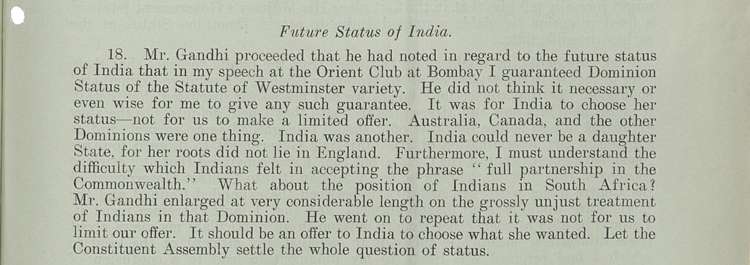
18. Mr. Gandhi proceeded that he had noted in regard to the future status of India that in my speech at the Orient Club at Bombay I guaranteed Dominion Status of the Statute of Westminster variety. He did not think it necessary or even wise for me to give any such guarantee. It was for India to choose her status-not for us to make a limited offer. Australia, Canada, and the other Dominions were one thing. India was another. India could never be a daughter State, for her roots did not lie in England. Furthermore, I must understand the difficulty which Indians felt in accepting the phrase “full partnership in the Commonwealth.” What about the position of Indians in South Africa?
Mr. Gandhi enlarged at very considerable length on the grossly unjust treatment of Indians in that Dominion. He went on to repeat that it was not for us to limit our offer. It should be an offer to India to choose what she wanted. Let the Constituent Assembly settle the whole question of status.
Viceroy Linlithgow’s record for the British Cabinet of his conversation with Mohandas Karamchand Gandhi, 5 February 1940. Catalogue reference: CAB 67/5/24
Listen
Viceroy Linlithgow’s record for the British Cabinet of his conversation with Gandhi, 5th February 1940. CAB 67/5/24
Future Status of India
Mr. Gandhi proceeded that he had noted in regard to the future status of India that in my speech at the Orient Club at Bombay I guaranteed Dominion Status of the Statute of Westminster variety. He did not think it necessary or even wise for me to give any such guarantee. It was for India to choose her status-not for us to make a limited offer. Australia, Canada, and the other Dominions were one thing. India was another. India could never be a daughter State, for her roots did not lie in England. Furthermore, I must understand the difficulty which Indians felt in accepting the phrase “full partnership in the Commonwealth.” What about the position of Indians in South Africa?
Mr. Gandhi enlarged at very considerable length on the grossly unjust treatment of Indians in that Dominion. He went on to repeat that it was not for us to limit our offer. It should be an offer to India to choose what she wanted. Let the Constituent Assembly settle the whole question of status.

Decypher of Telegram
From Governor-General to Secretary of State for India
Dated New Delhi, 22.25 hrs. 18th October, 1940.
Received 14.00 hrs. 19th October, 1940.
2129.G.
Vinoba Bhave made opening anti-war speech at Paunar village near Wardha on morning of 17th. “Following is summary of speech are (sic ? as) reported by Associated Press, which gives number of audience in pouring rain as 300. Begins: “Congress could not help Britain on ethical grounds in (?war) effort. He wondered why Britain claimed to fight for democracy which she denied to India. It was necessary to agitate against war, first, because Congress demand for formation of National Government was rejected. Secondly because freedom of speech against war effort was denied, thirdly because belligerency had been forced upon India by the Government. The war was uprising of Christian nations fighting among themselves. India was being asked to fight against some of them who were not her enemies and Christianity taught one to love even one’s enemies. India should not help either from fear or for personal gain which two motives the Government were utilising to get help in this war. Vinoba Bhave would confine himself to verbal preaching and would not hinder those who wanted to help Britain despite his advice. Villagers should not content themselves with non-participation in the war but should carry on constructive programme of spinning, khadi, village up-lift and Hindu-Moslem unity. Ends.
2. Intelligence reports that Bhave in course of speech said that German people were intelligent and as they had chosen Hitler as leader he could not be so bad as painted. There was in fact nothing to choose between Hitler and British and it would therefore be a sin for Indians to join in fight against people with whom they had no enmity. He appealed to all not to help war effort with men, money or materials and announced that if left free he would continue to arrange anti-war meetings.
Telegram from Governor General to India Secretary on Vinoba Bhave's antiwar speech, 18 October 1940. Catalogue reference: WO 106/3651
Listen
Congress could not help Britain on ethical grounds in (?war) effort. He wondered why Britain claimed to fight for democracy which she denied to India. It was necessary to agitate against war, first, because Congress demand for formation of National Government was rejected. Secondly because freedom of speech against war effort was denied, thirdly because belligerency had been forced upon India by the Government. The war was uprising of Christian nations fighting among themselves. India was being asked to fight against some of them who were not her enemies and Christianity taught one to love even one’s enemies. India should not help either from fear or for personal gain which two motives the Government were utilising to get help in this war. Vinoba Bhave would confine himself to verbal preaching and would not hinder those who wanted to help Britain despite his advice. Villagers should not content themselves with non-participation in the war but should carry on constructive programme of spinning, khadi, village up-lift and Hindu-Moslem unity.

Photo of early arrivals in France from the Royal Indian Army Service Corps and Veterinary Corps, 1940. Catalogue reference: CN 11/6 f.49

BEGINS.
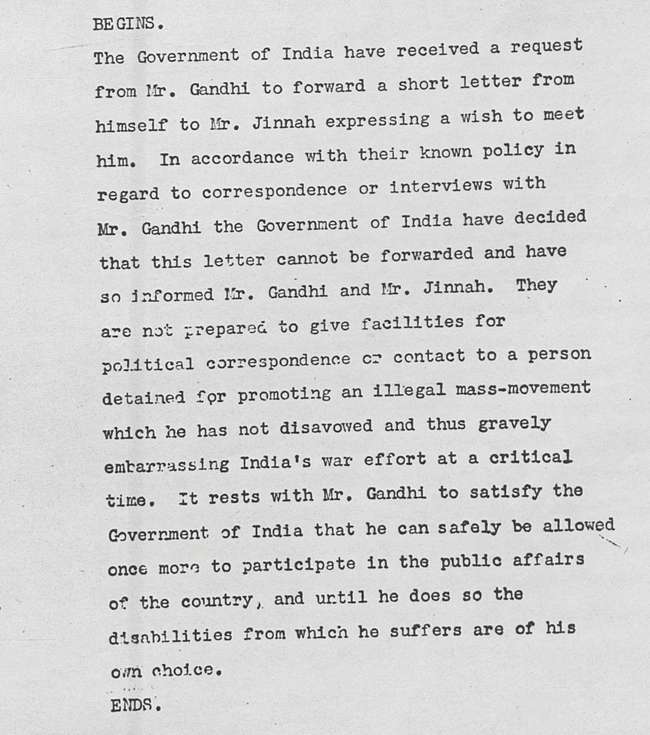
The Government of India have received a request from Mr. Gandhi to forward a short letter from himself to Mr. Jinnah expressing a wish to meet him. In accordance with their known policy in regard to correspondence or interviews with Mr. Gandhi the Government of India have decided that this letter cannot be forwarded and have so informed Mr. Gandhi and Mr. Jinnah. They are not prepared to give facilities for political correspondence or contact to a person detained for promoting an illegal mass-movement which he has not disavowed and thus gravely embarrassing India’s war effort at a critical time. It rests with Mr. Gandhi to satisfy the Government of India that he can safely be allowed once more to participate in the public affairs of the country, and until he does so the disabilities from which he suffers are of his own choice.
ENDS.
Telegram from Secretary of State for India to Prime Minister Churchill after Gandhi’s imprisonment over civil disobedience, 24 May 1942. Catalogue reference: PREM 4/46/1
Listen
The Government of India have received a request from Mr. Gandhi to forward a short letter from himself to Mr. Jinnah expressing a wish to meet him. In accordance with their known policy in regard to correspondence or interviews with Mr. Gandhi the Government of India have decided that this letter cannot be forwarded and have so informed Mr. Gandhi and Mr. Jinnah. They are not prepared to give facilities for political correspondence or contact to a person detained for promoting an illegal mass-movement which he has not disavowed and thus gravely embarrassing India’s war effort at a critical time. It rests with Mr. Gandhi to satisfy the Government of India that he can safely be allowed once more to participate in the public affairs of the country, and until he does so the disabilities from which he suffers are of his own choice.

1. Sir Stafford Cripps’ broadcast on India
(i) Text of the broadcast.
27.7.42
“I have always been a firm friend of India and I have done my best in the past to work for the freedom of India. When I joined the British War Cabinet and found the British Government anxious and willing to put forward a proposal for Indian self-government, I volunteered to travel the 20 thousand miles to India and back to put the case directly to the Indian political leaders on behalf of the British Government and people.
We offered to the Indian people complete liberty the moment the war was over, to devise and set up their own form of government. We suggested the broad outlines of how they should proceed. But there was no rigidity in these suggestions. It was left open to the various religions and races to agree upon some other method. But to my regret they neither accepted, nor put forward any agreed alternative.
It was not this future arrangement, however, but the immediate situation which caused the Congress Party in India to reject the proposals.
We offered the representative Indian political leaders immediate office in the Viceroy’s Executive Council, a body of ministers like those who advise your President. Mr. Gandhi has demanded that we should walk out of India leaving the country, with its deep-rooted religious divisions, without any constitutional form of government and with no organized administration. No responsible government could take such a step – least of all in the midst of war.
The Moslems, of whom there are at least 80 millions, are deeply opposed to Hindu domination as are also the tens of millions of the depressed classes. To have agreed to the Congress party or to Mr. Gandhi’s demands would have meant inevitable chaos and disorder. This is not merely my assertion, it is stated by Mr. Gandhi himself. Quite recently he has said: “Anarchy is the only way. Someone asked me if there would be anarchy after British rule. Yes, it will be there, but I tell the British to give us chaos.”
India is now an essential and vital part of the world front against the Axis powers. There are British, American and Chinese forces as well as Indians fighting side by side to defend India against Japan, and if the obligations of the British Government to the American and Chinese allies are to be observed, we must ensure that India remains a safe base in and from which to operate against the Japanese enemy, and we cannot allow conditions to be created by any political party or leader in India which will jeopardise the safety of the United Nations’ armies and air forces or throw the door open to the advance of our enemies into this new and dangerous theatre of war. That is an obligation, not only to the British and American forces in India, it is an obligation to the Indian peoples themselves.
That is why your country and my country find themselves both intimately concerned with the condition of India at this moment. Your sons as well as our sons are helping to defend India and wage war against the Japanese.
Your policy as well as our policy is to defend India. But Mr. Gandhi and the Congress Party have other views.
Mr. Gandhi I have always regarded with respect as a great nationalist and religious leader, but I am bound to say that in the present circumstances he is not showing himself to be practical and realistic.
Certainly the action which is now threatening – mass civil disobedience by his followers – is calculated to endanger both your war effort and our own, and to bring the greatest aid and comfort to our common enemies.
Mr. Gandhi’s views are not always easily defined, or always consistant, but let me read a few of his recent statements:
“We do not want these allied troops for our defence or protection. If luck favours us, the Japanese may see no reason to hold the country after the Allies have withdrawn.
Extract from broadcast to United States by Sir Stafford Cripps’ on Britain’s position on India, 27 July 1942 with comments from Pandit Jawaharlal Nehru and Gandhi. Catalogue reference: CAB 127/71
Listen
I have always been a firm friend of India and I have done my best in the past to work for the freedom of India. When I joined the British War Cabinet and found the British Government anxious and willing to put forward a proposal for Indian self-government, I volunteered to travel the 20 thousand miles to India and back to put the case directly to the Indian political leaders on behalf of the British Government and people.
We offered to the Indian people complete liberty the moment the war was over, to devise and set up their own form of government. We suggested the broad outlines of how they should proceed. But there was no rigidity in these suggestions. It was left open to the various religions and races to agree upon some other method. But to my regret they neither accepted, nor put forward any agreed alternative.
It was not this future arrangement, however, but the immediate situation which caused the Congress Party in India to reject the proposals.
We offered the representative Indian political leaders immediate office in the Viceroy’s Executive Council, a body of ministers like those who advise your President. Mr. Gandhi has demanded that we should walk out of India leaving the country, with its deep-rooted religious divisions, without any constitutional form of government and with no organized administration. No responsible government could take such a step – least of all in the midst of war.
The Moslems, of whom there are at least 80 million, are deeply opposed to Hindu domination as are also the tens of millions of the depressed classes. To have agreed to the Congress party or to Mr. Gandhi’s demands would have meant inevitable chaos and disorder. This is not merely my assertion, it is stated by Mr. Gandhi himself. Quite recently he has said: “Anarchy is the only way. Someone asked me if there would be anarchy after British rule. Yes, it will be there, but I tell the British to give us chaos.”
India is now an essential and vital part of the world front against the Axis powers. There are British, American and Chinese forces as well as Indians fighting side by side to defend India against Japan, and if the obligations of the British Government to the American and Chinese allies are to be observed, we must ensure that India remains a safe base in and from which to operate against the Japanese enemy, and we cannot allow conditions to be created by any political party or leader in India which will jeopardise the safety of the United Nations’ armies and air forces or throw the door open to the advance of our enemies into this new and dangerous theatre of war. That is an obligation, not only to the British and American forces in India, it is an obligation to the Indian peoples themselves.
That is why your country and my country find themselves both intimately concerned with the condition of India at this moment. Your sons as well as our sons are helping to defend India and wage war against the Japanese.
Your policy as well as our policy is to defend India. But Mr. Gandhi and the Congress Party have other views.
Mr. Gandhi I have always regarded with respect as a great nationalist and religious leader, but I am bound to say that in the present circumstances he is not showing himself to be practical and realistic.
Certainly the action which is now threatening – mass civil disobedience by his followers – is calculated to endanger both your war effort and our own, and to bring the greatest aid and comfort to our common enemies.
Mr. Gandhi’s views are not always easily defined, or always consistent, but let me read a few of his recent statements:
“We do not want these allied troops for our defence or protection. If luck favours us, the Japanese may see no reason to hold the country after the Allies have withdrawn."

SECRET CIPHER TELEGRAM
068293.
From: C. in C. India.
Desp.1600 17 Aug.42.
To: War Office.
Usual Addressees.
Recd.1220 18 Aug.42.
IMMEDIATE
19748/I cipher 17 Aug.
Sitrep 44.
Assam. Bridge on Imphal-Palel Road washed away. M.S. 22.
Internal. In most areas situation shows improvement but tendency noted for trouble to spread to rural areas in parts Madras Bengal and U.P. Indications of planning in sabotage and suggestion that forward bloc or other subversive organisation behind it in Eastern India. Situation by Provinces.
Bombay. Quiet exception Ahmedabad where some deterioration and troops patrolling city.
Bengal. In Calcutta sporadic attacks continue upon some essential services. In districts except Dacca disorder limited partial Hartals and Students. Considerable rioting Dacca Area including damage railway system.
Central Provinces. Situation improved except in area round Magpur where rioting continues.
United Provinces. Situation considerably improved Urban Areas exception Benares and labour working at Benares University has declared for Quote Free India Unquote and U.T.C. has been termed quote National Army unquote for dacoity and sabotage. Wire cutting continuous various districts.
Madras. City quiet. In districts Hartals Students strikes and demonstration continue as also attacks upon communications.
Assam. Atmosphere apathetic and Hartals feeble.
Punjab. Generally quiet except some wire cutting Lahore.
Orissa N.W.F.P. Sind. Nothing to report.
Bihar. Situation Patna improving. No serious disturbances coalfields. Sporadic attacks upon E.I. railway system continue. Signs that people beginning realize troops mean business. Aircraft flights over disturbed areas having good effect. Troopers pass Secretary of State India Office.
Report to the War Office in London of levels of disruption across various provinces, 17 August 1942. Catalogue reference: WO 208/761A
Listen
SECRET CIPHER TELEGRAM
068293.
From: C. in C. India.
Dispatch.1600 17 Aug.1942.
To: War Office.
Sitrep 44.
Assam. Bridge on Imphal-Palel Road washed away.
Internal. In most areas situation shows improvement but tendency noted for trouble to spread to rural areas in parts Madras, Bengal and Uttar Pradesh. Indications of planning in sabotage and suggestion that forward bloc or other subversive organisation behind it in Eastern India. Situation by Provinces.
Bombay. Quiet exception Ahmedabad where some deterioration and troops patrolling city.
Bengal. In Calcutta sporadic attacks continue upon some essential services. In districts except Dacca disorder limited partial Hartals and Students. Considerable rioting Dacca Area including damage railway system.
Central Provinces. Situation improved except in area round Magpur where rioting continues.
United Provinces. Situation considerably improved Urban Areas exception Benares and labour working at Benares University has declared for Quote Free India Unquote and U.T.C. has been termed quote National Army unquote for dacoity and sabotage. Wire cutting continuous various districts.
Madras. City quiet. In districts Hartals Students strikes and demonstration continue as also attacks upon communications.
Assam. Atmosphere apathetic and Hartals feeble.
Punjab. Generally quiet except some wire cutting Lahore.
Orissa North Western Frontier Province Sind. Nothing to report.
Bihar. Situation Patna improving. No serious disturbances coalfields. Sporadic attacks upon East Indian railway system continue. Signs that people beginning realize troops mean business. Aircraft flights over disturbed areas having good effect. Troopers pass Secretary of State India Office.

BOSE CALLS ON INDIANS ABROAD TO FORM AN ARMY:
TOKIO: (EXTRACT FROM BROADCAST BY SUBHAS CHANDRA BOSE)
Against our brutal foe, no amount of civil disobedience, sabotage or revolution can be of any avail. If therefore we want to expel the British from India, we shall have to fight the enemy with their own weapons. But it is not possible for our country-men at home to organise an armed revolution and to fight the British army of occupation with modern arms. This task must therefore devolve on Indians living abroad and particularly on Indians living in East Asia.
CONTINUING SERIAL 22
‘BOSE CALLS ON INDIANS ABROAD TO FORM AN ARMY’ No.2 12.26
We Indians, have up till now lacked one thing and one thing alone. We lack an organisation to meet force with force. It is our task to supply this one want, and thereby to eliminate once for all the only drawback in our national struggle. I therefore desire all able bodied Indians living in East Asia to volunteer to fight with me for the liberation of our motherland. This is our supreme task and duty, before which no other type of service VXX counts for much.
All those countrymen of mine who are prepared to fight for the liberation if India will please get into touch with me at once, either directly or through their local organisation. I am confident that with the help of my countrymen in East Asia I shall be able to organise a gigantic force to sweep the British from India, in conjunction with those who have been fighting at home.
The hour has struck. Every patriotic Indian must advance toward the field of battle. When the blood of freedom loving Indians begins to flow, India will attain her freedom.
Quote: A full version of the broadcast will be found in tomorrow’s digest:)
…
FREE INDIA RADIO (AXIS ORIGIN) IN ENGLISH FOR INDIA AND INDIANS ABROAD
1730 20.6.43
(EXTRACTS FROM COMMENTARY)
SUBHAS CHANDRA BOSE: FREEDOM TO AGITATE
The latest declaration by Prime Minister Tojo reaffirming Japan’s firm resolve to enable India to shake off the toils of British rule and to live in complete freedom gains all the more weight and significance from the fact. Now revealed, that the Japanese Prime Minister had only the day before received Subhas Chandra Bose in audience.
Of course, being outside India at such a momentous period is not without its serious disadvantages for a leader like Bose. But judging from what is happening in India today, it would not be difficult to imagine what would have been his fate had he been in India now. He was in prison already before he outwitted his captors and left India at a time when many other leaders were still at liberty in the country, whether to stay on in India, locked up in prison and helpless, or to be outside the clutches of the BRTXX British and there to work for his motherland was the choice before Bose, and he made his choice.
Besides, the present time makes it absolutely imperative for a prominent Indian who can rightly claim to voice the desires of his countrymen to be in close touch with the powers which are going to emerge victorious from this conflict. Only in that way can the claims of the Indian peoples get the weight and consideration they deserve in the changed world after the war.
Finally, the way in which Bose escaped from the clutches of the British despite all the much boosted vigilance of the C.I.D., and the way in which he has been travelling about at will, and now the completion of his long and hazardous journey across half the world from Europe to Japan. All this shows that the sway of the British throughout the world has ended for good. (BBC monitoring)
British transcript of broadcasts made by Subhas Chandra Bose in June 1943. Catalogue reference: WO 208/3812
Listen
Against our brutal foe, no amount of civil disobedience, sabotage or revolution can be of any avail. If therefore we want to expel the British from India, we shall have to fight the enemy with their own weapons. But it is not possible for our country-men at home to organise an armed revolution and to fight the British army of occupation with modern arms. This task must therefore devolve on Indians living abroad and particularly on Indians living in East Asia.
CONTINUING SERIAL 22
‘BOSE CALLS ON INDIANS ABROAD TO FORM AN ARMY’ No.2 12.26
We Indians, have up till now lacked one thing and one thing alone. We lack an organisation to meet force with force. It is our task to supply this one want, and thereby to eliminate once for all the only drawback in our national struggle. I therefore desire all able bodied Indians living in East Asia to volunteer to fight with me for the liberation of our motherland. This is our supreme task and duty, before which no other type of service VXX counts for much.
All those countrymen of mine who are prepared to fight for the liberation if India will please get into touch with me at once, either directly or through their local organisation. I am confident that with the help of my countrymen in East Asia I shall be able to organise a gigantic force to sweep the British from India, in conjunction with those who have been fighting at home.
The hour has struck. Every patriotic Indian must advance toward the field of battle. When the blood of freedom loving Indians begins to flow, India will attain her freedom.
Quote: A full version of the broadcast will be found in tomorrow’s digest:)
…
FREE INDIA RADIO (AXIS ORIGIN) IN ENGLISH FOR INDIA AND INDIANS ABROAD
1730 20.6.43
(EXTRACTS FROM COMMENTARY)
SUBHAS CHANDRA BOSE: FREEDOM TO AGITATE
The latest declaration by Prime Minister Tojo reaffirming Japan’s firm resolve to enable India to shake off the toils of British rule and to live in complete freedom gains all the more weight and significance from the fact. Now revealed, that the Japanese Prime Minister had only the day before received Subhas Chandra Bose in audience.
Of course, being outside India at such a momentous period is not without its serious disadvantages for a leader like Bose. But judging from what is happening in India today, it would not be difficult to imagine what would have been his fate had he been in India now. He was in prison already before he outwitted his captors and left India at a time when many other leaders were still at liberty in the country, whether to stay on in India, locked up in prison and helpless, or to be outside the clutches of the BRTXX British and there to work for his motherland was the choice before Bose, and he made his choice.
Besides, the present time makes it absolutely imperative for a prominent Indian who can rightly claim to voice the desires of his countrymen to be in close touch with the powers which are going to emerge victorious from this conflict. Only in that way can the claims of the Indian peoples get the weight and consideration they deserve in the changed world after the war.
Finally, the way in which Bose escaped from the clutches of the British despite all the much boosted vigilance of the C.I.D., and the way in which he has been travelling about at will, and now the completion of his long and hazardous journey across half the world from Europe to Japan. All this shows that the sway of the British throughout the world has ended for good.

SECRET CIPHER TELEGRAM
This message will not be distributed outside British Government Departments or Headquarters or re-transmitted, even in cipher, without being paraphrased.
(Messages marked O.T.P. need not be paraphrased).
From: C. in C. India
To: Machin Chungkin
Rptd. The War Office
B.A.S. Washington. Recd. 1020 11 Nov.43.
83997/I cipher 11 Nov.
One. Formation of Bose’s provisional government so far has aroused practically no interest in India. Govt of India policy at present is to ignore him in internal propaganda.
Two. References by Chungking radio to Bose’s provisional govt or his Indian National Army or quoting Japanese broadcasts would merely give undesirable publicity and prestige. Anything you can do through Embassy or other channels to induce Chinese propaganda authorities to refrain from this would be appreciated.
Third. Can Troopers arrange similar policy with BBC and in regard news agency messages despatched India. Reuters recently transmitting messages from UK based on DOMEI and referring above subjects.
Secret telegram from General Auchinleck on Subhas Chandra Bose, 11 November 1943. Catalogue reference: WO 208/3812
Listen
From: Commander in Chief India
To: Machin Chungkin
One. Formation of Bose’s provisional government so far has aroused practically no interest in India. Govt of India policy at present is to ignore him in internal propaganda.
Two. References by Chungking radio to Bose’s provisional govt or his Indian National Army or quoting Japanese broadcasts would merely give undesirable publicity and prestige. Anything you can do through Embassy or other channels to induce Chinese propaganda authorities to refrain from this would be appreciated.
Third. Can Troopers arrange similar policy with BBC and in regard news agency messages despatched India. Reuters recently transmitting messages from UK based on DOMEI and referring above subjects.
The highest percentages of army recruits came from the Punjab (25.5%) and Madras (18.4%). The majority of provinces have recruitment totals lower than a fraction of one percent.

INDIA
RECRUITING PERCENTAGES
Percentages of total enrolment into the defence services between 1.9.39 – 31.12.44
Punjab 25.5
Madras 18.4
U.P. 13.9
Bengal 6.8
Bombay 5.1
Nepal 5.1
N.W.F.P. 4.1
Bihar 3.4
Travancore 3.0
Jammu & Kashmir 2.5
C.P. & Berar 1.9
Rajputana & C.I. 1.4
Patiala 1.2
Assam 0.8
Hyderabad 0.8
Jaipur 0.7
Cochin 0.7
Orissa 0.6
Mysore 0.5
Jodhpur 0.4
Sind 0.4
Alwar 0.4
Jind 0.3
Delhi 0.3
Nabha 0.3
Kolhapur 0.3
Kapurthala 0.3
Bharatpur 0.2
Bikaner 0.2
Udaipur 0.2
Tehri Carhwal 0.1
Pudukottai 0.1
Baluchistan 0.1
Map showing recruiting percentages from different regions of British India and the states into the Indian army. Catalogue reference: WO 32/14406
Photograph taken by Cecil Beaton for the Ministry of Information.

Jute from a Calcutta factory being loaded onto a freighter on the River Hooghly in West Bengal, 1944. Catalogue reference: INF 14/432

FROM FOREIGN OFFICE TO WASHINGTON.
No. 4013.
June 17th 1943.
D. 8.25 p.m. June 17th 1943.
MOST IMMEDIATE.
DEDIP.
MOST SECRET.
Following personal for Ambassador from Secretary of State for India.
King has approved appointment of Wavell as Viceroy and announcement will be made in morning papers of 19th June.
(i) Never in the history of our relationship with India has the responsibility falling upon a Viceroy been greater than that which will be the lot of the new incumbent.
(ii) This is a moment in the destiny of the United Nations and of India herself when quite exceptional qualities are called for in a new Viceroy, and in Field Marshal Wavell there is the ideal combination of outstanding organisational and administrative ability and resoluteness of spirit and capacity for leadership. His war record demonstrates that we have in him one who has fully grasped the wider implications of total war.
(iii) Our whole policy in India depends upon the successful prosecution of the war. That is the first consideration in the mind both of His Majesty’s Government and of the Government of India. Only by the complete removal of the Japanese menace will the way be cleared for the fulfilment of India’s political aspirations.
(iv) As the result of the discussions in Washington between President Roosevelt and the Prime minister, the stage is set for the final assault against Japan, the liberation of occupied territories in the Far East, the freeing of China, and the complete removal of any further threat of Japanese aggression against India itself.
(v) The success of the strategy of the United Nations in the Far East depends upon the maintenance of India as a vital supply base, upon the mobilisation of all her resources, and upon the intensive development of her war effort. India is, in fact, the arsenal of the East and the life-line of China.
Telegram from Foreign Office to British Embassy Washington on the appointment of General Wavell as Viceroy of India, 17 June 1945. Catalogue reference: FO 954/12B
Listen
FROM FOREIGN OFFICE TO WASHINGTON.
8.25 p.m. June 17th 1943.
MOST SECRET.
Following personal for Ambassador from Secretary of State for India.
King has approved appointment of Wavell as Viceroy and announcement will be made in morning papers of 19th June.
Following points which we propose to use in talking to editors and Press correspondents may be useful to you:-
(i) Never in the history of our relationship with India has the responsibility falling upon a Viceroy been greater than that which will be the lot of the new incumbent.
(ii) This is a moment in the destiny of the United Nations and of India herself when quite exceptional qualities are called for in a new Viceroy, and in Field Marshal Wavell there is the ideal combination of outstanding organisational and administrative ability and resoluteness of spirit and capacity for leadership. His war record demonstrates that we have in him one who has fully grasped the wider implications of total war.
(iii) Our whole policy in India depends upon the successful prosecution of the war. That is the first consideration in the mind both of His Majesty’s Government and of the Government of India. Only by the complete removal of the Japanese menace will the way be cleared for the fulfilment of India’s political aspirations.
(iv) As the result of the discussions in Washington between President Roosevelt and the Prime minister, the stage is set for the final assault against Japan, the liberation of occupied territories in the Far East, the freeing of China, and the complete removal of any further threat of Japanese aggression against India itself.
(v) The success of the strategy of the United Nations in the Far East depends upon the maintenance of India as a vital supply base, upon the mobilisation of all her resources, and upon the intensive development of her war effort. India is, in fact, the arsenal of the East and the life-line of China.

ANNEXURE II
EXTRACT FROM A STATEMENT BY MR. JINNAH DATED 6TH DECEMBER 1945
I wish His Majesty’s Government, who by now ought to be in full possession of the facts regarding the quintessence of the Indian problem, would apply their mind to the real issue. Sir Stafford Cripps made it clear in his statement after the breakdown of the Simla Conference on July 15th 1945, when he said there will be no agreement possible till the Pakistan issue is solved. When his Majesty’s Government and the Secretary of State for India, Lord Pethick-Lawrence, boldly and frankly come out and expedite a permanent settlement on the basis of Pakistan, which is the major issue and the only solution of India’s constitutional problem, the deadlock will resolve itself. I therefore earnestly commend to His Majesty’s Government to declare their resolute resignation to the establishment of Pakistan in India. Muslim India will never accept any method of framing the Constitution of India by means of one Constitution-making body for all India, in which the Mussulmans will be in a hopeless minority and the conclusions are foregone in such an assembly. Nor will they agree to any united India Constitution, federal or otherwise, with one Centre, in which, again, they will be in a hopeless minority, and will be at the mercy of the perennial Hindu majority domination. Further, any attempt to set up a Provisional Government at the Centre, which would in any way prejudice or militate against the Pakistan demand, will not be acceptable to us, as the thin end of the wedge, as it is sought by Hindu India under the term of the Provisional “National” Government of India.
If the Labour Government wishes to prove its bonafides to give freedom to the peoples of this sub-continent, they must face realities and facts as they are. First, the Hindus and the Mussulmans are two major nations living in this sub-continent, and there are Muslim Provinces and Hindu Provinces, and it is high time that the British Government applied their mind definitely to the division of India and the establishment of Pakistan and Hindustan, which means freedom for both, whereas an united India means slavery for Mussulmans and complete domination of the imperialistic caste Hinduraj throughout this sub-continent, and this is what the Hindu Congress seeks to attain by constant threats to all and sundry, and this is what we are determined to resist with all that lies in our power.
Extract from a speech delivered by Muhammad Jinnah, 6 December 1945. Catalogue reference: CAB 127/136
Listen
I wish His Majesty’s Government, who by now ought to be in full possession of the facts regarding the quintessence of the Indian problem, would apply their mind to the real issue. Sir Stafford Cripps made it clear in his statement after the breakdown of the Simla Conference on July 15th 1945, when he said there will be no agreement possible till the Pakistan issue is solved. When his Majesty’s Government and the Secretary of State for India, Lord Pethick-Lawrence, boldly and frankly come out and expedite a permanent settlement on the basis of Pakistan, which is the major issue and the only solution of India’s constitutional problem, the deadlock will resolve itself. I therefore earnestly commend to His Majesty’s Government to declare their resolute resignation to the establishment of Pakistan in India. Muslim India will never accept any method of framing the Constitution of India by means of one Constitution-making body for all India, in which the Mussulmans will be in a hopeless minority and the conclusions are foregone in such an assembly. Nor will they agree to any united India Constitution, federal or otherwise, with one Centre, in which, again, they will be in a hopeless minority, and will be at the mercy of the perennial Hindu majority domination. Further, any attempt to set up a Provisional Government at the Centre, which would in any way prejudice or militate against the Pakistan demand, will not be acceptable to us, as the thin end of the wedge, as it is sought by Hindu India under the term of the Provisional “National” Government of India.
If the Labour Government wishes to prove its bonafides to give freedom to the peoples of this sub-continent, they must face realities and facts as they are. First, the Hindus and the Mussulmans are two major nations living in this sub-continent, and there are Muslim Provinces and Hindu Provinces, and it is high time that the British Government applied their mind definitely to the division of India and the establishment of Pakistan and Hindustan, which means freedom for both, whereas an united India means slavery for Mussulmans and complete domination of the imperialistic caste Hinduraj throughout this sub-continent, and this is what the Hindu Congress seeks to attain by constant threats to all and sundry, and this is what we are determined to resist with all that lies in our power.

10 AURANGZEB ROAD
NEW DELHI
9th February, 1946.
My dear Stafford Cripps,
I have received your letter dated 19th December, 1945, and I thank you for it. Yes, I have had free and frank talks with the members of parliament, who visited India and I have left no doubt in their minds as to the position of Muslim India and the Muslim League. I agree with what you said in your statement, which you made immediately after the breakdown of the Simla conference, given to the press on the 15th of July, that the major issue i.e. Pakistan must be immediately dealt with. The Government should, without any further delay, make a clear declaration of its policy accepting Pakistan as the only solution of India’s constitutional problem and I am hopeful that once the principle has been accepted the details can be adjusted.
There is no reason or ground for talking about ‘interim arrangement’ now that the war is over. Besides, it goes against the fundamental principle which we have repeatedly declared, that we cannot agree to any arrangement which postulates an all-India government whether interim or permanent. Our position was solemnly accepted by the British Government in parliament, by its declaration made in August, 1940 and we were repeatedly assured by the pronouncements made by the Secretary of State for India and other responsible leaders of Great Britain from time to time. The only exception that we were prepared to make was the exigency of the war and its prosecution successfully as in that case the entire attention would have been rivetted to the war effort and all domestic controversies and differences would have been, by common consent, kept in abeyance. A caretaker government already exists under the framework of the present Constitution viz. The Governor-General’s Executive Council, and there is no need to tinker with it under the new phraseology of “political Executive Council”. Equally, the idea of a single Constitution-making body is fundamentally opposed to the basic principles that the Muslim League has declared times out of number. It will be perfectly futile to force such a measure upon Muslim India, as it must result in disaster, not to say that it will be a breach of the solemn declaration of August, 1940 and the repeated assurances of His Majesty’s Government to that effect, given from time to time.
I am enclosing herewith a copy of my statement that I issued after the pronouncement made by Lord Pethick Lawrence, the Secretary of State for India, with regard to the visit of the members of the Parliament to India together with a copy of the address of the Viceroy to the Central Assembly on 28th January and my reaction to it.
I hope you are keeping well and with very kind regards,
Yours sincerely,
M Jinnah
Letter from Muhammad Jinnah to Sir Stafford Cripps, 9th February 1946. Catalogue reference: CAB 127/136
Listen
10 AURANGZEB ROAD
NEW DELHI
9th February, 1946.
My dear Stafford Cripps,
I have received your letter dated 19th December, 1945, and I thank you for it. Yes, I have had free and frank talks with the members of parliament, who visited India and I have left no doubt in their minds as to the position of Muslim India and the Muslim League. I agree with what you said in your statement, which you made immediately after the breakdown of the Simla conference, given to the press on the 15th of July, that the major issue i.e. Pakistan must be immediately dealt with. The Government should, without any further delay, make a clear declaration of its policy accepting Pakistan as the only solution of India’s constitutional problem and I am hopeful that once the principle has been accepted the details can be adjusted.
There is no reason or ground for talking about ‘interim arrangement’ now that the war is over. Besides, it goes against the fundamental principle which we have repeatedly declared, that we cannot agree to any arrangement which postulates an all-India government whether interim or permanent. Our position was solemnly accepted by the British Government in parliament, by its declaration made in August, 1940 and we were repeatedly assured by the pronouncements made by the Secretary of State for India and other responsible leaders of Great Britain from time to time. The only exception that we were prepared to make was the exigency of the war and its prosecution successfully as in that case the entire attention would have been rivetted to the war effort and all domestic controversies and differences would have been, by common consent, kept in abeyance. A caretaker government already exists under the framework of the present Constitution viz. The Governor-General’s Executive Council, and there is no need to tinker with it under the new phraseology of “political Executive Council”. Equally, the idea of a single Constitution-making body is fundamentally opposed to the basic principles that the Muslim League has declared times out of number. It will be perfectly futile to force such a measure upon Muslim India, as it must result in disaster, not to say that it will be a breach of the solemn declaration of August, 1940 and the repeated assurances of His Majesty’s Government to that effect, given from time to time.
I am enclosing herewith a copy of my statement that I issued after the pronouncement made by Lord Pethick Lawrence, the Secretary of State for India, with regard to the visit of the members of the Parliament to India together with a copy of the address of the Viceroy to the Central Assembly on 28th January and my reaction to it.
I hope you are keeping well and with very kind regards,
Yours sincerely,
M Jinnah

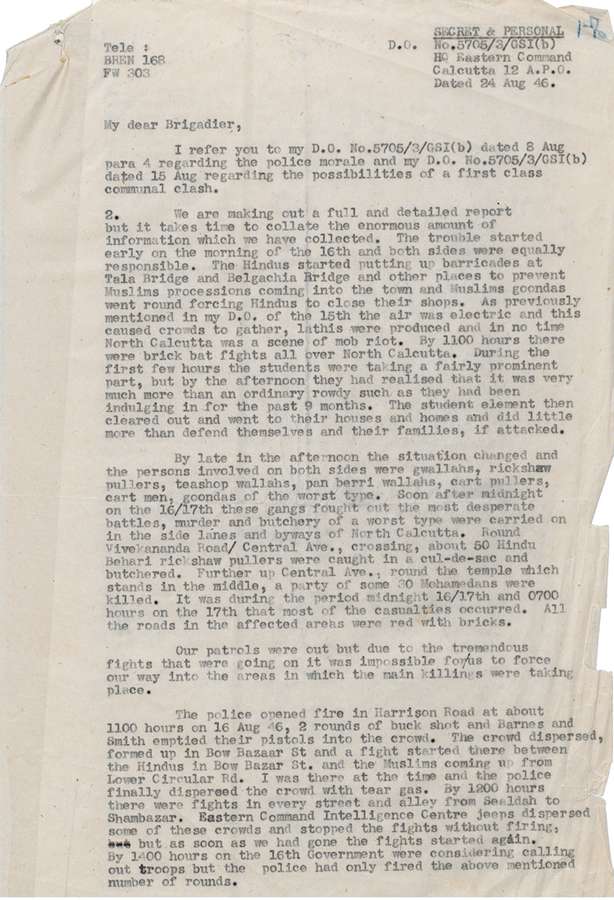
2. We are making out a full and detailed report but it takes time to collate the enormous amount of information which we have collected. The trouble started early on the morning of the 16th and both sites were equally responsible. The Hindus started putting up barricades at Tala Bridge and Belgachia Bridge and other places to prevent Muslims processions coming into the town and Muslims goondas went round forcing Hindus to close their shops. As previously mentioned in my D.O. of the 15th the air was electric and this caused crowds to gather, lathis were produced and in no time North Calcutta was a scene of mob riot. By 1100 hours there were brick bat fights all over North Calcutta. During the first few hours the students were taking a fairly prominent part, but by the afternoon they had realised that it was very much more than an ordinary rowdy such as they had been indulging in for the past 9 months. The student element then cleared out and went to their houses and homes and did little more than defend themselves and their families if attacked.
By late in the afternoon the situation changed and the persons involved on both sides were gwallahs, rickshaw pullers, teashop wallahs, pan berri wallahs, cart pullers, cart men, goondas of the worst type. Soon after midnight on the 16/17th these gangs fought out the most desperate battles, murder and butchery of a worst type were carried on in the side lanes and byways of North Calcutta. Round Vivekananda Road/ Central Ave., crossing about 50 Hindu Behari rickshaw pullers were caught in a cul-de-sac and butchered. Further up Central Ave., round the temple which stands in the middle, a party of some 30 Mohamedans were killed. It was during the period midnight 16/17th and 0700 hours on the 17th that most of the casualties occurred. All the roads in the affected areas were red with bricks.
Our patrols were out but due to the tremendous fights that were going on it was impossible for us to force our way into the areas in which the main killings were taking place.
The police opened fire in Harrison Road at about 1100 hours on 16 Aug 1946, 2 rounds of buck shot and and Barnes and Smith emptied their pistols into the crowd. The crowd dispersed, formed up in Bow Bazaar St and a fight started between the Hindus in Bow Bazaar St. and the Muslims coming up from Lower Circular Rd. I was there at the time and the police finally dispersed the crowd with tear gas. By 1200 hours there were fights in every street and alley from Sealdah to Shambazar. Eastern Command Intelligence Centre jeeps dispersed some of these crowds and stopped the fights without firing, but as soon as we had gone the fights started again. By 1400 hours on the 16th Government were considering calling out troops but the police had only fired the above mentioned number of rounds.
The first page of a military report on the Calcutta riots, 24 August 1946. Catalogue reference: WO 216/662

…
3. Apart from a few senior officers, the police themselves were unwilling to open fire and I don’t blame them. If they had done so and succeeded in quelling the outbreak, but mind you they would only haw succeeded if they had fired quickly and a very large number of rounds, they would have been blamed for unnecessary firing.
…
I don’t say that the whole riot could have been quelled by the Calcutta Police without the aid of military support, but I am confident that if all ranks had known that they would be supported to the hilt, nothing like the state of affairs which occurred would have taken place. There is no doubt that this situation will be put right in the very near future and I trust it will be an example to other provinces.
…
5. One of the most interesting points was that Europeans were not attacked. No bricks were thrown at army lorries except In stray cases, or when they took an active part in dispersing mobs. In fact, both sides were only too pleased to offer advice as to how to act and beat up the other side.
6. From the time the riots started every little blacksmith was working like mad in his house manufacturing spears, rods and knives. The iron rods used in reinforced concrete building works were all stolen and sharpened at both ends, and the butchery that these crude weapons did has got to be seen to be believed. Men, women and children were slaughtered by both sides indiscriminately and when Mullick Bazar was burnt three Hindu children were thrown into the flames.
7. The result of this riot has been complete mistrust between the two communities. Most of the Babus dare not go to their offices because they have to pass through Muslim areas, and they are afraid of being stabbed. Though the city is quiet there are still stabbing cases and both sides are very very frightened. The trams are running today (22nd). There are buses and taxis and the city is fast returning to normal. We have cleaned up practically all the corpses, D.D.T. has been sprayed and everything possible has been done.
8. There is a lot of talk in the town that the army should have been called in in aid of civil power earlier during the riot. Personally, I think that it would have been a mistake if this had been done. It is the duty of the police to first try and quell a disturbance and only when they had expanded all the power they have, then should the troops be called in.
…
11. There is hardly a person in Calcutta who has a good word for Suhrawardy, respectable Muslims included. For years he has been known as “The king of the goondas” and my own private opinion is that he fully anticipated what was going to happen, and allowed it to work itself up, and probably organised the disturbance with his goonda gangs as this type of individual has to receive compensation every now and again. It is difficult to estimate the number of casualties but I should say it is somewhere in the region of 2 to 3 thousand at least. There were corpses all over North Calcutta, they were in the river, canals, side lanes, in fact, everywhere. The number of shops looted and burnt must be somewhere in the region of 2 to 3 thousand. I personally think that the killings of both sides were fifty, fifty, or if anything, more Muslims than Hindus, but damage financially has been much greater to the Hindus than to the Muslims.
Further extracts from a military report on the Calcutta riots, 24 August 1946. Catalogue reference: WO 216/662
Listen
We are making out a full and detailed report but it takes time to collate the enormous amount of information which we have collected. The trouble started early on the morning of the 16th and both sites were equally responsible. The Hindus started putting up barricades at Tala Bridge and Belgachia Bridge and other places to prevent Muslims processions coming into the town and Muslims goondas went round forcing Hindus to close their shops. As previously mentioned in my D.O. of the 15th the air was electric and this caused crowds to gather, lathis were produced and in no time North Calcutta was a scene of mob riot. By 1100 hours there were brick bat fights all over North Calcutta. During the first few hours the students were taking a fairly prominent part, but by the afternoon they had realised that it was very much more than an ordinary rowdy such as they had been indulging in for the past 9 months. The student element then cleared out and went to their houses and homes and did little more than defend themselves and their families if attacked.
By late in the afternoon the situation changed and the persons involved on both sides were gwallahs, rickshaw pullers, teashop wallahs, pan berri wallahs, cart pullers, cart men, goondas of the worst type. Soon after midnight on the 16/17th these gangs fought out the most desperate battles, murder and butchery of a worst type were carried on in the side lanes and byways of North Calcutta. Round Vivekananda Road/ Central Ave., crossing about 50 Hindu Behari rickshaw pullers were caught in a cul-de-sac and butchered. Further up Central Ave., round the temple which stands in the middle, a party of some 30 Mohamedans were killed. It was during the period midnight 16/17th and 0700 hours on the 17th that most of the casualties occurred. All the roads in the affected areas were red with bricks.
Our patrols were out but due to the tremendous fights that were going on it was impossible for us to force our way into the areas in which the main killings were taking place.
The police opened fire in Harrison Road at about 1100 hours on 16 Aug 1946, 2 rounds of buck shot and and Barnes and Smith emptied their pistols into the crowd. The crowd dispersed, formed up in Bow Bazaar St and a fight started between the Hindus in Bow Bazaar St. and the Muslims coming up from Lower Circular Rd. I was there at the time and the police finally dispersed the crowd with tear gas. By 1200 hours there were fights in every street and alley from Sealdah to Shambazar. Eastern Command Intelligence Centre jeeps dispersed some of these crowds and stopped the fights without firing, but as soon as we had gone the fights started again. By 1400 hours on the 16th Government were considering calling out troops but the police had only fired the above mentioned number of rounds.
…
3. Apart from a few senior officers, the police themselves were unwilling to open fire and I don’t blame them. If they had done so and succeeded in quelling the outbreak, but mind you they would only haw succeeded if they had fired quickly and a very large number of rounds, they would have been blamed for unnecessary firing.
…
I don’t say that the whole riot could have been quelled by the Calcutta Police without the aid of military support, but I am confident that if all ranks had known that they would be supported to the hilt, nothing like the state of affairs which occurred would have taken place. There is no doubt that this situation will be put right in the very near future and I trust it will be an example to other provinces.
…
One of the most interesting points was that Europeans were not attacked. No bricks were thrown at army lorries except In stray cases, or when they took an active part in dispersing mobs. In fact, both sides were only too pleased to offer advice as to how to act and beat up the other side.
From the time the riots started every little blacksmith was working like mad in his house manufacturing spears, rods and knives. The iron rods used in reinforced concrete building works were all stolen and sharpened at both ends, and the butchery that these crude weapons did has got to be seen to be believed. Men, women and children were slaughtered by both sides indiscriminately and when Mullick Bazar was burnt three Hindu children were thrown into the flames.
The result of this riot has been complete mistrust between the two communities. Most of the Babus dare not go to their offices because they have to pass through Muslim areas, and they are afraid of being stabbed. Though the city is quiet there are still stabbing cases and both sides are very very frightened. The trams are running today (22nd). There are buses and taxis and the city is fast returning to normal. We have cleaned up practically all the corpses, D.D.T. has been sprayed and everything possible has been done.
There is a lot of talk in the town that the army should have been called in in aid of civil power earlier during the riot. Personally, I think that it would have been a mistake if this had been done. It is the duty of the police to first try and quell a disturbance and only when they had expanded all the power they have, then should the troops be called in.
…
There is hardly a person in Calcutta who has a good word for Suhrawardy, respectable Muslims included. For years he has been known as “The king of the goondas” and my own private opinion is that he fully anticipated what was going to happen, and allowed it to work itself up, and probably organised the disturbance with his goonda gangs as this type of individual has to receive compensation every now and again. It is difficult to estimate the number of casualties but I should say it is somewhere in the region of 2 to 3 thousand at least. There were corpses all over North Calcutta, they were in the river, canals, side lanes, in fact, everywhere. The number of shops looted and burnt must be somewhere in the region of 2 to 3 thousand. I personally think that the killings of both sides were fifty, fifty, or if anything, more Muslims than Hindus, but damage financially has been much greater to the Hindus than to the Muslims.
The purpose of this document collection is to allow students and teachers to develop their own lines of historical enquiry or historical questions using original documents on this period of history.
Students could work with a group of sources or particular document series which identifies a certain theme. Of course the sources offer students a chance to develop their powers of evaluation and analysis and support their course work.
Teachers may wish to use the collection to develop their own resources or encourage students to ‘curate’ their own ‘exhibition’ of the most significant documents on the topic.
The background information helps you to understand the causes for Indian partition, how it happened, how was it experienced by ordinary people, and how we can know more about it through primary sources and oral history sources. Some suggestions for further reading are also provided.
Before the British colonial officials left India in 1947, the subcontinent was divided into two different nations: India and Pakistan. India came to be ruled by the nationalist Congress Party under Pandit Jawaharlal Nehru’s prime ministership, and Pakistan by the Muslim League under the leadership of Muhammad Ali Jinnah.
The emergence of two nations was premised on religious divide – Pakistan for Muslims and India for Hindus, though India chose to become a secular republic. About 35 million Muslims remained in secular India. The origins of partition stretch back to the politics of nationalist leaders and the colonial state since the 1940s onwards.
To secure Indian cooperation in the Second World War, the Churchill government agreed to send the Cripps Mission in 1942 to resolve the Indian political situation. Though it failed to satisfy nationalist leaders, the Mission proposed the idea of independence for India after the war.
As the tide of anti-colonial nationalism began to shape the demand for an independent nation, the Muslim League Party under Jinnah began to mobilise the different classes of Muslims to demand Muslim’s right for self-determination. The demand for Pakistan as a separate territorial nation remained fluid and limited in the early 1940s, but during the provincial elections, the League mobilised Muslims, especially the lower and middle classes, in the name of Pakistan. The huge electorate mandate of the League in Muslim regions increased and popularised the demand for a separate nation for Muslims.
The British not only helped to consolidate the Muslim League in the East and the West by installing League ministries in 1942–43, but they also aired the idea that regions could secede from the Union through the Cripps Mission, legitimising Jinnah’s call.
The Congress Party under M.K. Gandhi, Nehru, and other leaders demanded a free united India. It was not acceptable to Jinnah who in his 1945 speech said, 'Whereas a united India means slavery for Mussulmans and complete domination of the imperialistic caste Hinduraj throughout this sub-continent.'
The Quit India Movement of Gandhi, the cost of the Second World War, and the Indian Naval Mutiny in 1946 made Britain realise that India could no longer be ruled. Hence, the newly formed Labour Party British government under Clement Attlee in July 1945, which was sympathetic to India’s self-determination but determined to safeguard British economic interest and influence in South Asia, sent a Cabinet Mission in 1946 to discuss the formation of independent India. The Mission failed and the League called for a popular agitation for Pakistan demand which led to killings of Hindus by Muslims in Calcutta accompanied by a reactionary violence by Hindus in Calcutta and other parts of India.
The British decided to leave by June 1948, but the Viceroy Louis Mountbatten moved this forward to August 1947. The press in the USA praised Attlee’s decision of actual withdrawal as otherwise, the New York Herald Tribune noted, 'The British might easily have lingered on in India, playing off Hindu against Moslem, prince against peasant, presiding over a tense and costly stalemate in the interests of imperial prestige.'
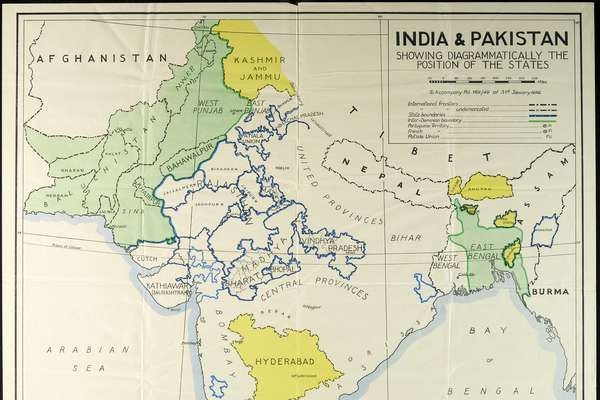
Sir Cyril Radcliffe was asked to draw border lines of the two nations within six weeks. As Muslims concentrated on both the East and the West side of British India, Pakistan was split into two awkward regions: the West-side Pakistan and the East Pakistan (which became Bangladesh in 1971). Jinnah was unhappy with a truncated Bengal and Punjab, though his goal of a sovereign nation for Muslims was achieved.
What followed the creation of Pakistan on 14 August 1947 was a large migration of Hindus and Sikhs from Pakistan to India and of Muslims to Pakistan. This resulted in deadly communal violence between the two communities amidst building tensions on religious lines, lack of law and order at the time of quick power transfer and uncertain migration.
About one million people died, more than 75,000 women were raped, and 10 million people were displaced along with a huge destruction of property. The horrors of partition violence left a never-ending legacy onto the families and psyche of migrants who lost their homes, family members, experienced significant years of life in harsh displacement (migrant camps and refugee colonies) and witnessed violence first hand.
Although historians’ focus has moved away from determining the causes of the partition and the role of elites to the meanings of partition and its violence on the two communities, this document collection of official papers covers key moments leading to the partition between 1939–47: the Second World War, the ideas of Indian nationalist leaders and their differences such as between Jinnah, Gandhi and Bose, what the British officials’ thought on the transfer of power, the partition violence, and the fate of Pakistan.
Background information written by:
Teaching resource
This set of documents allows key stage 4 and 5 students to explore the subject of Indian independence and partition in 1947. Part two covers the events of 1947.
1947partitionarchive.org.uk
Access more than 12,000 oral history interviews with witnesses of the partition of India.
projectdastaan.org
Watch a virtual reality experience marking the 75th anniversary of Indian partition.
nam.ac.uk
Browse information from the National Army Museum on the impact of partition, including a video called ‘Reflections and Recollections’.