





bbc.co.uk
Hitler's life
This BBC Bitesize timeline of Hitler's life spans from his early childhood to his death in 1945.
Teaching resource
Use the sources in this lesson to find out how Adolf Hitler was viewed by foreign commentators in the 1930s and 40s. Was he to be regarded as a ‘passionate lunatic’ who would take over Europe? Or an odd eccentric who was rebuilding Germany?

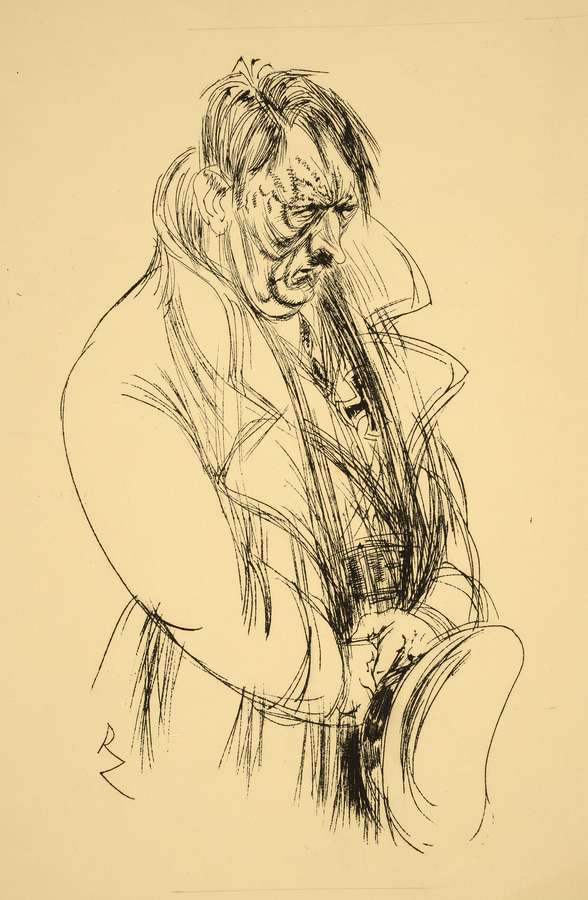
Hitler in distress by Richard Ziegler, around 1944. Catalogue reference: INF 3/1298
Was Hitler a 'passionate lunatic'?
This report from 1937 is from a Mr Law, a British businessman who worked in Germany.

I am told, on what I believe to be very good German authority, that really the most dangerous man of all is the Fuhrer himself. He falls into fits of passion and will listen to no advice. It was on his orders and against the advice of the Foreign Office and the army that recently an American was beheaded. It was again on his direct orders and before he could receive any advice that the bombardment of Almeria took place.
If this is true – as I believe it to be – the picture is not a cheerful one Noone wants war; certainly, but when you have a passionate lunatic at the top who still commands the devotion of the populace and who is evidently prepared to run great risks, then already the situation is dangerous. But when, besides that, the Russian army appears not exactly at the height of its efficiency, when (as it is believed in Germany) France is tottering on the edge of communism and Franco is at the gates of Bilbao, then we ought to be on our guard.
I was told in Berlin that another publicity campaign was contemplated in England by those English people who are advocating close relations with Germany. This I am informed both by Englishmen in Berlin and by patriotic Germans who do not like Nazi-ism would be at this juncture a most disastrous mistake. No further advances should be made to Germany at the present time.
Report from Mr Law, 1937. Catalogue reference: FO 371/20733
This is a report on a conversation with Count Bernstorff, a German anti-Nazi campaigner.

I had a talk last night with COUNT ALBRECHT BERNSTORFF, who has just arrived in London from Berlin. As is well known, he is a rabid anti-Nazi, and this fact must be taken into consideration in estimating the truth of his remarks. He was as usual full of stories and most entertaining. Compared with other opponents of the regeme whom I know, his boldness is amazing, and he does not suffer, as most do, from the nervous glance over the shoulder (Known as “der deutsche Blick”) when speaking about conditions in Germany. I record some of his remarks in case they are of interest.
Count Bernstorff said that Herr Hitler has lately been more frequently subject to fits, in the course of which he foams at the mouth and becomes very violent. One such fit occurred a short time ago when he drove through Munich and saw that the rebuilding which he had planned was not progressing as fast as he had expected. On being told that the reason was the lack of iron and steel, he developed a fit and became so violent that he had to be restrained by his A.D.C’s til a doctor could be sent for to give him a sedative injection. Herr Hitler’s main occupation nowadays is town-planning and he plays about all day long with models of Berlin, Nuremburg and Munich. He takes practically no interest in anything else. None of his Ministers, except Goebbels and Goering, can be certain of access to him. His favourite companions are men such as Julius Streicher. Goebbels is, according to Count Bernstorff, somewhat out of favour at the moment and has lost his influence in the country. Nevertheless, Hitler continues to use him as a source of ideas which he work up in his speeches.
Report on a conversation with Count Bernstorff, 1937. Catalogue reference: FO 371/20733
This drawing by Richard Ziegler was produced by the Ministry of Information, which was responsible for publicity and propaganda in the Second World War. It also controlled news and press censorship, home publicity, and overseas publicity in Allied and neutral countries.

Hitler in distress by Richard Ziegler, around 1944. Catalogue reference: INF 3/1298
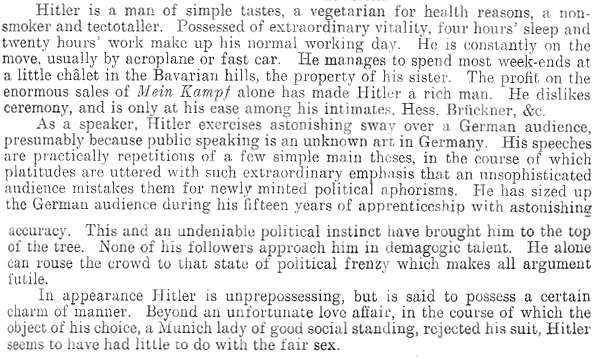
This is a a short description of Hitler prepared by the British Embassy in Berlin.

Hitler is a man of simple tastes, a vegetarian for health reasons, a non-smoker and teetotaller. Possessed of extraordinary vitality, four hours' sleep and twenty hours' work make up his normal working day. He is constantly on the move, usually by aeroplane or fast car. He manages to spend most week-ends at a little châlet in the Bavarian hills, the property of his sister. The profit on the enormous sales of Mein Kampf alone has made Hitler a rich man. He dislikes ceremony, and is only at his ease among his intimates, Hess Brückner, &c.
As a speaker, Hitler exercises astonishing sway over a German audience, presumably because public speaking is an unknown art in Germany. His speeches are practically repetitions of a few simple main theses, in the course of which platitudes are uttered with such extraordinary emphasis that an unsophisticated audience mistakes them for newly minted political aphorisms. He has sized up the German audience during his fifteen years of apprenticeship with astonishing accuracy. This and an undeniable political instinct have brought him to the top of the tree. None of his followers approach him in demagogic talent. He alone can rouse the crowd to that stage of political frenzy which makes all argument futile.
In appearance, Hitler is unprepossessing but is said to possess a certain charm of manner. Beyond an unfortunate love affair, in the course of which the object of his choice, a Munich lady of good social standing, rejected his suit, Hitler seems to have had little to do with the fair sex.
A short description of Hitler prepared by the British Embassy in Berlin January, 1937. Catalogue reference: FO 408/67
The purpose of this lesson is to encourage students to handle conflicting evidence on the character and personality of Hitler and assess their reliability. The first source is an extract from a report by Mr. Law, a British businessman, who worked in Germany provided to the Foreign Office.
The second is an extract from an account given by Johann Heinrich Count von Bernstorff, a founding member of the German Democratic Party and a supporter of the League of Nations. He left Germany in 1933 when the Nazis came to power. Both sources present a very unfavourable view of Hitler.
Students later examine a drawing which presents him differently. Why is this the case? The final source offers yet another angle. It is a short description of Hitler prepared by the British Embassy in Berlin. Students are required to contrast this to the earlier sources and consider what factors make a ‘reliable’ source. Does this impact on the value of a source or not?
All sources are provided with transcripts. Students could work on the sources individually or pairs and report back to the group with their findings.
The lesson can also be used as an introduction to a wider enquiry into appeasement and the decisions made by the British Government and others before the outbreak of the war in 1939. Students could use the background notes as a starting point for researching the wider context of appeasement.
Challenges for Britain, Europe and the wider world 1901 to the present day: the inter-war years: the Great Depression and the rise of dictators
Using the sources above, students could prepare a report for the British Government. Their report should:
Students could also research how Hitler expanded German territory and power in Europe before the outbreak of the Second World War.
When Hitler came to power in Germany in 1933 some people regarded him as a strong leader merely getting back German territory and restoring Germany’s national pride. They thought he would stop once he had reversed the terms the Treaty of Versailles which limited the power and strength of Germany. Hitler acted against the terms of the Treaty of Versailles by re-arming and re-building the German army through conscription (1935). He also moved troops into the di-militarised Rhineland (1936). He also tried to unite Germany and Austria with the ‘Anschluss’ (1938). Later that year he demanded the Sudetenland, the German speaking part of Czechoslovakia.
Throughout this time, he made passionate speeches about expanding German territory. These words and deeds worried foreign observers. Others feared that this was only the beginning of a far more aggressive foreign policy. They were to be proved right by Hitler’s decision to takeover of the whole of Czechoslovakia in 1939 after annexing the Sudetenland in 1938. Germany then invaded Poland, bringing about the beginning of the Second World War.
How the British government dealt with Hitler in the run up to the outbreak of the Second World War has come under scrutiny. Of course, at the time, Winston Churchill, no longer in Government from the early 1930s, was a significant critic of the Munich Agreement which allowed Germany to take over Sudetenland in Czechoslovakia an attempt to prevent a war. Churchill continued to criticize Hitler and call for Britain to rearm. When war was declared with Germany in 1939, he returned to power as First Lord of the Admiralty and later became wartime Prime Minister of a national government on 10 May 1940.
Appeasement was the name given to Britain’s policy in the 1930s which permitted Hitler to expand German territory unchecked and did little to stop him in his early moves against the Treaty of Versailles. It was closely linked to the Prime Minister at the time, Neville Chamberlain and was popular although is now regarded as a policy of weakness.
Appeasement found support with the British public who wanted to avoid the huge losses of the First World War. There was a strong anti-war or pacifist sentiment. Britain could not afford the financial cost of another war, nor could France, the country’s main ally.
Of course, to have stopped Hitler might have meant declaring war – a massive decision when most countries wanted to avoid war at all costs. Britain kept a close watch on developments in Germany. The government was very interested in Hitler’s personality. They wanted to find out what he was like, what he wanted to achieve for Germany, what kind of leader he was and, strangely enough, if he was sane.
bbc.co.uk
This BBC Bitesize timeline of Hitler's life spans from his early childhood to his death in 1945.
encyclopedia.ushmm.org
This timeline from The American National Holocaust Museum covers the period from 1933-38
Teaching resource

Use this lesson to explore documents concerning the meeting between Hitler and Chamberlain in 1938 and advice given to the Prime Minister in Britain.