






winstonchurchill.org
Churchill's speech on the Munich Agreement
Read Churchill's response to the Munich Agreement.
Teaching resource
In September 1938, British Prime Minister, Neville Chamberlain, flew to meet Hitler at his private mountain retreat to try and resolve an urgent situation in Czechoslovakia. This lesson explores original documents concerning the meeting and advice given to Chamberlain at home in Britain.

Caricature of Neville Chamberlain. Catalogue reference: INF 3/46
How useful are these documents in evaluating the foreign policy of Neville Chamberlain?
Watch Education Officer Kat as she introduces a document related to an agreement made between Neville Chamberlain and Adolf Hitler in 1938, just one year before the outbreak of the Second World War.
Watch
Hello, my name's Catherine and I'm an Education Officer at The National Archives.
Today we're going to be working together on one document from our collection, practising some key history skills and finding out how it can help us understand an important period of our history.
Let's see which box we're looking in today.
As you can see, every box has a unique code.
We have over 11 million of these boxes.
The code tells us which government department it comes from.
This can often reveal clues about what's inside.
For example, HO stands for Home Office and MEPO stands for Metropolitan Police.
Ours has the code p-r-e-m, PREM.
What do you think that stands for?
Before we open the box and find out what documents inside, I want you to think about what questions you should ask about a historical document that you've never seen before.
For example, what type of document is it?
Is it a newspaper or a photograph?
Sometimes this is obvious, other times it's not so clear.
I'm going to give you 30 seconds to come up with a few more questions we could ask.
Start thinking in 3 2 1.
Off you go.
Well done.
Let's see if we came up with similar questions we could ask what is it about?
Or what is the content of the document?
When was it made?
Is there a date or do we have to work it out?
From other clues?
Who made it or what is its origin?
Who's it for?
Perhaps we can answer these questions easily, or we might need to try and work them out.
Why was it made and what's its purpose?
And the last one, why do we have it at the National Archives?
In the next ten minutes, we're going to work together to find the answers to these questions.
Now we're going to find out what's inside the box and take a look at the document we are working on today.
At first I'm only going to give you five seconds to see what you can spot straight away.
Get ready, go, time's up.
That wasn't long, but I'm sure you have some suggestions already.
Let's point out some basic features of the document first.
Did you notice that the page is a little crumpled and ragged at the edges?
The text has been produced using a typewriter too.
That could give us some ideas about the date.
Also, it's been hole punched in the corner and just above that it says copy.
I wonder if that means that this is not the original.
There's a number handwritten in the other corner #46 is that a page number or a date, do you think?
It's also quite short.
It doesn't take up the whole page.
Does this mean that this is a complete document, or is it part of something larger?
Let's take a closer look and see what more we can find out.
I'll put up a timer for 60 seconds this time, as the document is quite short, we can read the whole thing.
Can you find a date?
What names can you see and what are some of the keywords and phrases?
Off you go.
Right, let's see what we've discovered.
If we start at the end of the document, we have some very useful information, a date and some interesting names.
The date reads September the 30th, 1938, which is almost exactly one year before the outbreak of the Second World War.
So we have a clear date for when this document was produced.
The two names are A Hitler and Neville Chamberlain.
It says signed in brackets by their names.
Although there aren't any signatures on this document, I'm sure you know that A Hitler stands for Adolf Hitler.
Who was the Fuhrer or leader of Germany at this time?
Neville Chamberlain was the British Prime Minister.
So we have two important people connected to this document.
What phrases stood out to you?
They give us some insight into the content of this document and also its purpose.
In the first paragraph it talks about Anglo German relations, which is the relationship between Britain and Germany.
In the second it says never to go to war with one another again.
And in the third there is the word peace.
So we can be confident that this document is about the desire to prevent war from happening between these two countries.
But how?
If we look again, we can find out.
If we go back to the first paragraph, it tells us that the German Fuhrer and the British Prime Minister have had a further meeting today.
This tells us that the two leaders have met in person to discuss this issue, but it also tells us that they are in agreement about the importance of having a good relationship not only for their countries, but for the rest of Europe.
Paragraph two tells us that the leaders signed an agreement last night and also mentions a naval agreement, which means they've met on at least two occasions and the meetings have produced these agreements.
The third paragraph talks about removing possible sources of difference.
The language used is also interesting in the second paragraph, describing the agreements as being symbolic of the desire of our two peoples.
This means these agreements represent the will of the people in their respective countries, not just the leaders themselves.
In the last paragraph, strong phrases such as we are resolved and we are determined suggest that these meetings and the agreements that came out of them are important and the leaders strongly support them.
There is a clear sense that through the method of consultation, in other words open and regular discussions, peace in Europe will be assured.
Before we think about the context of this document, let's return to the document code for a moment to see what else this tells us.
Our document comes from a box with a rather long code.
It starts with PREM.
Do you remember at the start of the session I told you that the codes tell us which government department the documents come from?
For example, HO stands for Home Office and FO stands for Foreign Office.
What do you think PREM stands for?
It's a bit of a tricky one.
It actually stands for the Prime Minister's Office.
PREM 1 covers a relatively long time period from 1916 to 1940, and includes official correspondence of a successive Prime Minister's Second World War policy and operational papers, as well as other things.
So we know from the date of the document and the names on the document that it comes from 1938, when Neville Chamberlain was the British Prime Minister.
The fact that it is included in the PREM 1 document series hints at its importance.
So time to reveal a little more about the context of this document.
Do you remember the word copy is at the top of this document?
It is in fact a copy of the Anglo German Agreement of Cooperation.
The original has signatures of both Hitler and Chamberlain on it.
This agreement was made in Munich, Germany between the two leaders and came at a time when tensions in Europe were very high.
The day before, Chamberlain had met with Hitler and the Italian and French Prime ministers Benito Mussolini and Édouard Daladier to discuss Hitler's demands on Czechoslovakia.
The Munich Agreement came out of this meeting on the 29th of September.
A copy of this agreement signed by the four leaders is also held at The National Archives.
The British Prime Minister, Neville Chamberlain, sought to avoid war with Germany through a policy of appeasement.
This was a diplomatic tactic which meant offering concessions to an aggressive nation in an attempt to avoid war or at least delay war.
Chamberlain returned immediately to London, apparently convinced that he'd achieved peace for our time.
However, this prediction of a lasting peace could not have been more wrong.
The Munich Agreement has been interpreted as a major failure of the policy of appeasement, which encouraged further aggressive actions by Hitler.
It's also been argued that the postponement of war with Germany gave the British government another year to build up its armed forces.
What do you think?
You're now really well prepared to go on to the rest of the lesson which looks at the lead up to these agreements.
I'm sure you'll have lots to say about what Chamberlain was trying to achieve, and like real historians, you'll be able to use archival evidence to support and inform your views.
Well done for all your hard work today.
Enjoy the rest of the lesson.
See you next time.
These are extracts from a letter written by Nevile Henderson, British Ambassador in Germany.

It is no exaggeration to say that the world is awaiting with anxiety the message which Hitler has to deliver at Nuremberg. He cannot get out of delivering it: that must be realised. The anxiety is no less great in Germany than elsewhere. And dictators can & must speak more clearly than the leaders of a democracy, that is why I have been pressing these last weeks for a clarification before Nuremberg of the situation at Prague. Benes [President of Czechoslavakia] will never go far enough till he is made to do so: & the whole of the Carlsbad points is better than any terms he is likely to get later, war or no war.
Extract from a letter from Nevile Henderson, British Ambassador in Germany, September 6th, 1938. Catalogue reference: FO 371/21737

I suppose the chances of Hitler coming out at Nuremberg with what will amount to peace or what will amount to war (thunder there is sure to be) are about 50-50. I opt for the former. If I am right I do wish it might be possible to get at any rate the Times, Camrose, Beaverbrook Press etc to write up Hitler as an apostle of Peace. It will be terribly shortsighted if this is not done. Cannot the News Dept help?
[Camrose was the owner of the Daily Telegraph at the time, Lord Beaverbrook owned the Daily Express]
Extract from a letter from Nevile Henderson, British Ambassador in Germany, September 6th, 1938. Catalogue reference: FO 371/21737

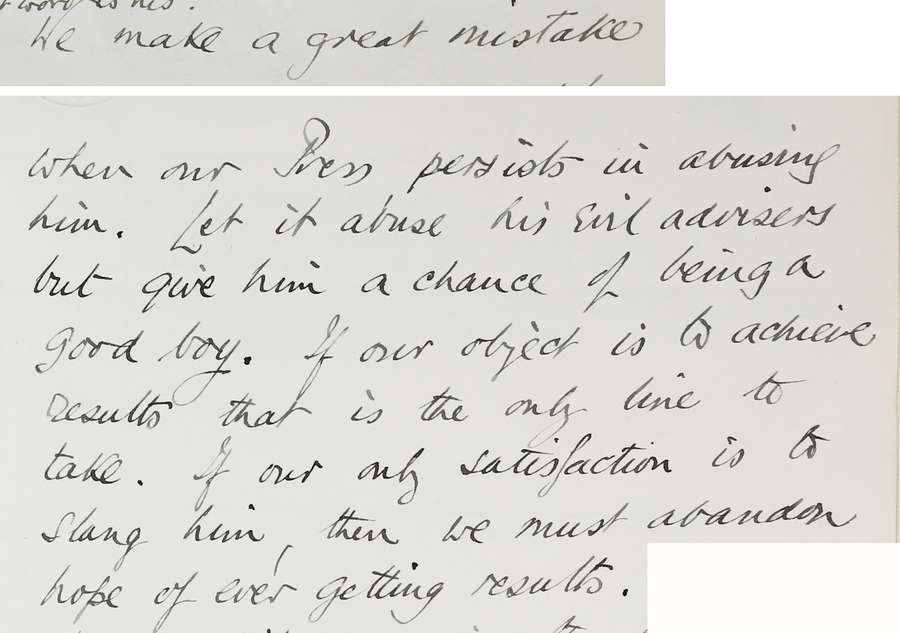
We make a great mistake when our Press persists in abusing him. Let it abuse his evil advisers but give him a chance of being a good boy. If our object is to achieve results that is the only line to take. If our only satisfaction is to slang him, then we must abandon hope of ever getting results.
Extract from a letter from Nevile Henderson, British Ambassador in Germany, 6 September 1938. Catalogue reference: FO 371/21737
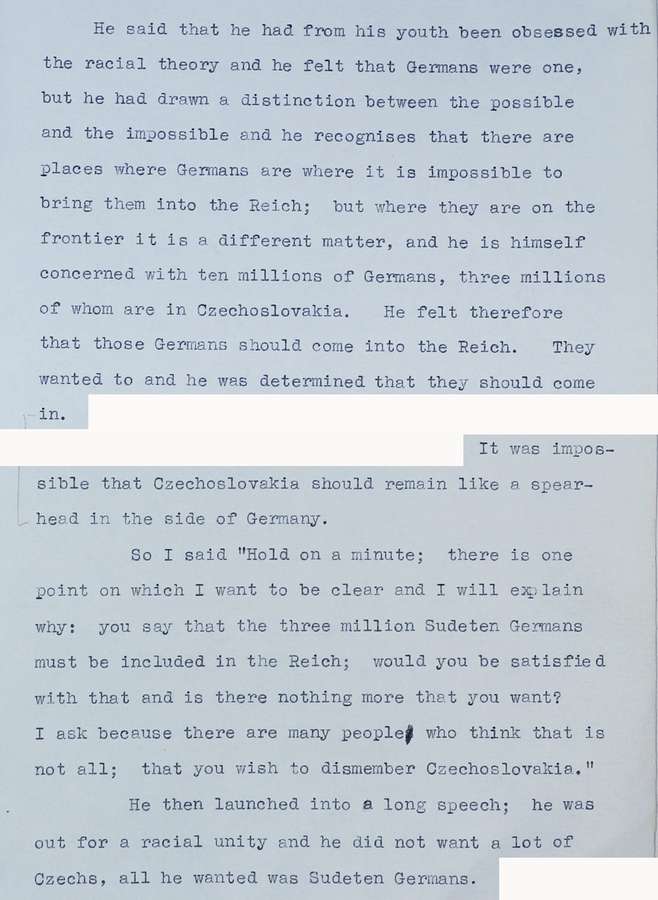
These extracts are taken from the minutes of the conversation between Chamberlain and Hitler at Berchtesgaden in 1938.

He said that he had from his youth been obsessed with the racial theory and he felt that the Germans were one, but he had drawn a distinction between the possible and the impossible and he recognised that there are places where Germans are where it is impossible to bring them into the Reich; but where they are on the frontier, it is a different matter, and he is himself concerned with ten millions of Germans, three millions of whom are in Czechoslovakia. He felt therefore that those Germans should come into the Reich. They wanted to and he was determined that they should come in.
It was impossible that Czechoslovakia should remain like a spearhead in the side of Germany –
So I said “Hold on a minute; there is one point on which I want to be clear and I will explain why: you say that the three million Sudeten Germans must be included in the Reich; would you be satisfied with that and is there nothing more that you want? I ask because there are many people who think that is not all; that you wish to dismember Czechoslovakia.”
He then launched into a long speech; he was out for a racial unity and he did not want a lot of Czechs, all he wanted was Sudeten Germans
Extract from the minutes of the conversation between Neville Chamberlain and Adolf Hitler at Berchtesgaden. Catalogue reference: FO 371/21738

I was then going on to some further questions on the subject when he said: “But all this seems to be academic; I want to get down to realities. Three hundred Sudetens have been killed and things of that kind cannot go on; the thing has got to be settled at once: I am determined to settle it: I do not care whether there is a world war or not: I am determined to settle it and to settle it soon and I am prepared to risk a world war rather than allow this to drag on.”
To that I replied: “If the Fuehrer is determined to settle this matter by force without waiting even for a discussion between ourselves to take place what did he let me come here for? I have wasted my time.
Extract from the minutes of the conversation between Neville Chamberlain and Adolf Hitler at Berchtesgaden. Catalogue reference: FO 371/21738

But I could give him my personal opinion which was that on principle I had nothing to say against the separation of the Sudeten Germans from the rest of Czechoslovakia, provided that the practical difficulties could be overcome.
Extract from the minutes of the conversation between Neville Chamberlain and Adolf Hitler at Berchtesgaden. Catalogue reference: FO 371/21738
This is the conclusion of a note from General Ismay to the British Cabinet sent on 20 September 1938, marked ‘Secret’. Ismay was Secretary of the Committee of Imperial Defence.

15. The broad conclusions of this Note may be summarized as follows :-
(a) A German absorption of Czechoslovakia will enhance her military prestige, increase her war potential and probably enable her to dispose of stronger land forces against France and ourselves than she can do at present.
(b) So far as air power is concerned, Germany may be able to maintain her lead over the Franco-British Air Forces in air striking power. On the other hand, it is open to us, provided that we make the necessary effort, to catch her up, or at least greatly reduce her lead, in the matter of defence (both active and passive) against air attack. By so doing we shall have heavily insured ourselves against the greatest danger to which we are present exposed: indeed by substantially reducing Germany’s only chance of a rapid decision, we shall have provided a strong deterrent against her making the attempt.
(c) It follows, therefore, that, from the military point of view, time is in our favour, and that, if war with Germany has to come, it would be better to fight her in say 6-12 months’ time, than to accept the present challenge.
Conclusion of note from General Ismay to the British Cabinet sent on 20 September 1938. Catalogue reference: CAB 21/544
This lesson has a video starter to hook students into the lesson.
Students examine extracts from a letter written by Sir Nevile Meyrick Henderson, British Ambassador in Germany, on 6 September 1938.
Then, they analyse three extracts from the minutes of the conversation between Chamberlain and Hitler at Berchtesgaden. These provide insight in the arguments presented by both leaders on question of Sudetenland. What criticisms can be made of Chamberlain? His assessment of Hitler? His national self-centredness in his failure to consult with his allies and his readiness to sacrifice the Czechs?
The final source in the lesson is the conclusion of a secret note from General Ismay to the British Cabinet sent on 20 September 1938. Ismay was Secretary of the Committee of Imperial Defence. Students examine its contents to see what it reveals about the Government’s views concerning the German absorption of Czechoslovakia.
In the conclusion of the lesson, students are tasked to make their own assessment of Chamberlain’s appeasement policy over Sudetenland. Perhaps, it is important to make the point that the release documents that were previously deemed secret can add different perspectives to this issue.
All sources are provided with transcripts. Students could work on the sources individually or pairs and report back to the group with their findings.
Challenges for Britain, Europe and the wider world 1901 to the present day: the inter-war years: the Great Depression and the rise of dictators
Chamberlain was of the generation that survived but was deeply revolted by the First World War. Is it fair to criticise him for underestimating Hitler? Students could try to construct the case for Chamberlain. Is this the same as a case for appeasement?
Students could research the term ‘policy of appeasement’ in the 1930s as linked to Prime Minister Neville Chamberlain before the outbreak of the Second World War.
The Treaty of Versailles, made in 1919 at the end of the First World War, was intended to make a lasting peace. Many people felt that the Treaty had caused terrible resentment in Germany on which Hitler had been able to play to achieve power. The government believed that Hitler and Germany had genuine grievances, but that if these could be met (‘appeased’) Hitler would be satisfied and become less demanding.
Hitler was open about his refusal to accept many of the terms of the Treaty of Versailles. Soon after he became Chancellor of Germany in 1933, he began to re-arm the country, breaking the restrictions placed on the German armed forces. In 1936, he sent German troops into the Rhineland and in March 1938 he joined Germany and Austria
In September 1938 he turned his attention to the three million Germans living in part of Czechoslovakia called the Sudetenland. Sudeten Germans began protests and provoked violence from the Czech police. Hitler claimed that 300 Sudeten Germans had been killed. This was not actually the case, but Hitler used it as an excuse to place German troops along the Czech border. German Nazis in the Sudetenland were told to stir up the trouble that led to the crisis examined in this lesson. Edvard Benes, the leader of Czechoslovakia, was concerned that if Germany was given the Sudetenland, most of the Czech defences would be handed over to the Germans and they would be left defenceless.
Chamberlain’s flight to Berchtesgaden was followed by another to Godesberg a week later and then another to Munich on 29 September. At Munich, Chamberlain got an international agreement that Hitler should have the Sudetenland in exchange for Germany making no further demands for land in Europe. Chamberlain said it was ‘Peace for our time’. Hitler said he had ‘No more territorial demands to make in Europe.’ On 1 October German troops occupied the Sudetenland: Hitler had got what he wanted without firing a shot.
Although people in Britain were relieved that war had been averted, many now wondered if appeasement was the best decision. They did not think it would stop Hitler, and simply delayed the war, rather than prevented it. Even while Chamberlain was signing the Munich Agreement, he was agreeing a huge increase in spending to increase Britain’s armament in preparation for war. He must have known from the situation outlined to him by General Ismay, that Czechoslovakia was lost, that war was bound to come.
Six months later, in March 1939, German troops took over the rest of Czechoslovakia. Poland seemed to be the next most likely victim of Nazi aggression and Chamberlain made an agreement with the Poles to defend them in Germany invaded. Hitler did not think Britain would go to war over Poland, having failed to do so over Czechoslovakia. He sent his soldiers into Poland in September 1939. Two days later, Britain declared war on Germany.
Chamberlain struggled on as Prime Minister until May 1940 when he resigned and Winston Churchill, a bitter critic of appeasement, took over. Chamberlain died in November 1940, however, he continued to be vilified for appeasement in general and for his actions in September 1938 in particular long after his death and the conclusion of the war.
winstonchurchill.org
Read Churchill's response to the Munich Agreement.
history.blog.gov.uk
This blog from 2013 further explores the Munich Agreement and its impact.
Teaching resource

Use the sources in this lesson to find out how Adolf Hitler was viewed by foreign commentators in the 1930s and 40s.
natarchives.qualtrics.com
How much do you know about Adolf Hitler and the rise of Nazism in Germany? Take our quiz to find out.