


Teaching resource
Working with political cartoons as sources

This resource is intended to help students learn how to use cartoons as historical sources, including examples of useful questions to ask when using cartoons.
Teaching resource
There are quite a lot of things you need to watch out for when using telegrams as sources. They represent a form of instant communication and can reveal the attitudes and feelings behind them. This resource is designed to help students develop their skills when using this type of source.

Telegram from Mary Whitehouse to British Prime Minister Harold Wilson, January 1967. Catalogue reference: HO 256/719
It is important to remember that differences between sources vary according to the audience for whom they were created. Was the source intended as a public broadcast or publication, or as a secret communication between national governments or internal government departments? Was it intended for the public or scientific community?
Read the telegram below and answer the associated questions. Then look at the photographic source that gives some context for the telegram.

RESTRICTED
CYPHER/CAT. A
FLASH FOREIGN AND COMMONWEALTH OFFICE TO WASHINGTON
Telegram Number 1626
21 July 1969 (American)
RESTRICTED
Tel. No. 622: APOLLO 11.
Moon Landing
The message from the Prime Minister which follows should be delivered to The White House for the President when the lunar astronauts are back in the mother-ship.
You should not deliver the message until it is certain that the astronauts are safely back within the mother-ship.
Please report by Flash telegram as soon as the message has been delivered. We shall publish the text of the message here as soon as you have reported delivery.
The message reads as follows:-
“I told you when you telephoned me this afternoon how excited everyone was in the United Kingdom by the success of the Apollo 11 Mission, but I held back my formal message until I knew that the astronauts had returned safely to their mother-ship. Now that they have completed their historic moon landing, I send, on behalf of Her Majesty’s Government, to you, to astronauts Armstrong, Aldrin and Collins, and to all associated with it our warmest congratulations on the magnificent success of the Apollo 11 mission. This epic voyage of discovery is an inspiration to us all. We offer our hopes and prayers for the crew of Apollo 11 for the successful completion of their mission and a safe return to earth”.
STEWART
DEPARTMENTAL DISTRIBUTION
AMERICAN DEPT
S. & T.D.
NEWS DEPT.
COPIES TO:
No. 10 DOWNING STREET
RESTRICTED
Telegram from the Foreign and Commonwealth Office to Washington, 21 July 1969. Catalogue reference: FCO 55/351

Mooncakes for Apollo Astronauts
-Hong Kong brings moon festival up to date-
When the three Apollo 11 astronauts returned from their historic mission recently, they brought back with them more than just samples of the lunar soil.
What else did they bring back? Mooncakes of course….given to them by a goddess.
This delightful version of what happened when the first man landed on the moon is how many bakery shops in Hong Kong are depicting the event on huge picture signboards.
It is the first time that three strangers from the West have been linked to one of the most colourful and spectacular festivals in the colony— the moon festival.
The festival which lasts for three days, and three nights commemorates the flight of an Empress, (later deity) to the moon some 3,000 years ago.
PICTURED: The moon goddess Sheung Ngor and the Apollo astronauts pictured together in this Hong Kong version of what happened when the first man landed on the moon.
HONG KONG GOVERNMENT
INFORMATION SERVICES 1969
Moon Festival photograph and caption provided by the Information Services for the Hong Kong Government in 1969. Catalogue reference: CO 1069/468
This telegram contains some specialist language codes so check the glossary to find out what they mean. Sir Archibald Clark Kerr was a British diplomat who served as Ambassador to the Soviet Union from 1942 to 1946.

COPY
(CYPHER) PRISEC. [Private Secretary] PRIME MINISTER’S
PERSONAL TELEGRAM
Serial Number T.1434/2
FROM FOREIGN OFFICE TO MOSCOW
Sir A. Clark Kerr
Moscow
No.334
5th November 1942 5th November 1942
MOST IMMEDIATE DEDIP BIGOT
Please deliver following message from Prime Minister to Premier Stalin.
Personal and Secret
I promised to tell you when our Army in Egypt had gained a decisive victory over Rommel. General Alexander now reports that the enemy’s front is broken and that he is retreating westwards in considerable disorder. Apart from the troops in the main battle, there are six Italian and two German divisions in the desert to the south of our advance along the coast. These have very little mechanical transport or supplies, and it is possible that a very heavy toll will be taken in the next few days. Besides this, Rommel’s only line of retreat is along the coastal road, which is now crammed with troops and transport and under the continuous attack of our greatly superior Air force.
O.T.P.
Telegram sent by British Prime Minister Winston Churchill to Soviet leader Joseph Stalin, 5 November 1942. Catalogue reference: CAB 65/28
In telegrams the word STOP was frequently used instead of a full stop to end a sentence as each punctuation character cost the same as an entire word. Its use helped to avoid confusion about the meaning of a message that lacked punctuation.

Post Office Telegram
A240 9.8PM Claverley, BM 92
Overnight
The Prime Minister 10 Downing St London
Someone somewhere has to take responsibility for standards of BBC programmes STOP In spite of the governors accepted obligation to exclude from the earlier part of the evening programmes which might be unsuitable for children Till Death Us Do Part at 7.30 this evening was dirty blasphemous and full of bad language STOP The Postmaster General seems powerless to take action STOP The Director General seems determined to provoke and insult the viewing public STOP Will you take whatever action seems necessary
Mary Whitehouse
Telegram from Mary Whitehouse to British Prime Minister Harold Wilson, January 1967. Catalogue reference: HO 256/719
In this resource students will examine three original 20th-century telegrams. The first is from Harold Wilson, British Prime Minister (1964-1970) in July 1969 to Richard Nixon, President of the United States (1969-1974). The second, sent by British Prime Minister Winston Churchill to Soviet leader Joseph Stalin in November 1942. The third sent by moral campaigner Mary Whitehouse to British Prime Minister Harold Wilson in January 1967.
In the 20th century, the technology used to transmit messages wirelessly by telegram meant that messages sent in this way were often brief and words selected carefully. When using telegrams as sources we must try not to infer too much or too little from their economy of words. They allowed fast communication over long distances, useful if telephone lines were unavailable or insecure.
Some telegrams are be labelled with the term ‘Inward Saving’: meaning that the telegram did not need to be sent in code form for security. On arrival at the Foreign Office therefore, this type of telegram did not need to be de-coded. Some telegrams are also labelled ‘By Air Bag’ meaning the telegram was not so urgent and sent via airplane. The term ‘By Bag’ meant the telegram was important but had a wider distribution.
Telegrams are also classified. ‘RESTRICTED’ is a classification which refers to its distribution. In our first example, this means the telegram could only be seen by those listed at the end and circulation was limited. Telegrams were also labelled as ‘Confidential’, ‘Secret’ or ‘Top Secret’, as in our second example. They were numbered too, so it is possible to track a series of telegrams sent and received in a particular government department.
British Invasion of German Occupied Territory, a term used before
(and after) the U.S.A. entered the Second World War. It was a security classification at the highest level, above ‘Top Secret’.
A translation of a code.
Sensitive and can only be shown to certain officials.
That the telegram requires an immediate reply.
One time pad. This is the name of a coding process. It means that a ‘key’ is generated randomly to convert the message into code. It is only used once and never used for any other messages making it very secure.
The telegram is only intended for those listed at the end.
(Science and Technology Department) or Government Office for Science.
Working with historical primary sources
OCR GCSE Germany 1925–1955: War and its legacy 1939–1955
AQA History GCE The impact of War, 1939-1945
Edexcel History GCE: Mass media and social change in Britain, 1882–2004; Mass media: mirroring or moulding society? Mary Whitehouse and the NVALA
Edexcel History GCE: Britain transformed 1918-1997
Teaching resource
This resource is intended to help students learn how to use cartoons as historical sources, including examples of useful questions to ask when using cartoons.
Teaching resource
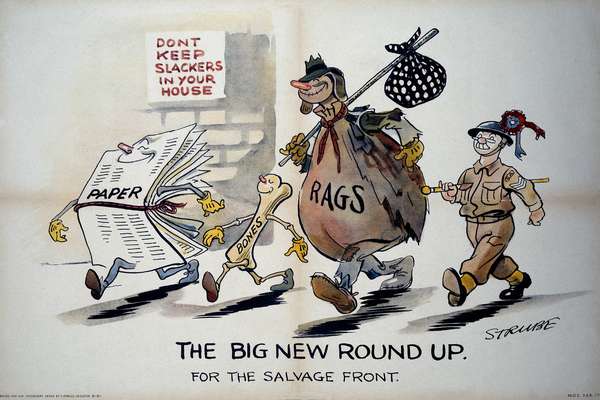
This resource includes various posters produced by the government during the Second World War with questions to help students interrogate them as sources.
Teaching resource

There are quite a lot of things you need to watch out for when using photographs as sources. Just like documents they must be treated with caution.