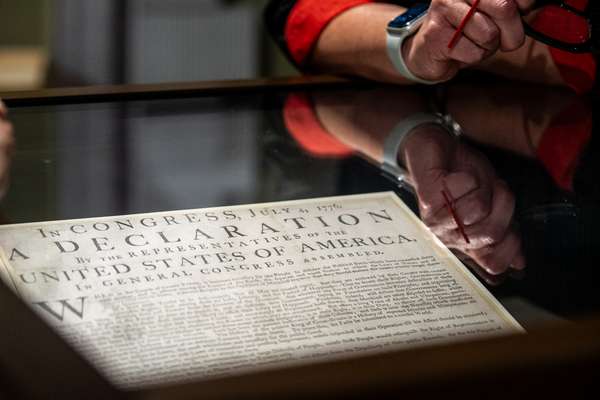
In July 2026, The National Archives launched its Revolution 250 exhibition charting the emergence of the United States from 1763 to 1783. Displaying maps from the time, papers seized from ships, and one of the first published copies of the Declaration of Independence, Revolution 250 offers visitors an overview of this monumental 20-year period.
Exhibition
Revolution 250: America's Independence Story 1763–1783

Marking the 250th anniversary of The US Declaration of Independence, this powerful free exhibition charts the emergence of the United States of America.
Similarly, archives from all corners of the country have been drawing on their collections to mark the anniversary through exhibitions, pop-up talks, walking tours, podcasts, film screenings, family workshops and much more.
This blog will be the first of two, focusing on the work of four archives from Sussex, Northumberland, Nottingham and Bath. Each of these services have been running programmes on American independence throughout the summer, often presenting local stories that frame American history from specific regional perspectives. Many of their exhibitions will remain open well into the autumn. The collections that inspired these programmes will continue to be accessible for viewing and research beyond 2026.
Part of our work at The National Archives is to support and champion archives of all types and sizes across England. In these blogs, I hope to shine a spotlight on how some of these archives are innovatively engaging new audiences, demonstrating the breadth of material you can explore in archives beyond our own.
The 'Sussex Declaration'
Over the summer, West Sussex Record Office in Chichester has held special viewings of what is now known as the 'Sussex Declaration'.
Held at the West Sussex Record Office since 1956, this is the only known ceremonial, handwritten, parchment copy of the Declaration of Independence, other than the ‘Matlack Declaration’ held in the US National Archives. This was confirmed in April 2017 as part of the Declaration Resources Project led by Danielle Allen, a professor and political philosopher at Harvard University.
Allen and her colleague Emily Sneff, Declaration Resources Project Manager, dated this rare, large-format parchment manuscript back to the 1780s. Non-invasive analysis conducted by conservation scientists from the British Library, Library of Congress, and the University of York subsequently supported their observations, cementing this as a highly significant discovery.

The Sussex Declaration on display at West Sussex Record Office.
West Sussex Record Office
West Sussex Record Office has hosted several sold-out viewings of the Sussex Declaration this summer including a session with Allen as a guest speaker. Allen has carried out further research using archives for her new book: The Radical Duke: How One Aristocrat – and the American Revolution – Transformed Britain.
In 2019, West Sussex Record Office received a grant from the Mellon Foundation in New York to kickstart a project that would build upon the 'Sussex Declaration' discoveries. This led them to uncover collections and stories showing the longstanding shared history of West Sussex and the United States over the centuries.
This project, named Transatlantic Ties, has increased access (in-person and online) to a wealth of archival material including a virtual exhibit of the Declaration itself and records on The Royal Sussex Regiment, which fought in both the Seven Years War (1756–1763) and the American War of Independence (1775–1783). Displays of these documents have been incorporated into the summer viewing sessions.
In late September, the 'Sussex Declaration' will be loaned to the British Museum to join the Declaring independence: USA 250 exhibition (running until 29 November 2026).
'The shot heard round the world'
Alnwick Castle, Northumberland, has drawn from their rich archival collections to launch their latest exhibition: The Shot Heard Round the World: Earl Percy and the American Revolutionary War (1775–1783). Open until Thursday 22 October 2026, it explores America’s independence story from the perspective of the British army officer Earl Percy, heir to the 1st Duke of Northumberland.
When Percy had risen the ranks of the British Army to become Colonel of the 5th Regiment of Foot, he was called to serve in America. At the time, British Governors were trying to raise taxes on the colonies, fuelling tensions with the rebels.
Earl Percy’s regiment, stationed in Boston, were ordered to rescue British soldiers who were trapped and surrounded by American Militia following the Battle of Lexington and Concord. This was the very first battle of the American Revolutionary War. Percy made his name in America escorting these troops 15 miles back to Boston under heavy fire and with limited ammunition.

A Map of Boston by Montresor. Collection of the Duke of Northumberland, reference: D2M_III_9
Collection of the Duke of Northumberland
In 1776, Percy was instrumental in the British Army’s invasion of New York Island, driving rebels from three lines of entrenchments and eventually capturing Fort Washington. Shortly after, he invaded Rhode Island with General Sir Henry Clinton and, when the latter departed, was left in sole command from January 1777. Eventually, Percy left America due to disagreements with his Commander-in-Chief William Howe and the death of his mother back home in Alnwick.
20 years later, Percy continued to train his own Napoleonic Home Guard, The Percy Tenantry Volunteers. He used tactics, quite contradictory to conventional British military strategy at the time, which he’d learnt from fighting the rebels in America. This included hiding behind hedgerows, taking cover behind trees and rocks, and wearing green uniforms to aid with camouflage.
The exhibition at Alnwick Castle displays personal correspondence, paintings, military logbooks and printed ephemera (such as dollar bills from the period). It also features a specially commissioned animation, curated by Lizzie Everard, bringing key figures to life on a digital version of a key military map.
Recordings of actors, reading letters between Earl Percy and his family or commanding officers, play throughout the exhibition space. Voice recordings also capture American witness statements taken after the Battle of Lexington and Concord. These reveal how Americans and the British largely blamed each other for firing the first shot that caused the battle, this informing the title of the exhibition.
Key items on display include:
- Percy’s logbook charting the voyage to Boston
- three maps by renowned surveyor and cartographer, Claude J. Sauthier
- Percy’s letters to his father describing The Great New York Fire in 1776
- a rough sketch map, most likely drawn by British scouts, showing the terrain around Boston, Concord and Lexington. Percy is thought to have used this map during his rescue mission, giving this record a strong claim as one of the first maps of the American Revolutionary War.
Join me next time, where I’ll look at two more archives, in Nottingham and Bath, who have put together programmes marking the 250th anniversary.
Outreach blog
How archives across England are sharing different sides of America’s Independence story (part two)
In his second blog this August, Joseph Kelly looks at two more archive services marking the 250th anniversary of the Declaration of Independence.