Image
Magna Carta, 1225
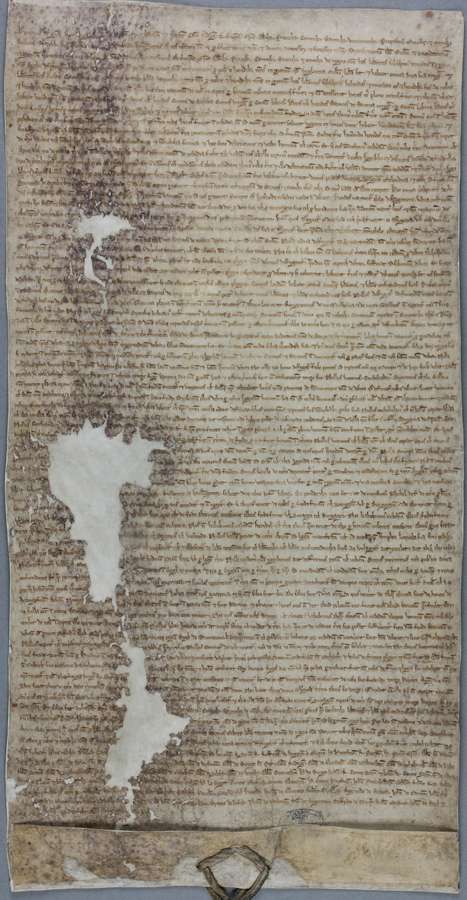
Partial transcript
Henry by the grace of God, king of England, lord of Ireland, duke of Normandy, Aquitaine, and count of Anjou, to the archbishops, bishops, abbots, priors, earls, barons, sheriffs, stewards, servants and to all his bailiffs and faithful subjects who shall look at the present charter, greeting. Know that we, out of reverence for God and for the salvation of our soul and the souls of our ancestors and successors, for the exaltation of holy church and the reform of our realm, have of our own spontaneous goodwill given and granted to the archbishops, bishops, abbots, priors, earls, barons and all of our realm these liberties written below to be held in our kingdom of England for ever,
(1) In the first place we have granted to God, and by this our present charter confirmed for us and our heirs for ever, that the English church shall be free and shall have all its rights undiminished and its liberties unimpaired. We have also granted to all free men of our kingdom, for ourselves and our heirs for ever, all the liberties written below to be had and held by them and their heirs of us and our heirs for ever.
(2) If any of our earls or barons or others holding of us in chief by knight service dies, and at his death his heir be of full age and owe relief he shall have his inheritance on payment of the old relief, namely the heir or heirs of an earl £100 for a whole earl’s barony, the heir or heirs of a baron £100 for a whole barony, the heir or heirs of a knight 100s, at most, for a whole knight’s fee; and he who owes less shall give less according to the ancient usage of fiefs.
(3) If, however, the heir of any such be under age, his lord shall not have wardship of him, nor of his land, before he has received his homage; and after being a ward such an heir shall have his inheritance when he comes of age, that is of twenty-one years, without paying relief and without making fine, so, however, that if he is made a knight while still under age, the land nevertheless shall remain in the wardship of his lords for the full term.
(4) The guardian of the land of such an heir who is under age shall take from the land of the heir no more than reasonable revenues, reasonable customary dues and reasonable services, and that without destruction and waste of men or goods; and if we commit the wardship of the land of any such to a sheriff, or to any other who is answerable to us for the revenues of that land, and he destroys or wastes what he has wardship of, we will take compensation from him and the land shall be committed to two lawful and discreet men of that fief, who shall be answerable for the revenues to us or to him to whom we have assigned them; and if we give or sell to anyone the wardship of any such land and he causes destruction or waste therein, he shall lose that wardship and it shall be transferred to two lawful and discreet men of that fief, who shall similarly be answerable to us as is aforesaid.
(5) Moreover, so long as he has the wardship of the land, the guardian shall keep in repair the houses, parks, preserves, ponds, mills and other things pertaining to the land out of the revenues from it; and he shall restore to the heir when he comes of age his land fully stocked with ploughs and all other things in at least the measure he received. All these things shall be observed in the case of wardships of vacant archbishoprics, bishoprics, abbeys, priories, churches and dignities that pertain to us except that wardships of this kind may not be sold.
(6) Heirs shall be married without disparagement.
(7) A widow shall have her marriage portion and inheritance forthwith and without any difficulty after the death of her husband, nor shall she pay anything to have her dower or her marriage portion or the inheritance which she and her husband held on the day of her husband’s death; and she may remain in the chief house of her husband for forty days after his death, within which time her dower shall be assigned to her, unless it has already been assigned to her or unless the house is a castle; and if she leaves the castle, a suitable house shall be immediately provided for her in which she can stay honourably until her dower is assigned to her in accordance with what is aforesaid, and she shall have meanwhile her reasonable estover of common.
Modern english
This is the new preamble (introduction), used for the 1225 version of Magna Carta. A longer extract is provided in the extended translation above.
HENRY, by the Grace of God, King of England, Lord of Ireland, Duke of Normandy and Aquitaine, and Earl of Anjou, to the archbishops, bishops, abbots, priors, earls, barons, sheriffs, governors, officers, and all bailiffs, and his faithful subjects, who see this present charter, greeting.
In the presence of God, and for the salvation of our own soul, and of the souls of our ancestors, and of our successors, to the exaltation of the Holy Church, and the amendment of our kingdom, spontaneously and of our own free will, we give and grant to the archbishops, bishops, abbots, priors, earls, barons, and all of our kingdom, the following liberties [legally enforceable rights] to be held in our realm of England for ever.
Technical details
- Format
-
image/jpeg - Width
- 467px
- Height
- 900px