Image
Salisbury Cathedral copy of Magna Carta, 1215
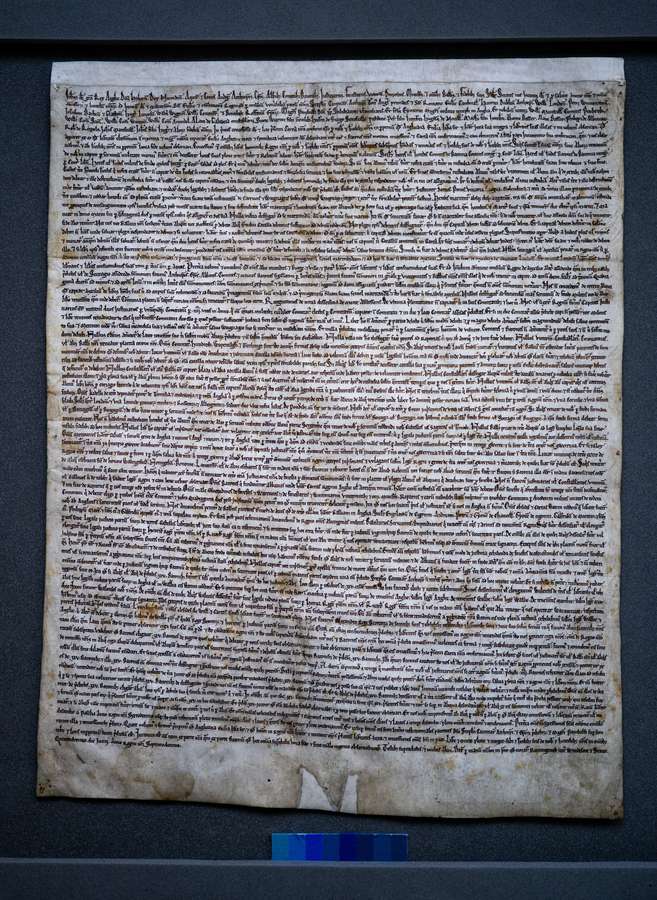
Partial transcript
JOHN, by the grace of God King of England, Lord of Ireland, Duke of Normandy and Aquitaine, and Count of Anjou, to his archbishops, bishops, abbots, earls, barons, justices, foresters, sheriffs, stewards, servants, and to all his officials and loyal subjects, Greeting.
KNOW THAT BEFORE GOD, for the health of our soul and those of our ancestors and heirs, to the honour of God, the exaltation of the holy Church, and the better ordering of our kingdom, at the advice of our reverend fathers Stephen, archbishop of Canterbury, primate of all England, and cardinal of the holy Roman Church, Henry archbishop of Dublin, William bishop of London, Peter bishop of Winchester, Jocelin bishop of Bath and Glastonbury, Hugh bishop of Lincoln, Walter bishop of Worcester, William bishop of Coventry, Benedict bishop of Rochester, Master Pandulf subdeacon and member of the papal household, Brother Aymeric master of the knighthood of the Temple in England, William Marshal earl of Pembroke, William earl of Salisbury, William earl of Warren, William earl of Arundel, Alan of Galloway constable of Scotland, Warin fitz Gerald, Peter fitz Herbert, Hubert de Burgh seneschal of Poitou, Hugh de Neville, Matthew fitz Herbert, Thomas Basset, Alan Basset, Philip Daubeny, Robert de Roppeley, John Marshal, John fitz Hugh, and other loyal subjects:
(1) FIRST, THAT WE HAVE GRANTED TO GOD, and by this present charter have confirmed for us and our heirs in perpetuity, that the English Church shall be free, and shall have its rights undiminished, and its liberties unimpaired. That we wish this so to be observed, appears from the fact that of our own free will, before the outbreak of the present dispute between us and our barons, we granted and confirmed by charter the freedom of the Church’s elections – a right reckoned to be of the greatest necessity and importance to it – and caused this to be confirmed by Pope Innocent III. This freedom we shall observe ourselves, and desire to be observed in good faith by our heirs in perpetuity. TO ALL FREE MEN OF OUR KINGDOM we have also granted, for us and our heirs for ever, all the liberties written out below, to have and to keep for them and their heirs, of us and our heirs:
(2) If any earl, baron, or other person that holds lands directly of the Crown, for military service, shall die, and at his death his heir shall be of full age and owe a ‘relief’, the heir shall have his inheritance on payment of the ancient scale of ‘relief’. That is to say, the heir or heirs of an earl shall pay £100 for the entire earl’s barony, the heir or heirs of a knight 100s. at most for the entire knight’s ‘fee’, and any man that owes less shall pay less, in accordance with the ancient usage of ‘fees’.
[...]
(62) We have remitted and pardoned fully to all men any ill-will, hurt, or grudges that have arisen between us and our subjects, whether clergy or laymen, since the beginning of the dispute. We have in addition remitted fully, and for our own part have also pardoned, to all clergy and laymen any offences committed as a result of the said dispute between Easter in the sixteenth year of our reign (i.e. 1215) and the restoration of peace.
In addition we have caused letters patent to be made for the barons, bearing witness to this security and to the concessions set out above, over the seals of Stephen archbishop of Canterbury, Henry archbishop of Dublin, the other bishops named above, and Master Pandulf.
(63) IT IS ACCORDINGLY OUR WISH AND COMMAND that the English Church shall be free, and that men in our kingdom shall have and keep all these liberties, rights, and concessions, well and peaceably in their fullness and entirety for them and their heirs, of us and our heirs, in all things and all places for ever.
Both we and the barons have sworn that all this shall be observed in good faith and without deceit. Witness the abovementioned people and many others.
Given by our hand in the meadow that is called Runnymede, between Windsor and Staines, on the fifteenth day of June in the seventeenth year of our reign (i.e. 1215: the new regnal year began on 28 May).
[Source: G.R.C. Davis, Magna Carta (London: British Museum, 1963), pp. 23–33. Courtesy of the British Library (CC BY 4.0)]
Copyright
Salisbury Cathedral/Finnbarr Webster
Technical details
- Format
-
image/jpeg - Width
- 657px
- Height
- 900px