This project, through the efforts of a dedicated team of volunteers, has catalogued 564 boxes of Royal Navy Captains’ letters of the French Revolutionary and Napoleonic Wars (1793–1815). This has made their content searchable on The National Archives' catalogue, Discovery. They are found within the ADM 1 series for the dates 1793 to 1815.
The last phase of work for Captains whose surnames begin with the letters N to Z, amounting to 35,205 letters across 225 boxes, is now complete. This brings the total to 101,928 letters and over 10,000 enclosures. None of this would have been possible without a team of volunteers who have selflessly striven to produce work of lasting value to researchers.
You can now search across these records on Discovery by a ship, captain or place name, and see details of all letters relevant to their search terms. In this final blog, I'll highlight some of the fascinating stories we've discovered during this final phase.
The merry king
In these letters can be found 114 authored by Sir Harry Burrard Neale, (1765–1840). In a distinguished career Neale served as member of Parliament for Lymington, Hampshire, as a Lord of the Admiralty from 1804 to 1807, and as the Mediterranean Commander in Chief in 1823. One of his most prestigious appointments, in May 1801, was to command the Royal Yacht, Royal Charlotte, bringing him into direct contact with the Royal family.
Having been tasked with transporting the family from Lymington to Weymouth, Neale states in a letter (catalogue reference: ADM 1/2227/85) from Weymouth on 9 July 1801 that there had been bad weather since their arrival. He notes that the Queen and some of the Princesses were sick on their passage. He also writes that King George III, who had previously experienced several episodes of mental health difficulties, most notably in 1788–1789, ‘seemed the happiest man alive and was really enjoying himself’.

My Dear Sir,
The King’s Bargemen have applied to me for permission to draw upon you for some money, I told them in reply that nothing could be done until I heard from you upon that subject, they state themselves to have been at a great expense in going to Portsmouth and living there for two days afterwards – We have had nothing but bad weather since we arrived here. The Queen and some of the Princesses were sick on their passage from Christ Church, but the King seemed the happiest man alive and really enjoyed himself.
Sir Harry Burrard Neale's letter, 1801. Catalogue reference: ADM 1/2227/141
Port blockers
An important function of the Royal Navy from 1793 to 1815 was blockading. Blockading prevented enemy ships leaving their ports minimising the risk of the invasion of Britain, disrupted enemy commerce, protected Britain’s trade, and forced enemy navies to be inactive denying them critical experience of operating at sea.
However, blockading, often for months at a time in all types of weather, placed enormous stress on ships and crews and was often a dangerous practice. Such dangers are highlighted in a letter by James Newman-Newman (catalogue reference: ADM 1/2227/141) dated 14 June 1801.
In 1801 the Royal Navy maintained a close blockade of Le Havre, France, undertaking raids to destroy French invasion flotillas and targeting gunboats near Cape De Seine protected by coastal batteries. These actions involved heavy shore to ships fire exchanges. Newman details such an exchange off Havre, reporting that HMS Maidstone and HMS Wolverine with HMS Loire had driven 35 enemy vessels into the Basin, recounting the event and resultant damage.
Newman commended Captain John Wight's action in HMS Wolverine under heavy fire from vessels and batteries. He enclosed a hand drawn map by Wight showing the coastline at Cape la Havre or Cape de Seine indicating the French coastal batteries and where the action, reported in the covering letter, took place.

Captain John Wight's hand drawn map, 1801. Catalogue reference: ADM 1/2227/141
Rosetta Stone
As well as transporting very important people the Royal Navy was also tasked with safeguarding and carrying historical artifacts. One of the most significant of these being the Rosetta Stone, which was carved in Egypt in 196 BC. The Stone’s discovery was critical in allowing scholars of the time to decipher and translate Egyptian hieroglyphs, completed in 1822. The Stone became British property following Napoleon’s defeat under the terms of the 1801 Treaty of Alexandria.
The Stone was shipped to England on HMS Egyptienne commanded by Captain Charles Ogle. This is detailed in a list of articles brought to the UK from Alexandria by the ship (catalogue reference: ADM 1/2254/88). Ogle wrote from Woolwich on 27 February 1802 that the Officers of Customs prohibited him unloading the ‘objects of curiosity’ brought from Egypt without a Customs House order. He adds he applied for the order but wishes to know if he should unload the items at the Custom House or at Woolwich dockyard. Subsequently, the Stone was presented in July 1802 by King George III to the British Museum.
The inactive officer
Among the 33 letters of Edward Rotherham, best known for his service as the Captain of the HMS Royal Sovereign at the Battle of Trafalgar, is one dated 13 November 1793, 10 months after the outbreak of war against France. He writes to the Admiralty (catalogue reference: ADM 1/2397/90) stating ‘he cannot help feeling very uncomfortable at the idea of being inactive…and having been since [his] infancy used to an active sealife finds living on shore not to agree with his health or inclinations’.
Timber supply
During 1793 to 1815 one of the most valued assets to the Royal Navy was timber. The supply of timber, particularly oak, was critical to the building of its ships and shortages of supply posed considerable operational risks to the Royal Navy. This led to global searches for additional timber resources. In a letter (catalogue reference: ADM 1/2530/160) dated 7 May 1812 Benjamin Street highlights his concerns about the waste of timber specifically in the Cape of Good Hope.
Street comments that having been previously employed to cut timber for the Dockyard at the Cape, in the forest near Plettenberg Bay, he was appalled by the dreadful waste in the cutting of trees on behalf of the local Cape Ordnance and Civil Government. He adds that he took a piece of green stinkwood and used it in the bends of his ship where it was constantly wet and dry and that three years later it was as sound as the first day. He writes he has no hesitation in asserting that it was equally durable as the best English oak and that the forests of the Cape, if taken care of would be sufficient for the British Navy for a thousand years.
Officer mutiny
Another letter (catalogue reference: ADM 1/2682/67) dated 29 July 1796 by George Blagdon Westcott, offers a potential fascinating prelude ahead of the sailors’ mutinies at Spithead and Nore in 1797 for better pay and working conditions in the Royal Navy. Westcott sends a printed paper to the Admiralty which he claims has been sent to all Royal Navy Lieutenants who have voiced their disapproval and consider its circulation improper. The printed paper was aimed at the Officer class of the Royal Navy directing them to petition the Government for better terms of service.

Captain Westcott presents his compliments to Mr Nepean and begs leave to enclose a paper which has been sent to the Lieutenants of the Majestic which they have given him as a thing they disapprove of, and think improper to be privately circulated.
George Blagdon Westcott's letter to the Admiralty,1796. Catalogue reference: ADM 1/2682/67
Drink and recreation
When Royal Navy ships were being provisioned and prepared in London during 1793–1815, drinking water was supplied to their crews from the River Thames. The water was stored in wooden barrels that became undrinkable after a few days. In a letter dated 14 April 1796, Captain John Williamson of HMS Agincourt moored at Woolwich relates an heated exchange (catalogue reference: ADM 1/2685/92) with Victuallers, a person or company who provided the supplies, about the water. Williamson complained it was ‘thick, stinking, putrid, foetid and rottenish of a grey colour’ only to be informed that everyone with sailing experience knew what water from the Thames was like!
There were many forms of recreation to distract sailors from their day-to-day ship routine, including storytelling, singing, and dancing. However, HMS Gelykheid’s crew were treated to much more lavish entertainment as revealed in a letter (catalogue reference: ADM 1/2698/29) enclosure dated 26 September 1804, by Issac Wolley. Williamson's names the cast for a performance of The Double Gallant or the Sick Lady's Cure a 1707 comedy to be performed at the Theatre Royal, Leda, followed by a hornpipe and a 'new pastime' of 'Harlequin Gambols' (an 18th-century English country dance tune).
Liverpool skyline
Manpower shortages was one of the main problems the Royal Navy faced during the period of the French Revolutionary and Napoleonic Wars. Once recruited, volunteers or press-ganged (those forcibly conscripted) men were kept on board stationary vessels known as Receiving ships at a distance from mainland ports before being transferred to their actual ship. This distance from the shore was supposed to minimise the risk of their desertion. However, this in practise was not always the case.
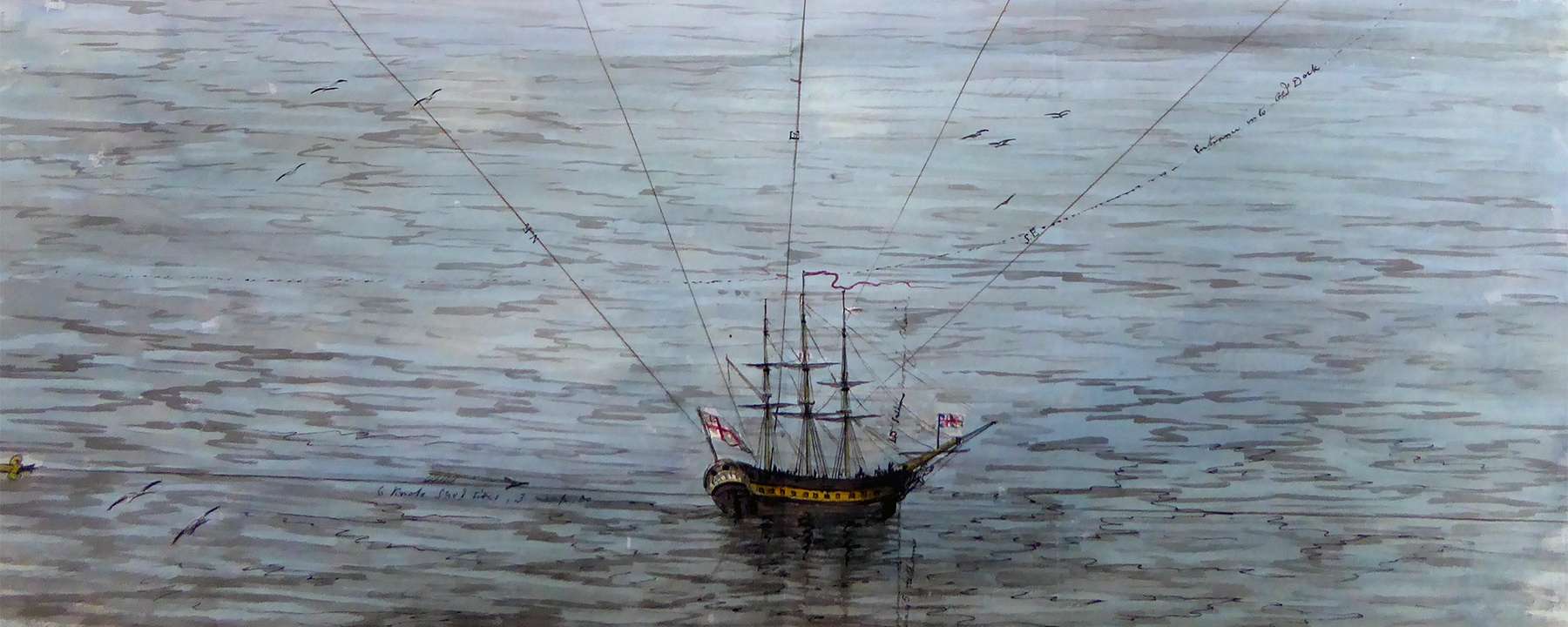
This is seen in a letter (catalogue reference: ADM 1/1645/151) dated 15 May 1806 by Captain Samuel Colquitt from the receiving ship HMS Princess moored in the River Mersey off the port of Liverpool. He is responding to Admiralty directions to state the ‘precise position’ of his ship, owing to the high rate of desertions from it. Colquitt’s response not only provides the length from the Parade in cables, but also a detailed watercolour sketch of his ship and of the Liverpool skyline as seen from the water. It marks landmarks together with distances from the ship to the shore at various points.
A note on Colquitt’s letter dated 6 June 1806 records to notify Colquitt ‘if a further desertion takes place, their Lordships will find it necessary to move the ship to a greater distance from the Docks'.

Captain Samuel Colquitt's watercolour sketch of the Liverpool skyline, 1806. Catalogue reference: ADM 1/1645/151
Collection blog
The A–Z of the Royal Navy Captains' letters project – 'D' to 'M'

Bruno Pappalardo reveals the latest findings of the volunteer Royal Navy Captains’ letters project.
About the author
Bruno Pappalardo is a Principal Records Specialist (Naval) and supervisor of the volunteer Royal Naval Captains’ letter project at The National Archives.