Important information
This blog includes mentions of suicide and mental health difficulties. This may be distressing to some readers.
The Victorian era was a time of great innovation. Often, to protect a new design, a business owner or inventor would apply for a design registration. This would give exclusive legal rights over the appearance (look and shape) of a product to its owner.
The National Archives holds a record of every UK design registration since the system began in 1839, including visual and material representations of each design, up to 1991.
Since July 2024, our volunteers have transcribed the design registers from 1885–1888, creating 150,000 searchable entries in Discovery, our online catalogue. This has made records in the BT 50 and BT 51 series accessible for new research and engagement possibilities.
One of the volunteers working on the project, Jessie O’Keeffe, has written this blog about what she uncovered during the project.
Jessie has transcribed a total of 12,719 individual design registration entries, recording everything from cotton textiles to tea trays and carriage lamps. From these records, Jessie has chosen to write about three designs for bottle tops, registered by Barnsley-based glass manufacturer Dan Rylands. Her blog demonstrates how these records of everyday objects can reveal the creativity and ambition of late Victorian Britain.
Dan Rylands and the screw-top bottle design
Between 17 February and 1 March 1886, Dan Rylands of the Hope Glass Works in Barnsley registered three designs, all variants on the mouths (tops) of glass bottles. While these designs seem simple, they provide fascinating insight into a family business that created something many of us take for granted today: the screw-top bottle.
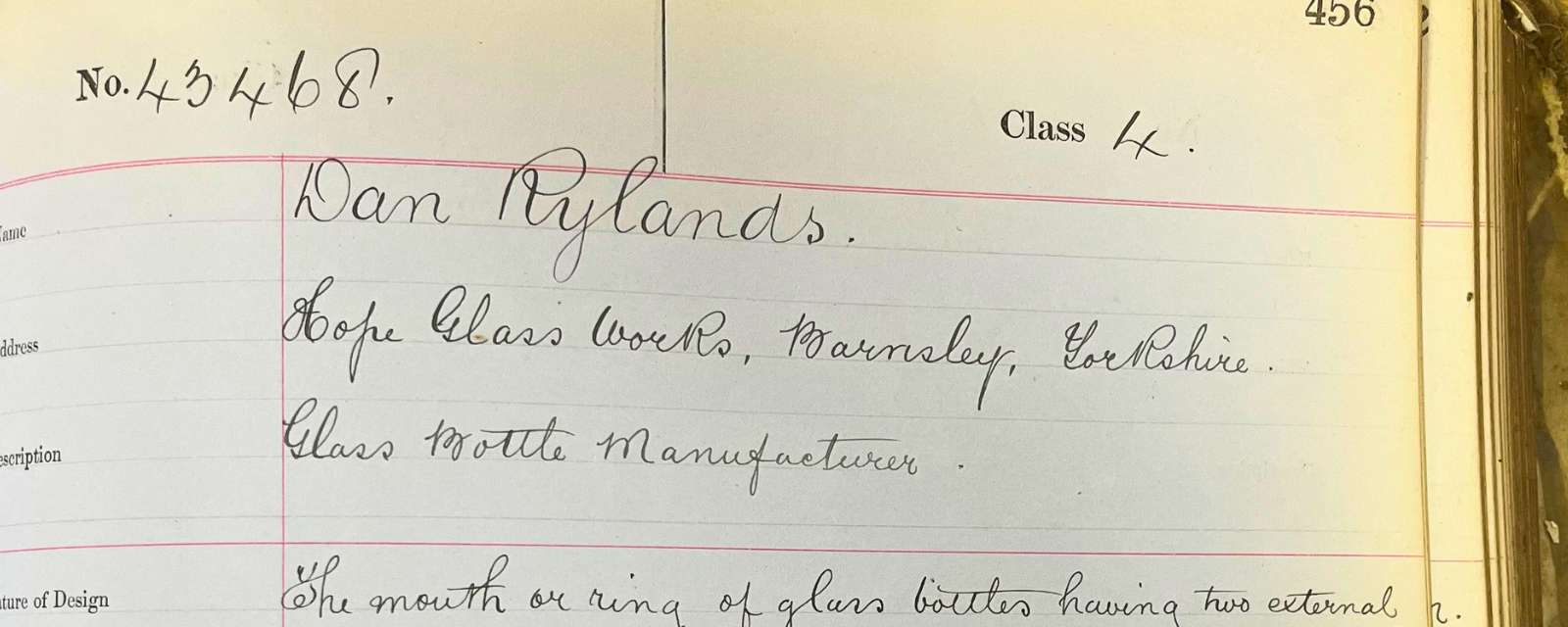
The first in this series of design registrations by Rylands is a bottle with ‘three external circular projecting rings around the mouth’, the second is one with ‘two external circular projections’, and the last with ‘[one] external circular projection’. I have transcribed each of their entries in the Design Registers, as seen below:
- Design number: 43358, Dan Rylands, Glass bottle manufacturer, Hope Glass Works, Barnsley, Yorkshire, The mouth or ring of glass bottles having three external circular projecting rings around the mouth or ring. The design being applicable for the shape configuration and for the ornament of same. Date of registration: 17th February 1886 (Catalogue reference: BT 51/21)
- Design number: 43468, Dan Rylands, Glass bottle manufacturer, Hope Glass Works, Barnsley, Yorkshire, The mouth or ring of glass bottles having two external circular projections around such mouth or ring, the design being applicable for the shape or configuration or ornament of the same. Date of registration: 19th February 1886 (Catalogue reference: BT 51/21)
- Design number: 44041 Dan Rylands, Glass bottle manufacturer, Hope Glass Works, Barnsley, Yorkshire, The mouth or ring of glass bottles, having an external circular projection around same, the design being applicable for the shape or configuration and ornament of the same. Date of registration: 1st March 1886 (Catalogue reference: BT 51/21)
Dan Rylands’ designs from 1886
Image 1 of 3

Design number 43358: The mouth of a glass bottle with three rings around the neck. Catalogue reference: BT 50/59/43358.
Image 2 of 3

Design number 43468: The mouth of a glass bottle with two rings around the neck. Catalogue reference: BT 51/21.
Image 3 of 3

Design number 44041: The mouth of a glass bottle with one ring around the neck. Catalogue reference: BT 51/21.
During this period, designs were registered in classes, according to the material objects they were to be applied to. All three designs were registered by Dan Rylands in Class 4: ‘Articles composed wholly or chiefly of glass, earthenware or porcelain, bricks, tiles or cement.’
The changes between these three designs reflect Rylands’ career in 1886. By this time, he was in sole control of the company started by his father, Ben Rylands, and seemed eager to make an impact. Rylands’ extensive work to develop the innovative screw-top bottle is reflected in our records of registered designs, as shown above.
In addition to these design registrations Rylands also applied for patents, which protect how a product works, rather than how it looks. Clearly, he wanted to protect his invention and recognised its potential. Thanks to Rylands’ work, the screw-top bottle is still a part of our everyday lives today.
Before the bottle top: Rylands and Codd
Rylands’ business practices appear to have caused frequent dramas throughout his working life.
In taking control of his father’s glass-making business, he also took over Ben Rylands’ partnership with Hiram Codd, inventor of the Codd-neck bottle. Created in 1872, it was the most popular method of containing carbonated drinks for over half a century. It worked by containing a small marble or ‘globe’ just below the neck, held in place by the pressure from the liquid. The National Archives holds several designs registered by Codd (Catalogue references include BT 45/28/5622, BT 45/28/5749 and BT 45/28/5665). Ben and Hiram began collaborating in 1873, and by 1877 Codd owned 20% of Rylands’ business, then named Rylands & Codd.
After his father’s death in 1881, Rylands took control of his father’s share of the company. To do this, he had to pay to keep his father’s partnership with Codd due to the legislation regulating inheritance and partnerships at the time. This marked the beginning of a strained business relationship and conflicts over intellectual property. For instance, Rylands once filed an improvement on a shared patent without Codd’s approval. On another occasion, Codd took Rylands to court over his use of a tool Codd invented. Ultimately, Rylands and Codd ended their partnership in 1884. This gave Rylands the freedom to develop his own bottle designs.
Rylands’ independence
By 1888, after Codd’s death, only Rylands’ name was attached to the company, which he renamed to Rylands Glass Works. Codd’s death also meant Rylands controlled the exclusive rights to various patents. This included the British patent for the screw-top bottle.
In 1889, he filed for a further patent, an ‘Improved means of forming and closing the mouths of bottles or jars’, which refined earlier patented bottle mouth designs. This became the method that allowed the screw-top bottle to be put into mass production.
When it was first mass-produced, Rylands’ screw-top bottle seemed like a unfinished invention. For instance, one of its intended uses was on wine bottles, noted in the patent specification (now found at the British Library). This failed due to a reaction between the acidic wine and the lid. It did, however, work for storing whisky, which was also listed as an intended use on the patent.

Volumes (books) from the BT 50 and BT 51 series.
A downward turn
Unfortunately, Rylands’ business and personal life suffered over time. He lost money from bad investments, and a fire in his factory severely impacted production output, and with it, his personal wealth. In 1893 he was declared bankrupt, which seemed to greatly affect his mental health. The same year, he survived a suicide attempt and then spent a short period in a mental health facility. After these events, he moved to live with his sister in Battersea, stepping down as head of the company.
Rylands’ legacy through design registration
While Rylands’ early retirement could have limited our memory of his career, The National Archives’ records highlight the significance of his work. The designs he registered in 1886 demonstrate research and development at an important turning point in his business.
His registrations were interesting in particular because of the number of them filed within just a few months of each other, almost identical in appearance and description but each featuring minor tweaks. To me, this is indicative of the often forgotten labour behind the final product, and the dedication to the process necessary for inventing.

Memorandum of Association
of
DAN RYLANDS, LIMITED
- The name of the COMPANY is DAN RYLANDS, LIMITED.
- The Registered Office of the Company will be situate in England.
- The objects for which the Company is established are: -
(I.) To acquire the lands, works, wharves, railways, plant, stock-in-trade book debts, patent rights and goodwill of the business and undertaking carried on by Dan Rylands, at Stairfoot, near Barnsley, at Wombwell, near Barnsley, and at Blake Street, Manchester, of a Bottle, Box, Wire-twisting, and Mineral Water Machinery Manufacturer, and to undertake all the engagements made in connection therewith, and with a view thereto to enter into the agreements mentioned in Clause 3 of the Company’s Articles of Association, and to carry the same into effect with or without modification.
(II.) To carry on the business of Bottle, Box, Twisted-Wire, and Mineral Water Machinery Manufacturers, machinists, smiths, carriers by land or water, and any other business which can conveniently be carried on by the Company in connection with the same in England or elsewhere.
(III.) To purchase or otherwise acquire the right to use any patents which the Directors may deem advisable or necessary for the carrying on of the businesses, and to grant licenses for the use of the said patents or any of them, and to assign or otherwise dispose of the same.
The Memorandum of Association for Dan Rylands Limited. This is a legal document Ryland signed when forming his company. Catalogue reference: BT 31/4232/27411
Along with Rylands’ registered bottle neck designs, there is so much to learn about modern everyday items from registered design records. Rylands’ designs, and others, have left me wondering: how many other stories are waiting to be found within these records?
-
- From our collection
- BT 51/21
- Title
- Designs 42375-44195
- Date
- 1886 Feb. 2 - Mar. 4
-
- From our collection
- BT 50/59
- Title
- Designs 43297-43974
- Date
- 1886 Feb. 17 - Feb. 27
-
- From our collection
- BT 50/60A
- Title
- Designs 43975-44628
- Date
- 1886 Feb. 27 - Mar. 11
-
- From our collection
- BT 45/28/5622
- Title
- Useful Registered Design Number: 5622
- Date
- 1874 Nov 2
-
- From our collection
- BT 45/28/5749
- Title
- Useful Registered Design Number: 5749
- Date
- 1876 Jan 15
-
- From our collection
- BT 45/28/5665
- Title
- Useful Registered Design Number: 5665
- Date
- 1875 April 20
-
- From our collection
- BT 31/4232/27411
- Title
- Company No: 27411; Rylands Glass and Engineering Company Ltd. Incorporated in 1888.
- Date
- 1888-[1916]