The making of a movement
On 7 June 1866, a rolled parchment with 1,499 women’s signatures was delivered to Parliament. Although a few vital women’s petitions predated it, this was the first mass-scale women’s suffrage petition in Britain. The petition countered the persistent argument that women did not want the right to vote. Movements towards women’s suffrage, the right to vote, had begun to grow.
Women had in practice long been excluded from formal parliamentary participation, but the Representation of the People Act 1832, also known as the Reform Act, legally prevented women from voting. It extended voting rights to more men but also defined voters as male. Suffrage organisations later referenced this time – and women’s exclusion in the Reform Act – as the start of their movement. The Act became a turning point, driving a campaign for change.

The Reform Act 1832, Parliament’s archive collections. Catalogue reference: YHL/PO/PU/1/1832/2&3W4n147
Alongside the feminist reaction to the Reform Act, a movement for women’s rights was starting to grow across many fields, from education to domestic life, and legal reform. At the time, married women had no independent property rights. Divorce laws heavily favoured men. Women were barred from earning university degrees, and most professions remained closed to them.
Class, as well as gender, shaped women’s experiences, with the impact often felt most sharply by working-class women. In 1854 artist and key women’s right campaigner Barbara Leigh Smith (later Bodichon), wrote the pamphlet A Brief Summary in Plain Language of the Most Important Laws of England Concerning Women. It exposed the reality of the inequalities women faced.

A booklet called A brief review of the Women's Suffrage Movement since its beginnings in 1832. From the pamphlet collections of James Ramsay MacDonald, 1911. Catalogue reference: PRO 30/69/1834
The Kensington Society
In March 1865, the Kensington Society was formed, named after the location of its meetings. Sharing members with the earlier women's club the Langham Place Group, this was a discussion society that brought together women who were eager for change. They debated progressive issues of the day, from education to working life. Notable figures included feminist Charlotte Manning as president, physician Sophia Jex-Blake, and educational reformer Elizabeth Wolstenholme Elmy.
Votes for women was high on the society’s agenda, with philosopher and politician John Stuart Mill having recently included it in his election address as MP for Westminster in 1865. Giving women the vote became the topic for their second meeting, with a range of perspectives shared and broad backing. The Kensington Society offered a supportive feminist space, from which the 1866 petition was born.

Photograph of a portrait of John Stuart Mill, painted by G F Watts, 1896. Catalogue reference: COPY 1/425/360
The organisers and their petition
In May 1866, leading member Bodichon wrote to Helen Taylor, stepdaughter of Mill, about action 'towards getting women votes', suggesting a petition. Taylor thought it was 'highly desirable now'. While she felt no immediate results were likely to follow, she wrote:
I think the most important thing is to make a demand and commence the first humble beginnings of an agitation…
Helen Taylor, 9 May 1866. The Women's Library at the London School of Economics, reference: 7BMC/B
Petitions were one of the few parliamentary tools available to women at this time. Their action followed in the tradition of abolitionists (the movement to end the trade in enslaved peoples) and Chartists (who pushed for democratic reform in 19th century). There’s a palpable excitement in the organisers letters as they start to plan their action. The related correspondence is available to view at The Women’s Library at the London School of Economics (LSE), as well as a printed copy of the petition.
Kensington Society members Bodichon, Taylor, Emily Davies, and Elizabeth Garrett became the key organisers of the petition. At the same time Garrett was challenging the University of London’s refusal to grant exam certificates to women (which did not change until 1878) – just one example of their work across campaigns.
Strategically seizing the opportunity presented by a newly proposed Reform Bill, together the women drafted a concise, legally framed petition focused on civic duties, taxation, and representation – deliberately avoiding divisive debates about which women should be eligible to vote. As was usual, the petition in its original form does not survive but a copy of the text is recorded in the Committee on Public Petitions.

Public petitions – appendix to the twenty-seventh report.
Delivered June 13th.
Containing Petitions presented June 6-8, 1866.
Elective Franchise (for Extension to all Householders without Distinction of Sex). Metropolis.
App. 747. Mr. John Stuart Mill. Sig. 1521.
8501. The humble Petition of the Undersigned,
Sheweth,
That it having been expressly laid down by high authorities that the possession of property in this country carries with it the right to vote in the election of representatives in Parliament, it is an evident anomaly that some holders of property are allowed to use this right, while others, forming no less a constituent part of the nation, and equally qualified by law to hold property, are not able to exercise this privilege.
That the participation of women in the Government is consistent with the principles of the British Constitution, inasmuch as women in these islands have always been held capable of sovereignty, and women are eligible for various public offices.
Your Petitioners therefore humbly pray your honorable House to consider the expediency of providing for the representation of all householders, without distinction of sex, who possess such property or rental qualification as your honorable House may determine.
And your Petitioners will ever pray.
BARBARA L. S. BODICHON.
MENTIA TAYLOR.
EMILY DAVIES.
&c. &c. &c.
Copy of the 1866 mass suffrage petition text, from the Appendix to Reports of the Committee on Public Petitions, 1866, Parliament’s archive collections. Catalogue reference: YHC/CL/JO/6/417
Collecting the signatures was done in just a few weeks. This was a remarkable logistical feat, something that is hard to imagine in our time of online petitions and mobile phones. Signatures were mainly collated by post and physically assembled at the home of radical MP Peter Taylor and activist Mentia Taylor, Aubrey House in London.

Aubrey House, Aubrey Road, Kensington
Name and Surname of each Person
Peter Alfred Taylor
Age of Male/Female
Male, 41
Relation to Head of Family
Head
Rank, Profession, or Occupation
Crepe Manufacturer
Where born
St Pancras, Middlesex
Name and Surname of each Person
Clementia Taylor
Age of Male/Female
Female, 49
Relation to Head of Family
Wife
Rank, Profession, or Occupation
-
Where born
Brockdish, Norfolk
1861 census schedule for Aubrey house, Kensington, home of Clementia and Peter Alfred Taylor. Catalogue reference: RG 9/14/333
The signatories
The signatories came from every corner of the UK and Ireland, from Leeds to St Andrews, and even included British women living abroad. Organisers mobilised contacts built through years of campaigning, family, friends and local networks. While the instigators were mainly educated middle-class and upper-class women, the signatories themselves included shopkeepers, domestic workers and laundresses.
Prominent campaigners signed the petition, such as Frances Power Cobbe, who led campaigns for divorce reform. Similarly, signatories Jessie Boucherett, Sarah Lewin, and Gertrude J King were all politically active and on the committee of the Society for Promoting the Employment of Women. This aimed to offer women training to move into the professions and be more financially independent.

Photograph of petition signatory and organiser Miss Frances Power Cobbe, 1896. Catalogue reference: COPY 1/425/300
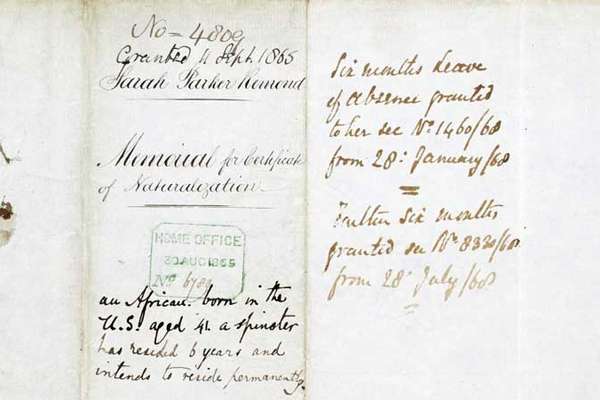
Sarah Parker Remond, an abolitionist and feminist, who was born in America and described herself as 'of African descent', signed while living at Aubrey House in London, where the petition was organised. Today, Ann Dingsdale’s pioneering research shows female-headed households were more likely to sign, such as shopkeepers Barbara Loftus and her daughter who sold baby clothes. Another was the Miall sisters. They collectively ran a girls’ school in Broughton and all three signed the petition. They wanted the girls they were educating to have a say in shaping society. The diversity of signatories challenges the stereotype that early feminism was exclusive to elite or metropolitan women, revealing a broader-based, intergenerational section of women interested in reform.

To the Right Honourable Sir George Grey, Baronet, Her Majesty’s Principal Secretary of State for the Home Department.
The Memorial of Sarah Parker Remond of Aubrey House, Notting Hill in the County of Middlesex.
Sheweth
That your Memorialist is desirous of obtaining for herself a Certificate of Naturalisation pursuant to the Act of Parliament passed in the eighth year of the Reign of Her present Majesty entitled “Act to amend the Law relating to Aliens”
That your memorialist is of African descent and a native of Salem, Massachusetts in the United States of America.
That your Memorialist is forty-one years of age and is unmarried.
That your Memorialist’s settled place of residence is in London.
That your Memorialist has resided uninterruptedly in the Country for the last six years and upwards and it is her intention to continue to reside permanently within the United Kingdom.
That the Grounds upon which your Memorialist seeks to obtain the rights and capacities of a natural born British subject are as
British citizenship application from abolitionist and physician Sarah Parker Remond, the only known Black woman to sign the petition. Catalogue reference: HO 1/123/4809
The strategic organisers planned to print and share copies with the press and MPs. This meant signing a public statement. It was not an easy decision, with some fearing for their reputation or impacts on other campaign work. Dorothea Beale, suffragist and Principal of Cheltenham Ladies’ College, was a Kensington Society member who declined to sign the petition, fearing it might affect her educational work. She later founded St Hilda’s College, Oxford. Approximately half of Kensington Society members signed the petition, but many did not.
From petition to Parliament
Taylor noted that anything more than 100 signatures would be 'very satisfactory'. In the end the printed petition had 1,499 names. Last-minute additions brought the official count to 1,521 on the version handed to Parliament.

11 am Monday.
Dear Miss Taylor
We are getting on towards 700 names — is it
not capital! [capital - common expression of enthusiasm at the time]
I saw Mr Russell Gurney at 9 am. The ladies all want him to present
the petition & he says he will if Mr Mill wishes it & will speak to Mr Mill to-day.
Letter from Barbara Bodichon to Helen Taylor updating her excitedly on the number of signatures received. The Women's Library at the London School of Economics, reference: 7BMC
On the day of delivery, Garrett and Davies carried the roll through Parliament – an unfamiliar experience to them given the male dominated nature of politics. The petition roll was physically large to handle, and legend goes that Garett and Davies concealed it behind an apple cart stall; a moment memorialised by the movement.
On receiving the petition Mill remarked, ‘I can brandish this with effect!’ and presented it to the House of Commons.
Although the petition brought no immediate change it marked a turning point, making women’s suffrage a formal parliamentary issue for the first time. The petition was quickly followed by Mill’s landmark 1867 speech and vote on women’s suffrage, which argued for legislation to use the word 'person'. The first women’s suffrage bill followed in 1870, introduced by Jacob Bright MP, a key parliamentary supporter whose sister Priscilla signed the 1866 petition. From this point on debates on women's suffrage took place almost every year in Parliament.

1866. The first Petition was presented to the House of Commons by Mr. John Stuart Mill, signed by 1500 women.
1867. May 4. Mr. Mill moved his amendment to the Representation of the People Bill “to leave out man and substitute person”. Lost by 196 to 83.
1870. Mr. Jacob Bright introduced a Bill to remove the electoral disabilities of women.
2nd Reading carried 124—91.
Committee stage defeated 94—220.
Internal Home Office document on the 'History of the Female Suffrage question in Parliament', written during an attempt to pass suffrage legislation in 1888. Catalogue reference: HO 45/9785/B2940
Petitioning became a core campaigning method, used strategically alongside other tactics. In 1873, Lady Anna Gore-Langton, a suffragist and signatory to the petition, used political lobbying as another approach. She warned Viscount Chelsea Cadogan that 'several ladies will work to prevent his election in Bath' if he opposed women’s suffrage.
Campaigners also worked on multiple fronts, with the vote being just one focus. In 1870, the Married Women’s Property Act passed after decades of campaigning, granting married women the right to own property and keep earnings. Suffrage petition organiser Bodichon was a key figure in both campaigns. These women also got involved in other mechanisms for influencing society, where available to them, such as being elected to London School Boards.

May 8th / 73
[Printed letterhead]
NEWTON PARK,
BRISTOL.
Dear Lord Chelsea,
Pray pardon me for troubling you by writing on the question of the political enfranchisement of Women who are householders & rate payers. My apology
is that I am President of the Woman’s Committee in Bath. I was sorry to hear from Mrs Pea[ch], that your opinions are supposed to be unfavourable
to this question. I do hope// [next page] that is a mistake, that you have not made up your mind that you cannot support this bill.
Lady Anna Gore-Langton, Newton Park, Bristol, to Viscount Chelsea Cadogan, 8 Feb 1873, Parliament’s archive collections. Catalogue reference: YCAD/132
Legacy
Despite later divisions, many suffrage organisations could trace their origins back to the early petition committee; the post-petition momentum spurred the formation of suffrage societies in Manchester, Edinburgh, and London.
In 1890, a 'Survivors' Petition', signed by 78 original petitioners including Bodichon and Garrett Anderson, was presented to Parliament. It highlighted that the situation for women had not changed since the original petition. Over decades of persistent campaigning, petitioning remained central to the movement, alongside legal challenges, meetings, deputations, and eventually militant protest.
Many original petitioners remained active. Taylor attempted to circumvent the law by standing for parliamentary election in 1885, and later focused on socialism and Irish land reform. In 1869 Davies co-founded Girton College, the first women's college at Cambridge. Garrett Anderson became England’s first woman mayor in 1908. Others, like Millicent Fawcett, who was too young to sign but witnessed her sister Garrett's involvement, were inspired by the petition and went on to lead major suffrage organisations.

Dame Millicent Garrett Fawcett, oil painting, by Annie L. Swynnerton, 1910.
Photo Courtesy: UK Parliament, WOA 7739 heritagecollections.parliament.uk
Some women gained the vote in 1918, and full franchise equality came in 1928 over 60 years after the petition. Few original signatories lived to see it, though Emily Davies cast her vote aged 88 in 1918.
The petition gave women a collective voice, showing what was possible when they organised and acted together. As Helen Taylor reflected at the time of the petition:
It is indeed a wonderful success. It does honour the energy of those who have worked in it and promises well for the prospects of any future plan for furthering the same subjects.
Helen Taylor, 8 June 1866. The Women's Library at LSE, reference: GB/106 7/BMC/B2
Further reading
- Read a transcript of names on the 1866 Mass Women’s Suffrage Petition on Parliament's website
- How to look for records of Women’s suffrage
Records featured in this article
-
- From our collection
- YHL/PO/PU/1/1832/2and3W4n147
- Title
- The Reform Act
- Date
- 1832
-
- From our collection
- COPY 1/425/360
- Title
- Photograph of portrait of John Stuart Mill
- Date
- 1896
-
- From our collection
- YHC/CL/JO/6/416
- Title
- Reports of the Committee on Public Petitions
- Date
- 1866
-
- From our collection
- RG 9
- Title
- The 1861 Census
- Date
- 1861
-
- From our collection
- COPY 1/425/300
- Title
- Photograph of Frances Power Cobbe
- Date
- 1896
-
- From our collection
- HO 1/123/4809
- Title
- Naturalisation Papers for Sarah Parker Remond
- Date
- 1865
-
- From our collection
- HO 45/9785/B2940
- Title
- Internal Home Office document on the 'History of the Female Suffrage question in Parliament'
- Date
- 1888
-
- From our collection
- YCAD/132
- Title
- Lady Anna Gore-Langton, Newton Park, Bristol to Cadogan
- Date
- 8 February 1873
Record revealed
List of suffragettes arrested from 1906–1914
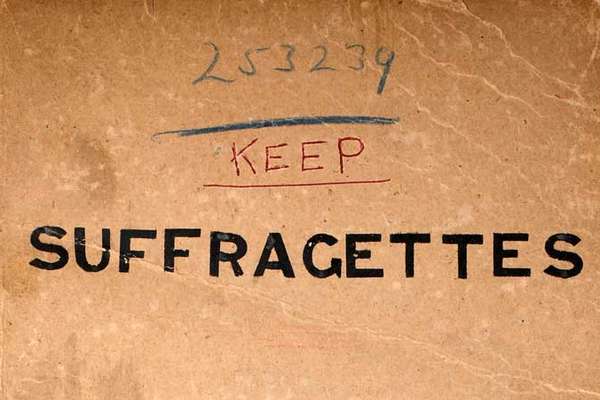
More than a thousand people who supported women’s right to vote were arrested for their activism. This document records them – and includes some famous names.