Record revealed
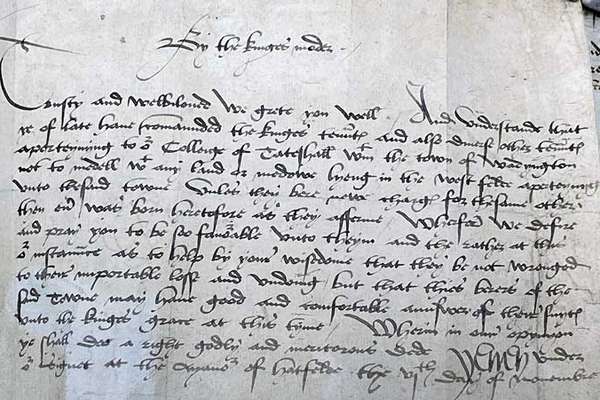
Katherine Howard's letter to Thomas Culpeper
Katherine Howard wrote this love letter when she was Queen of England but not to her husband, King Henry VIII. Instead, it is addressed to one of the king's grooms, Thomas Culpeper. The letter’s tone suggest a strong personal connection while hinting at the dangerous situation Katherine faced.
Important information
This article mentions child sexual abuse. No details of the abuse are given.

Images
Image 1 of 2

Katherine Howard's letter to Thomas Culpeper.
Partial transcript
Master Culpeper, I heartily recommend me unto you, praying you to send me word how that you do. It was showed me that you was sick, the which thing troubled me very much until such time that I hear from you, praying you to send me word how that you do.
For I never longed so much for [a] thing as I do to see you and to speak with you, the which I trust shall be shortly now. The which does comfort me very much when I think of it and when I think again that you shall depart from me again it makes my heart to die to think what fortune I have that I cannot be always in your company. Yet my trust is always you in you that you will be as you have promised me, and in that hope I trust upon still. Praying you then that you will come when my Lady Rochford is here for then
I shall be best at leisure to be at your commandment. Thanking you for that you have promised me to be so good unto that poor fellow my man, which is one of the griefs that I do feel to depart from him. For then I do know now that I dare trust to send to you and therefore I pray you take him to be with you that I may sometime hear from you one thing. I pray you to give me a horse for my man for I have much ado to get one, and therefore I pray send me one by him and in so doing I am as I said afore. And thus I take my leave of you, trusting to see you shortly again and I would you was with me now that you must see what pain I take in writing to you.
Yours as long as life endures
Katheryn
Image 2 of 2

Katherine's sign off in her letter to Culpeper.
Transcript
Yours as long as life endures
Katheryn
Why this record matters
- Date
- August 1541
- Catalogue reference
- SP 1/167
Katherine Howard was born in or around 1523. From her early teenage years, she had a complex and often abuse relationship history, which would be used against her throughout her life. As a child, she lived with her step-grandmother, Agnes Howard, the Dowager Duchess of Norfolk. In her household, many young female wards and attendants mixed with male household servants, often with little supervision. By around the age of 13, Katherine became the focus of predatory behaviour from her older music teacher, Henry Mannox of Streatham.
By 1539, a year after escaping Mannox’s advances, Katherine was connected romantically to Francis Dereham, her guardian’s secretary. Their relationship seems to have been wanted and consensual, at least within Tudor England’s legal age of consent. Evidence, in this letter and elsewhere, suggests that the couple had exchanged marriage vows and engaged in sexual relations following a marital precontract (a legally binding commitment to marry). In her letter to Culpeper, Katherine expresses desperation to conceal these events, suggesting he was aware of her past relationship.
Whatever she had planned with Dereham, life was about to take a drastic turn for Katherine. In the summer of 1540, her uncle Thomas Howard (the 3rd Duke of Norfolk) wanted to strengthen his family’s power by suggesting Katherine as the King’s next wife. She had already joined the household of Anne of Cleves before that brief royal marriage ended disastrously. During this time, her attractiveness and youthful energy caught the King’s eye. Katherine began to receive royal gifts in April and by 28 July 1540, she was married to Henry at Oatlands Palace.
During her time at court, both before and during her marriage to Henry, Katherine flirted with some of the king’s young household servants, including Thomas Culpeper. After she became queen, Katherine continued to meet secretly with Culpeper with help from Jane Boleyn, viscountess Rochford (widow of Anne Boleyn's brother George). Many of these meetings took place during the royal couple's progress (a tour taken by monarchs and their court) into Yorkshire during the summer of 1541. This is most likely when Katherine wrote her love letter to Culpeper.
Around this time, The Archbishop of Canterbury, Thomas Cranmer, began to assemble reports aimed at uncovering information he could use against the religiously conservative Howards, who he disliked. It was during this process that Katherine's letter was found in Culpeper’s rooms.
Once this letter was discovered, things deteriorated rapidly for Katherine. Confined to Syon Abbey and no longer Queen, she faced extensive interviews, with Cranmer. He wrote to the King about his findings, mentioning Katherine’s state of destress at her situation.
Using Katherine’s letter as a key source of evidence, Culpeper and Dereham were then tried for treason at London's Guildhall on 1 December and executed at Tyburn on 10 December. Following this, Henry gave his Royal Assent to the Commission Act (1541). The new law made it treason (punishable by death) for a Queen Consort to fail to disclose previous sexual history or to encourage another man to commit adultery.
In a troubled state, Katherine was taken to the Tower of London on 10 February and beheaded three days later, aged just 18 or 19 years old. The night before her execution, she practiced placing her head on the block, hoping to perfect her composure for her final moments. She was buried in the Tower's chapel of St Peter, along with Jane Boleyn who was executed immediately after Katherine, where they remain unidentified.
Featured articles
Record revealed
A letter from the most powerful woman in Tudor England: Margaret Beaufort
How did the founder of the Tudor dynasty reach and use her position of power?